I think one should also consider the failure modes when, for example, a tree falls into the wall. For a straight wall, it is possible that a falling section will propagate the failure along the entire length of the wall. For a wavy wall, it is likely to fail in shear, limiting the damage to one section.
I have been waiting for this for 50 years! It is wonderful that Roger Penrose and my father, Alan Mackay, are still alive to see it! If only Escher could see it!
That's a great find, it should be required reading for every intro to architecture and assembly course! I stumbled for a second over 'serial vs. parallel' but then realized it just meant a parallel data bus.
Thanks. My copy was actually the copy that they sent to J.D. Bernal, and was signed over to him "with the compliments of the authors". My father was another PhD student of Bernal's, and became Professor of Crystallography at Birkbeck later. The diagrams are scanned in from the original, but I re-typed the text for web presentation. It is astonishing how much of Computer Science was completely understood by the end of the war.
I was present at the BMUG meeting on Berkeley campus when Andy demonstrated Switcher for the first time. He did no talking, but simply ran up two or three applications... and then the whole screen scrolled sideways and the audience was on its feet cheering! The event was amazing, only perhaps matched by Bill Atkinson's demo of Hypercard. Happy days!
The notion of "Programming" was mentioned and even defined in 1947 by Donald Booth. See http://bobmackay.com/Booth/Booth.html Principles and Progress in the Construction of High-Speed Digital Computers.
"The word 'programme' as used in this context may require explanation. Before a problem is ready for solution in a computing machine it must first be broken up into processes which the machine is capable of performing. Thus, as mentioned above, when using a digital machine the continuous process of differentiation must be replaced by a finite difference formula. This translating of a problem in terms of the available functions of the machine is generally known as programming."
However he did not use the word "language" as only assembler was known at the time, and he was the first to use even that.
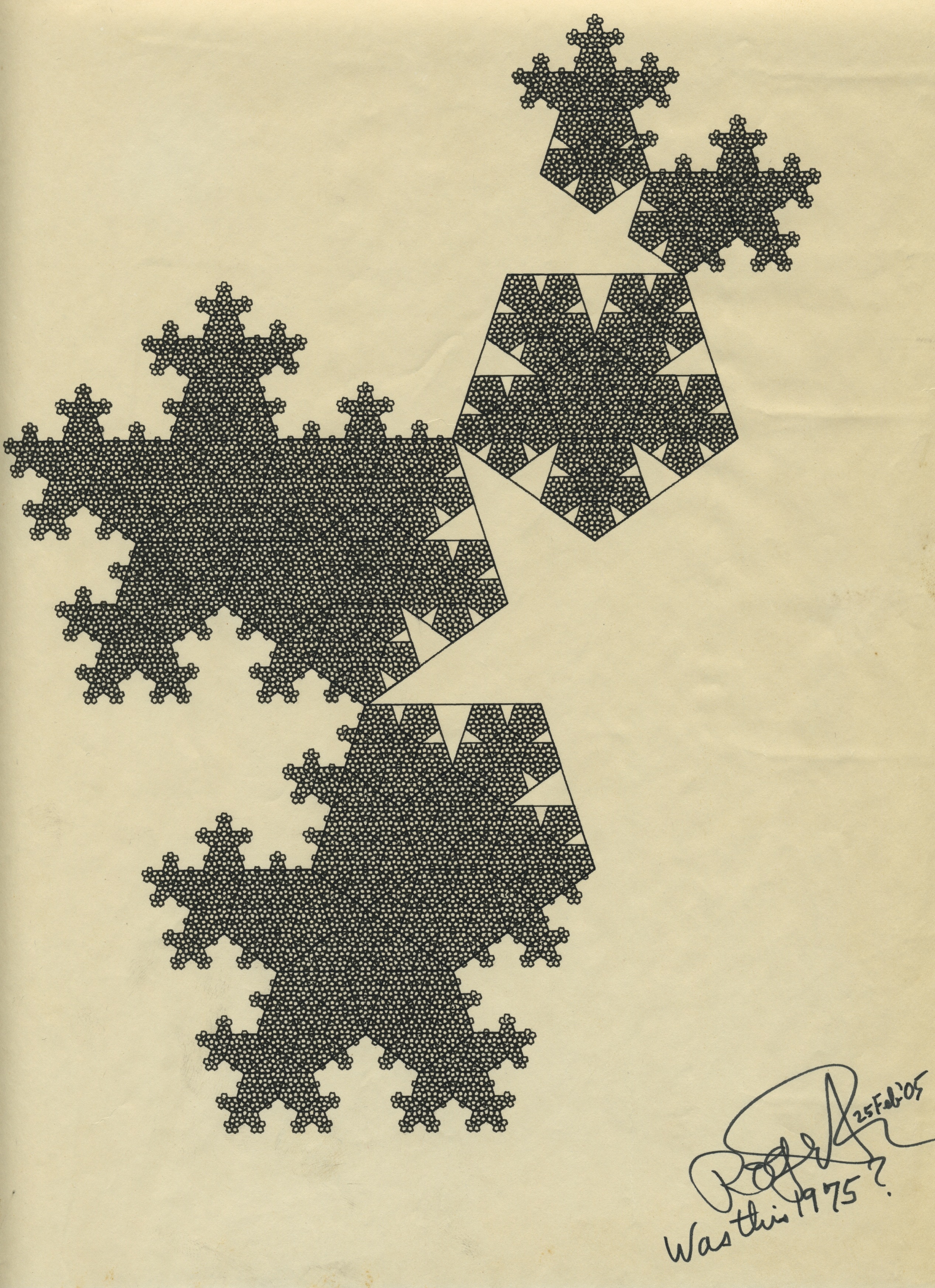
My father (Professor Alan Mackay) and I visited Professor Penrose in Oxford in 1975, to discuss his new tiling pattern, and I was able to write a computer program (in Algol 60) to draw it on a graph plotter. See http://bobmackay.com/Penrose/PenroseColour300.jpg
My father generated a diffraction pattern from this, using light rather than X-rays, and so was able to predict the pattern eventually discovered by Dan Shechtman some years later.
I recommend it if all you wish to cut is wood. It is not really stiff enough for aluminum. A great starter machine.
Mine is starting to wear out the rails, so I am in the course of building a new one based on 8020 tubing, which is going to have a much larger carvable envelope.
Just as a heads up, if you try to run this program with your monitor in portrait mode, the program defaults to full screen mode, but assumes a landscape monitor. The parts that are cut off are critical to getting the program to do anything at all, since you have to start by clicking on a green window that is off the side of the screen. Nice music though...
This counting-out game is known as the Josephus Problem, and dates back many centuries.
See https://en.wikipedia.org/wiki/Josephus_problem. I have a wood-block printed Japanese textbook from around 1700 with a good account of the problem.