Right; in 2006-2007 we all watched uploaded rips of The Simpsons between class in high-school; Original content on YouTube had a really limited appeal.
You can probably find a million situations where doing less is terrible.
I think first step would be to define for yourself what doing less actually means - it could mean taking a walk instead of chasing dopamine -> doing less but you move more.
But whatever it’s a philosophical question and there aren’t any right or true answers
Enshittification specifically is when a product/service/platform gets worse from the user’s perspective because the platform vendor can directly profit from user-hostile design; for example, Google intentionally serves up bad results on the first search results page so the user clicks-through to the second page of results, resulting in more advert revenue to Google[1].
…whereas I feel what you’re describing is another Tragedy-of-the-Commons.
You have to give NodeJS, somewhat individual, access to the system by clicking various prompts that pop up the first time it tries to access some things, in a relatively naggy way. This includes incoming network access. You also have to give terminal access to do anything.
So there's explicit permission, that you granted, involved.
But, I understand your point, and agree. It should be possible, I just doubt think it works result in something anyone would use. There's obviously a compromise between security and letting developers use their computer in ways that aren't possible on an iPad.
How? They run their scraping and training infrastructure - and models themselves - from within those “AI datacenters”[1] we hear about in the news - and not proxying through end-users’ own pipes.
[1]: in quotes, because I dislike the term, because it’s immaterial whether or not an ugly block of concrete out in the sticks is housing LLM hardware - or good ol’ fashioned colo racks.
> NT has a far better VMM than macOS does and handles OOM significantly better than macOS (and Linux, for that matter).
All of them handle OOM the same way: paging to disk with subsequent thrashing. How can any OS be better than any other in that respect?
If your computing experience leaves much to be desired it’s more-often-than-not the fault of the fact more and more applications are eschewing (admittedly neglected) efficient native platforms and using Electron/WebViews.
…looking at you, Balena Etcher. No-one needs a 200MB front-end for `dd`.
Don't forget the all-important last step: abruptly killing the product - no matter how popular or praiseworthy it is (or heck: even profitable!) if unnamed Leadership figures say so; vide: killedbygoogle.com
The engine itself isn’t gutted - it’s full of functionality that was never lost. MS just (correctly) reasoned that transparency effects in the UI - introduced in Vista simply to show-off the capabilities of the DWM compositor - ultimately detract from a good UI.
From what I remember it lost the ability to render rounded window corners, because while Windows 8 msstyle themes existed they all had the hideous boxed corners that clashed hard with many looks.
I don’t agree that transparency is always a detractor. Judicious use can be a net positive, but it doesn’t work for all themes and there should be an option to turn it off. Personally I didn’t find the W7 variation of Aero to be bad at all.
> From what I remember it lost the ability to render rounded window corners,
...I'm guessing you haven't used Windows 11?
--------
By "rounded corners" are you referring to rounded-off corners in the nonclient area (such that the hWnd's rect is not clipped at all)? If so, then no: those would be rendered using a 9-grid[1] and have always been supported.
If you're referring to how so many fan/community-made msstyles for Windows 10 retain the sharp corners, I understand that's not a limitation of DWM or msstyles, just more that you need to do a lot of legwork when defining nontrivial corners in an msstyles theme; it can be done (there are plenty of examples online, e.g. look for Windows XP's style ported to Windows 10), it's just that most people don't go that far.
-----
[1] In msstyles, the 9-grid defines how a rectangular bitmap is stretched/scaled/tiled to fill a larger area; it's very similar to how CSS image borders are defined with `border-image-slice`.
I’m speaking specially about Windows 8/8.1. Obviously 11 and the new Fluent design language it brought don’t suffer the same issue.
Whatever the case, rounded corners on the titlebars and window chrome were common in XP/Vista/7 custom msstyles but were nowhere to be seen for 8/8.1 custom msstyles. It was one of the most frustrating aspects of that era of Windows for me.
please recall that 8bit color was the common capability for CRT displays at that time. Simple one bit display was also common. Any smooth transitions in gray or color had to use dithering, or be very clever in the way they chose the palate.
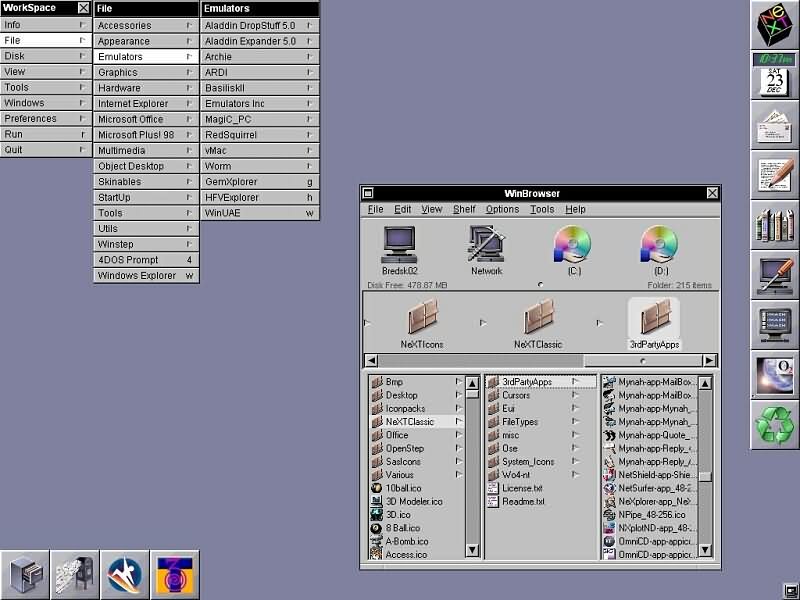
Certainly some historic credit goes to Motif, but, there are "levels to this game" .. Motif did not jump out as "wow that looks good" IMHO. Obviously NeXT was extreme in a different way.. sort of like a symphony orchestra more than an office machine.
It is genuinely entertaining to see people defend the dull and pedestrian UI in Windows 95.
Motif was also 3D, but the actual look of Windows 95/NT 4.0 clearly took some inspiration from NeXTSTEP and OPENSTEP, for example the window decorations.
I accept that's possible - if not likely (and everyone steals from each other!) - but even-so it only amounts to to the gunmetal-grey default colours and use of a 1px bevel/inset effect; because NS and NT3/NT4's UX/UI design and concepts are just so different otherwise.
...but I'm not personally convinced: instead, consider the demonstrable fact that similar engineering teams, working on similar problems, will independently come to substantially similar solutions; my favourite example to point to is how eerily-similar the Eurofighter Typhoon, Saab Gripen, and Dassault Rafale all look - even entirely indistinguishable at an air-show in-person - despite having zero shared pedigree - therefore it's possible that - given the constraints of desktop graphics hardware of the late-1980s/early-1990s - that a user-friendly desktop UI built around the concept of floating application windows - will all be similar in one way or another.
-------
My pet-theory for why that "Windows 95 1px bevel" look is so prevalent is because it suits working with premade UI graphics rasters/bitmaps using indexed-colors: for example, imagine a Windows-style Property Sheet dialog: prior to Windows 95, software would manually draw all of the elements of that dialog directly to the framebuffer (i.e. using unbuffered graphics) which was slow - ugly - and is the cmputer-equivalent of using a lavatory in a cramped bathroom actively undergoing renovations without any drywall/plastering). Even if there was enough vram for double-buffering it's still going to be slow: painting each and every button, checkbox (with the checkmark!) and tab header. So instead, many individual UI graphics elements could be prerendered (at design-time, hopefully by an actual artist), but not as single bitmaps for the entire dialog - but as an indexed color bitmap for each control type, so no slow/expensive draw/painting is required: only a simple blitbit for each checkbox, for example. Using an indexed-color bitmap based on a 4 or 8 colors palette (face, 3D light, 3D dark, transparent/BG; etc) means a single blob only a few hundred bytes in size can represent a chisel-cut bevelled checkbox - while integrating with whatever the user's preferred color scheme is.
----
....of course now we'll just build a UI in Electron, to hell with memory usage or integrating with the user's OS appearance settings. Le sigh.
As mentioned, Windows 95 uses more or less the same window decorations as NeXTSTEP - although with different semantics. What is minimize in NeXTSTEP is maximize in Windows 95 IIRC.
> my favourite example to point to is how eerily-similar the Eurofighter Typhoon, Saab Gripen, and Dassault Rafale all look - even entirely indistinguishable at an air-show in-person - despite having zero shared pedigree
Considering that France/Dassault was initially part of the Eurofighter / European Fighter Aircraft (EFA) project, I'm not sure if that's the best example to make your point.


reply