It kind of is their fault because of Google Play Integrity APIs. They are effectively developing tools that are designed to make their product mandatory. There wouldn't be a backlash that big if we could just unlock our bootloaders and run a patched version of Android.
What do you mean? The webchat client is linked right there in the second paragraph, doesn't require you to install anything and let's you connect and list channels as a guest without registering. It took me like 30 seconds to find out that there is indeed an astronomy channel.
Uhh, I'm not seeing any system requirements, am I blind? It just warns against using the /list command if you have a very slow internet connection since it produces rather voluminous output. If you scroll down a bit further they also link to a third-party website that has a searchable index of all publicly visible channels.
Sure, replacing the car with a plane for your grocery shopping would be probably more dangerous, but do you have any data at what distances do the risks flip?
When I see those statistics I think about flights like Austria to Finland and I imagine that is indeed safer by plane.
I went from a passively cooled RPi5 to a N100. The RPi idled at around 50°C and throttled under load. The N100 keeps 56°C under light load (the heaviest things are rtl_433, grafana, nextcloud). To keep it from throttling in heavy load I zip tied a small Noctua NF-A4x20 to the side of the case over the passive heatsink and adjusted the fan curve to only run at above 60°C. This works super well, the N100 doesn't get hotter than about 62°C under full load and the fan spins slow enough that I can't hear it at all even if I put my ear directly next to it.
> To keep it from throttling in heavy load I zip tied a small Noctua NF-A4x20 to the side of the case over the passive heatsink and adjusted the fan curve to only run at above 60°C.
I applaud your creativity but surely this is an indication of the limitations of the architecture!
Nice solution, but with the case I linked, my Pi idles around 37, and reaches 50-ish (both degrees C) at most (if I load it hard), since the case is sucking heat from all chips and bottom of the PCB.
How does it handle electrostatic discharge when touching it in that case? I used a case that was really more of an oversized heatsink[1] than a case and it was really sensitive. Managed to crash the rpi a couple of times when I touched it without touching ground first a couple of times.
edit: I replaced the thermal sticker for thermal paste, not sure if that could have affected it, the paste wasn't the conductive kind.
Thats somewhat surprising. I have an old 14nm Celeron I use as a home server and under typical usage it is a few degrees above ambient. Checking now it is 26C. There is no fan, and it just has whatever tiny stock heatsink it came with.
I tried some hl2 maps and the need for speed most wanted map. I'm really impressed by how close the rendering is to the original games. Not only did they get the lighting and shading right, there are also details like the NPCs being present, or even animated falling leaves particles in the most wanted map.
I'm at a loss how they managed to convert/managed so many different formats — the textures, level data, sprites, etc. Rare games on the N64 made extensive use of "vertex shading" like techniques, and these have all been carried over to a higher degree than I would've expected...
Off topic, but you're the guy who made the HN User Tag script! I recognise you since I have you tagged as "tag-legend". Still waiting for you to post your creation as a Show HN! ;)
Many of the contributions are others reversing and implementing a new game on top of the existing API, so the really labor-intensive per-game work is still spread out reasonably well.
A lot of games use similar or derived map formats (for instance, most Valve games). There’s a fair bit of game-specific tinkering to do, but you sometimes don’t have to reverse-engineer a new binary format from scratch…
They are definitely ripped from the game. More significantly, there's a lot of work on the rendering engine side of things to make all these different types of games with their different rendering techniques work on the browser.
On the projects page (https://suricrasia.online/projects/) it says "Make glitchy beats with randomly generated Opus protocol packets." So I guess it's random data fed into the opus decoder.
author here: this is correct. the opus protocol is so efficient, you can fill a packet with random data and it will still decompress into a sensible sound. this is where all the sounds come from
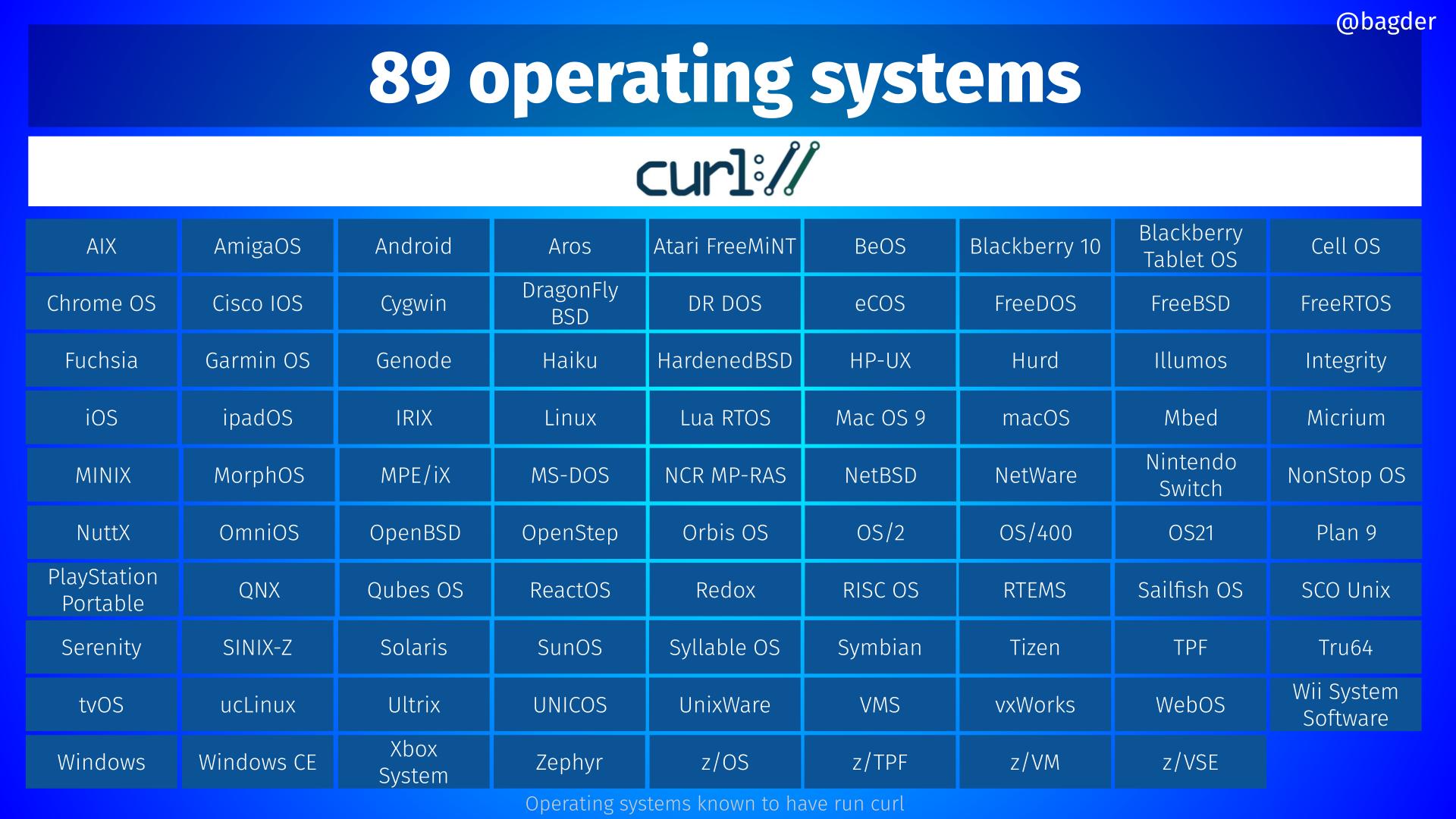
No longer maintained / barely changing, like MS-DOS, Mac OS 9, Amiga OS (which does occasionally get an update but usually not much in the way of core changes)
It's relevant because Windows is a moving target and the dead operating systems aren't so there's not a lot of support work needed for them nor will there be as much of a user base.
Many of them are better at being unix-y because they are Unixes or Unix clones.
Apart from Windows, which squares remain if one removes any Unix/linux derivative?
The real joke is that people defending Windows' oddity by saying it's a VMS clone, where curl authors apparently consider actual VMS an easier platform to support.
> Are you really saying that it's normal to be harder to port some software into Windows than into z/OS?
No, I'm saying that from 89 OSes mentioned on that picture, a lot of them are better at being *nix because they are *nix.
But answering your question, sure! The only good thing in POSIX is that you have easy access to a lot of *nix software. Other than that, POSIX is a spectacularly bad API.
Windows doesn't really care about running *nix software natively, because most of Windows userbase just want and use different things. Therefore, why invest into a bad API? For those wanting to use *nix software on Windows, there is Cygwin or WSL anyway.
A bit flip at the most significant bit is a one cycle 22.05kHz pulse - so yes you almost certainly wouldn't hear it even if the speaker could reproduce it.
You would totally hear it, as a small click. I had a bug in some audio software I was working with that did almost exactly this, and it sounded terrible.