What stops house building given Canada is so big? In the UK, its all green "farmland" (mostly sheep) that prevents land being used for housing.
Anyway UK population will overtake Germany in the next decade or two if immigration to UK continues like it has past 12 months and Germany doesn't open for mass immigration.
The answer will vary depending on what part of Canada you’re looking at. In my city, it’s remarkably hard to get approval to build new rental housing. While most of the population agrees that we need more rental units, nobody wants to live near rental housing.
We also face a big infrastructure problem which is exacerbated by some odd urban planning decisions. As small as my city is, it’s still possible to get caught in a logjam of traffic. Add in subpar transit and the city is extremely car centric, but despite all the wide open space around us it is still relatively hard to get from point A to B at certain times of day. (Not hard compared to cities like Toronto or Vancouver but harder than people are used to).
Canada also suffers from some very difficult social issues that should be part of a grand housing solution. Unfortunately, in practice there just isn’t much political will to truly solve these issues.
First off, Canadian colonialism was a complete disaster. Between the Indian Act and its manifestations (ie - residential schools), a portion of our population has been really kicked down. In my province, for example, the last time they did a decent statistical analysis, an Indigenous man was statistically more likely to have served time in a Federal prison than to have completed an undergraduate degree. As part of treaties, Canada is responsible to provide housing on reservations. Unfortunately, the housing is so substandard that people often move to cities and then fall through various cracks in our system.
Drug abuse is a major issue in Canada. I'm not from Vancouver but spend quite a bit of time there for work/family reasons. Entire neighbourhoods are very good anti-drug commercials.
My province has been underfunding education for a very long time. That has created some really interesting side effects. For example, many professionals have chosen to leave the province behind. It's hard to get a family doctor and many people are stuck using emergency rooms for primary care. Add in covid and our once vaunted health system has become a real shit show.
Canada also has a really interesting issue with welcoming newcomers. It's odd how a country that's mostly composed of immigrants can do such a shit job of welcoming immigrants. The best way I've ever heard of to describe immigration to this country is that you'll take the absolute best and brightest, give them points for amazing professional degrees and long careers....then make them drive cabs because we don't recognize any of their experience or education. This has created a really difficult world where on one hand, people who are from here blame the immigrants for driving up the price of house. While on the other hand, many of the people who chose to come here really aren't thriving - they're barely surviving on a hodge podge of minimum wage positions.
I'm sure that you'll find a number of other people with many different views on this. But I hope that I helped a little bit!
So, so many reasons that it can’t simply be summed up, as there is no simple answer, though “big cities have network effects” is close enough. Toronto, Vancouver, Calgary, Montreal, those are the tech and oil and finance centers, and people want to be near there.
But also: yes, Canada is big. Canada will also kill you real good and hard in most places. There’s a tremendous amount of land, and a lot of it is very very cold, and you really, really don’t want to live there.
...is a function of, among other things, weather. much of geography is also very problematic; huge portions of the country are marshes that are dicey to build on, while other parts are mountains, and often in rain-shadows
> maritimes
...don't have any jobs. the fisheries are dying and climate change is driving that, on top of excess demand collapsing fish populations. the offshore oil platforms are dead too; those guys became Alberta roughnecks.
What service companies there are in CAN have followed suit with the US and demanded all of their workers go back to the office.
Yeah it's sparse but there are no jobs and no ability to move there -- non-starter of an idea. And "milder" weather is still quite cold by most of the world standards.
It's a huge country so it's difficult to generalize, but in Vancouver/Victoria we're constrained by the ocean and the mountains, and by farmland.
There's a strong but slowly diminishing opposition to medium-/high-density housing because neighborhoods of detached single family homes have defined the character of these cities for decades.
It's been years since I lived near Toronto but the city is ringed in on all sides by the lake and what's called the Green Belt, which is a protected swathe of farmland and nature preserves. Toronto's doing a better job than Vancouver in terms of managing the density and growth, but every city has problems growing and we Canadians lack the culture of collectivism that makes Tokyo work.
same as the main thing that stops housing everywhere: the people who already own homes want the value of their own investments to continue rising uncontrollably, and building more houses has the potential to threaten that.
the stated reasons are usually that building more housing outside of existing urban areas is bad for the environment, and building more housing within existing urban areas is bad for the "neighbourhood character". but the reality is just that a housing shortage is good for a lot of people's bank accounts.
Strange comment, in my area nobody is against more housing, if you don't plan to MOVE out of the city, your house keeps doubling in price and your taxes go up, you make no money. If you want to buy up into a larger house because you had a kid? The gap between a 2 bed 1 bath house and a 3 bed, 2 bath is too much to justify.
Locals that have been here 20-30 years are selling and moving into remote areas because the only way to use your home equity is to abandon the area. More houses are not built here because our infrastructure has been poorly planned for 40 years. We are also surrounded tightly by mountains and water, every new build is condos to jam in as many people as possible.
Toronto is already so big that "Toronto is an hour away from Toronto." I prefer more density than the sprawl, but I don't think most voters think likewise.
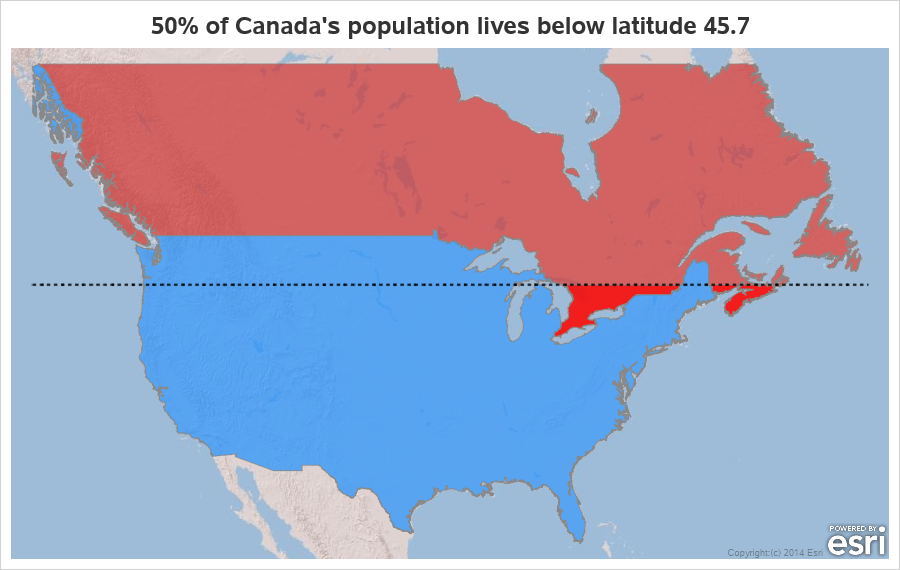
Most people want to live in or close to bigger cities. Canada is big, but ~85% of the population lives within 100 miles of the border. Once you get far enough north, which is not that far, there's much more limited infrastructure (and everything else).
even within 100mi of the border, there's not even close to a shortage of space to build housing. land is not scarce. Even in the GTA or Vancouver metros there's plenty of buildable land.
There is a lot of land, but I think not enough to keep up with the demand. Not that this is the primary driver of the housing crisis, but I think it's a contributing factor.
Canada is much better at building housing than the US is. For example, Toronto typically is #1 in North America in counts of construction cranes.
The problem is that being better is not good enough since our immigration and growth rate is so much higher than the US. IIRC the Vancouver metro area builds about 50,000 housing units per year which is way more than a typical American metro. But that's about half of demand, so the demand/supply imbalance grows faster in Vancouver that it does in an American city.
An incredible proportion of the Canadian population live basically on the US border. This means people are more familiar with nearby parts of the US and that internal Canadian logistics are distinctly barebones.
The absolutely insane part is how local the recent growth has become to essentially one subregion of Ontario.
I don't have any skin in this particular game but it sure seems to me that the UK is the one who stands to gain the most out of this particular transaction...
I mean if you're all about maximising economic gain over sovereignty: joining the much larger (and growing) US makes much more sense than the declining EU
Funny you say that because I know someone who picked Manchester after moving to UK from HK because he and his dad support Manchester United. He moved along with his brother,
sister and retired parents, all under the HK visa. They are looking to buy two homes in Manc with their in savings.
The newspapers are suggesting the new migrant stats to be published soon by Home Office for past 12 months will show extremely high numbers from both Hong Kong and Ukraine. To be honest I'm surprised people from Hong Kong didn't pick Australia instead of UK given it's better weather and bigger homes/roads compared to cramped England.
You could apply for a British National Overseas (BNO) passport if you were born before 1997, and since 2021 one could stay in UK with BNO. For many people it is the easiest way to leave Hong Kong. Most places are much stricter, my friends going to Australia are going back to studying to apply for a student visa.
The policy is not without flaws though, the youngest BNO holders are now 26, immigration policy that focus on older generation is much harder to work. The 12-18 year olds are having a hard time as well, a 6 year stay is required before you could go to university with home fee, and no home fee basically means no university for many families.
My undersntanding is that a BNO holder can bring their dependent family members with them which might help a bit. But yeah, it must be sucky to be a young pro-democracy camp Hongkonger with parents either explicitly pro-Beijing or at least uninterested in leaving.
> I'm surprised people from Hong Kong didn't pick Australia instead of UK
My understanding is that the UK has the pretty generous BNO visa with immediate working rights and a path to citizenship, while Australia has an enhanced post-graduation pathway.
ARM delisted in 2016 because they were bought by SoftBank and became private company. The fact they (and the others listing in US) are not going to EU tells you a lot, they view it lower than London.
Helmand/Afghanistan was an insurgency war. IEDs, bombs under the road, shoot and scoot. The Taliban would run rather than take on NATO troops head-on. The US also failed, doesn't mean the US cannot handle a conventional war because of Afghanistan.
Re ARM: you're right about the delisting date. I was thinking of their decision to list in NYC rather than London when they go public again this year. I suspect this says something about their lack of confidence in rhe UK, but thats not the only factor I'm sure. And I confused rhe point by referring to "delisting".
Re Afghanistan: tha fact that the US can still handle a conventional war, post defeat, doesnt mean that the UK could.
UK employers refused to increase salaries because they had unlimited supply of cheap labour from Eastern Europe, they treated them like shit but they still came and worked for them. Well the end result is those same working class British who they refused to pay more eventually voted Brexit. Now the UK employers are super desperate for staff because there is no more cheap labour for them to take advantage off. And wages are rising faster because the workers are in charge now.
The UK hasn't passed EU laws since Brexit was done Jan 2021 like they did when they were a member. It's just a free trade agreement now. It is up to UK exporters to provide proof of compliance just like Canadian exporters to EU. 42% of total UK exports is to EU, even pre-Brexit it was below 50%.
So the majority of trade was/is/likely to remain with the EU?
Perhaps I should clarify on the EU law point. I made the point that most EU laws were copied, but the trade point was not about laws in the Uk. It's that UK companies will and do voluntarily comply with EU laws. They do that so they can continue to trade with the EU - the Uks largest trading partner. Moreover previously the Uk had a large seat at the table in deciding such EU laws. Now the Uk largely complies either by law or by necessity to trade with laws it doesn't even have a say in.
On bendy bananas, it also turns out...
> EU ‘bendy bananas’ regulation to remain despite Brexit
Not that this is some huge deal. It's just another (somewhat amusing) data point in a project that doesn't appear to have any significant tangible benefit.
Moreover I'd claim it isn't going to get much better, because how can it? The UK made trade much harder with it's main trading partner.
An example of how oblivious drivers on phones are is this:
I parked (where I could not be seen by the van) to warn oncoming drivers of mobile speed van 50 metres ahead over brow of hill.
While nearly all made eye contact with me and speeders instantly slammed the brakes, two drivers on phones (both women with kids), despite me flashing my headlamps AND putting my hand out of my car and waving at them, they still did not look at me or put down the phone.
This was after the penalty was doubled to 6 points.
(And yes I know its not legal for me to warn drivers of speed traps like this)


Anyway UK population will overtake Germany in the next decade or two if immigration to UK continues like it has past 12 months and Germany doesn't open for mass immigration.