Not exactly, I have automated stuff which uses python and does rar and unrar and it's installed through brew, it is not a cask, but every time I do brew update, my code will fail to run because it was updated.
This is like buying a machine and not having the ability to do whatever you want with it.
Oh who are we kidding, that's what is happening anyways.
I was in a grand jury recently and a cop/attorney came to the supreme court of our state with a terroristic threat from a homeless person in a park who made a gun sign and said pow pow, and they wanted us to indict them....
By this standard most of the sports player in the nation should be indicted.
What benefits are you getting from this? I mean have you built an entire CDN to cache the fonts so that your server does not have to download it every time a new page is loaded? I understand self-hosting for your own servers, but for a website this is overkill.
I'm not sure what you mean with the rest of the comment though, it's a very small change and it gets cached by the browser like other static assets, so I'm not sure what is the overkill here.
It’s more than just “bothers people”. Some jurisdictions consider this to be leaking PII without consent and will issue fines if you don’t self-host or ask permission. For example:
> Also, please note that Google LLC is certified under both the EU-U.S. and Swiss-U.S. Privacy Shield frameworks and our certifications can be viewed on the Privacy Shield list.
It’s very important to be aware that the Privacy Shield was declared invalid by the European Court of Justice in 2020, so that note from April 17, 2018 is worthless.
For me the biggest benefit is that my customer doesn't have to whitelist a google endpoint to use our website. Secondary benefit is being in control of downtime and/or updates (though the secondary benefit on it's own is nowhere near enough to justify self-hosting to me, but for some people it might be)
But they are considerably more expensive than more common TLDs, so if you’re getting one you presumably want it specifically and understand the association users will make.
Or it could be that the .com domain was already registered and unavailable, so they started browsing the other TLDs to see where they could find something and felt like .ai is new/hip/trendy
> and it does not make anybody less legitimate than AI startups (which was the parent’s point)
Was it? I’m interested in what exactly in their post makes you say that. I see confusion, not any accusation regarding legitimacy.
> Besides, they do sell AI-related services.
I know, I checked the main domain. My point was simply that if you spend extra money on a domain which has a strong association with something, it would be expected that whatever you put on it is associated with it (which indeed is the case). Otherwise you’d be wasting money and confusing potential users, which isn’t generally good business practice.
If you are on a Mac, I have been using OrbStack[1] and it has been fantastic. I spin up few containers there, but my biggest use is just spinning up Alpine linux and then running most of my Docker containers in there.
1. ssh orb (or machine name if you have multiple)
2. sudo apk add docker docker-cli-compose (install docker)
3. sudo addgroup <username> docker (add user to docker group)
4. sudo rc-update add docker default (set docker to start on startup)
Bonus, add lazydocker to manage your docker containers in a console
I use OrbStack too and think it's great software, both for running containers and stuff like having a quick Alpine environment. However, I don't see the point of running Docker within Alpine. Wouldn't that defeat the optimizations they have done? What benefits do you get?
No, you don't run the Docker containers run in OrbStack, you can spin up an Alpine instance and run all docker instance on it.
The benefit is that, Alpine has access to all your local and network drives so you can use them. You can sandbox them as well. It's not a big learning curve, just a good VM with access to all drives but isolated to local only.
And you can run Docker inside OrbStack too, it is really good. But most of my containers are optimized Alpine containers so I prefer to run them on an OS they were built for and others in OrbStack.
I worked on this while I was at LI and I think the major selling point back then was Replayability of messages but it was something similar to what you would get with Pub/Sub. We could also have multiple clients listening and processing same messages for their own purposes so you could use the same queue and have different clients process them as they wanted.
Its the ability to replay messages at later notice when needed.
At least this was the reason we decided to use Kafka instead of simple queues.
It was useful when we built new consumer types for the same data we already processed or we knew we gonna have later but cant build now due to prorities.
This is a good theory but the basic maths is that 1 mile = 1 km * 1.6 or vice versa. This is the basic thing you need to do.
However, this can get confusing it it get's to odd numbers etc, so what you can do is, simple leave it as miles because if you are in a miles country no one is converting it to km or vice versa.
Same with C and F in temperatures, there are basic maths systems that can do this in constant time, so there is no real reason to complicate it unless you want to do it in your head and then there is the basic maths to do it, if you can't just use a calculator.
> if you are in a miles country no one is converting it to km or vice versa
My relatives & friends visiting from Europe often appreciate knowing such values in km/C. There are various other reasons to want to do the conversions too, and sometimes speed > accuracy. It's a bit ridiculous to think that _no one_ is doing these conversions and that shortcuts/approximations like this are not useful.
>simple leave it as miles because if you are in a miles country no one is converting it to km or vice versa.
Maybe true in a miles country, I'm not sure.
However, so much stuff posted on the internet just assumes you are from the states, so they use imperial measurements only, and most of the rest of the world does need to do these conversions. I'm converting on an almost daily basis.
It's a minor peeve of mine that many people assume English means miles and pounds, when there are millions of tourists etc reading the English signs who want the original, metric measurements.
If you use Google Maps, it will automatically prompt you to download a map of the area if there is known poor coverage. It also has automatic (?) local maps.
One beef of mine with Google’s offline maps is that they’re only driving maps, and not walking/transit/cycling maps. Obviously you can kinda figure out walking paths anyway, but since I’m sometimes travelling without roaming access, it’s unfortunate.
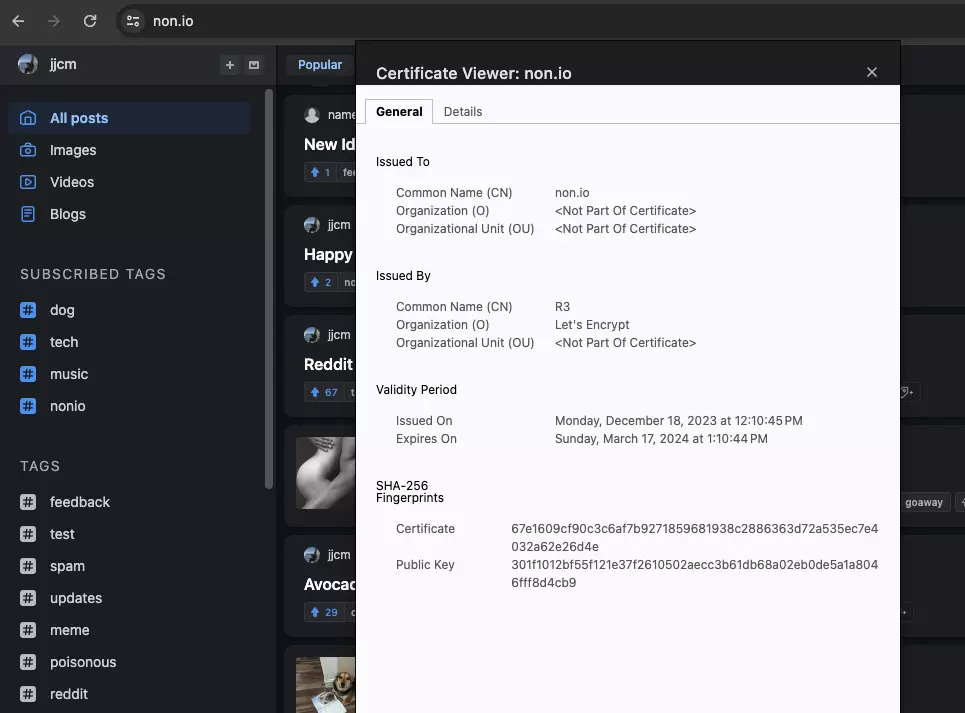
This is due to the browser not trusting certificates from letsencrypt, you probably might also see this on other sites like stackoverflow, videolan etc. You need to import and trust the certificates for ISRG Root from[1] and should not see that error.
Please don't link plagiarized content. This guy also linked to his own "Big O Notation" in his page, where he says O(n) is polynomial
>>>In our shopping list example, in the worst-case of our algorithm it prints out every item in the list sequentially. Since there are n items in the list, it takes O(n) polynomial time to complete the algorithm.
This may be the same author ... Anyway f(n)=n is definitely a polynomial and O(n) is a class of algorithms that run in polynomial time (i.e. are in P).


This is like buying a machine and not having the ability to do whatever you want with it.
Oh who are we kidding, that's what is happening anyways.