The reality is quite complicated. Canadian English is a version of North American English, with a distinctive pronunciation and sub-dialect, but still has vestiges of British English that are lost in America.
I feel like Canada is of two minds, awkwardly and indecisively straddling North American English and British English. It wasn’t until I worked overseas that I realized North America has a very distinctive English that imprints on people, even if they lived there a few years. As in Londoners who spent a few years in North America as toddlers have obvious North American tonality, which is baffling to me.
I have native relatives in Canada and the UK and I find the language dynamics across the anglosphere fascinating.
> The reality is quite complicated. Canadian English is a version of North American English, with a distinctive pronunciation and sub-dialect, but still has vestiges of British English that are lost in America.
Does Canadian English still use "gotten"? IIRC, that's a vestige of British English that's been lost in Britain.
New Englander here. Gotten is normal vocabulary. If it's not used in British English, then it's probably a feature of North American English, since most North American linguistic differences are snapshots of common features of 16th-17th century British English that somehow ossified over here.
What I'm most interested is not usage of "gotten", but whether somewhere in the English-speaking world, using "I've" standalone (without a follow-on got, been, had etc) is normal.
I see it from time to time online, and immediately assume they're a non-native speaker who doesn't understand the nonsensical nuances of the language.
Eg people will say something like "I've 3 apples", which is just "I have 3 apples", which is perfectly gramattical. But, for some reason, we use "I've got 3 apples". But I think we'd also say "I have 3 apples" and not "I have got 3 apples".
Due to my somewhat international career, I had to learn to code-switch between American and British English. My default is American but can do British as needed. Spelling, vocabulary, dialect to some extent, etc.
For a global audience, I find American is the best default. Nonetheless, actual Americans barely notice if you use British English-isms in American contexts. They may notice but no one cares. Everyone knows what you mean. Using British dialect may confuse them occasionally but even then no one cares. Canadians should do what is natural for Canadians.
It boggles my mind that someone from a Commonwealth country using British spelling would even warrant a news article. Why is anyone talking about this?
Pfft. Spelling differences is minor league stuff. Try code-switching on silence.
Pointed out to me by a Kiwi, that Americans take silence after a statement to mean general agreement, but in Britain silence implicitly asks, "Are you _really sure_ you want to be doing that?"
Where I grew up in the US, in grade school, our neighborhood school in the small city had teachers from both Quebec and Ireland. So we learned non-US spelling first. That caused a pain when I and my friends ended up in high school and had to use US spelling.
But to me, who cares, there was a time ages ago people spelt a word the way they wanted and no one cared. Just look at old documents from the 18th century in the US.
Even decades later, once in a great while, I end up using colour instead of color :)
I never grew up in a British family, or had any sort of close proximity to British things. But I still somehow ended up using "grey", "colour", and "behaviour". They just look more correct.
The Rivian has pretty limited range. The Scout looks promising though.
People out in the ranch country, oil patch, some mining areas, etc often want a reliable 600-ish miles unloaded. That’s why extended fuel tanks are a common option. Even without an extended fuel tank, you can often achieve that with an ICE and a jerry can.
EVs have great potential as 4WD off-road vehicles. In a lot of ways they are more naturally suited to it. Their main weakness is range and loiter time. In many contexts it will be days before you’ll be able to get to a charging point.
The killer feature of ICE in this context is the tremendous range and simplicity of extending range if you need more. Fuel is very compact, easy to bring with you, and available from other vehicles if you run short. An EV that can augment its range indefinitely with fuel is probably the sweet spot.
I guess you could strap a few kw generator in the bed with some jerry cans as backup. Would take longer, but if by loiter time you mean time out in the field where you’re not moving, then maybe that’d work. Would be cool if there was the equivalent of siphoning gas from one to another.
Is there electric infrastructure in the places you’re describing? If so, should be really easy to throw down some moderate-speed L2 chargers in various parts as a last resort. They’re incredibly cheap and don’t need much maintenance.
Holy hell, that's 640ish km, that's plenty - and yep, I'm not from a large continental country, 640 gets me to the other side of my island and 2.5 times, and to the northern or southern end once.
That’s fair. There are “recreational offroaders” in the sense of urban bros that do casual offroading on well-developed trails with associated infrastructure. That is the nerf version of offroading in the US. Some of those trails are cool on their own merits, I don’t want to take away from them.
The US has vast regions that casual tourists never venture into and have no infrastructure that are nonetheless economically important or excellent for exploring.
If you stay near the Interstates, you’ll be able to manage with electric vehicles. But the best parts of the Mountain West are pretty far from the Interstate Highways. The deep Utah, Nevada, or Arizona wilderness is phenomenal but you’d be an idiot to attempt that with an EV. Just getting caught in a mountain pass during a blizzard in May or September could be enough to cook you.
I’m not against EVs in any sense but the tech is still pretty risky for the realities of the Mountain West of the US. I have learned many lessons the hard way about how you can be stranded or die in the Mountain West that makes me cognizant of the limitations of EV currently.
I am bullish on EV, I’d love to have one if it met my technical specs, but they aren’t there yet.
I'm from NZ where 640km range is plenty, for even our gnarliest terrain, so I'm stoked. I have to say, this is a bit dismissive out of hand.
> urban bros that do casual offroading on well-developed trails with associated infrastructure.
Yeah, no, that's not what I'm talking about. Not everyone commenting here is from the US.
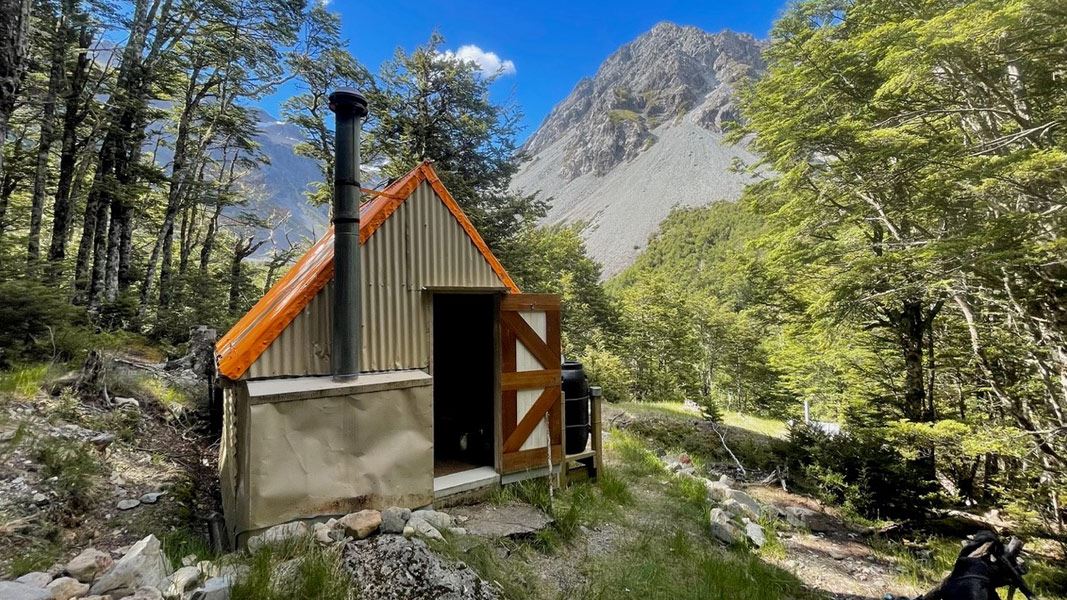
I'm talking about things like driving up braided riverbeds to places like this, Mathias Hut, just downstream of a glacier or two. [0]
Or like this, Avoca Hut, in an isolated valley two days walk in otherwise. [1]
Or some of the very rugged routes on the West Coast of the South Island / Te Waipounamu. [2]
Trips like this in the Southern Alps. [3]
Or Napoleon Hill. [4]
640km range would get me to that route, from the east side of my island via an alpine pass [5], through the route, and back home again, on one charge, which is awesome.
We don't have the same scale of distance as the USA, that's true, but we have the same scale of challenging terrain, so please don't be so quick to dismiss our use case as "urban bros doing casual offroading", just because the distances are lower, please.
As for well developed 4WD trails, lol.
I used to be a ranger in a national park here, and American tourists were routinely gobsmacked that our tramping (hiking) routes (trails) didn't have bridges, (and also, often didn't have an actual track or trail, you just picked your own way up the riverbed) and you'd have to walk through the rivers - and no, don't take your boots off, because you're going to cross that river another 5 - 10 times, you just have to accept you're going to have wet feet, welcome to NZ hiking.
So if we don't have that many well developed hiking trails, we certainly don't have well-developed off-roading trails.
That looks amazing! I haven’t been to NZ yet. I was not trying to dismiss your offroad bonafides.
It is the distance scale in the US that makes the difference. In the mountain west, you can blow through a range budget of 640km really easily. There are weather and other events that add 100-200km of unplanned travel that you can’t know ahead of time. There is also no Internet connectivity in much of it! The sparsity of charging stations in more remote regions just makes it worse. If you find you need to re-route, you may be a very long way from the closest accessible charging station and it may be in a direction you did not intend to go.
I wasn’t trying to be dismissive. The US has unique challenges for EV range due to its scale. There isn’t much margin for error on range, especially if the road closes due to avalanches, flooding, etc. You can find yourself hundreds of kilometers from the nearest thing resembling civilization at inopportune times.
The F-150 is valued because it is utilitarian and the platform is engineered for a pretty abusive duty cycle. Ford understands this. If you use trucks in anger, you start to appreciate this.
The entry of Japanese automakers into the F-150 market is instructive. While the Japanese trucks looked similar, the early versions had a bad reputation for slowly coming apart under the typical workload and stresses people put on the F-150, which Ford had been refining for many decades. Those trucks often get used hard, and because people know an F-150 can take it they aren't afraid to use them hard. The median abuse significantly exceeded what the Japanese engineers anticipated. Japanese trucks are much better now but the attention to survivability is a big part of the F-150's enduring reputation.
I've taken the Ford platform through situations where I've seen many other vehicles get destroyed. That's where the loyalty comes from and why it is a default choice for many. Most people aren't using them as hard as I have but it does provide a safety blanket.
Maybe not where you live but there are many parts of the US where you really do want significant ground clearance regardless of vehicle type. The ubiquity of Subarus in several regions of the US isn't because people are fond of Subarus as an automotive brand.
High ground clearance isn't about "going offroad".
I live in a place where people drive either trucks or subarus. There are plenty of alternatives to subaru with high clearance (basically any small suv). People buy them because they work well in snow and well...everyone has them. Easy to sell, easy to get them worked on.
The kinds of situations that drive range consideration for things like trucks is that your planned route suddenly becomes unavailable after you've already burned most of your range. Range anxiety isn't about the ideal case.
I've had several situations in the Mountain West when roads suddenly closed <25 miles away from my final destination (and fuel). Some of these required upwards of 100 mile detour on rural roads with almost no civilization. That detour was not part of the original range calculation. For an EV the detour may not even be an option, you have to go backwards to a major highway to find a charging station that may be in range.
Hell, I've nearly come up short in an ICE vehicle a couple times. I try to keep 150-200 miles of spare range on my vehicle when I am in that kind of country. That is hard to do on a typical EV.
I just drove 100mi in freezing temps (around 25F) at mostly interstate speeds (70+) mph. I completed my trip around 95% of EPA. Maybe a function of the quality of your EV.
The limited range and inability to refuel quickly and easily in the middle of nowhere remains a critical deficiency for EV trucks in many parts of the US. Range is something you have to be conscious of even with ICE trucks in some areas even though they have better and more reliable range. There are places where I'd start thinking about fuel once I hit half a tank.
Getting caught out in the middle of nowhere with a dead EV because conditions beyond your control changed the range requirements is a nightmare scenario. ICE trucks do much better in these situations.
Level 1 and 2 charging are something of an equivalent to siphoning gas, and maybe too easily overlooked. Carry a wall plug and dryer plug adapter and you can plug in just about anywhere. RV plug in the camping area of a national park. Utility plug on the back of a work shed in the middle of nowhere.
Won't charge you fast, sure, but can be the difference to charge you enough to make it to the next stop, in some cases.
Yeah, I meant siphon gas truck-to-truck, but it seems most worksites would be wired or have generation of some sort, so mobile charger should be able to do something in a pinch. I have had situations where a normal 1400W wasn’t enough to keep pace with keeping the battery warm enough to make any headway on an actual charge, though, but that remote AND cold is a another level.
That is almost literally the entirety of it. If we could do that, EV would be lit. EV is honestly better for remote environments in most other regards.
Or you know, PUT A FUCKING GAS GENERATOR IN A GIANT BED THAT YOU HAVE OUT BACK.
Im legit suprised this isn't a thing yet. I saw the Rivian gear tunnel when it got first announced, and I was almost sure that they are gonna offer a generator+fuel tank to fit into there for range extension.
You can do an efficient diesel or multi gas 1 Cyl engine, and you can make a system where you can put one or 2 of them in the bed along with any aftermarket gas tank, and now you have something that is "mission configurable".
Ah, there’s always zero-sum competition for housing to eat up any excess that might otherwise go to savings. That’s true. Money gets freed up across the board, you spend it on housing or lose ground in the housing competition. Good ol’ red queen’s race.
We don’t prospect too many years beyond current requirements, the economics don’t warrant it. We also consider development costs and regulatory overhead when deciding where to prospect. Copper mining is capital intensive, ore grade contributes less to the calculus than you might think. No one has exhaustively scoured the globe for copper, the incentives to do so aren’t there.
Companies have strong incentives to sandbag reserve estimates from existing mines. Anecdotally I’ve heard rumors that whisper reserves for copper specifically have materially expanded in recent years, driven by market demand that justifies that effort.



I feel like Canada is of two minds, awkwardly and indecisively straddling North American English and British English. It wasn’t until I worked overseas that I realized North America has a very distinctive English that imprints on people, even if they lived there a few years. As in Londoners who spent a few years in North America as toddlers have obvious North American tonality, which is baffling to me.
I have native relatives in Canada and the UK and I find the language dynamics across the anglosphere fascinating.
reply