Maybe I don't understand journalism but this guy being a reporter, shouldn't he have had an editor reviewing his work before they hit publish? I understand trusting a senior reporter but I would think due to libel concerns, they would check people's quotes ESPECIALLY if the reporter was sick.
Honestly it seems like journalism has been in their 'vibe code' era for a decade where they just publish whatever typos and all.
This was an institutional error, not an individual reporter's fault. We should also be asking why he was still contributing when he had a high fever. Why did his editors push him to publish his work? I will certainly write code and answer questions when I am sick when I am up to it but I would never push to main while sick.
> Maybe I don't understand journalism but this guy being a reporter, shouldn't he have had an editor reviewing his work before they hit publish?
While the journalist is still responsible for their own actions, I agree with you that this being published in the first place is indicative of a deeper failure akin to - "if a junior dev accidentally deletes your production db on their first day that's on the company itself"
> But I don't think the intention was to compare with junior devs
Junior was said specifically.
A better analogy would be if one of your staff engineers decided to connect OpenClaw to his workspace and it found a way to delete the production DB.
The author was an AI reporter. You can’t argue that he didn’t know what he was doing when he made these choices. Any comparisons involved junior devs are just dishonest.
Specifying a junior dev on his first day is a plain deliberate rhetorical ploy to frame systemic blame as more legitimate than individual blame. If not, then why not make it a senior developer? Anybody can fuck something up, but we give special consideration to noobs who make noob mistakes, and that's what is being implicitly appealed to, illegitimately. This journalist wasn't a noob, and using ChatGPT to write his article was an error in judgement but not an actual mistake.
I disagree with you, deal with it. Specifying a junior developer to make the point of blaming systems instead of individuals, to absolve a journalist of individual blame for fabricating quotes, is flat out bullshit and you're wrong to try weaselling it.
Inb4 Omg I still can't believe you're disagreeing with me, like yikes dude go outside.
Auroiris is right, it's a Motte and Bailey routine. And it's insulting that you're pretending otherwise.
I don’t think so. Junior was a key designator in the claim and words have meanings. It would have been easier to leave it out if they didn’t intend for it to contribute meaning.
I think this is turning into a Motte and Bailey argument where the junior dev story is used to push the argument and then it’s backpedaled out when others identify the fallacy.
Sadly this is a reality of the money disappearing from the journalism industry. You're right, there absolutely should be fact checkers. A reporter absolutely shouldn't be filing while sick. And the big news orgs still do that. But I doubt Ars has the resources.
Ars is owned by Conde Nast, which is owned by Advance Publications. Ars's parents could have funded all these to ensure journalistic integrity, but would rather squeeze their staff and make money off the brand goodwill and advertising.
The root offense wasn’t that this was published. The root problem is that the author submitted an LLM hallucination as a story. He should have faced consequences even if it had been caught.
> This was an institutional error, not an individual reporter's fault.
The person who caused the problem is at fault. It doesn’t help to do mental gymnastics to try to shift blame to a faceless institution. The author is at fault.
> We should also be asking why he was still contributing when he had a high fever. Why did his editors push him to publish his work?
I think you’re putting too much stock into the excuse. The author got caught doing one of the things you cannot do as a journalist: Publishing fake quotes. He was looking for any way to excuse it and make it not his fault so he could try to keep his job.
He made the choice. The consequences are his to bear. If it had been caught before publishing he still should have faced the consequences.
The “system” should make it difficult to make mistakes.
But more importantly, why can’t both be at fault?
Having fact checkers review every articles you publish is a very low bar (as in you should not be in the business of publishing news if you can’t do it effectively).
If the Ars Technica editorial process requires assuming reporters don't fabricate quotes, then their process is inadequate. That's like a software company letting junior engineers release directly to production with just a spellcheck and no real process to catch errors. Major publications like The New Yorker, The Atlantic, etc. have a dedicated fact-checking department that is part of the process and needs to give the ok before any article is published. Why is their process so deficient by comparison? Why wasn't there any fact checking?
> That's like a software company letting junior engineers release directly to production
This person wasn’t a junior.
Editorial processes don’t actually check every single line of everything that is written. Journalists are trusted to report accurately. This person demonstrated they could not be trusted.
> Why wasn't there any fact checking?
Why do programmers ever let any bugs get to production if they have code review? Journalistic outlets do not fact check literally every line that is ever written before it goes to publication.
I agree completely, the people who are acting like it's Ars' responsibility to assume every sentence from their journalists are lies just aren't being realistic.
And even if Ars editors had caught the fabricated quote, what then? Obviously he should still be fired. Ars could probably benifit from better editors but even so this doesn't absolve the journalist of any of his own blame, for being the one responsible for introducing these fabrications in the first place.
I think this is the thing people are missing the most. Libel is an incredibly serious thing to do. Misstating a fact is a faux pas and a bad look but misquoting someone, especially if that article is taken as a hit piece, can cost hundreds of thousands or millions.
As someone coming from a family of editors and plugged into the publishing world, I think it would be really weird if that was your job. It's not an adversarial relationship. Your job is to pressure-test the arguments and the language, not to ask every time if maybe the person submitting the article didn't really write it, or didn't really interview the person they're claiming to have interviewed.
> A lapse in that non-hypothetically left me responsible, and legally liable, in situations like this.
It didn't. At worst, it exposed the publisher. And the publisher would have the defense that they had the right policies in place and that the misconduct lies with the journalist. Unless it could be shown that you knew about potential issues and still went through with it for political or financial gain, it's a nothingburger.
> It's not an adversarial relationship. Your job is to pressure-test the arguments and the language, not to ask every time if maybe the person submitting the article didn't really write it, or didn't really interview the person they're claiming to have interviewed
It doesn't have to be adversarial. The things you're describing as part of the job are the things I did to prove that the reporter was doing their job. So was building a relationship with reporters that shared the load of documenting what's verified and how it's verified, so we could both trust that we were each doing our jobs correctly.
> > A lapse in that non-hypothetically left me responsible, and legally liable, in situations like this.
> It didn't.
Aside from the bald-faced arrogance of telling me what did or didn't happen to me, my lawyer, their lawyer, and my publisher's lawyer all sure didn't agree with you. Fortunately for me, you weren't involved in it.
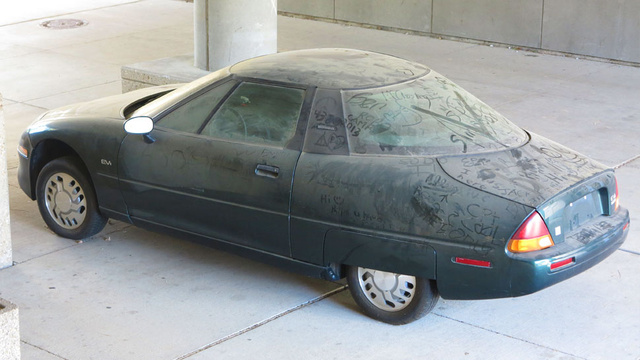
I used to walk past one of these every day on my way to and from my dorm.
My school apparently had no idea what it was for years and it just sat outside underneath the EE building and people would draw dicks in the dust on it. When they realized what it was, they immediately yonked it inside and made a student team to refurb it.
It's super cool I got to see such a piece of history and rare car even if I didn't realize it for so long.
I love tools like this but I am currently in a cycle where I question why a tool has to operate like this.
These text-driven tools always come across like "programming the space shuttle to drive down the street for ice cream". Like, do we really need... all of this. It's beautiful and neat but does it solve the problem in a user friendly way?
Sometimes it seems like there is a lost art to simple but deep products. Many of these replacements tools are starting to seem more about demonstrating how nerdy you are by over-complicating the solution in a novel one-off way.
A great example of this, in my opinion, is Taskwarrior's sync in both 2.0 and 3.0. Just use auto-discovery of peers using a shared secret key then negotiate the connection seamlessly. I don't want to do SSL setup so I can have my tasks on two computers.
> Many of these replacements tools are starting to seem more about demonstrating how nerdy you are by over-complicating the solution in a novel one-off way.
This is a really pessimistic view on a tool that has been developed since the 80s.
Some people just enjoy the power tools like this - and the CLI in general - offer. You don't need "all of this"? Well then don't use it! That's sort of the beauty of it - it can cover basic needs and much more complicated needs.
That said, I think more users would use more powerful software if they gave it a shot. Unfortunately, many users get intimidated by slightly-user-unfriendly UX and instead go use software where they have little choices. So instead of adapting software to their workflow, they adapt their workflow to the software.
The nice aspect of these text driven tools is in the name. Being text driven means they are nearly universal. There's nothing more versatile than text on a computer. When I think on anything that operate on text, it feels more like having a set of workflow that act on my data, that the computer doing (and someone else) doing obscure incantation.
> I don't want to do SSL setup so I can have my tasks on two computers.
I use to think that way, then I found that I never use two computers at the same time. At most it would be using one to remote on another, or using one to do stuff I can't do on another (like browsing the web when installing an OS). So I just use my laptop as my main computer. I have some files on my home server and mostly use my phone for HN reading and communication. If I really want to sync something, I just share files using sftp/smb/http/....
For me it's not "overcomplication," it's strong interoperability with a workflow I like, specifically one that was kind of complicated to write once, but afterwards operates in a way such that I don't have to think at all.
I've been using this for years, so perhaps today there may be some voice or AI driven way to do this but -- first I add weekly events. And for one off events, I have a bash script that's like "whats the event?" then "what's the date/time" using standard linux date formatting, and returns an error and loops if wrong. (So e.g. "tomorrow" works, or "monday 4pm"
Then for retrieval, I can have it do notify prompts, and/or be a part of my bash prompt, and also throw up a nice HTML calendar.
Most of these tools are something you set once, write some scripts if it's a CLI, then forget about until someone tries to make a breaking change. Then you switch to the fork that maintains the old feature set.
The launch count of SpaceX per year compared to the rest of the world is quite large.
SpaceX in 2025 has launched 134 times. Everyone else in the entire world has launched 115 times combined, including other US companies. SpaceX launches a lot of stuff very often.
EDIT: Originally meant to do 2024 but accidentally read the wrong bar. Regardless, this holds for most years.
2,000 may be stretching it but it is possible if the driver is trusting enough. Personally many of my disengagements isn't because it is being dangerous, but just sub-optimal such as not driving as aggressive as I want to, not getting into off-ramp lane as early as I like, or just picking weird navigational choices.
Trying to recall but I haven't had a safety involved disengagement in probably a few months across late 13 and 14. I am just one data point and the main criticism I've seen from 14 is: 1) getting rid of fine speed controls in favor of driving style profiles 2) its car and obstacle avoidance being overtuned so it will tap the brakes if, for instance, an upcoming perpendicular car suddenly appears and starts to roll its stop sign.
Personally, I prefer it to be overly protective albeit turn it down slightly and fix issues where it hilariously thinks large clouds of leaves blowing across are obstacles to brake for.
Driver profiles seem like a terrible answer to the question of choosing a maximum speed, both for the driver of the vehicle, and for Tesla — because it shifts the understanding of the car's behaviour from the driver to Tesla. I think it's insane that Tesla would take that risk.
IMHO, it's okay for the driver profiles to affect everything other than max speed, including aggressiveness of acceleration and propensity to change lanes. But since exceeding speed limits is "technically" breaking the law, the default behaviour of FSD should be to strictly obey speed limits, and drivers should be given a set of sliders to manually override speed limits. Perhaps like a graphic EQ with sliders for every 10 MPH where you can manually input decide how many MPH over that limit is acceptable.
This would be an inelegant interface, and intentionally so. Drivers should be fully in control of the decision to exceed the speed limit, and by how much. FSD should drive like a hard-nosed driving instructor unless the driver gives unambiguous permission to do otherwise.
[0] Note that I am describing this based on my understanding of the US environment. I am Australian, and our speed limits are strictly enforced at the posted speed, without exception. On any road, you should expect a fine if going 3—6 km/h [2—4 MPH] and caught by a fixed or mobile camera. This applies literally anywhere, including highways. By contrast in the USA, I understand that 5—10 MPH on highways has been socially normalised, and law enforcement generally disregards it.)
Considering Boston Dynamics sat around for like 15 years being a research lab and only started commercializing when they were sold... I'd agree.
Argue with that as you like but Google _loves_ to sit around on good ideas and, in my opinion, hamstring them away from pushing their products to commercialization.
> How much more expensive is it that it seemed like such a splurge?
LiDARs at the time Tesla decided against them were $75k per unit. Currently they are $9,300 per car with some promising innovations around solid state LiDAR which could push per-unit down to hundreds of dollars.
Tesla went consumer first so at the time, a car would've likely cost $200k+ so it makes sense why they didn't integrate it. I believe their idea was to kick off a flywheel effect on training data.
Robot Taxis will be competing on price. Whoever can release the lowest cost per mile and most reliable taxi will take lion's share simply because consumers are generally price conscious about transport. Very few will be analyzing the data if two are judged to be 'safe enough', it will come down to price.
Companies like BYD and Tesla are positioned well for that if they can get their AV functionality proven out as both are fully integrated car manufacturers.
Waymo doesn't have in-house manufacturing and is, to my knowledge, purely software so they have lots of vendors along with a relatively low output of vehicles. Their 2025 and 2026 plan is to build 2,500 new cars per year. Each Waymo car currently costs over $100k. Even if Tesla was pushing out Model Ys as their robotaxi platform, they could flood the market very easily in both scale and price per mile _if_ UFSD (unsupervised FSD) was proven.
I did a basic napkin calculation in the other comment. The price of the car is not that relevant per km than you make it to be.
I think self driving will be a commodity in the long term and every car will be able to do it. If Tesla will solve it purly by cameras, every other car manufacturer will be able to add this too. Perhaps a few years later but they will be able to do it too.
So Tesla has to leverage the first mover advantage, and they are loosing this already.
And while Musk says robot taxis are fundamental to tesla, the taxi market is actually not that big. All the broad nice areas like small cities etc. will buy a small fleet of cars and i don't think the price point of a Tesla will that crazy much cheaper than whatever everyone else will have that it will be obvous for everyone to just buy the Tesla model.
I alone will not use Tesla alone for Musk. Despite that, people might want to pay a euro more to have a SVU to have space or higher entry point than choosing the cheapest Tesla model to drive with.
Tesla can't flood the market very easily. If they could, they would have done it. And its expected that Tesla will not suddenly find the solution to their problems. They are optimizing away the next 9 at the 9x% reliability. Every additional 9 will take the same amount as the previous 9. And the nines are quite relevant if you look how many km these cars will have to drive.
If Americans were price conscious about transport they wouldn't be driving $60,000, 15mpg, oversized pickup trucks to go drop off their kids at daycare and commute to their office job, they'd be riding the bus.
Most Americans don't seem to consider the cost of their transportation in the slightest.
> If Americans were price conscious about transport they wouldn't be driving $60,000, 15mpg, oversized pickup trucks to go drop off their kids at daycare and commute to their office job, they'd be riding the bus.
> Most Americans don't seem to consider the cost of their transportation in the slightest.
Time is also an important cost. It would take us about 90 minutes from home to school to drop off my kid by bus (plus walking, since no bus stops near the school).
By car, it is 15 minutes worst case if I hit all red lights.
By car we leave home 8:15, kid is in school on time and I'm in my work meetings easily by 9:00.
By bus, we'd have to leave home at 6am and I might just barely make it in time for 9am meetings, or often be late.
So yes, people do consider the cost of transportation but it is not just dollars, also time.
The level of bus service is a societal choice. One could get bus service to be a lot more competitive in time. But I do agree, individuals do not have much control over bus schedules and people do what they can with what's currently available.
The context of the previous comments was clearly about monetary cost though, not other kinds of cost. There's also obviously environmental, health outcomes, etc, costs in question.
People who use ride share use more than one app because they can pick the one that is the cheapest. The people who use these will be price conscious.
Of course there will be other factors like amenities.
Personally, I think 'style' is going to be a non-insignificant factor to it as well. Few normies will want to get out of a 'nerd car' that has bulbous sensors all over it if they can pay a bit more to have a cooler looking ride, it's the Prius effect.
The style thing is just my opinion though but price will be the major one. People will tolerate an ugly robotaxi if it is significantly cheaper or more convenient.
With ride share you can take the cheap option 99 times out of 100, and then rent a limo for your hot date. And then rent a truck or movers when you need to move something. People buying vehicles usually buy something that covers all their needs, however rare.
So in other words, they value other things much higher than cost? Gee, sure sounds like exactly what I stated. People care more about other things than the cost, like how cool they look or how much departure angle they can achieve while they drive around in a parking garage. Overall TCO rarely figures into it.
I think other people might be smarter than you give them credit for and (for example) may chose a 30 minute car commute (plus associated dollar costs) over a much longer and multi-step public transportation trip.
Do other people not receive the same psychic damage from driving, especially during rush hour? Hopefully you're not texting during that 30 minutes that you're driving, but regardless, it's really draining to drive. Advanced lane guidance that actually works is amazing tho.
That 1 hour train commute's a nice way to unwind while doing something much more relaxing; reading a book, writing poems, making jewelry, knitting, writing letters to friends, etc
That's not to say every train commute's automatically better, 2 trains, a bus, and a tram over 1 hour would be annoying timed. I'm just saying wall clock time isn't the end all, be all metric.
Everything else held constant and I actually do have the time in my schedule, I'd generally prefer a 1 hour train ride to a half hour drive. I can spend that time doing lots of things I'd much rather do than force myself to stay focused on boring and at the same time stressful situations. I'm far more relaxed when I arrive. I'm probably getting dropped off closer than the parking garage. I'm not worried about my car getting vandalized/broken into/hit by other cars. I don't have to worry about finding a place to park or pay for parking. And its a considerably safer trip in the end.
> So in other words, they value other things much higher than cost?
This is what PP said:
> > Have you considered that Americans might value their time differently than you?
Not random other things, specifically time
Time is a lot more valuable than the other things. If I'm billing $250/hr and the bus round trip takes 3 hours, that's $750 per day lost. That completely dwarfs any of the other costs like car payment (which you don't need - buy a used car) and maintenance/insurance.
What you might not be considering is they didn't need a $60k+ oversized truck to go commute to their office job or a massive $70k 3-row SUV just because they have one kid now. That's the other side of my comment.
Not only do people tend to ignore (or even actively vote against) cheaper options they tend to then massively overbuy their more expensive form of transportation, at least if what they cared about was cost.
But it's not about cost. It's about comfort, style, lifestyle image projection, personal enjoyment, and more. Cost barely figures into it for so many.
If I were to ask the people I know "how much do you spend on transportation monthly on average", most probably wouldn't come close to having an answer. Many might be able to say their car payment. I doubt many would come close to factor in all the rest of their costs. It's crazy to me to see people balk at a $3 train fare to go into the city, "that's expensive!". Then when we calculate the cost for them to drive their oversized truck into town and back it's more expensive.
The premise you established is a false dichotomy. Original text:
> If Americans were price conscious about transport they wouldn't be driving $60,000, 15mpg, oversized pickup trucks to go drop off their kids at daycare and commute to their office job, they'd be riding the bus.
In reality, those are not the only two choices.
Riding the bus is extremely expensive unless your time is free, so that needs to be taken into account.
One can get a cheap efficient car and have all the time-saving benefits of a car and all the cost-saving benefits of a cheap one.
> One can get a cheap efficient car and have all the time-saving benefits of a car and all the cost-saving benefits of a cheap one.
They could, but they often don't.
The top selling passenger vehicles in the US are a pickup truck, a pickup truck, a small SUV, a pickup truck, a mid-sized SUV, a mid-sized SUV, a pickup truck, then finally a full-sized sedan, then a pick up truck, and then a compact car. I guess we're just all farmers and off-roaders here in the US. Maybe one day we'll get paved roads to commute to our office-based farming jobs, 'till then I guess we really need all that ground clearance.
You think all these people are basing these purchasing decisions of buying those pickup trucks entirely because its the more cost effective option to go get groceries and go to their office job?
All of the four crashes mentioned are low to no speed crashes.
At least two, to attestation of another person, was because an inattentive SUV hit the back of the car when it was making a left turn. People really want Tesla to not be good at self-driving.
None of these crashes occurred at higher than 8 MPH.
But yeah, let's not mention Waymo crashing into stationary objects and doing dangerous maneuvers such as cutting opposing traffic off during left turns or making turns from the middle lane despite having like 8x more sensors than Tesla does and pre-trained mapping
Crashes happen. Tesla is currently having a rash of them but Waymo isn't immune to "wtf how" kinds of crashes even with all of its built-in advantages (far more sensors and having pre-mapping).



Honestly it seems like journalism has been in their 'vibe code' era for a decade where they just publish whatever typos and all.
This was an institutional error, not an individual reporter's fault. We should also be asking why he was still contributing when he had a high fever. Why did his editors push him to publish his work? I will certainly write code and answer questions when I am sick when I am up to it but I would never push to main while sick.