I suspect the threat of a full-on nuke response to USSR or China, in all eventualities, was sensible ie don't even entertain the thought of any, even deniable or covert actions against us, although we all know we do it to you. Daily.
Cuba wasn't a 'tiff'. Deploying Soviet nukes to Cuba was an attempt to subvert MAD, which would have made WWIII more likely.
Not getting your Cheney thing. If he said it, was probably a joke. But I doubt it, since Iraq was an Ally at the time.
Nuking Japan likely saved millions of US/UK/AUS/NZ/CAD etc lives, so I don't think you've worked through the numbers, curiously, despite your moralistic, high-brow typing.
If you actually read both links I provided, you might find them interesting. Also, why shouldn't I quote r/AskHistorians when discussing historical events?
r/AskHistorians has some of the highest quality research you're going to find on the internet, at least if you're not a history major yourself. The mods there are amazing, and the posts usually have sources you can look into yourself.
If you haven't browsed it before, I highly recommend looking into it.
I've seen people make this sort of argument all the time.
First of all, the United Nations did warn Japan to surrender. The Potsdam declaration promised that if the Japanese didn't surrender, "the alternative for Japan is prompt and utter destruction." The Japanese prime minister told a press conference on July 28th 1945 that his response to the declaration was "mokusatsu" which apparently has several different translations (either something like "no comment" or something like "to ignore with contempt"). There is some controversy about how that was intended, but Suzuki's next sentence to the reporters was "The only alternative for us is to be determined to continue our fight to the end" which in my mind signals that ignoring was the correct way to interpret it. No matter how you translate it, however, it wasn't the immediate surrender that was the only answer to the Declaration that the United Nations would accept.
There was no mention of nuclear weapons in the Declaration, but remember that in 1945 nuclear weapons weren't a scary thing- it's largely because of what happened to Hiroshima and Nagasaki that they become taboo, but up to that point they weren't particularly scary to the public at large. The MIT Radiation Laboratory had chosen that name to suggest that it was harmless nuclear physics research, not it's actual highly classified military radar work, as a point at how nuclear physics was viewed in the first half of the 1940's even by physicists, leave alone the public at large.
But I think your plan is a heck of lot riskier than the historical approach, for two reasons.
A) Your plan seems to assume that time is on your side. That simply isn't true. While the numbers are uncertain, I've seen esimates between 20,000 and 50,000 Chinese dying each week the war continued. China was a US ally. If plan AOEUASDF1 takes more than three weeks (or two months if the lower estimates are correct), congratulations, your plan ends up with more total people dead than what happened historically- and the people you've killed are your allies, not your enemies. Great work there, statesman.
B) The effect of the bomb was largely psychological, on one single man (who mattered) and a more leisurely approach could well have lessened the psychological impact- and given that there was still a bit of skepticism on the effectiveness of the bomb (running all the way up to Truman) making a big deal of it and then having it turn out to be a flop would vastly reduce those all-important psychological effects.
Recall that after both atomic bombings, the intervention of the Soviets into the war, and the deadliest air raid in history (Operation Meetinghouse, the firebombing of Tokyo back in March actually killed more than either atomic bomb) the key Japanese decision makers, the Big Six, were tied 3-3 on whether to try and negotiate a peace. They'd actually been deadlocked that way since April 1945 when the Suzuki cabinet had been formed. Nothing changed anyone on the Council's minds until very early in the morning of the 10th, many hours after receiving news of the second atomic bombing, Suzuki took the unprecedented step of asking the Emperor what he wanted. He said that he wanted peace. Only at that point did the hardliners give way- both atomic bombs were not sufficient. And even so, it took several more days of discussions with senior military leaders- and an attempt at a coup by junior military leaders- before the Japanese finally surrendered. Given all of that hindsight knowledge (which Truman had no idea about), it seems clear to me that the Japanese surrender was a really near-run thing. Again, none of the three hard-liners in the Big Six changed their mind after two atomic bombs actually destroyed real Japanese cities, killing something like 150,000 people. It does seem to have changed Hirohito's mind, but it's hard to predict what impetus was enough to do that. Given that the earlier firebombing of Tokyo did not cause him to intervene and end the war, and that killed more people, it was clearly something more than just the number of dead that drove Hirohito's decision. I seriously wonder if the idea of an atomic bomb was rolled out more slowly- to give him a chance to get used to it- it would have had as great a psychological shock.
So if you don't change Hirohito's mind then you kill far more people overall. Even with perfect hindsight, I'm not sure that your approach leaves more people alive. Given that I know far more about how the Japanese government of 1945 worked (or didn't, really) than Truman did, it's really hard for me to say he should have done anything other than what he did.
I always wondered why the US didn't nuke Japanese military bases instead of major cities. Would have made the same impression on the Japanese government with far fewer civilian casualties.
The primary target for Fat Man was Kokura; Nagasaki was an alternate. As for its military importance, to quote Wikipedia:
"The city of Nagasaki had been one of the largest seaports in southern Japan, and was of great wartime importance because of its wide-ranging industrial activity, including the production of ordnance, ships, military equipment, and other war materials. The four largest companies in the city were Mitsubishi Shipyards, Electrical Shipyards, Arms Plant, and Steel and Arms Works, which employed about 90% of the city's labor force, and accounted for 90% of the city's industry."
> The US and Iraq were most decidedly not allies then.
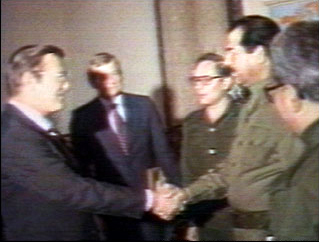
Actually, the US and Iraq were allies until Iraq invaded Kuwait. Ambassador April Glaspie.
  We have no opinion on your Arab-Arab conflicts, such as
  your dispute with Kuwait. Secretary Baker has directed me
  to emphasize the instruction, first given to Iraq in the
  1960s, that the Kuwait issue is not associated with
  America.
The Iraqis even sent an Exocet missile into the USS Stark and other than bombing one of their oil platforms, Reagan turned the other cheek.
Until after the Kuwait invasion and until after Thatcher lent H some of her testicles, yeah, Reagan and Bush were Iraqi allies.
    as defense secretary for the elder Mr. Bush,
    Mr. Cheney commissioned a study of how many
    tactical nuclear weapons would be needed to
    take out an Iraqi Republican Guard division,
    if necessary.

    (The answer: 17.)


You read that in a mainstream journal? You were played. You typed it yourself? You've been played. You dreamt it? You're a bard.