Is that really the case? Let me think about the apps I use most often. Could they be replaced by an LLM?
* Email/text/chat/social network? nope, people actually like communicating with other people
* Google Maps/subway time app? nope, I don't want a generative model plotting me a "route" - that's what graph algorithms are for!
* Video games? sure, levels may be generated, but I don't think games will just be "AI'd" into existence
* e-reader, weather, camera apps, drawing apps? nope, nope, nope
I think there will be plenty of apps in our future.
The people who have won the game in our current system love to point to this statistic, as if "extreme poverty" is the only thing that matters.
Even if people have a roof of their own head and bread in their belly, they don't like living with anxiety about being able to pay off debt, or what would happen if they had an unexpected hospital stay. And above all, they don't like working so hard only for the value they produce to be sucked up and used to buy back stock for the benefit of billionaires.
Not only do I disagree with the premise, but I think the article is poorly argued.
Was working on the Manhattan project unethical because it furnished the ability for us to kill humans on an even more vast industrial scale than we previously could have imagined? Perhaps, but it's hard to square this with the reality that the capability of mutually assured destruction has ushered in the longest period of relative peace and global stability in recorded history, during a period of time we might otherwise expect dramatically increased conflict and strife (because we are sharing our limited planet with an additional order of magnitude of humans). Had everyone at Los Alamos boycotted the effort, would we be in a better place when some other power inevitably invented the atomic bomb? Somehow I doubt it.
The world is a complex system. While there are hopefully an expanding set of core "values" that we collectively believe in, any single person is going to be challenged by conflicting values at times. This is like the Kagan stages of psychological development [1], but societally. I can believe that it's net bad for society that someone is working on a cigarette manufacturing line, without personally holding them accountable for the ills that are downstream of their work. There are competing systems (family, society) that place competing values (good - we can afford to live, bad - other people get sick and die) on the exact same work.
If people want to boycott some types of work, more power to them, but I don't think the line between "ethical" and "unethical" tasks is so clear that you can put whole corporations on one side or another of that line.
Sometimes I try and put a dollar amount on how much value I have received from Google in my lifetime. I've used their products for at least 20 years. Tens of thousands of dollars seems like an accurate estimate. I'm happy to recognize that two things are true: that there are societal problems with some big tech businesses that we would collectively benefit from solving AND that I (and millions of other people less fortunate than me, that couldn't "afford" the non-ad-supported cost of these services) have benefited tremendously from the existence of Google and its ilk.
> Was working on the Manhattan project unethical because it furnished the ability for us to kill humans on an even more vast industrial scale than we previously could have imagined? Perhaps, but it's hard to square this with the reality that the capability of mutually assured destruction has ushered in the longest period of relative peace and global stability in recorded history
Ah, consequentialist versus deontological ethics: neither camp can even hear the other. Some people just pattern-match making thing X (weapons, profits, patents, non-free software, whatever) against individual behavior and condemn individuals doing these things regardless of the actual effects on the real world. Sure, invading Japan instead of bombing it would have killed a million Americans and who knows how many Japanese (real WW2 allied estimate), but ATOM BOMB BAD and PEOPLE WHO DO BAD, and so we get people who treat Los Alamos as some kind of moral black hole.
The world makes sense only when we judge actions by their consequences. The strident and brittle deontological rules that writers of articles that feature the wor d"ethics" in the headline invariably promote are poor approximations of the behaviors that lead to good consequences in the world.
> invading Japan instead of bombing it would have killed a million Americans and who knows how many Japanese (real WW2 allied estimate),
Most people who believe that nuclear strikes on Japan were morally wrong also believe that Japan would have surrendered regardless, and nukes were thus redundant (and hence, wrong).
If you studied this question, you should know that there's a compelling argument that Japanese were motivated just as much if not more by Soviets entering the fray with considerable success. Now, you may personally disagree with this assessment, but surely you can at least recognize that others can legitimately hold this opinion and base their ethical calculus on it?
> The world makes sense only when we judge actions by their consequences.
I'm not sure I agree with this part. To quote Gene Wolfe: "until we reach the end of time we don’t know whether something is good or bad, we can only judge the intentions of those who acted." Judging morals by outcome seems like a tricky path down a slippery slope. The Manhattan Project is morally complicated, both because the intentions of those involved was complicated, and because the outcome was complicated. What's wrong to do, I think, is simplifying it down to "was good" or "was bad".
I don’t really understand the categories you’ve set up or the traditions you’re referring to, but it seems like consequentialist ethics would be good as a historical exercise, but not much else. Because we mostly don’t know what will happen when we act, at least not with the clarity that that kind of analysis would need. I think the implicit ethical problem here is that there’s not much any individual can do that will have a measurable effect when it comes to entities as large and powerful as big tech (or any other industry). So then how do you think about making ethical decisions?
> that I (and millions of other people less fortunate than me, that couldn't "afford" the non-ad-supported cost of these services) have benefited tremendously from the existence of Google and its ilk.
People who were into Google seem to tremendously overestimate the value it provided.
The only Google thing I ever used is Android, and only because it's too hard to avoid it.
Had there not been Google you'd have used alternative services, and your life would not have been much worse.
Yes, a similarly good search engine would have emerged, similar products would have been devised, and the internet would have been ad-supported as it already was before Google.
I used Altavista, Lycos, Yahoo, etc in the era before Google - and it was worse.
If you're suggesting that some other company besides Google would have worked out the same algorithms and business plan, then this seems incoherent. Even if true, we'd be here discussing how much value we've gotten from Notgoogle. It's still a tremendous amount of value, whatever the company is named.
> I used Altavista, Lycos, Yahoo, etc in the era before Google - and it was worse.
I guess you were only talking about the search engine, then.
The technology was ready, PageRank was inspired by other work, and Google came to a good degree out of government grants.
And by the way, the search engine I was using when Google came out (I think it was Northern Light, but I might be mistaken) was not significantly worse; Altavista and Yahoo were definitely among the worst engines by then
> If you're suggesting that some other company besides Google would have worked out the same algorithms and business plan, then this seems incoherent.
Why incoherent?
Had another company done exactly the same but with a different name, yeah, not much would have changed...
But there was no need for things to go this way, for the products you love to emerge; they just, probably, would have been made by several companies, rather than all by one.
But actually, there have always been alternatives to Google's products, it was just your choice to not use them; you could probably have gotten a similar value without ever touching a Google product.
I agree that competitors have caught up now, but there was a time when Google Translate and Google Maps (for example) were the only game in town. I tried most competitors, and they were all nearly useless in comparison.
It sort of does to me - disks made up of concentric orbits are have no intersections, and so collisions are less likely. In a ball, debris would have different directional vectors that would eventually collide with one another. The disk is the stable evolution of that state.
I believe it's not that collisions (and gravitational interactions) don't happen when it's in a disk, but the galaxy as a whole has an overall rotational momentum about some axis, and collisions within the galaxy can't change that. This means that it can flatten along the axis, but it can't shrink in the perpendicular plane.
If everything were twice as close to the axis (as gravity would like it to be), it would need to be moving twice as fast to conserve rotational momentum, but that's faster than the velocity of a circular orbit at the new radius (assuming everything was in a circular orbits to begin with).
The same principle is why almost everything in the solar system approximately lies within a plane.
> The concept of endless growth is a key ideological component of capitalism. Despite its devastating environmental and social consequences, growth for the sake of growth remains one of the main drivers of the global economy. Without it, the entire system comes crashing down like a gigantic house of cards.
I hear this a lot, but is it even true? Yes, our current system incentivizes increased consumption as a primary driver of growth. However, with the internet-era advent of 0-marginal cost goods/services, with extremely sublinear real-world resource usage (ie. electricity), aren't productivity increases just as valid a mode of growth as consumption increases? If we appropriately tax the consumptive inputs that feed an enterprise (eg. Carbon) isn't it reasonable to say that the growth of capital is not necessarily permanently hitched to the cart of otherwise limited real-world consumption?
This is a key part of my perspective that degrowth is not the only path forward. Innovation can yield us a carbon-neutral future. In the same vein, can't invention yield us an economy with fewer "devastating environmental and social consequences"?
It's incumbent upon us to price the negative externalities of consumption, not to abolish consumption entirely.
IANAEconomist, so I'd welcome critique on these points.
As you quoted (skeptically): The concept of endless growth is a key ideological component of capitalism.
What people (shareholders) want is more. Next quarter's profit ought to be more than last quarter's profit, forever. Why? Because more is better. More is the be all, end all. More, more, more.
"Productivity increases" cannot keep this going... forever.
Because consumption feeds the machine that ultimately increases the availability of resources which deliver basic human needs to people around the world [1]. Food, water, and shelter are important.
From another perspective: global GDP seems to be in the ballpark of $100T. If we grow at 3% for 100 years, we get 100T*(1.03)^100, almost 2000T global GDP. If we cut off 1% of that growth and use it to feed and house people worldwide, it becomes 100T*(1.02)^100 = 725T, plus 1% of global GDP per year in assistance (1T per year now, 7T in 2123, summing to 35T over 100 years [2]).
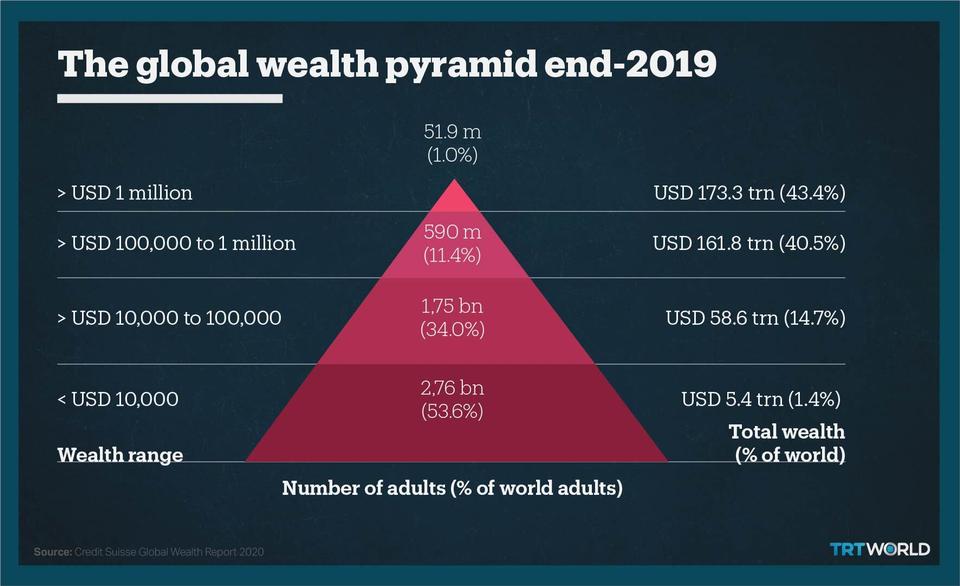
I think the utilitarian question is whether an additional 1200T in global wealth outweighs 35T of targeted assistance to the most vulnerable people in the world. If we look at the wealth distribution [3], the bottom 53% have 1.4% of the wealth. If that holds (which isn't necessarily a safe assumption, it could get worse), the bottom 53% would get 16T. Doesn't look so great compared to that 35T (probably targeted at the very bottom of that 53%), I admit. If we extend out to 200 years though, even these lines cross (if we make it that far :).
I think this tells me the most beneficial path forward is to maximize GDP growth while minimizing inequality to ensure that the fruits of that labor/growth help the vulnerable get food, not the rich buy another boat. That said, I think cutting global wealth by a factor of 3 in 100 years is not a great outcome. It would be like global wealth in 2020 being reverted back to that of 1980ish [4]. Life wasn't so different in the developed world then, but it was quite different outside of it (see [1]).
There is a valid criticism that perhaps the world doesn't need more wealth than that which can house, clothe, and feed everyone on earth. And we already produce that much wealth, it's just not distributed evenly enough to meet those needs. OTOH, what luxuries would you forgo to deliver those benefits? AC? Your laundry machine? Availability and quality of healthcare? We also need to motivate 8B people to continue working and producing the goods/services that yield a good life for everyone.
In the face of these questions, I don't find capitalism to be as evil as I once did when I was a bit younger. I don't mean to blindly support the invisible hand. The Keynesian approach balances government intervention ("distributions", above) with capital investment. My point is just that the trade-offs are not as simple as I once thought they were, and that growth is not the unmitigated evil many are eager to make it out to be.
Growth is the natural consequence of capitalism. More humans solving more problems means that we have more choices. Instead of going to your local post office for sending a telegram we now have smartphones. It's a choice that people did, to stop using paper letters to communicate.
Consumption is the basic principle of any modern economy because that's how you create jobs. Otherwise we have BS jobs, where what people have useless jobs they don't solve any problems.
For every thing you produce, someone has to buy it, and for every thing you buy someone has to make it.
In the USSR they didn't understand this concept and they just had jobs for the sake of jobs. Then you'll end up with warehouses full of useless products that none buy. Just to create jobs.
One example from the book Basic Economics of Sowell: the Ushanka hat where the skin of some animal would be used to make those typical Russian hats. The government would pay you for each individual animal skin you hunt. But there was a disconnect between animal skins killed, and hats sold. It's easier to hunt the animal than to sell the hat , and they'll end up with warehouses full of dead animals that would rot and never be used for hats.
What has growth to do with it? Capitalism would tell you to stop killing animals and do something else instead. The same thing that happened with sending paper letters and instead using smartphones. That's growth.
From what I understand the purpose of the mining operation is to keep the grid "balanced". "Bitcoin solves this" loses its luster a little when you compare it to running a data center next to that plant, without implicitly gambling the financial success of the nuclear investment on the continued value of bitcoin.


* Email/text/chat/social network? nope, people actually like communicating with other people * Google Maps/subway time app? nope, I don't want a generative model plotting me a "route" - that's what graph algorithms are for! * Video games? sure, levels may be generated, but I don't think games will just be "AI'd" into existence * e-reader, weather, camera apps, drawing apps? nope, nope, nope
I think there will be plenty of apps in our future.