Russia's intentions for Ukraine were not limited to only destruction of statehood and identity, but included the physical extermination of Ukrainians too; at least to such extent that Ukrainians would not be able to self-govern anymore: https://en.wikipedia.org/wiki/What_Russia_Should_Do_with_Ukr...
This closely mirrors the actions of Russians in the 1940s against a number of countries in Eastern Europe. Exterminate doctors-lawyers-merchants to destroy natural leaders, and then exploit the working class people as slaves. The parent poster mentioned banality several times. It's utterly banal to believe that you can smooth talk your way out of this.
As much as they criticize Western attitudes, they end up reproducing one of the most characteristic ones: the belief that every conflict can be managed through negotiation and that there is always some mutually acceptable deal to be made. This reflects the Anglo-American bubble and bias toward materialism, which leads to serious misjudgements when applied to situations where motivations other than economic.
Only if you accept the hidden assumption that Russia is an antagonist toward the rest of Europe. Otherwise the common "national security" justifications make no sense, because Russia benefits immensely from other NATO members investing resources into the development of institutions in newer member states.
A former Russian foreign minister has labeled NATO "free-of-charge security" for Russia, because NATO membership requirements turn a country into a stable and predictable place. The best neighbors Russia has are in NATO, and much of that stability is directly attributable to their membership.
> I gave you a link to the video where former American ambassador to the USSR is saying "though it was not a legally binding assurance, we gave categorical assurances to Gorbachev, back when the Soviet Union existed, that if a United Germany was able to stay in NATO, NATO would not be moved eastward".
Eduard Shevardnadze, the USSR's minister of foreign affairs at the time, clarified that the context was the potential stationing of foreign NATO troops (US, UK, etc) in East Germany after reunification. There was nowhere further "east" to move at the time, since East Germany bordered the Warsaw Pact. German reunification was agreed upon with the understanding that foreign troops would not be moved directly to the border with the Warsaw Pact, because the Pact had not yet had time to establish military infrastructure after retreating from East Germany. That was the agreement and parties adhered to it.
Shevardnadze also said that in 1990, it was unimaginable to the Soviet leadership that the Warsaw Pact and the USSR itself would dissolve. Therefore, there was no reason to discuss potential NATO membership of countries and territories that were under Soviet control at the time. And according to him, this was indeed not discussed at all during his tenure (1985-1991); not internally, and not with foreign partners either.
The putinesque sob story that NATO promised never to accept any new members is an anachronistic perversion of these events.
He didn't. Talks about NATO's future were limited to East Germany alone and written down into the articles 4 and 5 of the so-called "4+2 treaty" from 1990, which settled the post-reunification status of East Germany. In the treaty, it was agreed that foreign NATO forces would not enter East Germany before Soviet forces had withdrawn (by 1994).
It's absurd to even suggest anything beyond that, because post-reunification Germany was to border the Warsaw Pact. Even theoretically, there was nowhere for NATO to "expand." Gorbachev's team did not foresee the dissolution of the Warsaw Pact the following year.
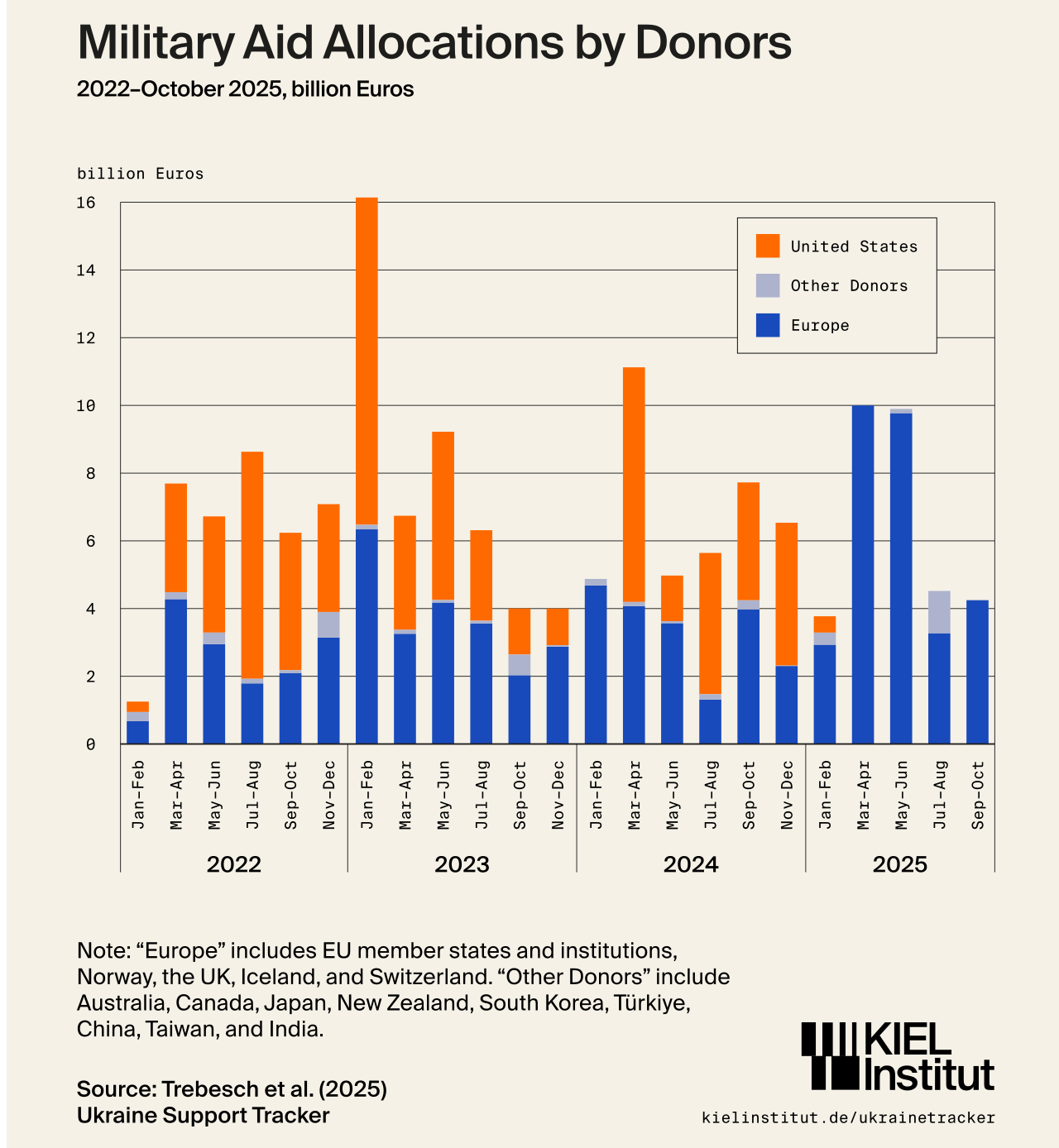
To put this into perspective, the US provided Ukraine with $64.62bn of military aid and $50.72bn of humanitarian and financial support in the four years between January 2022 and December 2025.
80 Days is a really wonderful literary game that captures the joy and adventure of travel (quite a nice escape during the pandemic). There's tons of replayability with different routes and subplots to discover.
Sponsorblock offers by far the best experience. It skips over channel intros and outros, engagement prompts, sponsored segments, tangents, etc (configurable per channel) and offers jumping to "highlight" (that is, the most important part of the video).
Highly ironic that the best experience is free, and no paid option gets even close. Tim Cook watching paid Youtube on Apple TV device has far worse experience than some random kid with Firefox and Sponsorblock gets for free.
> They have such beautiful names for this: "The end of history". Yes, really. "The peace dividend". "The unipolar moment". "Military-to-civilian conversion".
Who is this "they"?
  * "The end of history" - coined by Francis Fukuyama, an American political scientist.
  * "The unipolar moment" - coined by Charles Krauthammer, an American political columnist.
  * "The peace dividend" - older term, popularized by George HW Bush, an American president.
  * "Military-to-civilian conversion" - older term, popularized by Seymour Melman, an American professor of industrial engineering.


This closely mirrors the actions of Russians in the 1940s against a number of countries in Eastern Europe. Exterminate doctors-lawyers-merchants to destroy natural leaders, and then exploit the working class people as slaves. The parent poster mentioned banality several times. It's utterly banal to believe that you can smooth talk your way out of this.
As much as they criticize Western attitudes, they end up reproducing one of the most characteristic ones: the belief that every conflict can be managed through negotiation and that there is always some mutually acceptable deal to be made. This reflects the Anglo-American bubble and bias toward materialism, which leads to serious misjudgements when applied to situations where motivations other than economic.
reply