The EU is not a single country. It feels like a lot of Americans at the moment think of the EU as a single homogeneous entity that they often also just confusingly refer to as “Europe”.
Even the EU is a lot of different countries. Some of them quite poor, and some of them wealthier also with high GDP per capita.
GDP per capita does also not give you the whole picture. It is a number. Other numbers are median life expectancy, shootings per capita, PPI, median income, average vacation days, average distance to nearest high-speed rail station, physicians per capita, average number of pupils in a school class. Unemployment rate. Air quality.
GDP per capita is one indicator among many that says something about the country’s or region’s inhabitants, but in itself it is just a measure of how much money is being moved around annually. And it is potentially quite misleading. You could have a high GDP per capita and a poor population, if all the money went to large cooperations and billionaires.
I am not saying that everything is rosy in the EU, but just that there are also other important indicators and that it is a lot more complicated than just looking at GDP per capita across the entire EU.
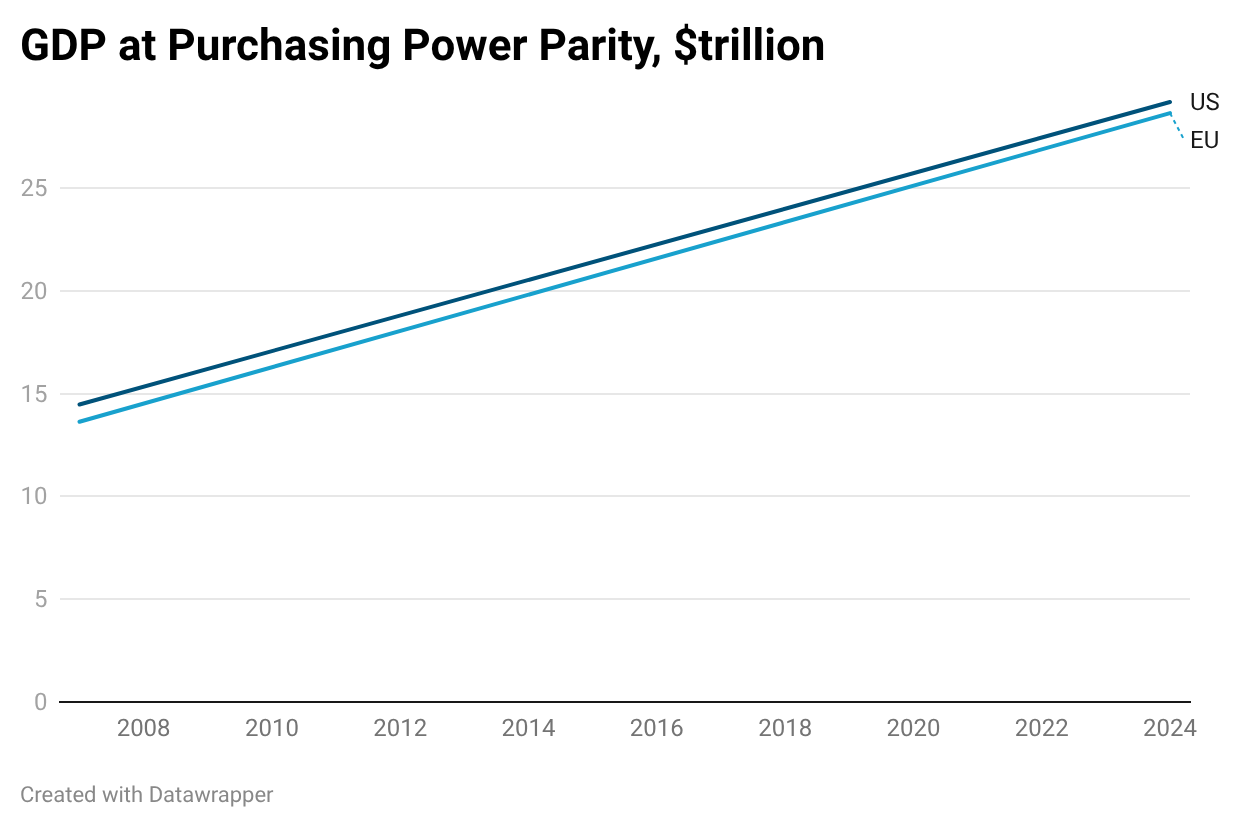
Not sure if you still conflate "poor" with "GDP/capita". If you do, that is an incorrect statement. Mississippi's GDP/capita is lower than many EU members' (e.g. Luxembourg, Ireland, Denmark... ). If you look at purchasing power parity (PPP) it also becomes a lot more muddy.
And that is not counting the substantial safety net that your average European has. I would MUCH rather live in Belgium than Mississippi, and I say this as an American.
Not GP, but: Belgium and Louisiana. And I’d pick Belgium again in a heartbeat, even if you removed all of the non-political (e.g. climate) differences.
Yet there are many places in Europe I would rather live in than Mississippi. That’s America in hard mode.
The best thing about living in Mississippi is that you have absolute freedom to move to another State where the benefits of living in the US are much easier to realize.
My point was that many of the oft-argued benefits of living in the US are relatively difficult to access in Mississippi. But if one finds themselves in that position it is relatively easy to improve their lot even if they are poor and don’t work in tech.
Been there, done that, and know many others that have.
The “freedom of movement” in the EU is considerably more difficult and limited in practice than what exists in the US.
40-50% of US citizens live in a different State than the one they are native to. 4-5% of EU citizens live in a different country than the one they are native to. That is a very large disparity.
An economy is there for the people. The people in Europe seem to have a higher quality of life than those on the other side of the Atlantic, don't you think?
Outside a handful of places, the standard of living is unambiguously higher in the US. Average Americans have insane incomes (~45% of US households earn >$100,000) and can afford many things the average European cannot. Many types of lifestyle spending Americans think of as “normal” is definitely not normal in Europe.
Quality of life has few objective measures beyond standard of living. One man’s “quality of life” is another man’s oppressive conformity and risk averseness. American culture places an enormous value on self-actualization and trades comfort and certainty to get it. Average Europeans demonstrably would not make this trade in many cases. Neither is objectively correct.
I think Europe may have had a comparable or better quality of life at one time allowing for the cultural differences. As someone who has spent a lot of time on both sides of the Atlantic, I don’t think that has been true for well over a decade. The slow impoverishment of Europe has become noticeable to American eyes in a way it wasn’t before.
I obviously said that in jest, an air conditioner is not expensive nor is it that expensive to run if you keep the set temperature within reason. The question itself is disingenuous. There is no one thing, because whatever the thing, there is a cheap knockoff available. It’s the quality of all things.
A cheap Android phone can do all the things an iPhone can, but the experience is worse. How do you quantify that?
I would urge Europeans to visit the US and stay at an AirBNB outside of a city to see how people live. I’ve done the same in reverse. Could I have a similar lifestyle to what I have in the US? Yes. But only with my American salary. This is the point that is being made here. There is nothing that Europe lacks. The problem is the numbers and what is available to the median household.
> The people in Europe seem to have a higher quality of life
Absolutely not, most places in Europe outside of a few rich countries like Switzerland and Liechtenstein and maybe a few flagship cities seem very low-QoL compared to similarly sized population centers in the US.
I think this may be partially about perception. I have been to the US over ten times. The first time I went to the US as a teenager, I was surprised how poor the US looks outside rich neighborhoods. Crumbling infrastructure, 80 year olds still working at supermarkets because they couldn't afford a living, many overweight people, most of the food sold in supermarkets is over-processed junk, and it is a car hellhole (can't walk or cycle to many places). I have also travelled most of Europe and with a few exceptions, European cities/villages look greener, more walkable, the people look healthier, people retire timely, etc.
There is also really weird segregation, like neighborhoods where only African-American people live. We once walked into a large restaurant and people looked at us in shock. There were only black people in the restaurant and by the shock on their faces, a family of white people walking in must have been rare occurrence. They were super kind, but it also was very weird.
How many years ago was this? Because over the past 20 years things have gotten better
Last time was 15 years ago, though family has been as recent as a few years ago and havent's seen a much of a change change. Also, in many ways, the last 20 years is quite a bad example to pick, since wealth of everyone under the 90th percentile was the same in ~2017-2018 as in ~2007:
I mean the best way to measure QOL is to see which countries people want to migrate to. The hurdle to do so is high for most people, so they pay a significant cost to get their preference.
If you adjust for population size and limit just to high income countries, the US comes out on top.
> Is that why they're electing far-right parties at an unprecedented rate?
According to a recent Guardian article, the reasons are immigration and the far-right's ability to masterfully tell a story how things were better in the idealized past.
Sorry, but you are just talking out of your, well whatever. E.g. in The Netherlands we have mostly had right-leaning or right-wing governments in the last few decades [1] and still right-wing populists are very popular. It's more that xenophobia is a disease that spreads very easily over and over again. Combine this with refuge crises, partially caused by the US (e.g. the wars in Afghanistan, Iraq, and knock-on effects), partially caused by proximity to a lot of countries with continuous instability (the middle east, North Africa). Finally, add some Russian disinformation campaigns on top and this is what you get.
Many Europeans are better off than a few decades ago. Heck, many European countries were still under authoritarian rule until a few decades ago (East Europe, Spain, Greece, etc.).
"Dammit why don't the voters realize how much better their lives are!!! Must be xenophobia then"
I get that people always want a simple answer and vilifying your political opponents feeds the ego.
Clearly Europeans don't feel like things are better than a few decades ago. Any politicians who ignores that or blames something like xenophobia has blinders on.
Germany, not even comparable lol.
Affordable healthcare, clean living spaces, decent wages for the majority of people. Also, Mississippi has the highest gun death rate in the US.. Not sure how much feeling safe should factor into QoL for you but that's a pretty significant one in my book
I have lived in Germany for five years and your parent poster is right. Scandinavian countries and The Netherlands are generally better. But Germany is a great country to live in with high living standards.
Claude at least has had memory for months, and also has scheduling now (and knows cron better than you or I, and can easily trigger itself on a schedule)
They've been at this for a while. They do have offerings you subscribe for and pay monthly. They have also consistently offered an option for each of those offerings to bring your own or self host. They've earned my trust.
Recently they removed the option to take certain types of backup locally (for the Network app). Now it only does it to the cloud, for those who allow this. It’s these small things that make me cautiously pessimistic that long term Ubiquity won’t pull the rug from under the customers.
Once you invest thousands in network equipment or cameras you’re less likely to jump ship when they start sneaking things in. And this is long lived equipment, not the kind you anyway replace every couple of years. So that’s a relatively strong lock-in.
It's definitely where they fit now, but are Ubiquiti's goals really always going to be the cheapest option when there are already a dozen other vendors who have demonstrated how to get higher margins & subscription revenue?
The usual trend that the smaller upsets compete on cost until they get higher and higher volume and work their way into higher and higher end markets. Ubiquiti 10 years ago was mostly doing volume for small niche ISPs or prosumers at home, now it's got enormous gains in SMB & products aimed at enterprise. I don't think they'll just stop at where they are, focus will keep shifting to wherever they think they can grow to rather than where they've had success before.
They would be shooting themselves in the foot in the long term.
I was surprised to learn that Ubiquiti is a publicly traded company, but also the CEO and founder owns the mass majority of the shares, so he is not beholden by shareholders wanting to enshittify the company for the same of increased stock prices.
Sure. But all you can do, when deciding with whom to do business, is base your decision on what they have already done. It's not viable to refuse to do business with a company on the basis of "they might one day get bought by PE and introduce customer hostile changes".
At home, my "NAS" is the Linux desktop box under my desk. It's got a bunch of local drives doing ZFS things, and samba.
I could split up the functions into different boxes and build a faster LAN to connect them, but doing that wouldn't improve anything except giving me more parts to goof around with. :)
In my opinion, as long as the majority of their profits come from people continuing to buy the self-host devices, it is fairly unlikely they'll ever stop offering those devices. Why change a working business model?
Yes, subscription models are enticing for that recurring revenue... number must go up, right? /s
If a majority of your sales are not in subscription products though, I think it would be foolish for a business to blow off its own leg trying to chase that particular dragon.
Then again... businesses have made dumber calls in the past out of nowhere...
They can sell subscriptions to people who buy them and allow self contained as possible. For securities sake requiring off-site storage of a security system is a non-starter.
Yeah, that's also a very good point. I imagine they're going to need to support that use case indefinitely. Hence their edge/IoT line of managed switches.
Reputation guides your behavior toward that person. But they're no longer around. There is no behavior toward them. They're gone. Their reputation is no longer relevant.
> Reputation guides your behavior toward that person. But they're no longer around. There is no behavior toward them. They're gone. Their reputation is no longer relevant.
It also culturally informs someone's perceived suitability as a role model. It doesn't matter to the dead person if they are held in high or low esteem, but it may matter to people in their formative stages deciding whose influence they follow and whose they shun.
Yeah, that's not how things work. Senate can't pass anything unless the House agrees and the House is representative of the population. Also, footnote, we've been structuring governments this way for thousands of years. Rome, etc.
The Senate heavily favors rural voters. The House is supposed to be representative, but favors rural voters thanks to gerrymandering and the cap on congressional representatives (Nebraska should have less than 1 rep in a truly representative institution, for example). Then you’ve got the presidency itself, where the electoral college favors rural voters. And the courts, which reflect the will of the president in cooperation with the senate, so also heavily biased toward rural voters.
There’s a reason the U.S. is the only modern democracy with a system like this. Almost any other country you’re likely to want to live in has a parliamentary system.
If you go that route Nebraska will lag ever more behind other states given they don't get to have any political power.
Look, I'm just someone from the other side of the pond. This is what happens: when you have no substantial representation for the country side your political system rewards centralisation, rural areas will stagnate, leading to less people there. A cycle that fuels itself.
As someone that has had to live through this I can assure you that those feeding the country should be given proper representation. Not doing so favours huge metropolies, rises urban house prices, prevents proper traffic flow, increases crime rate, etc...
Of course no system is perfect but a middle ground is preferable in my view.
With all due respect, being "from the other side of the pond", I don't think you understand the U.S. well enough to be commenting. For example, California is both the largest producer of food in the U.S., and the state being most significantly under-represented in all three branches of government.
The U.S. is also, easily, the most volatile (extreme partisanship) country of comparable rich, democratic nations. The system we have is pretty unique in its attempts to bend-over backwards to boost rural voters' importance, and we're worse off in virtually every "bad thing" you mention than countries that don't do this.
Centralization? Our president is independently murdering people in the carribbean, demolishing an entire wing of Whitehouse to build himself a new ballroom, independently changing funding (i.e. has hijacked the power of the purse from Congress), is independently sending in the U.S. military into states run by his political opponents against their will, pardoning violent criminals who supported him (one of whom was caught plotting to murder the House Minority Leader, Hakeem Jeffries), etc.
Rural areas will stagnate / people will move away? Dawg. That's already been happening despite the political concessions they've been given. That ain't the problem.
Urban house prices skyrocketing? Happening. NYC is among the least affordable major cities on the planet.
Crime rate? Generally highest in the places where we give disproportionate political sway to.
Are you suggesting the 66x more representation Wyomingers get over Californians in the Senate isn't enough? Is the ~3.5x more voting power they get in presidential elections not enough? What is a fair "middle ground" in your estimation? Because it feels extraordinarily unfair in the exact opposite direction, to me.
(Editing to add): It's also worth pointing out that this delta in voting power is much more extreme today than it was when this system was designed. In the 1800 census, the most populous state, Virginia, had 885,000 people, around 15x more than Delaware, the least populous state. Today, California has 67x the population of Wyoming.
I am but stating the dark side of equal voting power when you elect representatives per "region" dictated by the population they have. It is meant to be a warning, something to bear in mind when you do attempt to change the system you have.
I am not arguing in favour of what you have right now, hence the middle ground point at the end.
Regardless, my understanding of the US is not important. What is important in my comment is my understanding of what you don't do, and potential footguns.
A good middle ground would be to still have it entirely dictated by population (I understand this seems contradictory but hang on). But, in order to prevent votes from low population regions from being useless, your system uses "preferential voting". Most other countries do not do this, hence my previous comment. The key here is that at a national level, politicians still need to value less populated regions, because at least a percentage of their votes came from someone who voted in an order that still got them a seat (even though they weren't the top pick). Given rural regions have less seats to vote for, this vote would likely come from someone from the country side.
This solution however is only important when you do have more than 2 parties. If you don't do this, having more than 2 parties would be moot in these regions, because they need to vote strategically if they want representation. And 90% of the time that means your vote is limited to only one of the top 2 parties (as perceived by national polls before voting day). This is yet another dark side of the system my country does have, it incentivizes the status quo to prevail, even when your current leaders are a bunch of corrupt fellas.
The House is not as skewed as the Senate. But it still has a "rural" bias through two mechanisms: 1. gerrymandering, and 2. the 435 cap on the number of representatives.
Both parties do gerrymander. But there are more "red" states than blue, so it systemically favors one party.
The cap on reps also skews things. Nebraska, Wyoming, Alaska, and Vermont all have less than 1/435th of the U.S. population, so they're over-represented in the House. That over-representation comes at the expense of big states like California being under-represented.
You can see this effect by looking at the popular vote vs the representation in The House.
In the 2016 election, Trump won the election with just 46.1% of the popular vote. Republicans maintained control of The House with 55.4% control. In the 2020 election, Joe Biden won 51.3% of the popular vote. And Democrats gained control with slightly less than that, 51.03% of The House. In the 2024 election, Trump won 49.81% of the popular vote, Republicans won 50.8% of seats in The House.
The point of engineering is to make something that’s economically viable, not to slap together something that works. Making something that works is easy, making something that works and can be sold at scale is hard.
That's simply not true. Engineering can exist outside industry. "Stuff costs money" is not a governing aspect of these kinds of things.
FOSS is the obvious counterexample to your absurdly firm stance, but so are many artistic pursuits that use engineering techniques and principles, etc.
Industry includes FOSS and artistic endeavors, anything that’s done professionally.
My intent was to exclude research efforts, which is fundamentally different from engineering, which is a practical concern and not a “get it to just work” concern.
That's an interesting question, the question of whether engineering per se is strictly pragmatic. I personally think drawing a hard line between research and engineering is a misstep and relies too heavily on a bureaucratic kind of metaphysics.
There is no market for such a thing. At that price point, you get a personal chauffeur. That’s what rich people do and he can do stuff that a self driving system never can.
And the rich people who don't want a chauffeur like driving the car. They will buy a $10M car no problem, but they want driving that car to be fun because that's what they were paying for. They don't want you to make the driving more automatic and less interesting.
Slate is ugly and not nearly as functional. Predicting who is doomed at this point is silly. But there will be a small electric truck soon, which is nice.
You can self host something like https://big-agi.com/ and grab your own keys from various providers. You end up with the above, but without the pitfalls you mentioned.
BIG-AI does look cool, and supports a different use case. ABACUS.AI takes your $10/month and gives you credits that go towards their costs of using OpenAI, Anthropic, Gemini, etc. Use of smaller open models use very few credits.
The also support an application development framework that looks interesting but I have never used it.
No, what if the tariffs go away before you are done building your widget factory. Now you have widgets that are too expensive to sell to anyone.
If they want anyone to believe that the tariffs will remain in effect long enough to make a profit, they will need to pass a bill. Ideally, a bill that ratchets tariffs up over a long enough period of time to actually build the capacity in the US of the thing you want to tariff.
Still not sure a bill will give you that stability, since Trump has used loopholes to sidestep ratified trade agreements that he himself negotiated. Anything signed by this President isn't worth the paper it's printed on.
A bill wouldn't provide any security. It'd just be repealed as soon as the economic stagnation set in. If you wanted to build a factory through socialist policy, the only way to do it would be to cover the capital costs with direct investment by the treasury.
The tariffs hit domestic manufacturers harder than imports, so no?
If manufacturers move overseas, they (so far) get to compete for US business on a level playing field, and (in some alternate countries) can make planning decisions that assume due process exists and the law will be upheld. In the worst case, they can sell everywhere but the US.
If they move to the US, the cost of their inputs varies 100% week over week, and 2/3rds of their highly skilled factory workers are subject to random imprisonment.
Also, the president will use market manipulation and insider trading schemes to raid their capital reserves, then brag about it on video.
But then you risk tariff policy changing, and suddenly you're undercut by foreign factories again, and you lose all your investment in the American factory. It still needs certainty that the tariffs are staying.
The uncertainty only works to return manufacturing where America is cost-competitive without tariffs, and that's a tiny slice of manufacturing.
Manufacturing is extremely capital-intensive with a lead time of years. That's a huge gamble to make when policy will probably change by the time you're done and leave you manufacturing at a big loss.
No, because all your precursor components are also fluctuating massively every few days. How do you produce and price widgets when widget grease is $1 on Monday and $10 on Tuesday?
Manufacturing doesn't just happen magically. You need factories and a trained workforce, and various infrastructure. The point is that you may not be keen to invest now in building a factory that'll be usable in a couple of years if everything is constantly changing every week.


reply