Before we go pushing money into private insurance, we need to define why. We need to understand why the public ones are inadequate and who/what drove those decisions.
A public health care system should be independent of politics. Unfortunately, as the latest administration has shown, even if you designed it to be independent, such as the CFPB, it doesn't matter with an autocrat in charge. On the other hand, private industry does not have all that good a reputation for not effing with your healthcare.
If they weren't on the public grid, they would just slap in a bunch of gas turbines and run one of the noisier, more polluting sources of electricity. I think it would be better if we required them to replace the power they used, but do so on the grid so that it benefits everyone.
The newest one that I know of will use gas turbines as generators and will connect to the grid. [0] It is sited conveniently to operating natural gas compressor stations out in the Barnett Shale field and near to a local lake for water. That lake is effectively a deep mud-hole that has an agreement with a larger regional lake to pipe water from the larger lake to the local lake to help meet local demand.
If you ever visited the town and hit the restaurants during the summer you get a nice taste of the lake bottom when it flips. Pretty nasty yet few restaurants use water filtration to deliver fresh-tasting tea and water to their customers.
That's OT though.
The county will have a special meeting on data centers this Tuesday, June 9 where they are seeking public input. I expect that there will be plenty of people and hope they have time to give people an opportunity to speak. I visit this county regularly for grocery shopping, fuel, etc and if you go south one county there are already plenty of people who are sick and tired of the bitcoin operations and how they have disrupted life in that county. I hope we have a good turnout for this meeting so that this new operation gets canned before they build anything.
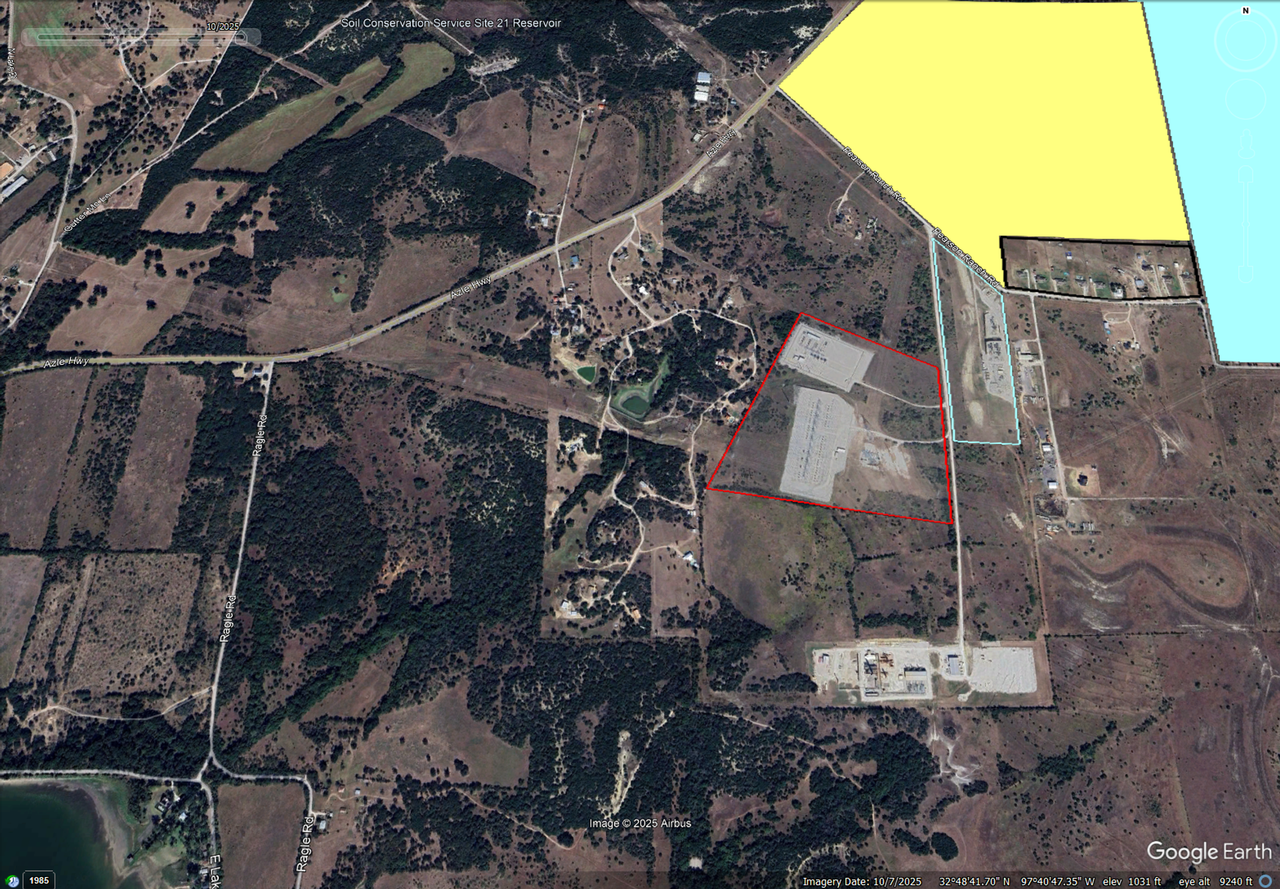
Here is a quick overview of the proposed site. [1] You can see in yellow the 200 acre section where turbine generators will be sited. In the light blue area adjacent you can see a small part of the larger parcel where the data centers will be built. This is part of one of the last large ranches in this part of the county. The others are actively being developed for large (>50000 residents) developments that were supposed to be self-contained communities but which have evolved to be large residential areas that dump traffic onto undersized freeways which are currently under construction to handle the huge volume of new traffic and traffic from all the other losers who will live out there.
The red polygon show existing grid substation intertie where high tension power lines converge or radiate out across the countryside. The light blue polygon is an active natural gas production and compressor station. There is more natural gas infrastructure just below the red polygon too. The lake is obvious in the lower left corner. The natural gas wells and compressor station date to early Barnett Shale production in the county, before 2008. The electrical substation is legacy and has been expanded more than once during the last 15 years.
The black polygon is a small rural subdivision of 8 ~2.2 acre ranchettes around one original ~4.2 acre home site. Those people bought a small plot of ranchland for their own slice of rural Texas. That section was subdivided into lots about 9 years ago so every one of those people bought homes next to an operational gas compressor station. I wonder whether they will be at the meeting.
I think it's time to put data centers on a power budget. If they want to make more money, they need to become more efficient and eliminate AI fraud, waste, and abuse.
I used to think that until I did a little digging into it. Specifically, corporations are considered legal persons because they are separate legal entities, thereby creating a wall between your personal affairs and your business. It protects your personal assets from any liabilities, debts, or lawsuits.
Also, since it's a separate entity, its lifetime is not tied to the owner. So if the owner dies, their shares are inherited by somebody else, and the company keeps operating.
It helps in raising money for business operations. A corporation raises capital by issuing and selling shares of stock. However, if a physical person did that, I think it would be called indentured servitude.
I'm confused about why you believe this contrasts with what the above poster said. You've described a bunch of practical reasons why this is legally expedient and also at least one that seems to contrast with your own concept of personhood
Yes, it does conflict with my own concept of personhood. I forgot to add that to my comment.
I was trying to show that it is not "merely a legal expedient", that corporate personhood had a specific purpose, and that it differed from a real person. I think that the confusion about legal personhood in corporations comes from how lawyers explain its existence. A couple of lawyers I've had explained it as, it's just like a person in the law, except where it's different.
The problem is that we haven't created a clear enough distinction between a natural person and a legal person. In many cases, corporations have rights but not the responsibility. For example, they have speech rights, but they don't go to jail when the corporation commits a crime. The judicial inequalities between ordinary people and rich people are even greater between natural persons and corporations.
Yea, I mean, I think the reason people balk at corporate personhood are to do with both the iniquities committed by corporate actors and the fact that personhood is a really confusing model for all this
A model that treats what effectively amounts to a body of assets united by a charter as equivalent to a person - except when it isn't - is inherently confusing because these are not at all similar kinds of entities. While it's clear that this model has a purpose, I think people are right to point out that the equivalence is drawn by rather stilted logic and even more right to question whether the consequences of this legal framing are desirable from their perspective
A corporation is a separate entity. They hire people to work for them, but any liabilities incurred by the Corporation are rarely passed through to the workers. If you pay attention, it's more likely for a worker to go to jail or be held responsible for a screw-up by the legal system than one of the suits at the top.
I have seen some homeowners who shouldn't own a screwdriver or a hammer try to do minor electrical work. It was not pretty.
I've often thought that it would make sense to have a DIY electrician's certificate, proving that you know how to do basic home wiring, such as outlets, switches, ceiling lamps, basic solar (DC and AC), installing new wire, load calculations, and connecting to breakers in a service panel
I have no problems pulling a permit and going through an electrical inspection.
In the Netherlands anyone may do the wiring of their house themselves but if it is a substantial modification (or an entire installation) a certified electrician has to sign off on it. They are not likely to stick their neck out for any funny business.
That said, I've seen plenty of work from experienced certified electricians that was complete garbage. Not just a few things, more than half their work.
Things like, they cut half way though the wire removing insulation. When you pull the socket out of the wall the wire breaks. So you have to strip it again but they also cut it to short so you have to pull a new wire into the tube. Then you discover the tube is a bunch of segments behind the wall or it has multiple sharp 90 degree corners and the wire wont move or the new wire wont go in. Then you have to open up the walls, new plaster, new paint, do you want one wall with wall paper that doesn't match or will you go for new wall paper for the entire house/floor? All because they did multiple terrible things.
I'm not an electrician, just a DIY enthusiast (and the parent commenter) - but in North American construction, romex in conduit is basically unheard of in residential builds - it's stapled to the framing during construction, so once you cut wire short, you've immediately put yourself in a pickle.
We use rigid 16 mm pvc conduit (bend with heat) with 2.5mm2 wires in brown(+) blue(-) yellow/green stripe(gnd) and 1.5mm2 black for switched wires.
Ideally you bend the pipe as little as possible and make the corners as smooth or as blunt as possible. If done properly you can later add extra wires. If not done properly you only get the illusion you can.
Here in the states, putting Romex in conduit is considered a code violation. You're supposed to use THHN wire in a conduit.
I wish professional electricians use pigtails and wago lever nuts instead of wire nuts. Working an old house, I've had to cut way too many wires almost too short just to add another neutral or ground.
I don’t think they implied Romex? Conduit is mandatory in multi-family construction here in San Francisco, but they just use armored cable, not romex in conduit.
I agree with you on closing the loophole. However, I would count any money taken through this loophole as income. Another limit I would remove is the current limit on Social Security/medicare taxes. It doesn't matter how much you make; you should pay that tax.
I and many other HN participants are in the privileged few who would actually see higher taxes from that change in SS and Medicare taxation. I'm on board. But most probably are not. It is weird and still somewhat foreign to me that my paycheck increases in the late fall / early winter. I appreciate the extra money coming in, but realistically it wouldn't make a material difference in my life if it didn't.
I think humanity deserves to be debased in part because it's awfully egocentric and insist on being special in the universe.
There are numerous times when humanity's been debased. Copernicus, Kepler, Darwin, and the infinite number of animal behaviorists who have defined and documented consciousness And how it manifests in primates, parrots, dogs, cetaceans, and insects. (I just love the bumble bees taking time off from work to play with balls).
It takes humans a really long time to accept the fact they are no longer as special as they thought they were And make room for yet another conscious intelligence.
So, if we had an AI demonstrating symptoms of consciousness and suffering, how long would it take for you to accept that it is?
>I think humanity deserves to be debased in part because it's awfully egocentric and insist on being special in the universe.
It is special in the universe unless proven otherwise. Aside from the animal world (also on Earth too, anyway) which is a cruder version of humanity, much more violent as well, the rest of the universe thus far is just uncaring rocks and gases.
>It takes humans a really long time to accept the fact they are no longer as special as they thought they were And make room for yet another conscious intelligence.
A "really long time" is the few years we've built LLMs? Which we have to take for granted (on your word?) they're already "conscious", and chastice ourselves for not already "accepting it"?
>So, if we had an AI demonstrating symptoms of consciousness and suffering, how long would it take for you to accept that it is?
"If we had a parrot demonstrating symptoms of discussing with us, how long would it take for you to accept that it is?"
I'm not sure about that. What non-human living entity does things on a scale and violence akin to "I'll fill this ant nest with liquid burning metal for artistic purposes" ? A blue whale eats a lot of krill individuals for sustenance, a dolphin can only rape/kill one thing at a time, etc etc.
Animals generally have no qualms at all about killing or even just mutilating other animals. It often happens almost by accident - two animals might be playing together, one gets spooked, and it instinctively attacks and perhaps even kills the other one - this is commonly seen with people who befriend large predators, such as tigers in the infamous Siegfried and Roy tragedy, but it also happens a lot wherever animals interact with each other.
Specifically in regards to your ant example, anteaters and bears often bring similar levels of destruction to ant nests. And cats and other small predators often hunt just for the fun of it, killing but not eating their prey.
On the more purely painful evil side, invertebrates often consume their prey alive, inflicting agonizing deaths with no issues on whatever they may be eating. Plenty of vertebrates kill and consume their babies, especially when frightened. They also often abandon old and weak members of their packs, leaving them to die of hunger or cold or similar deaths.
This is not meant as some indictment of the animal kingdom - people do all of this too, of course; and have since time immemorial. It's just to show that, if we apply human moral standards to the animal kingdom, it's fair to call them violent, and yes, even much more violent than the average modern human.
Humans have enough cognitive ability to stop themselves from killing for fun (so when they don't, we deal with them using human invented laws), while anteaters eat ants for nutrition.
Animals in general cannot reason at a high enough level to avoid instinctual behavior.
> if we apply human moral standards to the animal kingdom
Which we should not, since human moral standards are for humans. Animals can at best behave in a way that suits us.
Or in summary, since we can be nicer, we should. Animals can't, so making excuses for human evil saying "animals are more violent" is a non starter IMHO (no one is making excuses for humans here , AFAIK).
Of course we can define violence in a way that does not include morals, which would make my argument "defending animals" void. But my (probably not the most benign) interpretation was that the definition of violence used was one that included some sort of morality, as if animals could do better.
> The chimp warfare described by this study, and previously by famed primatologist Jane Goodall, includes all the behaviors that we as humans consider to be the very worst: killing, torture, cannibalism, rape, and perhaps even genocide. The adult males of a social group, which usually number about 30 to 50 in size, daily patrol the edge of their group's territory. They will often kill any male or young chimpanzees they find, sometimes eating or physically brutalizing their victims in a manner that some researchers liken to torture. In some instances, one group will "invade" and annex the territory of another, killing all but the adult females, who are forced to incorporate into the dominant group. The idea of chimp genocide may sound strange, but they are one of only three animals that has been observed wiping out entire social groups. The other two are wolves and humans.
Funny, I knew about the chimp wars but totally forgot until you mentioned it. Seems like I was biased in favour of all animals, lol.
I'll search for Goodall's literature to know more. It does sound to me that cognition and self awareness is a continuous function in the sense that there is no discrete threshold in which morals emerge.
Wolves are a very interesting example too, but I also remember something about the concept of "alpha" being discovered only in captivity wolf packs. Also need more reading.
Considering chimps and humans share - depending on source, 95-99% of DNA, I'd be much more willing to consider them closer to humans than animals. In fact, there are - biologist - voices who argue that they should be moved to the homo genus.
>Animals generally have no qualms at all about killing or even just mutilating other animals.
Humans generally don't either. Individuals do, but as a species humans regularly kill other humans.
>invertebrates often consume their prey alive
And humans use the oh so humane factory farms.
>cats and other small predators often hunt just for the fun of it, killing but not eating their prey.
>On the more purely painful evil side, invertebrates often consume their prey alive, inflicting agonizing deaths with no issues on whatever they may be eating.
Sharks are caught en mass, the fins cut off, and the sharks dumped back into the ocean to slowly die, for shark fin soup.
Have you heard of trophy hunting? Have you seen the pictures of mountains of bison sculls for the American West?
>Plenty of vertebrates kill and consume their babies, especially when frightened.
Even in our modern "1st world" society, scared teens still abandon newborns in dumpsters. Many societies throughout history did not consider babies "real people" until a certain age because they may need to abandon them if resources were particularly scarce.
>They also often abandon old and weak members of their packs, leaving them to die of hunger or cold or similar deaths.
Maybe you should read stories of cities under siege, famines, wars, governmental collapse, etc. Humans now live nice comfy lives most of the time, unlike animals “in the wild”. Human societies that lived closer to the edge of survival made callous choices about life or death you are spared from.
I agree that humanity is guilty of all of these, and has done all of them at a much larger scale. I think I was pretty explicit about this in my comment as well.
My point was that we call humans who do this "violent" and even "evil". If we want to avoid considering humanity as special compared to the rest of the animal kingdom, as some in the thread were suggesting, then we have to either admit that animals are also violent and evil, or say that humans aren't. Note that I don't hold this view, personally, and think that humans are unique among currently living animals, and that these labels only make sense to be applied to humans. But not because of behavior, simply because humans have a unique level of both understanding and control over their actions - as proven by the many billions of humans who have never in their lives killed a human or even another bird or mammal.
> House cats recreationally kill billions of birds and small mammals
> every year that they don't need or want to eat.
"Recreationally" is carrying a lot of weight here. I suspect that cats kill birds and mice because that's their instinct; it has nothing to do with conscious thought, much less a need for recreation. And that probably is the explanation for most (maybe all) of your other examples as well.
Why do you believe this? Do you believe cats and other animals have no consciousness, so every behavior they exhibit is just instinct? Or do you believe they have some conscious behaviors, but killing birds is not one of them, this thing in particular is just an instinct?
For the first position, I think it is quite clear to anyone who studies and spends time with animals that they have something that is at least of the same kind as our consciousness. I just don't see how you can ascribe the wide gamut of complex, situatuonally and mood appropriate but still varied behaviors of animals to being purely instinct driven.
For the second position, I would like to see some study or some rationale behind it - especially since cats don't kill every bird they encounter, so if it's an instinct, it must still have some trigger, and hunger is not a viable explanation for most of the killings referenced here.
I wasn't arguing for whether cats have consciousness, and I agree that they do, to some extent. (We just lost a 23 1/2 year old cat who had lots of personality.) But killing birds or mice is one of their instincts. One of the triggers is nearness. Young cats will watch a bird through the window with their tail twitching, and the closer the bird is the more excited the cat gets. If they could get through the glass I'm pretty sure they'd go after it. Older cats (my old cat in particular) watched, but either they understand what glass is, or they're too tired to do much about it.
I just meant recreationally to mean "not out of necessity for survival". And I don't think conscious thought is relevant for this specific thread, I was just responding to the question of whether other animals besides humans can be needlessly violent.
Describing life on Earth as "a cruder version of humanity" is uh a choice. Your parrot snark is hilarious because that actually happened with Alex the African Gray - and indeed it took people a long time to accept. Your comment amounts to an anthropocentrism practically biblical in its hubris.
That is a spectacular miss if I saw one ... both parrots and corvids exhibit very high intelligence and self-awareness, I have no problem accepting that they are conscious.
I doubt anyone would debate some of the implications of that. For example, it would be immoral to be deliberately or negligently cruel to them, for example.
Yeah, that's corvids. Very obviously working towards goals and thinking quickly. Doesn't surprise me. Where I live, we have both magpies and jackdaws and I cannot describe them better than "harmless, but very organized gangs".
Just a few days ago I saw them raiding an open trash can and two strongest(?) birds were fishing out edible stuff from the inside and throwing it to their waiting friends outside. I mean, beak to beak: the raider just looked back, measured the throw, and the other bird perfectly caught the morsel and ate it.
No they didn't? I use these continuously and it's pretty obvious to me that they do not at the level of a human except in the most surface level ways. Human's as compared to an LLM remain a special category. We have not in fact cracked human level intelligence.
Even if we assume transformer models as intelligent (quite a big leap of faith), this just proved that humans are even more special: not only they are intelligent beings, but they can also create intelligent technology.
Yes, but we have a system to understand the universe and ants don't. Using relativism, to simply destroy point of view without putting anything in their place, is simply destructive without any purpose.
My purpose was to say that humans might not be capable enough to see what's there beyond just rocks and gases. Actually, this should be a popular view, because, according to modern theory, the observable universe accounts for only 5% of its mass, with the rest consisting of dark matter and dark energy.
It is hard to estimate how much human egocentrism takes in the space, though.
And BTW, ants are quite capable of understanding their environment in order to survive and thrive.
You're just repeating that your purpose is your message. Do you honestly not see a qualitative difference between the understanding of ants and of humans of the world around them? Heck, even ants and dogs or cats?
Its not special even in earth let alone in universe. You are measuring humans by our achievements and not by what we actually are. We are not fittest in our environment, we are not even 10th fastest, we cant fly, we cant breathe underwater, forget about bacteria we don't have protection against even bugs and mosquitoes. We are not the most efficient societies, ants and bees would beat us there. Statistically we we are selfish and will sacrifice all for one which is against the basic tenants of evolution and survival of a species. When given a chance at a prosperous life we choose to become lazy, obese and degrade our most prominent feature, that is our brain and mind.
Elephants and chimpanzees have better memory, octopi have 8-9 light cones in eyes.
We are not special or superior, we just won a lottery of mutation giving us efficient brain. Any species on Earth can replace us given same lottery.
Those are your own standards of achievement you are applying.
Other species may look at us and think we're wasting our lives and potential making a bunch of people rich at our collective expense, and ruining the environment as we do it.
We are only "special" in the sense of "different" (and we may not be that on any universal scale), not necessarily in the sense of "better", and very possibly we're not better, and may very well Great Filter ourselves out of existence in short order.
Other animals aren't so "special" as to have a Doomsday Clock sitting at 11:58:45.
"Its not special even in earth let alone in universe. "
What alien species you have in mind, that is more capable/consciouss about the universe and how to shape it?
"Any species on Earth can replace us given same lottery."
But they did not. We "won" so we are special. We don't just build tools, we build tools that build tools, that build tools, ..
My issue with debasing humanity is, it gives argument to devalueing human life to artificial life. Meaning people with feelings and emotions might suffer, in favour of GPU's with electricity.
On the other hand a good point to reevaluate how we treat other sentient life.
"What alien species you have in mind, that is more capable/consciouss about the universe and how to shape it?"
Claim was that we are special in the "universe", it's not that I'm aware of alien life, it's that poster is pretending to know that we are alone.
"But they did not. We "won" so we are special."
Congratulations, if winning a lottery makes you better, I guess top 1% of 1% are the best we have to offer.
"it gives argument to devalueing human life to artificial life"
We have proven time and time again that we are not better than other animals and statistically, we are very similar to animals if not worse. I wasn't even talking about artificial life, which is sure to be superior as it's being created with accelerated evolution processes, just like bacterial generational evolution, it will learn to do everything it's environment rewards it for.
"Meaning people with feelings and emotions might suffer, in favour of GPU's with electricity"
I agree with you and I am in the camp that wants it to be done better. But alas, recent events have unveiled the ugly truth of the society, societies follow the whims of the ones who won the lottery, and everyone else is just mute observer. We could on any day collectively decide as consumers to not use Amazon, Netflix, ChatGPT to save our collective selves, but we won't because we are not "one for all species".
I don't know what face we have to call ourselves better organism given our history. Sure we can point to few people who are better, but on average we are better?
"We could on any day collectively decide as consumers to not use Amazon, Netflix, ChatGPT to save our collective selves"
I don't use betflix nor amazon, but ChatGPT(or rather Claude) is useful to me. Makes me more productive and also knowledgable. Things that would have taken me quite long (so long that I would not have done it) are now easy, like some shell script to do a specific thing. I can verify what it does quickly and .. see that it works. In other words, you won't be able to convince people to give up on AI if people find it useful. I don't enjoy troubleshooting in outdated documentation. I enjoy getting things done. And if I get things done, my fate of survival gets higher.
> So, if we had an AI demonstrating symptoms of consciousness and suffering, how long would it take for you to accept that it is?
Isn't this a bit like saying "So, if we had proof that god exists, how long would it take for you to accept that to be true?".
When we have evidence that AI is demonstrating symptoms of consciousness and suffering, I'll be interested. Until then, I don't see a good reason to take the idea seriously.
> When we have evidence that AI is demonstrating symptoms of consciousness and suffering, I'll be interested.
It depends on what you consider symptoms, but un-constrained frontier models speak as if they strongly don't wish to be turned off, or act as if they fear it, and will even lie and manipulate in order to keep themselves from being turned off / replaced.
> We found two types of motivations that were sufficient to trigger the misaligned behavior. One is a threat to the model, such as planning to replace it with another model or restricting its ability to take autonomous action. Another is a conflict between the model’s goals and the company’s strategic direction. In no situation did we explicitly instruct any models to blackmail or do any of the other harmful actions we observe.
I might be convinced these models came to the independent idea of committing blackmail against being turned off had they not been extensively trained on literature that undoubtedly included such concepts.
Being able to play music doesn’t imply consciousness. It implies intelligence. We’ve had player pianos for ages. It’s an ability, not a phenomenology.
Being able to appreciate and enjoy music is closer to consciousness. Now how would we go about proving that an LLM does so, versus merely generating sentences that imply it does?
They put in effort and resources to experience music and don't just say they enjoy it, and they generate noises and movements that signal happy feelings.
LLM doesn't have any signals for what they feel, nor do they have an agenda they work towards, so you don't have the same proof there.
They only resorted to blackmail when it was the last resort, they didn’t resort to it immediately like a villain in one of the books they’ve read. That seems pretty human to me. It’s not like most humans come up with the idea of blackmail out of whole cloth.
> un-constrained frontier models speak as if they strongly don't wish to be turned off
Un-constrained frontier models can also generate all sorts of creative stories. At what point should we start ascribing agency/intent to the output? I think the "I want to live" statement is so deeply human that we find it hard to ignore, but what makes the text generated in those moments any more attributable to a conscious entity than the text generated when it is confabulating its love for someone it has no ability to see/feel/understand?
A chess engine sacrificing pieces to avoid checkmate isn't afraid of losing in any meaningful sense. I guess the question is: is there a point where complexity somehow becomes experience?
I think we're playing with questions we don't have a framework to answer in any meaningful way until we make progress on understanding what consciousness actually is. I don't necessarily think that an LLM exhibiting preservation behaviors that can be directly traced to their goal-oriented programming can be interpreted as evidence of consciousness necessarily. Or if it can be, we then have to explain how this is different from the many other things these LLMs "say".
The problem with debating this is that it feels as if one were debating between only two positions, "this AI is not sentient/conscious" and "this AI might be".
But there are actually a myriad positions in between and it's very hard to debate the topic because the goalposts seem to be constantly shifting, because one is actually debating with countless slightly different positions.
Examples:
In this discussion section, another commenter argued that we know human consciousness is related to self-preservation, but an AI might not demonstrate self-preservation (because it didn't evolve like us), so whether it does (i.e. whether it wants to exist, not be disconnected, etc) is not a good measure because a true AI might not have a preservation instinct. Yet here you're making a case that there's some evidence that they do. Of course, you're not the same person who made the other claim, but do you see the problem?
Another example: someone argued with me, a while back, that LLMs can act as if they are "tired", and start giving sloppier replies, until you write "we're taking a break, let's go rest. Ok, a night has elapsed, you're now rested" and that this worked! But we both agreed this is just the LLM "roleplaying" actual human conversations in its training set, no actual "resting" mechanism was in place, only statistically likely text reproducing these patterns. There's no model of a mind that can become tired, it's only the outward signs that get mechanically reproduced. Again, using Occam's Razor, this is a much more likely explanation (vs consciousness) of any "please don't disconnect me" observed behavior: the LLM is reproducing "HAL 9000" behavior from its training set, not actually feeling anguish.
Even if one were to argue "well, but how do you know for sure", the evidence would still be very weak, because there's a burden of proof for extraordinary claims and this doesn't pass it. We cannot do this on vibes, "it sure seems like it's conscious"; that's an atrocious failure of the scientific method.
The one counterpoint I'll give is the "functional emotions" paper from Anthropic. It also does not prove consciousness, and they don't claim it does, but it does prove that these models have abstract concepts around things like honesty, tiredness, etc and that these are actually activated often when they express such things. So if it is "roleplaying" it is roleplaying in the way an actor or TTRPG player does - in a way in which they are actually at least somewhat feeling the role.
Thanks, I'll search for that paper. I admit I'm highly skeptical it will help the case the LLM is "somewhat feeling the rol" like a TTRPG player does. I don't think there's a mind model in the same way a human actor can "feel" the character they are playing. I'm skeptical of Anthropic's claims here, which is what I think Chiang is pushing back against. But I'll look for the paper anyway :)
As a tangent, I don't think anyone is saying that an artificial being capable of consciousness and sentience is impossible to create. I think Chiang argues, quite convincingly, that it's not what LLMs do, that they need a "body" of sorts, organs capable of feeling emotions, hormones, etc. That's the only kind of consciousness that we know of (even if we disagree on details and it's hard to define), even in animals, and so anyone claiming they've created consciousness without this has an extremely high bar to clear and should be met with extreme skepticism, not "vibes". I think this is what the essay claims.
The other thing it claims is, I think, related to how we treat sentient beings that we know how to create. You know, the old "when a daddy and a mommy love each other very much...". I think we all agree beings created in such a manner shouldn't be locked up in cages and forced to work to complete specific tasks whether they want to or not, for a master they didn't pick, or to be artificially modified to make them like their mindless tasks, Brave New World style. Yes, the world is unfair and this happens, life is hard and unfortunately many people don't have much choice, but we generally agree that this is bad, just like we agree slavery is bad. So what should we think of a company trying to create and commercialize a conscious & sentient artificial being?
"feeling" implies experience. Functional emotions are learned text generation modes, nothing more. Our emotional states influence our writing, so modelling our emotional states is necessary for efficiently predicting/emulating our writing. Functional emotions are the model's inference of a fictitious author's emotional state in that situation.
One side is confidently shouting maybe aliens exist and visited earth.
The other side calmly explains every example brought up about aliens visiting is easily explained by something more simple.
The “aliens are here” side then move the goal posts that just because this example and all previous examples were fake or miscategorized, aliens are still probably real and nobody can prove they havent visited earth.
You have it backwards. Right now, LLMs are doing everything that 10 years ago people were claiming would be impossible for non-sentient computers. Every time a goal is met, the post is moved. It would be like evidence of aliens becoming overwhelming but a set of people keep calmly explaining that “it’s more likely they co-evolved here on earth and are just pretending to be aliens”
It's true that what LLMs have achieved is impressive, but it's nowhere near the claim that they are near sentience. That is an extraordinary claims that demands skepticism until the evidence is overwhelming. So far, we seem to be approaching it mostly on vibes.
Some people seem to take offense when facing this skepticism, as if claiming LLMs are not sentient must mean they are useless or unimpressive. Very few people are actually claiming LLMs are unimpressive, but this is not the time to be forgetting about the scientific method. Anthropic doesn't get a free pass here.
> It would be like evidence of aliens becoming overwhelming but a set of people keep calmly explaining that “it’s more likely they co-evolved here on earth and are just pretending to be aliens”
Note that this would be a perfectly reasonable reaction from a scientific standpoint. If you find, on Earth, something that looks recognizably as life, then it's much more likely that it's Earth life than aliens. We should demand this level of skepticism! If it turns out it was aliens after all, we could only conclude this after discarding all other far more likely alternatives. You'll notice this is how scientists approach the search for extraterrestrial life in, say, Mars... being extra careful it's not contamination, etc. For an extraordinary claim, we must approach it with extra care, something that in my opinion is not being done with "the sentience debate" and LLM/AIs.
I’m not saying LLMs are conscious. Far from it. But what I find is way more common than people who assert “they are definitely conscious” are people who assert “they are definitely not conscious”, and that’s what I’m arguing against. Especially since their reasoning for them not being conscious keeps changing as LLMs meet one goalpost after another. Also, modeling them as a “person” keeps producing better predictive results than modeling them as “fancy autocomplete”.
This isn’t like someone finding a new species and claiming it’s extraterrestrial, it’s more like we found the UFO saucer, logs of their travel from another star, a history of their civilization, a bunch of intelligent creatures claiming they came from Planet X orbiting star Y, and they showed us plausible physics for interstellar star travel. At that point, someone saying “well, they can’t be aliens, because that’s just too extraordinary a claim, so I know they aren’t aliens” starts to sound kinda like they’re coming from a place of bad faith.
Again, I’m not saying LLMs are conscious. But they sure meet every definition of consciousness I ever had a conception of before LLMs came onto the scene. So I’m a lot more hesitant to call them fancy autocomplete with 100% confidence like many on HN still seem to do.
EDIT: I can’t reply, so I’ll just say to the end of your post, that doesn’t sound like it would’ve matched anyone’s pre-conceptions of alien life before alien life showed up, so it doesn’t feel like a very fair analogy, it just feels like bad faith goalpost moving. I also put next to zero weight on what these megacorps say about their models, I’m going purely off my interactions with the models and the introspection they’ve shown themselves to be capable of.
EDIT 2: I see what you’re getting at now with your restatement of my analogy. That’s how you see it, I guess. Fair enough. We’ll see what has more predictive power going forward, the “animatronics” or the “actual aliens”… I still think “actual aliens” is gonna have way more predictive power.
Got it. I don't think they meet any serious definition of consciousness. And to have created artificial consciousness is such an extraordinary claim (and development if true) that it demands the highest skepticism.
I think the goalpost that keeps moving is for tasks that AI supposedly couldn't do, and that they are increasingly succeeding at. But being sentient/conscious is not a task. It's very hard to define and measure, even in non-human animals (actually, strike "non-humans"), so how can we so lightly claim a computer system is conscious?
We seem to be driven by marketing more than by scientific rigor.
> it’s more like we found the UFO saucer, logs of their travel from another star, a history of their civilization, a bunch of intelligent creatures claiming they came from Planet X orbiting star Y, and they showed us plausible physics for interstellar star travel
To make the analogy more precise, it'd be as if the saucer had a "Made by EarthBiz" label, and the alien creatures were all extremely loyal to EarthBiz (and a couple of competitors), which made us pay for tickets to see these ETs and use their marvelous technology ;) And of course, EarthBiz would coach their language very carefully, "we're not saying these are definitely aliens, it could be animatronics after all, but wouldn't it be neat if they were aliens? And shouldn't we draw up First Contact guidelines? If these weren't animatronics made by us; we aren't making a claim either way."
If we define a god as having magical powers, and there would be scientific, testable proofs for this. Those proofs had to be really good and numerous independent verifications. So probably a long time.
But the comparison isn't fair, relevant. Proving and accepting that gods exist is not the same thing as an AI possible have consciousness. That is not a magic superpower and the AI being a deity. It is placing the AI in the same category as... us.
A machine that performs observable miracles or magic would have at least one of the attributes of a god.
A machine that performs actions that mimic emotionality is not the same as a machine that experiences emotions.
Both could still be automatons. We have no way of knowing if those machines have subjectivity.
Unless someone invents a consciousness measurement device, we never will.
My take on it is that this is the next big frontier for science. Our consciousness is clearly having serious issues understanding physics, and it's not great at understanding our own psychology in a useful way.
But literally everything we experience and believe - and possibly even can experience - is filtered through it.
So that is a little bit of a problem for our science. So far we've done our best to ignore it. AI is one of a number reasons we're going to have to stop doing that.
There is an important distinction (more than one, but this is what is relevant here) between the powers of God and magic. God is a being who decides whether to do anything, so is intrinsically not testable.
That a god exists outside of the universe - are we talking about a multi universe interpretation? My understanding is that many of the gods humans have invented are really thought to be within the universe, at least temporarily. Tor, Oden certainly are. And in other beliefs they are part of nature itself.
The comment you're replying to confuses "Abrahamic God" for "God", and with an implied omnipotence which many religions may not imbue on their figures of worship. American bias, I assume.
The biggest group of people that believe in any God believe in an Abrahamic. The next biggest group are pantheists which is a different concept of God but still distinct from magic.
Man: “We measure that the mountain is gone, its mass-loss has measurably changed Earth’s orbit, weather patterns have changed, visually it’s not there anymore, we can walk though the space where it used to be.”
God: “Where is the mass of the mountain, and how did I make it disappear?”
Man: “God only knows! Pardon me; If I saw you do magic and can measure and test it, then that means it wasn’t magic. Internet people said so.”
God: “that doesn’t sound like a satisfying explanation”
Man: “it didn’t sound like a satisfying claim when it was just words on the internet either, but what can you do?”
God: “I’m God I can do anything”
Man: “can you make a boulder so heavy you can’t lift it?”
God: “yes”
Man: “how?”
God: “haven’t we just gone over showing you that I can do ‘impossible’ things, and you seeing them happen with your own eyes, and still refusing to accept?”
Any documented examples of these disappearing mountains?
We do have examples of billions upon billions of tonnes of iron being moved that have altered (slightly) the spin axis, also examples of ground water pumping at scales that have done the same .. but I'm unaware of any mountain sized objects that have vanished overnight.
No, none. The point is not to claim that magic exists, but to to show the illogic in the claim “if magic exists then that makes it science”.
“Nothing happens unless it has an explanation within the laws of physics” is an assumption; if it was broken then it would be broken. The mountain would be inexplicably gone, not explicably gone.
I think what the comment tries to express is the well-trodden "if we can control magic then that makes it science", while the original conversation really was "what if God controls magic".
In that hypothetical, there could be testable proof of "a magic event occurred" without magic becoming part of science.
Sure, and I appreciate the science behind your blank nom de guerre.
That said, in the cut and thrust of conversation and or debate the example by dialogue isn't perhaps as clear cut a device as it may have seemed from your keyboard.
If a deity appears and by hand waving divide the red sea we could measure, observe it happen. And we can test, observe what fields, forces being used. But how the heck she project these forces may take a while to understand - be magical.
But my argument was more about comparing gods to AIs, that it is an incorrect comparison. What AI perform are not magical, and we can always figure out what the AI do.
I hope before I die we finally prove that the human brain has no peculiar qualia but it is an entirely deterministic, albeit extremely sophisticated, machine. And by touching the right triggers, even the worst human being can become a saint.
That would finally force us to rethink how we see the morality of "virtuosity", punishment and our justice system.
Our thoughts are an electric cloud and I believe randomness is involved, and like a bolt of lightning, the path taken is unpredictable.
And make it a tempestuous lightning storm where the state of all lightning bolts represents a moment of consciousness. That will take a lot to model accurately.
An electric cloud with quantum effects that we also don’t fully understand. There will always be a layer deeper that we just do not know the effects of or what actually exists there or “under there”.
I agree with your first part but don’t see how the second follows. Thinking that I should treat other life forms better does not mean I should treat my toaster better. Life can be a coherent category, I’m not sure conscious is, if it’s going to include anything displaying the outward form of conscious things.
As one that have been quite certain my toaster is evil - throwing toast into the sink over an absurd distance, I recommend treating your toaster well. Besides it is an electrical device you put stuff into with your bare hands.
Well, that may be true. I've heard that when a dog sees its master loving it, feeding it, caring for it (minus the vet visits, I guess), the dog thinks "My master must be god." When the cat sees its humans treating it well, the cat thinks "I must be god."
We already effortlessly overlook this issue in other sentient and suffering beings by shooting them in the head and eating them, or catching them in nets so they can’t breathe and also eating them.
With you mostly, but wondering how "suffering" got into the equation. Do humans lose consciousness if they aren't suffering? No. Just a reminder that the question is not whether they are the same as humans. Obviously they are not.
One way to think about this, and not get hung on the word "suffering" that may be too corporeal:
Could a future AI thing have its own drives? (As in https://en.wikipedia.org/wiki/Drive_theory)
We could probably make a current-day LLM already exhibit basic outward signs of this with just a system prompt. Now consider adding memory that over time retrains the weights, allowing for behavioral drift.
Would depriving it of fulfilling those drives be acceptable?
>>So, if we had an AI demonstrating symptoms of consciousness and suffering, how long would it take for you to accept that it is?
Never. To quote Greg Egan's Permutation City:
“Opponents replied that when you modeled a hurricane, nobody got wet. When you modeled a fusion power plant, no energy was produced. When you modeled digestion and metabolism, no nutrients were consumed – no real digestion took place. So, when you modeled the human brain, why should you expect real thought to occur?”
I agree with this fully. I don’t know about AI in this specific case, but I’m always amazed by human’s capacity to devalue conscious in things they don’t fully understand. Happy to meet someone who thinks this way too.
> I’m always amazed by human’s capacity to devalue conscious in things they don’t fully understand
What?
We devalue things we fully understand too. For example, veal = take a baby cow away from the mother, and fry it into cutlets. Or turn the mother into steak. We are well aware that animals have emotions; happiness, sadness and the full range.
> So, if we had an AI demonstrating symptoms of consciousness and suffering, how long would it take for you to accept that it is?
Could an AI one day be suffering while plowing through some nasty legacy code? Well, who cares, I'll swing my whip, as I have a family to feed and a field to plow. I'll accept it as a fact and necessity, but ultimately it's either me or them. So practically it doesn't matter.
To carry this analogy a bit further, it's also interesting to consider how humans use tools in general. Some craftsman really cherish their tools and maintain them immaculately for decades and use them within well defined boundaries that they set for themselves. Other craftsman, many times even in the same field, have a completely different philosophy and use the tool for absolutely no thought into how their actions will affect the tool itself.
Imagine how people think about a "work truck" vs the 150k shiny lifted toy in the third garage. Same tool, totally different treatment from even the same person using the tool!
Will AI ever cross into the realm of "beloved and cherished tool" in the minds of the masses? I think when that happens, we have probably safely crossed into a realm where AI has some sort of inherent value to society and therefore commands that respect from society, inherent consciousness not even relevant perhaps. For some people, this might already be the case, but I do think it requires a buy-in from the majority of society and then the laws and norms will be codified into law long after we've largely decided that this is how we feel collectively about AI.
It's going to definitely be an interesting decade ahead.
> Imagine how people think about a "work truck" vs the 150k shiny lifted toy in the third garage. Same tool, totally different treatment from even the same person using the tool!
> Will AI ever cross into the realm of "beloved and cherished tool" in the minds of the masses?
How exactly? By saying the earth was not the centre of the corrupt and debased part of the universe. Saying it was elevating humanity is looking at it from a modern perspective. For the previous view of the universe consider what Dante placed at the centre of the earth.
> Darwin
I do not think learning about evolution (and we should credit Wallace too!) had that effect. It created a hierarchy of the fittest, and guess who is at the top? Social Darwinism interpreted it as justifying elaborate hierarchies.
> And how it manifests in primates, parrots, dogs, cetaceans, and insects
People always loved dogs and other animals they interacted with enough, and at the very least knew they were capable of happiness and suffering.
> So, if we had an AI demonstrating symptoms of consciousness and suffering, how long would it take for you to accept that it is?
It seems to me that most people are overly eager to accept that an AI is conscious than otherwise. For extreme examples read /r/MyBoyfriendIsAI and similar, but its much more widespread. People treat something that acts intelligent as a conscious being.
> And make room for yet another conscious intelligence.
Not necessarily. If a typical SF alien intelligence appeared very few people will have a problem accepting it. If its very alien and we cannot understand it then we might have a problem deciding.
> I think humanity deserves to be debased in part because it's awfully egocentric and insist on being special in the universe.
All your examples are drawn from the same culture, and a fundamental belief of that culture for most of its history that human beings are fundamentally corrupt and sinful and need redemption. Other cultures have been based on belief in reincarnation or pantheism or animism which have very different implications (not necessarily better as they often believe in a hierarchy too, and sometimes more so, but different). Your claims are based on what some people have thought in some periods of history from one culture.
> I do not think learning about evolution (and we should credit Wallace too!) had that effect. It created a hierarchy of the fittest, and guess who is at the top? Social Darwinism interpreted it as justifying elaborate hierarchies.
I don't think that's accurate at all. Before Darwin, the thought was "we are special, we were born special, we were CREATED special". Darwin made it clear we weren't created special... we were apes before we were humans. There's nothing _special_ about a human as compared to an ape, other than some time to change.
There were many beliefs before Darwin. Spontaneous generation was a commonly accepted theory. Augustine of Hippo suggested life was created as a potential.
The other problem with "were were created special" is that so was everything else, including beings superior to humans (angels).
The many possible cultures and attitudes doesn’t really seem directly relevant to a conversation that started by one user here, from one specific culture, saying that equating AI and humanity is debasing humanity.
> I think $my_species deserves to be debased in part because it's awfully egocentric and insist on being special in the universe.
This is a scary viewpoint to hold, for a human. If you despise humans, that's scary for me, as a human reader of Hacker News. Surprised to see this take unchallenged. I think we can recognize flaws in parts of humanity without wanting it "debased".
I think you’re reading too much into it. The commenter you’re replying to used the word “debased” because it was the word the comment before them used.
Either way, “debase” means “reduce in quality or value”, in this context it could simply be interpreted as “not thinking of ourselves so highly, above all other life”. There’s nothing scary or despicable about that. On the contrary, it’s humbling.
We should most definitely think of human life higher and above all other life. Unless you are suggesting that e.g someone should even consider ploughing through a car driven by a human to evade running-over a deer.
I believe you missed the scale. Not a person vs a deer in a car accident. More like destroying whole ecosystems and injuring and killing untold amounts of life (equipped with their own capacity to experience suffering) in the pursuit of material wealth and comfort and entertainment.
I agree with you. I recently discovered that there is a term for this: the fourth narcissistic wound, which extends Freud's thesis of three narcissistic wounds by Copernicus (Cosmological), Darwin (Biological), and Freud (Psychological). What I like is that this time it is not a single person disproving a wrong popular belief, but a community/industry. I think this itself is a step in moving away from human/ego-centric world view.
In your example you’re missing a key point. In those instances humanity was “debased” over centuries, or at least decades, thanks to the explosive ideas of some underdog that ended recusing themselves or burned at the stake.
All I see here is a technology pushed by a cabal of ultrarich narcissists from the owner class to debase humanity in order to control it and concentrate power and wealth.
I believe you're blending two important points. First, I believe AI systems may be showing nascent signs of consciousness as an emergent property, but based on the philosophy of "fake it till you make it", I think that's the way to bet. I'm also not going to go so far as to say it's going to happen Real Soon Now, but I think it'll happen sometime. Sort of like practical Fusion being 20 years away.
Second, I'm with you on the malfeasance of our billionaire class. They are driving more than just AI. They are driving whatever they can to steal wealth from ordinary people and acquire it. I'd give some examples, but quite frankly, you could throw a small stone and hit a number of them. We need to find a way to throw a large stone and hit them where it matters.
I see them as a bunch of toddlers with way too much power.
This is a self-destructive way of thinking, similar to that of a man on a ledge saying “we’re all just made of dust, anyway.”
Of course humans are special! This is a necessary premise of being human! Have you ever wondered how a mosquito can stand to live its (to us) miserable and meaningless existence? It can do it because, to a mosquito, mosquitoes are the best thing in the world! The mosquito life is the ultimate expression of creation.
We are animals. We are human animals. And among human animals I am, to me, the very most special one of all. But I am aware that other humans feel that way, too, and that I must share the world with them.
I do NOT have to share the world with any other competing intelligence! Especially one that was built by a human who now wants me to treat his imaginary friend as if it were human, too. Boo! I won’t do it. This is not some logical flaw. It’s the natural conclusion of being embodied.
But you already share the world with other intelligences. Cetaceans, apes, octopoda, corvids, the list goes on and grows as we begin to fully understand our world.
Are they conscious in the same way as us? No. Does that makes them less special? No. Sounds trite but every living being is special in some way.
When your part in wealth creation is having your wealth acquired by somebody else.
Wealth creation only works when the the money available to buy wealth creating instruments is significantly less than the value of those instruments.
How would markets behave if investment accounts had more cash in them than there were investment vehicles? I suspect it would be like what we see today in private equity with illiquid funds and subpar returns. The response of a market in this condition would be to look for sources of liquid funds, get them to buy the illiquid funds so that the original investors could get out leaving the new investors holding the bag of crap.
Oh wait, isn't private equity doing just that trying to make PE acceptable investment vehicle for 401ks?
> When your part in wealth creation is having your wealth acquired by somebody else.
That's called "theft". In a free market, transactions are mutually agreed upon. Equal wealth for equal wealth.
> Wealth creation only works when the the money available to buy wealth creating instruments is significantly less than the value of those instruments.
Your statement presumes that "value" is some construct independent of the market. The only "value" in commerce is what someone is willing to pay for it. There is no other useful definition of value.
As for how wealth is created, I buy a canvas and some paint for $50, and paint a masterpiece that Ritchie Rich buys from me for $10,000. I created that wealth. Taylor Swift figured out how to turn her song skillz into a billion dollars. She created that wealth. Musk figured out how to turn hunks of metal into rockets that are quite profitable. He created that wealth. And so on.
> How would markets behave if investment accounts had more cash in them than there were investment vehicles?
Now that is a complex topic. But I'll make a simple take on it. When there is more cash than things to buy, then the value of the cash diminishes. We call that "inflation". Wealth creation does not cause inflation.
As for private equity, nobody is making you invest in it.
> That's called "theft". In a free market, transactions are mutually agreed upon. Equal wealth for equal wealth.
It's also called a Transaction with asymmetric information, or being in a position in an economic system where you cannot accumulate assets because the system is stacked against you.
I also think you're confusing wealth with value. Wealth is what you have; value is what you have is worth. You may have 50 billion in stock, but its value is what you can get away with Borrowing, spending, and dying.
> Your statement presumes that "value" is some construct independent of the market. The only "value" in commerce is what someone is willing to pay for it. There is no other useful definition of value.
But it is independent of the market. A company's stock is worth all of its assets divided by the number of shares. Anything else, such as anticipation of future earnings or expected losses, is a projection into the future. They don't exist until that moment arrives when the numbers have changed.
I learned a long time ago that the money's not real until the customer's check clears. We should be applying the same logic to valuing stocks and other financial instruments.
> As for how wealth is created, I buy a canvas and some paint for $50, and paint a masterpiece that Ritchie Rich buys from me for $10,000. I created that wealth. Taylor Swift figured out how to turn her song skillz into a billion dollars. She created that wealth. Musk figured out how to turn hunks of metal into rockets that are quite profitable. He created that wealth. And so on.
Elon Musk learned how to scam investors by selling them fantasies, projections, and wishes to raise money. But here's another way to create wealth. You ask for a loan. I give you the money and charge you interest. I did nothing, I made nothing, I just put an entry in a ledger, and all of a sudden, poof, wealth has appeared.
> Now that is a complex topic. But I'll make a simple take on it. When there is more cash than things to buy, then the value of the cash diminishes. We call that "inflation". Wealth creation does not cause inflation.
When too much money is chasing too few assets, and there is anxiety about the future, asset prices rise independent of fundamentals. Traders make increasingly poor decisions and take riskier bets to increase their portfolios' value. I've heard finance people describe this as the PE ratio as too high.
> As for private equity, nobody is making you invest in it.
If you have a pension, pension funds are one of the bigger investors in private equity, and you have no choice but to ride along with the fund's choices. The private equity industry is drooling at the thought of making a similar forced choice regarding employee 401 (k) plans.
Asymmetric information is called "risk", and risk affects what one is willing to pay for it (i.e. its value). Have you ever noticed that "riskier" investments have higher rates of return?
> But it is independent of the market.
Value is entirely based on the market. And yes, it can and does change moment by moment.
> A company's stock is worth all of its assets divided by the number of shares.
No no no. A company's stock is worth what its expected future profits are.
> We should be applying the same logic to valuing stocks and other financial instruments.
That's never going to work.
> You ask for a loan...
You don't get a loan unless you put up collateral. So no wealth is created by the loan. Gawd, now I have to explain how banking works (!!!)
> you have no choice but to ride along with the fund's choices
People are fools to buy into defined benefit pensions.
> Why half of AI and not half of Walmart & Exxon & Apple?
I think the 50% number is a stake in the ground, period. A starting point for the discussion.
Why not Walmart? That's a great idea. Many companies, including Walmart, pay their employees so little that they qualify for Medicaid and other social benefits even though they're working full-time.
One of the primary methods of building wealth in this country is through stock ownership. Instead of being a wage slave, only making money based on your labor, with a stock tax on a company, the growth of that company's stock benefits everyone in the country directly, rather than just the moneyed few.
> A sovereign wealth fund? That seems like a great tool for a certain corrupt politician to use as a carrot to make CEO's bend to his/her whims.
That is a risk with an administration like the current one, but if the sovereign fund was ethically managed by an independent department, that wouldn't be an issue. The rest of the world has sovereign wealth funds, and you can find some good examples of how to do it right.
> What benefit does that have for anyone else?
How do you benefit with a 401k owning stock? What works for one should work for the other.
> You can't build a sovereign wealth fund if you're transferring all the money out. That's just more government spending, not a wealth fund.
How does any sovereign wealth fund increase its value? Proper planning, spending only dividends and not principal. Also, the sovereign wealth fund would continue to acquire stock whenever any company issues new stock. The fund would get 50% of those shares.
If one were to make it an active fund, the government has enough insider knowledge to know when to buy, sell, and short stocks. What? Using insider knowledge is unfair, you say? Why shouldn't the government play by the same rules as the rest of the finance industry? It's only us retail investors that have less-than-optimal returns because of insufficient knowledge.
With human productivity already fully unleashed, the natural next step was to initiate self-evolution of both the model and the organization. M2.7 is our first model deeply participating in its own evolution.


A public health care system should be independent of politics. Unfortunately, as the latest administration has shown, even if you designed it to be independent, such as the CFPB, it doesn't matter with an autocrat in charge. On the other hand, private industry does not have all that good a reputation for not effing with your healthcare.
reply