Only before Jan 19th and if a sale was in progress. After Jan 19th the law went into effect, and whatever Trump said or wrote in executive order became legally irrelevant
You're Apple or Google's lawyer - the CEO asks, should I take Tiktok down from the app store. What do you say?
Otoh there's a law and civil penalty. On the other, Trump says he won't enforce. Statute of limitations is 5 years, and the liability will exist whether Trump enforces or not. In 5 years, there will (may?) be a new president. On the other hand, trump saying he's not going to enforce may give us an out if we're ever sued over this (we just did what the Pres told us to do...).
Hard call, I give > 50% that they take it down whatever Trump says.
I'd use the term 'originalism' rather 'textualism', but you have a point. For 1st amendment cases, the court hasn't (yet) tried to use their new fangled originalist methodologies. In fact justice Gorsuch wrote separately in the Tiktok case to dig on the levels of scrutiny.
I think it's understandable, in a Chesterton's Fence sort of way - they better make sure that if they're going to start using a new methodology, it works better than what they use now, (these weird judge-created levels of scrutiny), but there's so much 1A precedent that is hard to be confident.
For 2nd amendment, they have used 'originalism' already. There isn't nearly as much precedent in that area, and so they were able to start more or less from scratch.
they found some of the arguments compelling and acknowledged that the law may burden free speech. But they also found that the law is not about speech, it's about corporate ownership. In these cases the court will often (not always) defer to congress / the state.
The replies here seem slightly off base. The Court acknowledges that 1s amm. free speech issues are at play. A law can regulate non-expressive activity (corporate ownership) while still burdening expressive activity, which is the case here. In such instances, the Court grants Congress more leeway compared to laws explicitly targeting speech. It checks that (1) the govt has an important interest unrelated to speech (it does), and (2) the law burdens no more speech than necessary (arguable, but not obviously wrong)
My reading of it is they didn't bother to take the motivation of the law into account (suppression of speech), and only took the law "as written" to decide.
> We need not decide
whether that exclusion is content based. The question be-
fore the Court is whether the Act violates the First Amend-
ment as applied to petitioners. To answer that question, we
look to the provisions of the Act that give rise to the effective
TikTok ban that petitioners argue burdens their First
Amendment rights...
they talk more about the motivations of the law in part D.
The "exclusion" referred to in this quote is not the exclusion of tiktok. The court is responding to one of the arguments that tiktok made. Certain types of websites are excluded from the law, and (tiktok says) if you have to look at what kind of website it is, then obviously you're discriminating based on content.
the court is saying that this would be an argument that this law is unconstitutional, period. That's a very hard thing to prove because you need to show that the law is bad in all contexts, and to whoever it applies to, very hard. So tiktok is not trying to prove that, that's not how they challenged the law - instead tiktok is trying to prove something much more limited, ie that the law is bad when applied to tiktok. It's an "as-applied" challenge. In which case, the argument about looking at other websites is irrelevant, we already know we're looking at tiktok. As the opinion says "the exclusion is not within the scope of [Tiktok's] as-applied challenge"
> At what point in the ruling did they wonder what motivated the effective ban? "5 why's" it, so to speak. Did they ever say, "because X, Y, and Z, it is clear the intent of the law is not to prevent speech of certain parties"?
part D. "The record before us adequately supports the conclusion that Congress would have passed the challenged provisions based on the data collection justification alone"
This is belied by the lack of laws (and lack of provisions in this law) preventing American companies from collecting data and selling to the highest bidder, including China.
from the opinion: "[Tiktok] further argue that the Act is underinclusive as to the Government’s data protection concern, raising doubts as to whether the Government is actually pursuing that interest"
ie what you're saying...the Court replies:
"the Government need not address all aspects of a problem in one fell swoop...Furthermore, as we have already concluded, the Government had good reason to single out TikTok for special treatment"
Congress can solve one problem without needing to solve all problems.
The quote you posted is about if the exclusion of platforms "whose primary purpose is to allow users to post product reviews, business reviews, or travel information and reviews" means the law is content-based, but the Court is saying that provision is irrelevant because TikTok brought an "as-applied" challenge (and not a facial one) [0] and that provision doesn't change how it applies to them. So they are looking at the parts of the law (and the congressional record supporting them) which actually cause TikTok to be subject to the qualified divestiture.
Right, I'm saying they based it on on the "text" of the law, instead of the motivation.
At what point in the ruling did they wonder what motivated the effective ban? "5 why's" it, so to speak. Did they ever say, "because X, Y, and Z, it is clear the intent of the law is not to prevent speech of certain parties"?
> Right, I'm saying they based it on on the "text" of the law, instead of the motivation.
Sure, although they do discuss TikTok's challenge to the motivation ("Petitioners further argue that the Act is underinclusive as to the Government’s data protection concern, raising doubts as to whether the Government is actually pursuing that interest"). I just don't think the quote you had stands for what you were saying.
> At what point in the ruling did they wonder what motivated the effective ban?
Above is at page 15. Also, I think you're probably looking for the paragraph starting with "For the reasons we have explained, requiring divestiture for the purpose of preventing a foreign adversary from accessing the sensitive data of 170 million U.S. TikTok users is not 'a subtle means of exercising a content preference.' Turner I, 512 U. S., at 645." (at 12).
I saw elsewhere you likened this to the Trump muslim ban. I don't think that comparison is apt. The First Amendment issues there were not decided by the 9th circuit in the first one (“we reserve consideration of [First Amendment religious discrimination] claims until the merits of this appeal have been fully briefed.” State v. Trump, 847 F.3d 1151, 1168 (9th Cir. 2017)) the stay there was issued due to likelihood of success on the merits wrt due process issues; I don't know offhand about the second one; and the third attempt was upheld.
Of course if the app have done anything seriously illegal it would not have been necessary to bring this law to ban it, because existing laws would have sufficed to do it.
Perhaps because US government wanted to do it despite TikTok not breaking any serious provisions of law this law has been made.
It feels like a sleight of hand from government to ban something that has broke no (serious) law (yet).
Did the SCOTUS go into the necessity of having this law to achieve what government wanted, if existing laws would have sufficed, provided that government met the standards of evidence/proof that those laws demanded.
If not, it is as if government wanted a 'short-cut' to a TikTok ban and SCOTUS approved it, rather than asking government to go the long way about it.
I appreciate the thorough response. So they speak to the motivation in part being "preventing a foreign adversary from accessing the sensitive data of 170 million U.S. TikTok users", but not at all the portion of the motivation to "prevent the CCP from having a megaphone into 170 million attentive US TikTok users" (my words). Did they omit that this was likely a motivation, or contend that it wasn't.
I think this is discussed at length in part II.D (starts at the bottom of 17). I would write more but I have spent too long already on this thread :)
I would be a bit careful about trying to liken motivation for something like an EO to a law though; many members of congress voted to pass the exact language in the final bill, and they might not all have agreed with _why_. So I would put to you that the text itself is the primary thing one should consider, especially more in the legislative case than the executive one.
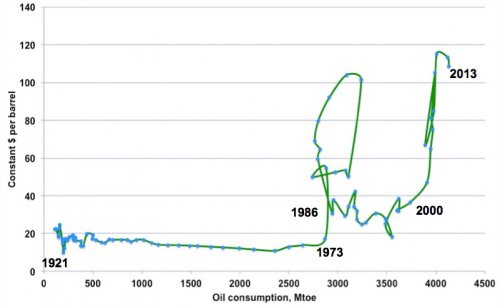
Normally people use the term "demand" to mean a curve, which is a function of price. In an efficient market (a good approximation for the oil market), the price solves for the equilibrium between supply and demand. The quote in the article, "demand will peak before supply", is meaningless. It's not wrong, it's just not saying anything.
The fact that the price has come down in the past couple of years means that either demand has shifted down (that is, keeping the price constant, people demand less) or that supply has shifted up.
On the demand side, it's unclear to me, I'd appreciate any pointers others would have. While advanced countries get more efficient with their use of energy, emerging economies are increasing their demand as more people escape poverty.
What is clear is that the supply curve has shifted up. Both because of technological improvements in the U.S. in fracking, and due to political improvements in countries like Iran, Iraq and Nigeria.