In my experience/opinion it also has to do with the artificially inflated complexity of many things in corporate world. Which leads to more people being required (which is the point of course), which leads to more communication (which does not work in favor of autistic people generally).
So now you have a three individual contributors, a line manager, a human resource people lead or whatever it's called this year and many many meetings.
True, it's a nightmare in my corporate job. Most of my work is jumping through hoops other teams have put up, in most cases not really for function but just for political purposes (it makes them important and needed).
When I see this it's pretty clear how big companies like meta can dump billion after billion into something and have nothing to show for it. Most of the work is just artificial, satisfying other teams' unnecessary requirements.
In my experience, autistic adults - if employed in their area they care about - will also care about things like ‘does it work’, ‘is it good’, ‘is it doing the right thing’.
That will get you targeted in the current corp environment pretty bad.
They also tend to compulsively tell the truth - also a bad idea in the current corp environment.
And if doing something outside of their interest, burnout is hard to avoid. Especially when you have bosses screaming at you to go go go - to do stuff that just doesn’t work.
And interestingly due to some very clever integrations[0], sending Apple Events (the underlying tech for the actual IPC communication done with AppleScript) is very easy to do in Swift. Easier than in AppleScript actually!
It’s a shame most apps do not support Apple Events anymore, though.
Im really not sure why this has to be said again and again.. it seems humans just don't learn do they?
Im waiting for someone to show me something that starts with the experience and then explains how the LLM fits in. Not the other way round.
I think because Google Search is predominantly tech-based, it is easy to see why LLMs have impacted the way we think about the experience associated with Search over large spaces of information.
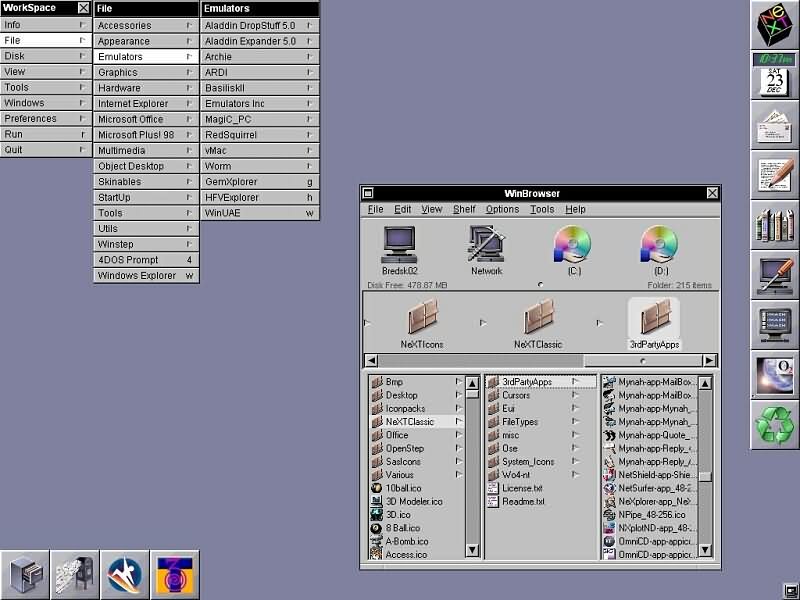
Motif was also 3D, but the actual look of Windows 95/NT 4.0 clearly took some inspiration from NeXTSTEP and OPENSTEP, for example the window decorations.
I accept that's possible - if not likely (and everyone steals from each other!) - but even-so it only amounts to to the gunmetal-grey default colours and use of a 1px bevel/inset effect; because NS and NT3/NT4's UX/UI design and concepts are just so different otherwise.
...but I'm not personally convinced: instead, consider the demonstrable fact that similar engineering teams, working on similar problems, will independently come to substantially similar solutions; my favourite example to point to is how eerily-similar the Eurofighter Typhoon, Saab Gripen, and Dassault Rafale all look - even entirely indistinguishable at an air-show in-person - despite having zero shared pedigree - therefore it's possible that - given the constraints of desktop graphics hardware of the late-1980s/early-1990s - that a user-friendly desktop UI built around the concept of floating application windows - will all be similar in one way or another.
-------
My pet-theory for why that "Windows 95 1px bevel" look is so prevalent is because it suits working with premade UI graphics rasters/bitmaps using indexed-colors: for example, imagine a Windows-style Property Sheet dialog: prior to Windows 95, software would manually draw all of the elements of that dialog directly to the framebuffer (i.e. using unbuffered graphics) which was slow - ugly - and is the cmputer-equivalent of using a lavatory in a cramped bathroom actively undergoing renovations without any drywall/plastering). Even if there was enough vram for double-buffering it's still going to be slow: painting each and every button, checkbox (with the checkmark!) and tab header. So instead, many individual UI graphics elements could be prerendered (at design-time, hopefully by an actual artist), but not as single bitmaps for the entire dialog - but as an indexed color bitmap for each control type, so no slow/expensive draw/painting is required: only a simple blitbit for each checkbox, for example. Using an indexed-color bitmap based on a 4 or 8 colors palette (face, 3D light, 3D dark, transparent/BG; etc) means a single blob only a few hundred bytes in size can represent a chisel-cut bevelled checkbox - while integrating with whatever the user's preferred color scheme is.
----
....of course now we'll just build a UI in Electron, to hell with memory usage or integrating with the user's OS appearance settings. Le sigh.
As mentioned, Windows 95 uses more or less the same window decorations as NeXTSTEP - although with different semantics. What is minimize in NeXTSTEP is maximize in Windows 95 IIRC.
> my favourite example to point to is how eerily-similar the Eurofighter Typhoon, Saab Gripen, and Dassault Rafale all look - even entirely indistinguishable at an air-show in-person - despite having zero shared pedigree
Considering that France/Dassault was initially part of the Eurofighter / European Fighter Aircraft (EFA) project, I'm not sure if that's the best example to make your point.
The first letter was the recorder used for initial recording, say a Studer A800 as an example of an analog multitrack or DASH as an example of a digital one).
The second letter was the recorder for the mixdown, i.e. usually some 2-channel system like an analog ATR-102 or Studer A80 or a digital DAT.
The third letter was the recorder for the master, which for CD by definition was always digital. In the early days usually a Sony U-matic, which funnily enough was an analog video tape format which got reused for digital audio (and is the reason for the odd 44.1 kHz sampling rate of the CD).
Edit:
The code was actually always considered a bit meaningless.
For example, you could record on a digital DASH, but mix on an analog SSL console and print the mix to a digital recorder. That would have been a DDD CD.
On the other hand, you could record on an analog A820, mix on a digital Studer desk, print the mix on an analog A80 and that would have been a AAD CD.
So, two codes indicating "pure" digital or "pure" analog, even though both processes used both technologies.
Or record on a ADAT and mix on a Yamaha 02/R, which would have been DDD but probably sounded worse than the AAD recorded on a Studer analog tape ;)
To add, what I wrote in parent is very brief and superficial. There is at least one comment here with more detail about when they can be liable, and why Dyson was liable in this case.


So now you have a three individual contributors, a line manager, a human resource people lead or whatever it's called this year and many many meetings.
reply