The agency's proposal comes more than 40 years after the agency was first tasked with evaluating triclosan and similar ingredients. Ultimately, the government agreed to publish its findings only after a legal battle with an environmental group, which accused the FDA of delaying action.
    - AngularJS http://shop.oreilly.com/product/0636920028055.do
    - Web Application Development With AngularJS http://www.packtpub.com/angularjs-web-application-development/book
I am currently reading "Web Application Development With Angular". Its a well written book geared towards who already know angular basics. That's why I suggested O'Reilly book as its introductory which explains angular core concepts.
Another book worth looking at is: Recipes with Angular.js which is covered under Leanpub Unconditional Return Guarantee. so if you don't like the book. 45 days of purchase you can get a 100% refund.
https://leanpub.com/recipes-with-angular-js
so you can try the above, if you don't like the other two
Sadly I agree that the O'Reilly book is of poor quality. Bad editing, sloppy writing style, terrible organization of the chapters. Whatever happened to O'Reilly's standards?
This may be easily countered by making the mortar round rotate faster. At list that has been the concern in the past. I guess that the laser has to heat the mortal shell so it exploded in mid ear. If the shell rotate slow it may be possible to heat a single area, but if it was to rotate fast you would need much more energy.
Such a system will probably not help Seoul much in an all-out war. According to this article [0][1] N.Korean may have as much as 13,000 artillery pieces positioned along that border, capable of delivering 10,000 rounds a minute. Any anti artillery system will be overwhelmed by thus numbers.
Not if you have 10,000 anti-artillery 100KW laser on vehicles. Let's say each one costs 1 million dollars, you would have to spend 10 billion dollars. Lets' say your operating costs are 3 billion a year (2 man crew at total cost of $100,000 each and another $100,000 for support, maintenance, and command, per unit). Over ten years the system would then cost 40 billion dollars, ($10B upfront + $3B/year x 10 years). This averages out to 4 billion a year. Per wikipedia, there are 25 million people in Seoul metropolitan area. This turns out to be $160/per person per year (or 43 cents per day per person).
You can bet the US government and the South Korean government are going to look seriously at that option.
Let's say my numbers are off by a factor of ten, and each unit costs $10M, and the support is $3M, and the total cost is $40B/year over 10 years: that's still completely worth it, at $1600 per person per year, especially if Korea pays $20B and the US pays the other $20B.
I imagine any rotational speed beyond a certain point is indistinguishable from other, higher rotational speeds in that you are basically heating the whole shell. I don't know how fast these shells rotate, but it seems like it would be hast enough that they are probably heating the whole shell anyway.
Additionally, if you are firing from close to the intended target, you may not have to deal with rotation at all.
Counter Rocket, Artillery, and Mortar (C-RAM) systems have been around for a while using guns rather than lasers - often based on CIWS from naval ships:
According to the Amazon listing, it's just 3 layers of dense foam with a cotton cover. The story is interesting but the only selling point seems to be the return policy. You can get more mattress for less money from Ikea or even Amazon itself, and I wouldn't want to sleep on 5 inches of foam at any price -- it's more a mat than a mattress, and is going to be even thinner once you put your body weight on it.
Their twin is $199, and less than half the height of a normal mattress. For $139 you can get a 5-star-rated 8" foam mattress with 4" of dense foam, 2" of soft foam and 2" of memory foam, delivered tomorrow with the same certifications and 5-year warranty. [1] For $229, you can get a 12" foam mattress, which is more like a traditional full height mattress. [2]
We recently bought one of those inexpensive spring mattresses from Ikea. Let me just say that the thing was about as comfortable as a sack of slinkies. Would not buy again. And you can't try them out in-store either as they don't have all of their mattresses on display.
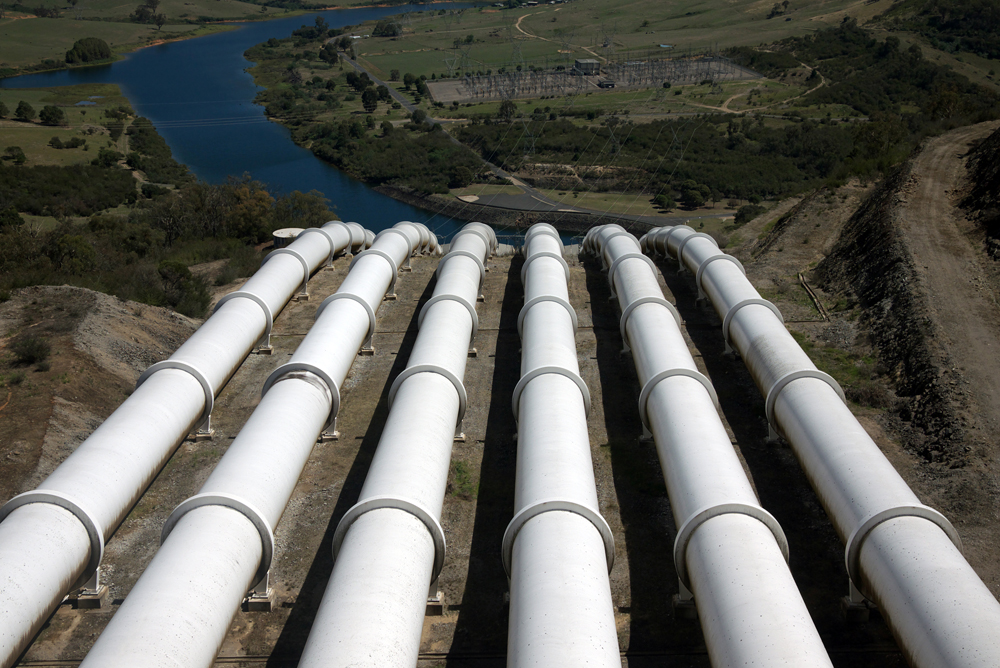
Well, 4 bar is about 133 feet of head. I'm guessing that he doesn't have a 100 foot waterfall on his property, he has a stream that loses 100 feet of elevation over some large distance.
If you put a 4 foot dam up and block the stream, you have 4 feet of water delivering pressure. If you use a pipe, you can have lots of feet of water delivering pressure (1 bar is about 33 feet of water, so this installation is at least 60 feet of water delivering pressure).
The reservoir provides an opportunity to even out the energy production (and helps with flood prevention and irrigation, two big motivators of dam building).
The other factor is that the power achieved by the station will roughly go with the volume of water and head. So if you want a lot of power you end up needing huge pipes.
Basically In hydro power to generate power you can go for a small amount of water falling a long distance or a large amount of water falling a small distance
Its a classic high head low flow pelton wheel installation.
He wouldn't need such large pipe for a penstock if he was using a pelton wheel, but he also doesn't have the head to drive a pelton efficiently - the more the better for one of those.
I've seen systems that put 2kw of energy through 2" pipe! 350+ feet of vertical head will do that.
Yeah it's basically a modification of a pelton wheel, sort of adapted for higher flow and lower pressure. Technically a turgo wheel IS a pelton wheel, but they serve sort of separate purposes.
Would it be possible for CoinBase to have some kind of FDIC like insurance? It seems like that's the biggest problems with bitcoins these days is that there's no safe place to store them.
The purpose of deposit insurance is to prevent runs on banks that make loans and don't have as much money in their vaults as the total of their customers' balances. Coinbase does not make loans. As far as I can tell, it's a service that stores your actual bitcoins for you. FDIC-style insurance isn't applicable.
Very good point. But I still think the bitcoin ecosystem is missing a foolproof way to securely store bitcoins in the way that US dollars have a bank.
Paper wallets can get lost or stolen, A lot of online wallets get hacked, and DIY encryption doesn't seem like a great way to go either, especially for grandma.
I'd happily pay a fee to coinbase in exchange for some kind of insurance against them being hacked.
Agreed. The bitcoin ecosystem will need traditional banks, credit cards, and the rest of the financial services industry. Prices that involve transfers will just be lower, and interest rates on deposits will have to factor in expected deflation once that stabilizes.
This is a many-page plot point in Kim Stanley Robinson's Mars Trilogy. Highly recommended to all interested in the colonization of Mars.
14,000 kg would be equal to 98,000 tonnes of CO2. Trivial amount of heating, esp. since atmospheric forcing is weaker on Mars since the Sun is further away.
Incidentally the Mars Trilogy is some of the best hard sci-fi out there. Absolutely not to be missed.
I reread it a year or two back, and it's standing the test of time very well, in spite of the fact that Red Mars was first published almost 21 years ago and the story begins in the 2020s.
According to the wiki article on the topic ([0], citing [1]), you could get significant terraforming of Mars with something on the order of 39 million tons of CFCs. One Falcon rocket can carry 14 tons there, so that would naively 2.8 million Falcon launches, at a current cost (@$100MM/launch) of $280 trillion. (And surprisingly little terrestrial CO2 emissions -- only about 3 billion tons).
As ealloc points out [2], this particular fluorine compound isn't very different, as a greenhouse gas, from the other CFCs these estimates are based on.
Well, the Martian atmosphere is apparently around 25 teratonnes, so I would be surprised if a warming effect from the addition of 14,000kg of any known gas at martian air pressure and temperature would be either measurable or in any sane way even calculable.
The melting point of Fluorinert is -50 C. The average temperature on Mars is, if I recall correctly, -50 to -60 C. The material would tend to precipitate out over the poles and stay there. Another source of warming would be required for it to produce any long-term effects.
It's pretty simple. I generated a bunch of public/private keypairs. I kept the private keys offline and I hand out public addresses when people add a message.
Which part is generating the keypairs? Is it bitcoin specific?
I'm curious how it's done. I'm thinking to code up something where people can have a small amount of bitcoins donated to every URL they visit. If it ever caught one if could be a way to fund content instead of ads.