I do not agree. It's not because my door does not have locks that you can feel free to enter. And vice-versa, it's not because there are locks on a door, that you don't have the right to try to enter...
While he made a successful comeback (however far from his first success), saying he toiled in misery for years is a little bit exagerated. Indeed, he was still the owner of a house (and probably of other goods). And this house was big enough to have a value probably equal to a today million dollars. That's not what I call to be toiled in misery.
Whether or not he toiled in misery is independent of how much money he had. It only depends on whether he toiled, and whether he was miserable doing so.
Most people reading this will never feel extreme hunger and have all their material needs met forever, but they will probably also go through things that to them, feel like miserable failures.
You might even be forced to leave your cushy jobs and take an annual salary that is what 50 African laborers make in year. And it will possibly take years, maybe well over a decade, to live down how bad you feel about yourself.
Zoom out from specific circumstances and it seems like human misery is fairly constant.
Whether you're scrambling around the forest looking for berries and killing things to eat with pointy sticks or working an office job living in a suburb – I don't really think your emotional experience really changes all that much.
I think your misery and delight are driven by the best and worst things in your life and it doesn't really matter all that much what your circumstances are. When things get better you find new things to be miserable about, when things get worse you stop caring about the little things and your misery is driven by the new worst thing.
I don't see standard of living really driving all that much happiness. Maybe some, but much less than I think most people expect.
Spoken like someone who can't comprehend living hand to mouth.
Happiness is definitely a hockey-stick shaped curve, going from 1M to 10M is not going to make you happier, but someone who is making $100k is going to be far far happier than someone making $20k. The difference between scrabbling to pay your bills and keep the heat on, vs actually having some savings and free money for recreation, is absolutely massive.
I’m not so certain about that actually, I’ve certainly seen people making $20k that had more free money and recreation time than some people making $100k. Especially as regards recreation time.
To be fair, making $20k was almost always a choice in those cases.
That’s not consistent with the empirical evidence in sociology research. Reported happiness does drastically change between $20k in the US and $80k specifically.
And in fact it isn’t specifically a choice. Sure you can make choices that, over a long term, will boost your income but it’s rarely a choice.
It doesn't change "drastically," only by a point or so. Knowing the way studies like this typically work, it could also be that if you are smart with your money (e.g. frugal and not chronically short on cash), you're just as happy as making someone more. I'm sure many of the 6's were in the "I'm doing okay, but man my life would be better if I weren't so broke right now" camp.
How were those people living? Are they single people in their mid 20s with no significant other or kids? Are they making enough to put some towards retirement?
I guess if you're willing to sacrifice some things it could work. You're definitely not raising a family of 3-4 in a nicer neighborhood with that amount.
I don't know how other people live, but for me, the overriding expense has always been rent. But in some places I've been, there are apartments with lower than market rent that are reserved for people with low income.
I don't think there is one correct answer to the question of how much money you have to have to live, because it's mostly about your biggest expense, imo. Everything else you can economize on to an extreme if you have to, if you're healthy and sane and frugal.
Once you start talking about a "nice" neighborhood, you're talking about a competitive zero-sum game where the costs can increase without limit.
The median annual household income worldwide is about 10k/year. 20k/year puts you in the 91st percentile globally for person income. So it's perfectly possible to live with that money, most people in the world do.
I figured we were talking mostly about US, so technically until you're a family of 3 you're not living in poverty, which seems pretty reasonable. It also probably greatly depends on where you live. Housing prices closer to major/wealthy cities are more expensive.
Having an income of 20k/year in US puts you at like 16th percentile.
I'm not exactly saying not having a family is a sacrifice, but where you want to live. The cheapest apartment I could find in my area (before kids/marriage) was about $700 and that's a few cities away in a no-so-great area where cops were getting called to our neighbors every few days. I could go closer to downtown and be in a worse area.
With kids, the cheaper areas have generally worse schools, parks, etc.
Ah, these people were living in a first world nation with functional social systems, so it wasn’t actually as hard as it might seem.
The neighborhood they were living in was generally fairly average, everything considered. But only one of them had one kid (also single parent though).
Not in a large city. But I’m fairly sure in that case the main downgrade would be the neighborhood.
A lot of people are happy in college and they're almost all living on less than $24k a year despite working over 40h a week (although schoolwork is a lot more engaging than industry IMHO).
That's because it's expected, all their friends are living in the same way, and they see this as temporary, with a larger income not that far off.
I can say I was very happy with minimal income in my university years, but would not be anymore as my friends are out of the campus and getting forward with their lives.
Yes, so it is not the lack of money that makes one unhappy (say, at ~$24k/yr and no health problems), but comparison to others and attachment to worldly things.
This is what causes people in the West who earn $35k and $350k alike to feel 'poor' despite the fact that even the former income is already in the global 99th percentile.
Yes, but I'd emphasize the "temporary" part: hope of better things in the future is important for the human psyche (for extreme case see religions, for example). Students are full of hope, someone at 24k may feel like they are at a dead end.
Happiness has the absolute strongest correlation with a strong social life and not with wealth. That's why happiness is declining in the WEIRD countries (Western, educated, industrialized, rich and democratic).
> To draw an analogy: a man's suffering is similar to the behavior of a gas. If a certain quantity of gas is pumped into an empty chamber, it will fill the chamber completely and evenly, no matter how big the chamber. Thus suffering completely fills the human soul and conscious mind, no matter whether the suffering is great or little. Therefore the "size" of human suffering is absolutely relative.
My standard counterargument to this is to look at animals. We know that treating animals better lead to happier animals. Poorly treated and well treated animals do not converge to the same happiness level.
I think there are a few key things that drive happiness. Secure food and shelter. Short commute. Nature. Being able to walk away from toxic jobs and relationships.
Transform your puppy in an spoiled human baby clothed in expensive ribbons or giving vegan food to your cat will not make it happier necessarily (not to mention the neutering clause in the small letter of the contract). Our definitions of better can difer from theirs.
I think this is also the reason why humans strive to do better. If we're never satisfied with what we have then the only solution is to do even better!
Being rich doesn't make you automatically happy, you can hear many stories about billionaires who have and have achieved everything they could possibly want being miserable – wanting things and then getting them isn't the source of happiness, being faced with this reality firsthand by running out of things to want and still feeling dissatisfied with life can be (imagined at least) really miserable and hopeless.
The line is subsistence, not being a billionaire. If you don’t have food, shelter and health care you are often very very in happy. If you have those, each additional dollar contributes a much smaller degree of happiness. The research suggest the line for diminishing returns in the US is $80k in most cities.
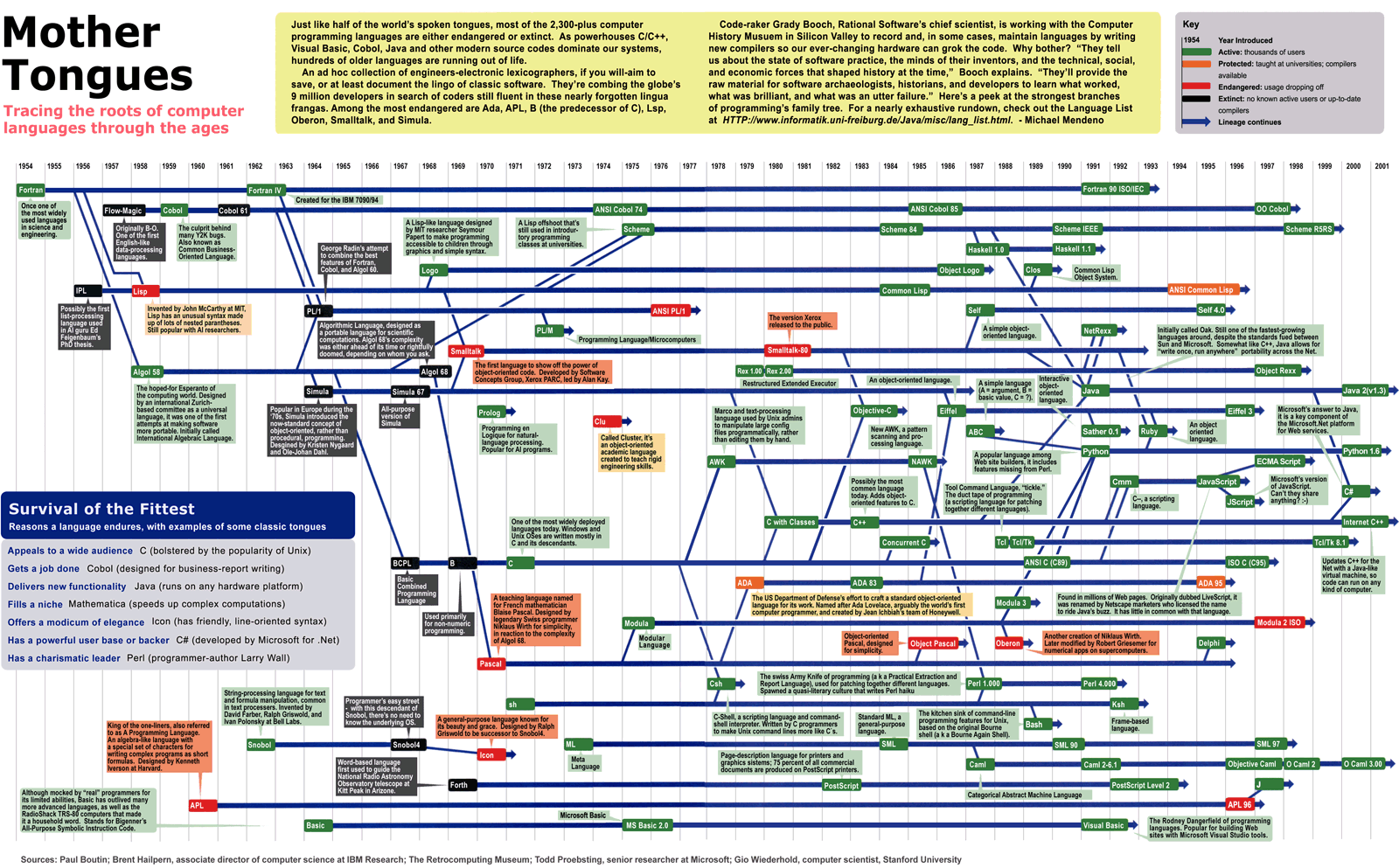
Nothing if you refer to one of the other referenced graph [1]. In this graph it's a derivative of C and C++. IMHO, regarding JS, nobody can affirm from which languages it is a derivative unless Brendan Eich himself.
By the way, such a graph does not give much information about the influences that make a language evolves. It's like saying English is a fork of German and since the split neither of these languages have been influenced by others (e.g. Lambdas have been added to Java only because one of the mainteners had a new idea one morning while taking its shower)
Back in the 90s (at least in the second half) you didn't need how to code. You just used Dreamweaver or Frontpage and you got your site! The only technical bits were to use FTP to upload it to your free hosting provider.
Here is a difference between EU countries. In France, you cannot even tip by credit card or anything else that can be controlled by the employer or the state. It's only cash and at your discretion. Thus, it cannot even be a taxable event. However you need to have some cash if you want to tip.
I think you can, you have to ask "I want to tip x euros" before the waiter puts your cc in the machine. It feels really awkward and so most don't do it
Indeed you are right, you can do it! However they need to add a line to the invoice to sell you something more (e.g. a bottle of water). And when they will report what they have sell and what they have buy there will be a difference. So for few customers it may be OK, but they can't do it every time.