Yeah! That's pretty accurate, although it's not quite css/html.
It also integrates some helpful libraries, like libuv for cpu intensive tasks and I'm currently working on adding networking/HTTP and builds for android (it already runs on a pinephone).
The thing I think that is cool is that you don't need to compile your apps, you can just run them with the binary.
The motivation came from building desktop applications and working with awesome but cumbersome GUI toolkits like Nuklear.
I built a graphics backend-agnostic GUI library in CRuby called Hokusai, but Hokusai uses FFI, isn't portable, and is hard to distribute. (Need a Ruby interpreter on the target)
I ported the library to MRuby, developed some build tools, and now have a portable binary for different platforms that can run a dynamic desktop application/game that is written in Ruby.
If you notice the paint repository, there is nothing to build, just ruby scripts and assets.
The tool also has commands to build your application for different platforms as standalone binary, but I'm currently working in that space for other reasons.
There are of course constraints to using MRuby vs CRuby, but I hope I speak to how this library addresses those.
> I mean, I can follow ops intent to a general degree, it sounds interesting, but ..
Thanks for trying to meet me halfway. I hope I can bridge the gap.
The repository is the codebase for a GUI toolkit. It runs ruby scripts that make use of a custom templating language (like html), and a super class that provides similar component technology you'd likely find in vue or react. (Hokusai::Block).
When the ruby script is run from the binary built from the codebase (hokusai-pocket), it spawns a window with your application. There are releases for x86 linux, windows, and osx - and also arm64 linux. You just write your application, and run it with `hokusai-pocket run:target=app.rb`
The hokusai-pocket binary also include a command for publishing your application as a standalone binary for different platforms, but I'm currently working on that.
So all in all, it is a gui toolkit + runner that you can download for x86 linux, windows, and osx to dynamically run desktop applications.
I think the distinction is pretty easy imo. HN is topic centered, Social Media is person-centered. Before MySpace there was a pretty big proliferation of forums and other topic centered discourse. The profile was such a minor part of those tools.
When MySpace came out, the profile was the home page for a lot of people, and the content orbited around that. Coupled with the mass movement to represent oneself faithfully online as in the real world, (maybe for banking, maybe for surveillance), I think social media sort of operates as a trap. On facebook, you are encouraged to upload your real photos of drunken night out, family vacation, or whatever IDs you in life. On LinkedIn this is mandatory, your "avatar" must mirror your physical self. I have a lot to say on this, but I think I'll just leave it at topic vs profile.
>On LinkedIn this is mandatory, your "avatar" must mirror your physical self.
Huh? On LinkedIn, the only thing that's mandatory is to have a profile that maybe looks like your resume, and that's about it. A photo helps too. Lots of people do nothing more with it than that, and use it to find jobs.
Create a false identity on LinkedIn, misrepresent your identity, create a Member profile for anyone other than yourself (a real person), or use or attempt to use another’s account (such as sharing log-in credentials or copying cookies);
> You can use an illustration, caricature, or other artistic rendering of yourself, but your profile photo must reflect your likeness. We may remove profile photos that don’t comply with our User Agreement and Professional Community Policies, including images that consist solely of the following:
I'm pretty sure even this has been updated to accommodate all the Ghibli AI avatars that people use.
This link points to a collection of artworks made from a variety of media which generally employ some kind of constraint or deterministic system in their fabrication.
If anyone is interested in this kind of thing, I'm happy to speak to any of the choices I've made as well as my emotional state in making this collection.
Capacity for intention and will were already driven by augmentations that were knowledge and reasoning. Knowledge was sourced externally and reasoning was developed from externally recorded memory of past. Even the instincts get updated by experiences and knowledge.
I'm not sure if you wrote this with AI, but could you provide examples?
Knowledge is shaped by constraints which inform intention, it doesn't "drive it."
"I want to fly, I intend to fly, I learn how to achieve this by making a plane."
not
"I have plane making knowledge therefore I want and intend to fly"
However, I totally understand that constraints often create a feedback loop where reasoning is reduced to the limitations which confine it.
My Mom has no idea that "her computer" != "windows + hp + etc", and if you were to ask her how to use a computer, she would be intellectually confined to a particular ecosystem.
I argue the same is true for capitalism/dominant culture. If you can't "see" the surface of the thing that is shaping your choices, chances are your capacity for "will" is hindered and constrained.
Going back to this.
> What's yourself without your material possessions and social connections? There is no such thing as yourself without these.
I don't think my very ability to make choices comes from owning stuff and knowing people.
I agree that you are an agent capable of having an intention, but that capability needs inputs from outside. Your knowledge and reasoning doesn't entirely reside inside you. Having ability of intention is like a car engine, waiting for inputs or triggers for action.
And no, I don't need AI for this level of inquiry.
We shape the world through our choices, generally under the umbrella of deterministic systems. AI is non-deterministic, but instead amplifies the concerns by a few wealthy corporations / individuals.
So is AI effective at generating marketing material or propagating arguably vapid value systems in the face of ecological, cultural, and economic crisis? I'd argue yes. But effective also depends on an intention, and that's not my intention, so it's not as effective for me.
I think we need more "manual" choice, and more agency.
This is a great question that I don't yet have an answer for.
Ideally, there should be an automated way builtin to the gem that packages apps.
Currently, I use a tool I wrote called Barista to package an an application with it's dependencies, (part of it was modeled after chef/omnibus). This might not be the best way though, so I'm open to ideas.


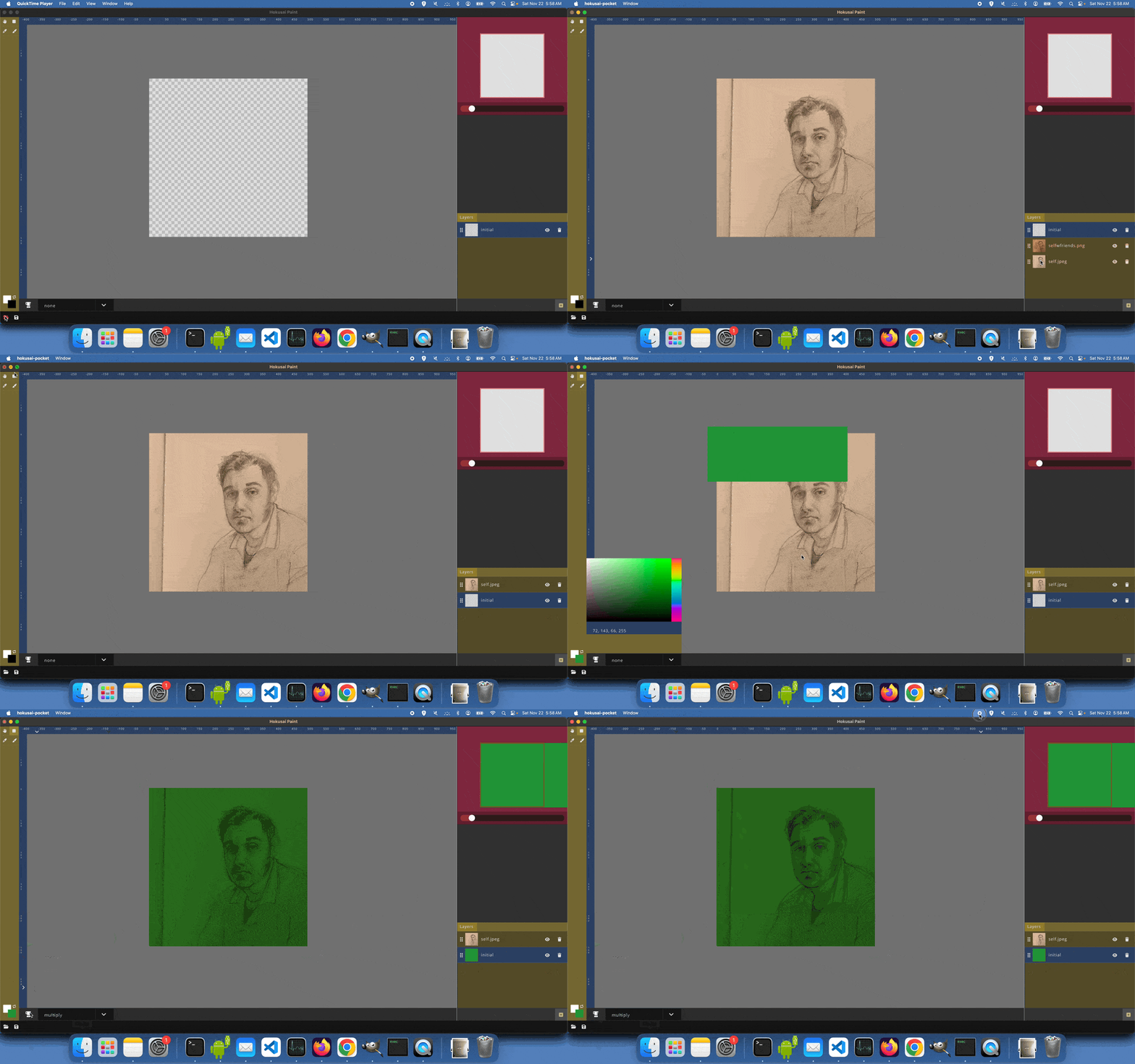
It also integrates some helpful libraries, like libuv for cpu intensive tasks and I'm currently working on adding networking/HTTP and builds for android (it already runs on a pinephone).
The thing I think that is cool is that you don't need to compile your apps, you can just run them with the binary.
reply