It seems that the first quote is still in the middle of the industrial revolution.
That is a period were human activity has been dramatically changed in a way that has not happened before. I remember reading that the 40 hours is only good compared to that period, we have always worked less than that earlier in history (1). The changes in that period were so dramatic that we even forgot how we slept before it.
Seems that both the article and xkcd make the mistake of comparing the same period in history which is also only a very short 200 year period to lightly suggest that things never change. Well, that's like observing that soccer fan are as anxious about the score 30 min in the match than they were after 15 min. It gives some idea of how the match is going, but not really anything concrete.
Not saying it is not interesting or informative, but there is limited wisdom to extract from it.
"we have always worked less than that earlier in history (1)."
I'm not so sure about that.
Most people lived on farms, and if you know about farms, you know it's almost 12 hours, 7 days a week. Or rather, it's an 'all consuming' type of business.
That said, this is North American farming wherein farmers owned their land.
"Two things have always been true about human beings. One, the world is always getting better. Two, the people living at that time think it`s getting worse."
- Penn Jillette
Of course, the full context of the statement transforms this from a head nodder into a well reasoned argument:
"It's because you get older, your responsibilities are different. Now I'm taking care of children instead of being a child. It makes the world look scarier. That happens to everyone."
The children now love luxury; they have bad manners, contempt for authority; they show disrespect for elders and love chatter in place of exercise. Children are now tyrants, not the servants of their households. They no longer rise when elders enter the room. They contradict their parents, chatter before company, gobble up dainties at the table, cross their legs, and tyrannize their teachers.
I'm not sure that actually matters in the current conversation. The quote, even from a satirical play, demonstrates that this was a common enough sentiment in ancient Greece to be worth lampooning. That's nearly as relevant as if Socrates had in fact uttered the quote in earnest.
One of the things that people ought to consider before trotting out that quote is that Athens fell. Socrates' culture is now long dead. The broad stroke of history may be upwards in many ways, but societies can and have fallen apart. Most of the other cultures you may trot similar quotes out from have also effectively fallen, even if they were not destroyed; Victorian England, for instance, does not rule the world anymore. Rome fell after a protracted period in which it was obvious it was becoming weaker. It doesn't take all that much imagination to look about and conclude that we're in the process of "becoming weaker" too.
I don't think this quote proves what people think it does.
I'm not sure it's right to conflate arguments about the possibility of new technology having other-than-positive effects with arguments about the moral decay of society.
I'd argue it's plainly obvious that the end results of technological innovation are unpredictable (how many of us here make novel use of tech to earn our livings every day? who conceived of all this when computers were first imagined?) and that it's plainly obvious that some technological innovation has not been to the greater benefit of man (e.g., the industrialization of war and genocide over the last century)--none of that has much to do with children misbehaving or society losing manners.
> Otherwise we are postulating or at least heavily implying that conservatism is always wrong.
This point isn't that all of conservatism is always wrong, but that that romantic nostalgia aspect of it mostly is. Of course, conservatives hardly have a monopoly on romantic nostalgia.
I see this in context of automation system with feedback loop.
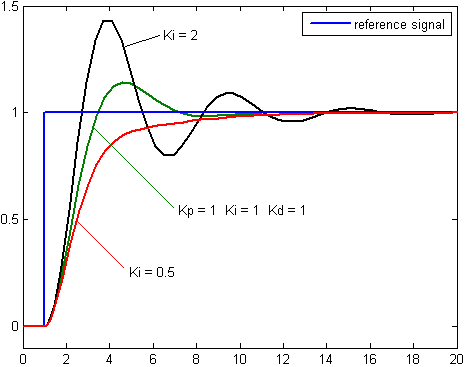
Look here: https://upload.wikimedia.org/wikipedia/commons/c/c0/Change_w...
This are responses of different PID controllers to the change of target value. You can notice that controller can overshoot target value to get near target value faster. I see conservatives working for one side of this graph and liberals for the other. You probably just need both.
I've often observed the same thing with a different machine. It's a great metaphor for many things.
There is something about cybernetics and control theory, that, if applied to governance would be of enormous value, but I've never seen a real world application. I wonder if we'll get to see such a thing in our lifetimes.
In the cyberpunk Pyscho-Pass there exists a nice fictional account of such a system.
> You probably just need both.
Yes, today. My complaint is that this is a very crude algorithm! There has got to be a better way that represents people's true interests. My own hypothesis is that in the year 20XX there will exist a <country> with a combination of intelligence agency with a vastly expanded remit and a computer system which produces most central governance.
Did you believe/think/feel X today? Your inputs have been factored and there are Y resolution proposals! The resolution you have chosen shall be weighted against counterproposals and if selected shall be converted into contracts for activities that a new arm of the State shall spring into existence to deal with. Government functions can scale backwards and forwards in an orderly and consistent fashion with the desires/knowledge of the citizenry.
I think it can only work by illustrating trade-offs in order to keep stakeholders in the loop. As long as the system is comprehensible it should work. Pray we never fork.
We should try experiments like these on a Seastead first before we kill everybody.
Yes I have. I don't know much about it though. In my imagination I see crates of Cybersyn machines being shuttled away for good measure like the Ark of the Covenant into that warehouse. I can see them thinking, "ah, let's revisit this in, say, a century or two".
It is high time these kinds of projects were revisited, not as an attempt to provide a new economic system per se as some envisioned in the past, but to change central government.
As you probably already know many governments in the West are approaching half of the real economy. Things are starting to get weird, which is normal when the territory has evolved beyond the map. I think there shall be a phase change sooner rather than later in how government is managed. I mean a deep structural change in how administration works and not an ideological one.
The question is not so much how and why, since there are lots of productive lines of inquiry and the value proposition is endless, but what must be done to accomplish political decision making moving from a network of men to one partly/wholly composed of machines making autonomous decisions?
My guess is that governance does not require an AGI. It is already a slow moving narrow AI that lives partly in the legal realm and partly in the human realm. I suspect the technology to do this existed decades ago and the real reason the idea has not been developed is inertia. That and it's slightly scary. It is like fiddling with the boot sector! Better recreate a backup...
We could lose things of value all the time, but losing things of value isn't always bad. Plus we are gaining things of value all the time as well. Seems we are generally on the winning side of things given how well humans have done.
It makes perfect sense if you replace "liberal" with "neophilic" or something like that. Looks like a bad choice of words, I don't think it is aligned with the meaning of "liberal" and "conservative" on US politics, but I'm not from there, so I'm not sure.
I've edited my post to remove the mention of political orientations (and if you edit your post, they will disappear).
I believe some political discussion is on topic should the political circumstances be particularly novel e.g. Brexit, but not the everyday fighting that goes on all the time I agree.