> Yeltsin, then 58, "roamed the aisles of Randall's nodding his head in amazement," wrote Asin. He told his fellow Russians in his entourage that if their people, who often must wait in line for most goods, saw the conditions of U.S. supermarkets, "there would be a revolution."
It's awe-inspiring to imagine that not too long ago the societal order of multiple countries depended on their millions of residents being ignorant of such a simple fact. What really gets my mind going is the next thought: what are some simple facts that would cause revolutions nowadays if made widely known?
What I found crazy about this is that the leader of such a large country had no clue how western countries operate. The Soviets and their allies had plenty of spies in the West and yet their senior leadership didn't even understand the basics of everyday life for the citizens of the countries they were prepared to launch nuclear missiles at. The west was likewise ignorant of much of the details of life behind the Iron Curtain though that's a bit more understandable given the secretive nature of the Soviets.
What struck me is that we don't know if the Soviets are being accurately quoted in this article. They could write a lot of exaggerations and not be called on them.
You assume that I hadn't seen the video before writing that.
Look at the quotes. They are over the top. You don't think it's possible that a 1989 reporter could have taken some liberties and not been called on it?
It was 1989, Yeltsin was not a president of Russia. At the time he was a regional Communist Party leader just elected to the (kind of a) parliament of Russian Soviet Federative Socialistic Republic - RSFSR, then still a member of USSR. He would be elected a President of RSFSR in 1990, and in 1991, after dissolution of USSR, Russia became an independent country. Unless one was a diplomat or KGB or shown a special interest in learning the way of life in "the West", there was not too much exposure even for people at his level.
From some family experiences, whatever intelligence services reported to Party bosses, if it did not agree with the Party dogma, it would be ignored.
Besides, they lived much better than the average Soviet citizen (degree of inequality was far greater than that between a ghetto dweller and Zuck), and that's what they wanted to preserve.
That's because it is genuine. Take it from a Canadian who has had to wait many months multiple times for MRIs. Right now I have a tear in my hip joint that needs an MRI, been waiting since November, still nothing. Meanwhile I'm yelping in pain when I try to stand up from sitting down.
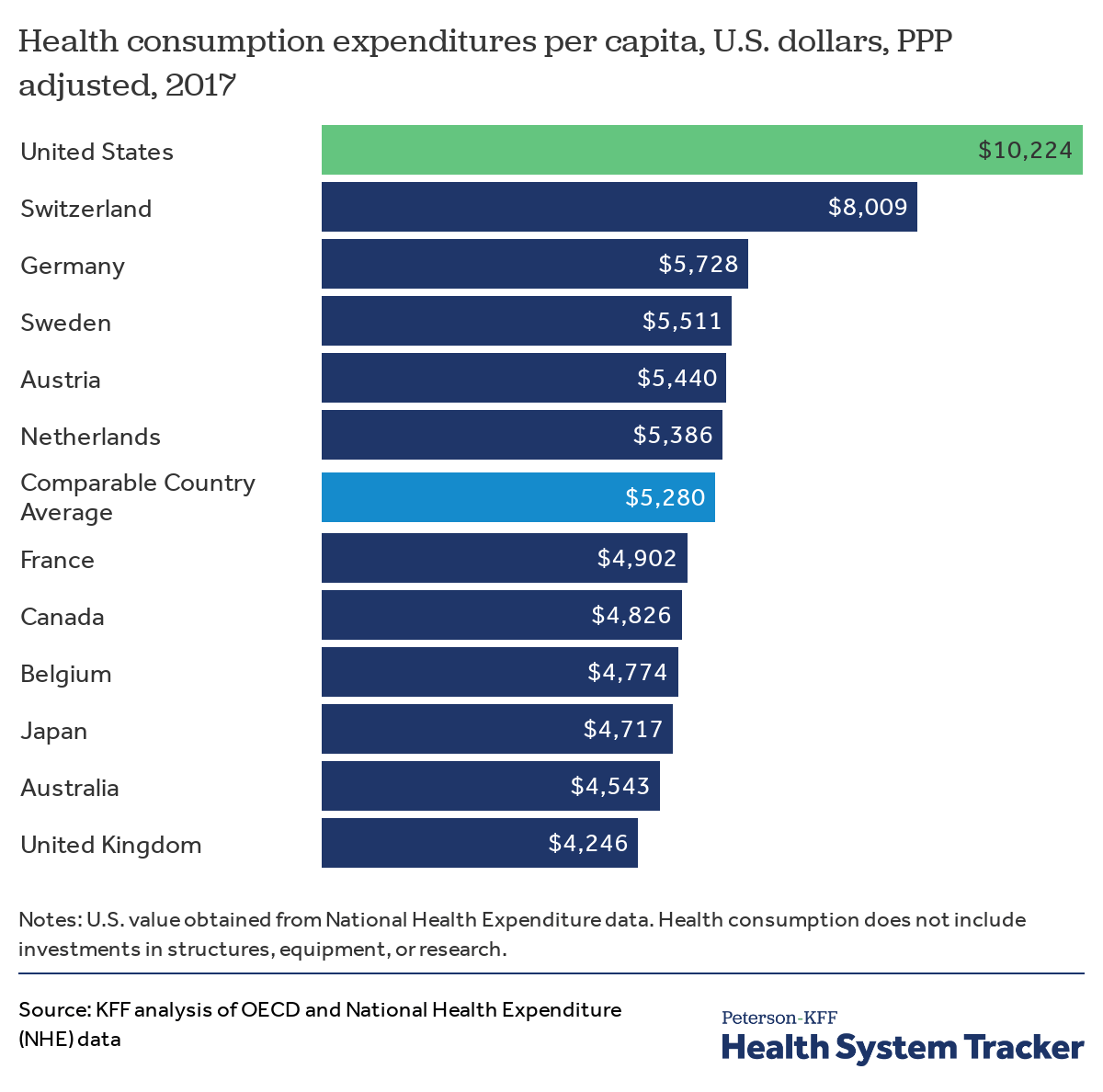
Both times I needed an MRI in Japan I got it within hours of being referred to a major hospital. My out of pocket costs were ¥10,000 ($120 CAD). Japanese spend a bit less per capita on healthcare than Canada:
When will people understand the what works for one country won't magically work in another country with a vastly different economy, population, geography, and a million other things?
I mean, even ignoring advanced reasons and thinking about this logically, do you really think healthcare for a country with 348 people per square kilometer scales to a country with 4 people per square mile?
Yes, considering that per capita Canada has more money than Japan and spends more on healthcare? I think total population density is misleading when Canada’s population is very concentrated in a few cities.
I accept that Japan has the most MRI machines per capita in the entire world, but the question is why is that? It could be economy of scale, but that doesn’t explain why Japan is such an outlier globally
You think spending 2% more will result in comparable healthcare to a country with 870% higher population density?
> I think total population density is misleading when Canada’s population is very concentrated in a few cities.
Ah yes of course, because you can just abandon those who don't live in the few cities.
-
It's almost like this is a complex issue you can't simplify by examining one dimension at a time, but even if for a second you smoke test this idea by singling out population density, it's absurd to expect similar outcomes.
That's incredible. Which province are you from? I know that over the 6 years I spent in Alberta (I'm from BC), I was always shaking my head at how much worse their healthcare was than it was back home in BC. It really is a crying shame how the stark difference is between provinces and the quality of care provided.
These situations are rare despite what the occasional outrage-inducing news story would have you believe. Here in Ontario for example, the average wait time for urgent patients is 1 day, for high-priority (target 10 days) it's 15 days, and for low priority (target 28 days) it was 58 days. Detailed, up-to-date stats for this are available at https://www.hqontario.ca/System-Performance/Wait-Times-for-D...
As bad as it is in the US, I can get seen the same day or next day.
I had a thrombosed hemroid, I called and got an apointment the next day with a specialist. He confirmed my diagnosis and I got surgery to drain and remove it the following day. Only cost me less than 200 dollars after insurance.
I had a bump on my testicle. I was concerned about cancer, so I see my regular doctor. $20 copay and he said it was just a blood something. I wanted to be sure, so he refered me and I got an ultrasound the same day at another facility. That only cost me a $100-something dollars after insurance. (It wasn't cancer.)
Thrombosed hemroid where 95% of people treat it by soaking it in water daily? Probably low-priority, 58 days. Waiting 58 days for an ultrasound to see if you have cancer?
Yeah, I'll keep the coverage/insurance that I have. I still understand the vast majority doesn't have it as good as I do and we still need to fix the system. I think we can bring people's standards up to what I experience, not down to what Canada experiences.
I don't know about Canada but in most countries with socialized health care you can always opt in for private care, on a case by case basis, at very reasonable prices (since private care has to compete with public care).
Canada is one of the few (the only?) countries where it is specifically illegal to offer privately a service that is covered by public insurance. For the most part, there is no option to opt in for private care as an alternative.
>The most visible manifestation of Canada’s failing health care system are wait times for health care services. In 2013, Canadians, on average, faced a four and a half month wait for medically necessary treatment after referral by a general practitioner. This wait time is almost twice as long as it was in 1993 when national wait times were first measured.
I think it depends on the area. I have Kaiser now, in the Silicon Valley, and I've never waited more than a day for a specialist. Oftentimes I can even go in the same visit as my GP after he refers me.
I think it's the same in Canada. In some areas there are no waits and in other areas there are long waits. I think they need to look at percentiles to get a more accurate measure.
This says that, Going by referral to consultation (not treatment, that takes another 10 weeks), the shortest waits for specialist consultations are 6.7 weeks in Ontario and longest are in New Brunswick (26.6 weeks)
Including treatment times, the variation is 15.4 weeks to 41.7 weeks.
Just as an FYI, the Fraser institute is one of those organizations where you know the conclusion of their report just by seeing the subject in the title. I would be gobsmacked if I read an article by them that had anything positive to say about Canadian healthcare.
First, understand that there isn't really a Canadian federal health care system. The Canadian government (federal) transfers funds to the provinces, which operate health plans for provincial residents. The provincial health plans control the number of available specialists. A health care provider can only bill the provincial plan if they have a billing number, and the provincial plans manage billing numbers to limit/encourage specialists and to make sure doctors provide services in less populous areas. I don't know if it's still the case, but historically there was no private alternative available (so doctors couldn't operate a private practice that didn't need a billing number from the provincial plan). If provinces chose to allow private practices, the federal government threatened to withhold funds from the plan.
As with most western democracies, Canadian doctors are well compensated in comparison to the rest of society. But it is generally understood that they can make more money in the US if they qualify for immigration (and many can because of rules allowing people with specialist skills to get immigrant visas). This also contributes to reduced supply of specialists, and longer waiting times.
To get to see one of the available specialists in Canada, you have to have a referral from a primary care provider. Here in the US (in my experience) a referral is as simple as saying to your GP, "I want to see a cardiologist." Then your GP says "Oh, sure, this one's very good. I'll refer you." In Canada, your GP has to follow plan guidelines for referrals, and confirm that it is warranted. Then you get on the waiting list for the specialist. You'll wait for a consultation. At the consultation the specialist will determine whether or not you need treatment, and the urgency. Then you go on the waiting list for treatment.
Of course, Canadians with the financial resources are free to travel to other countries to obtain medical treatment more quickly. The provincial medical plans do not pay for treatments obtained outside of Canada. Medical "tourism" is not that unusual, including travel to the US and other countries.
Where are you? A friend of our’s has some heart issues. It was probably a couple of weeks between when his doctor in Iowa referred him and when specialists in Minnesota were seeing him.
Maybe that’s another reason folks in the different sides are basically talking past each other. If you’re not in a major urban area, seeing a doctor is very fast in the US. When I lived in DC it could take a month or more to get a routine pediatrician’s appointment (something like a physical for school enrollment). In exurban Maryland I can often get them the next day, rarely more than a few days.
The reason people are talking past each other is because they’re basing their opinions on personal experience and anecdotes. If you look at the data we pay more for worse outcomes.
We pay a lot more for worse outcome in education too, don't we (and from what I heard, in infrastructure also), so by what reason can we believe that Healthcare would be totally different?
>This wait time is almost twice as long as it was in 1993 when national wait times were first measured.
Why? Are there more sick people? Are there fewer doctors and resourced? I've seen many articles covering the issue, but nothing that provides a concrete explanation for why a system used to work but doesn't anymore.
Yes, mainly due to an ageing population and partly due to obesity. An increasingly old and obese population needs more healthcare and is more complicated and expensive to treat.
I don't think this is quite true. And if I were to accept it as a hypothetical, what you are saying is that if too many people need to see a specialist, many of them should outright not be able to because they do not have enough resources. Which is ethically horrific.
No I'm saying the supply is artificially constrained by the price of "free" so there is less incentive to go into medicine, hence shortages at the price demanded.
No, but they aren't compensated nearly as well due to the market prices being "set" lower than what they can command in another market. i.e. practicing medicine in the U.S. commands a higher wage than in Canada so doctors leave the Canadian system after completing their residency. Hence, the shortage of supply caused by a market distorted by socialism.
In the capitalist paradise of the United States, as I sit here, covered by top-of-the-line health insurance...
My wife needed 3 months to schedule a sleep doctor appointment, 3 months to schedule a minimally-invasive surgery (That manages to bill her, and the insurer wrong), and every time she needs a re-fill of her prescriptions, it's a complete fucking crap-shoot of whether or not:
1. The manufacturer managed to produce enough pills to fill its orders.
2. The pharmacy bothers to call her, to notify that the prescriptions are in.
3. That the prescriptions are actually in, and that she didn't waste her time walking to the grocery store.
Meanwhile, on my side of things, I end up watching my insurance get billed $750 for 5 minutes of a doctor's (And 15 minutes of his assistant's) time. This is truly the most humanitarian, efficient, and accountable medical system on the face of the planet.
> Canadians, on average, faced a four and a half month wait for medically necessary treatment after referral by a general practitioner.
'Medically necessary' is an irrelevant qualifier. All treatment is medically necessary, if it weren't, the GP wouldn't prescribe it, and Canada wouldn't pay for it.
The term you're looking for is 'Non-life-threatening'.
That has been my experience. I've walked into an ER twice with heart palpitations. The first time I had an EKG, chest x-ray, and specialist consult and was in and out within 45 minutes. The second time was more serious and I was admitted, treated, seen by a cardiologist, and sent to a cardiac ward for overnight monitoring without being taken off the gurney. I know people who have walked in to their GP to investigate a lump in their breast and been under the knife a week later. They don't mess around with serious time-sensitive stuff.
But I have heard that the wait time for old people who need hip or knee replacements is quite excessive.
> 'Medically necessary' is an irrelevant qualifier. All treatment is medically necessary, if it weren't, the GP wouldn't prescribe it, and Canada wouldn't pay for it.
This is nowhere close to being true. Patients frequently demand treatment that the doctor, left to his own devices, wouldn't give.
My least favorite example of this comes from China, where people will go to the hospital to get intravenous saline solution for a common cold, but it's ubiquitous everywhere including the US.
From the point of view of the Canadian healthcare system, they can't tell that apart from actually necessary care. If a doctor prescribed it, and it's a covered procedure, it is considered necessary, and a hospital will do it.
Hence, medical care is either life threatening (which will get you seen ASAP), medically necessary (which may take some time to get to, depending on the procedure), or medically unnecessary (which is not covered by the healthcare system, and your wait time will be until the heat death of the universe.)
There is no 'a doctor said that we should do this, but we think he's full of shit, so we are scheduling you X months in the future' tier of medical care in Canada. You either need it now, need it, or don't.
If the hospitals can't tell the difference between necessary and unnecessary care apart, then the study authors sure as shit can't. That's why the quantifier of 'necessary medical procedure' is a weasel word. If the procedure is covered, it is by definition, necessary.
The average wait to see a specialist across the US is closer to 24 days, the longest it's ever been - the average in Canada is 21 weeks, also the longest recorded.
since you seem to have the data handy, could you check what's the average number of people filing for bankruptcy for medical reasons in Canada vs. the US per year?
It's true. I needed to get an MRI in Canada. The doctor said it wasn't necessary and even if I was put on the queue, it would be 9 months. I asked to see a neurologist. The wait? At least 6 months, absolute minimum.
I moved to the US. When the doctor told me the wait would be a couple weeks and to call back if I was having issues, I laughed. I was amazed. And the MRI was absolutely necessary.
You don't need coverage for MRI, as Canadian there is whole industry near border dedicated to servicing Canadian on wait lists. You drive over border, get MRI done(tomorrow), then get a dvd with results. Done. Cost is less then a $1000cdn vs waiting for 3 month
Same for some kinds of surgeries. Friend was bounced around in TO for a year he needed some knee reconstruction. He could walk but nothing else but it was not a priority.. So drove over border, had consultation, drove week later and had it done. I am not sure what it cost, but he is not rich, typical sysadmin job
Poor people with free healthcare in the US can get MRIs and CT scans almost on command. All you need to do is have a normal reason and go see a physician. Your wait time will be less than two weeks typically.
How do I know? I grew up exclusively utilizing free healthcare for the poor. I never had any other kind until I was an adult. I still know a lot of poor people from where I grew up that rely on programs like Medicaid. They have no problem expeditiously accessing normal things like MRIs and CTs.
Here in the UK, I have to wait about three weeks for a GP appointment. The NHS target for routine appointments with a specialist is 18 weeks, but that target is habitually missed. Routine surgeries are frequently postponed due to a lack of capacity. Many treatments are unavailable due to a lack of funding.
We do spend less than half as much on healthcare per capita than the US and we have better health outcomes by most measures, but it's very much a no-frills system.
It's a tricky issue, the NHS is probably understaffed and underfunded but also extremely expensive already. Massively gutted isn't really true: Spending ( % GDP) has decreased but levels are still at record absolute spending
Nurses are to the UK what Soldiers are to the US, any criticism of the NHS is effectively shot down as Capitalist propaganda. There are some serious questions to be asked about the NHS, which arguably cannot be answered (Even if the result is staying with the status quo) due to an extremely sceptical and anti-capitalist left wing.
In Alabama and Georgia I've never waited more than a week to see an ENT and sometimes have even gotten a same day appointment. These things seem to vary quite a bit by region.
I’ll believe in socialized medicine in the US when they fix Indian Health Service. Until that day, if the politicians cannot come up with a decent system for a small part of the population then they cannot for everyone.
Heck, it only took three operations to fix a botched root canal, and I considered myself lucky.
But we actually do as long is it's not a life treatning disease.
As an example, I am now waiting 2 months to see my family doctor (I just need prescriptions for simple anti histamines, since it's cheaper that way), and 3 years to see a dermatologist for a routine check.
On the other side, a member of my family unfortunately was diagnosed cancer about 3 weeks ago, and she had several medical appointments every week since then.
I had a super weird one. I worked for a startup with a British CTO who was very Republican and would constantly rail against poor people and talk about how the NHS killed people and made them wait months.
I was like, wait, you lived there, experienced the opposite of what you're saying and STILL manage to make up lies to make it sound bad? WHAT ARE YOU DOING?!?!?!
> what are some simple facts that would cause revolutions nowadays if made widely known
One example I would suggest is how incredibly simplified (very often to the point of being objectively not true) the various hot button topics of the world are described in the media (official and social), if they are reported on at all.
One of the main reasons "fake" news is so successful is that it's so easy to find untruths to exploit in the official or status quo descriptions of reality.
This. The level of discourse in mainstream news is gobsmacking in its simplicity. This recent "capitalism v socialism" debate revolves around a limited set of widely accepted aphorisms, happily tossed back and forth like handfuls of sand on a playground. No one bothers to disaggregate these words, examine their premises, or fit together different components to see what shakes out. Or, god forbid, ask whether they are even useful abstractions.
That's true, but I don't think any other state of affairs is possible. Compare this selection from SPQR:
> The first word of the second book of Livy's History, which begins the story of Rome after the monarchy, is 'free'; and the words 'free' and 'freedom' are together repeated eight times in the first few lines alone. The idea that the Republic was founded on libertas rings loudly throughout Roman literature, and it has echoed through radical movements in later centuries, in Europe and America. It is no coincidence that the slogan of the French Revolution -- Liberté, égalité, fraternité -- puts 'liberty' in pride of place; nor that George Washington spoke of restoring 'the sacred fire of liberty' to the West; nor that the drafters of the United States Constitution defended it under the pseudonym of 'Publius', taken from the name of Publius Valerius Publicola, another of the earliest consuls of the Republic. But how was Roman liberty to be defined?
> That was a controversial question in Roman political culture for the next 800 years, through the Republic and into the one-man rule of the Roman Empire, when political debate often turned on how far libertas could ever be compatible with autocracy. Whose liberty was at stake? How was it most effectively defended? How could conflicting versions of the freedom of the Roman citizen be resolved? All, or most, Romans would have counted themselves as upholders of libertas, just as today most of us uphold 'democracy'. But there were repeated and intense conflicts over what that meant.
> That's true, but I don't think any other state of affairs is possible.
As a proof of this, you point out one of many ways that words can be used to muddy the waters. I would argue a "different state of affairs" (an improvement at least) could be achieved via a concerted effort by multiple influential people or organizations to point out that contrary to the simplistic perspectives and "facts" we're fed by the media, the world is actually extremely complex and we usually only have an approximate idea of what's really going on.
I'd argue that we have the opposite problem today - there are too many simple facts unacknowledged, too many truths unspoken, too much information, so much that our reaction is to shut down and look for simplicity and easy answers where there are none. To quote Nietzsche (albeit from a different context):
You trip over truths. You even crush some to death, there are too many of them.
Yes, but I mean income. Real Estate is pretty conspicuous by its nature.
The fact that this is so down voted supports my premise that this makes people uncomfortable. I don't have an agenda, I just think this is something people try very hard to hide.
Yeltsin by that time hadn't bought any groceries for close to 30 years as was (and still is) common for the ruling elite in Russia. He probably didn't even fully understand the extent of the scarcity his people were experiencing while he was letting his oligarch friends pillage and burn the remains of the USSR. This is kind of like when Ellen DeGeneres asked Bill Gates how much a banana costs, and his guess was $10.
So the extent of Yeltsin being "amazed" is likely vastly exaggerated here. He was a charismatic hick from the boonies, and being treated as a semi-equal by his peers in the US went to his head quite quickly and hard. He was eager to please. But no one in the West was ever confused about what he was.
That was a scene from the fictional TV show Arrested Development.
> Lucille: Don’t you judge me. You’re the selfish one. You’re the one who charged his own brother for a Bluth frozen banana. I mean, it’s one banana, Michael. What could it cost, ten dollars?
I take umbrage to his guesses being reasonable. It's obvious Gates has no idea the cost of things. He isn't even in the right ballpark on most of them, with the floss being the only thing he got. It's pretty sad in my opinion
> what are some simple facts that would cause revolutions nowadays if made widely known?
I don't know about revolution, but most Americans tend to be pretty shocked about the rapid development of China. Even those who have some understanding get surprised seeing it for themselves.
I offer you a contra thought. We have unparalleled access to information, we have Wikipedia, free online courses, video documentaries, books, you name it. Yet 1/10 people believe the earth is flat, 1/5 does not understand that homeopathy is a fraud, 1/3 believes different races have different levels of intelligence, 1/2 believe in some religion, 3/4 are proud to be born in the given nation and 4/5 never heard of the law of comparative advantages (aka why import taxes hurt economy).
My point is society has already gained all value that can be extracted from free knowledge and information. What we see today is the base level of human dumbness.
> My point is society has already gained all value that can be extracted from free knowledge and information.
This doesn't really follow. Just because the information is available doesn't necessarily mean society will instantly absorb it or trust it.
Right now we're in the early stages of the information boom, where there's a lot of information floating around, but it's difficult to validate that information and determine whether or not it's accurate. Hopefully in the coming decades we as a society will figure out better means of such validation and start to actually address the problems around "fake news" and other sources of misinformation.


It's awe-inspiring to imagine that not too long ago the societal order of multiple countries depended on their millions of residents being ignorant of such a simple fact. What really gets my mind going is the next thought: what are some simple facts that would cause revolutions nowadays if made widely known?