Yes, you can compare. There are differences - there are always differences - but there are also similarities. Any reasonably smart person can pick out some signal from the noise, if they just try. Meanwhile, those who do not learn the lessons of history, etc. And contrarians (using the polite term) are gonna do their thing too, no matter how injurious, because its fun for them.
The basics are the same. If it spreads (R0 > 1) and the number of sick people in the hospitals grow beyond some limit you will have a lot of problems. No fancy high-tech thing is going to help if it isn't a rapidly deployable cure.
Plus, on top of all that tech the good old politics seems the same. Many countries botched testing, too little too late. So great we had its RNA code online in a matter of days, and even had success stories here and there if some dickheads can't mange the coordinated response.
I think that's a little overblown. It's true in the strict sense that general purpose manufacturing capacity was more common and the production of many goods was more distributed, but on the other hand that manufacturing capacity would have been very limited in capacity and scalability. I'm not convinced it would actually make a big difference in practice.
Actually I was thinking more about scale than about absolute impossibility: simple things like emergency hospital beds and the like, a modern city could still make them at artisanal scale, but not in volume like they could back then. All those amazing efficiency gains we have from flatpacks, automation and specialisation come at the cost of reduced flexibility.
There is still plenty of ability though. I have a table saw in my garage, If I'm needed to stop my computer job I can make a couple jigs and turn out bed rails, someone else in my town can turn out legs, (repeat for a lot of other parts), then the whole kit gets sent to other people with just a screwdriver.
Not for long. You could probably sustain that for a 3-5 weeks. I live in an area of upstate NY where this would be possible in 1918.
Today, no sawmills, no regional tool and supply manufacturers, no regional raw materials. Iron ore from the lake Champlain area could be smelted in the Albany area and made into nails in many places.
Today, you’re 100% dependent on diesel and open roads to Newark, the I-81 corridor and rail traffic from the west for food. 75% of the regional produce producers of gone. Most (50-70%) of whatever is left of dairy production will be driven into bankruptcy this year.
There is plenty of transport, and plenty of diesel fuel. Thus my city doesn't need to be self sufficient. I'd expect my beds to be exported to other nearby cities, while they work on making ventilator parts.
I'm not sure if it is needed though: there is probably more than enough lumber in the local lumber yards currently intended for local construction projects but when nobody is building/remodeling...
Actually I live in a manufacturing city so I'd expect we would be making ventilator parts, since I don't have machining experience I'd be repurposed to packing the parts into boxes. Any city has enough tablesaws to build beds, not every city has as many people who know how to run a lathe as mine.
There is implied failure of services in Spookies response. Already here in vegas, my step dad works at a bread factory as supervisor, they are seeing an increase of demand. He's had to go in several times late at night to relieve someone who was on a longer shift. He says if they lose one person they will start falling behind.
The short term consumables or raw resources are the ones that matter the most. If people stop going to work to make bread or toilet paper or refine oil it's going to put a strain on a lot of things. The oil and chemical industries are really going to be important for producing medical items like gloves, sanitizer, cleaning agents, plastic ventilators, sanitary plastic containers for equipment and needles, etc. Not to mention the effects of lower oil production and the strain and cost on shipping those things back and forth to their respective factories.
But it will have to be pretty bad before we have to worry about that I think.
A lot of that can be attributed to the bullwhip effect. It is the effect that even small demand fluctuations down stream, e.g. consumers, in a supply chain can have on parties, and availability, up stream, e.g. manufacturers, suppliers, whole sellers and so on.
One of the reasons why panic, and the resulting changes in consumer demand for certain products, is so dangerous. Not because stores are running out of toilet paper, but because of the mid term effects this has on availability of all kinds of things. This effect is impossible to predict upfront.
So, yet another reason to stay calm and avoid this kind of stress on supply chains providing goods of daily need.
This is, in my opinion, a common misconception about modern day supply chains. JIT is mostly used for the last delivery step, component deliveries for automotive final assembly lines are the best example for this. And even there is a certain buffer, a well planned and monitored one.
All other steps involve buffer stocks and inventories. This inventory is sitting local warehouses for example. Or just dead weight in the various locations. More often than not, this is due to inefficiencies.
That beingsaid, JIT is simply to hard to implement to use it for anything else then the most important parts. and even there only for the very last step, everything else smply has to many variables for JIT to work.
The best example are automotive supply chains that kept running all the time through February.
And stuff like groceries are not run JIT, with the exception of the replenishment of shelves and local stores from a regional warehouse. And that is not true JIT.
How were hospital beds made in 1918? Basically by hand ("artisanal"), but with lots and lots of very cheap labour. Those conditions still exist, since training someone to cut and bend metal tubes, drill holes and screw them together is not hard.
This effeciency doesn't simply go away, so. In the worst case scenarios we are discussing here, the relevant products are only asmall portion of global trade and supply chains. You could, for example, completely ignore Apple's operations under this scenario.
These critical porducts, and the coresponding manufacturing base, will be part of the critical infrastructure to be kept running. Automation is a huge benefit for this, as these operations can be run with a very limited number of people. Distribution and transportation is the same, it can be kept up for the essentials with a very limited amount of people. Even internationally, container ships continued to sail from Chinese ports. Granted, sometimes they sailed empty, but that was due to the shut-down of Chinese manufacturing.
In a true worst case scenario, dedicated ports will be kept running. again wth close to no people involved.
Administration for all this can be done to a huge part from home. Feet on the ground are by no means as important anyore as they used to be.
a situation like this should be avoided at all cost so. Hence the measures currently being taken.
Could it? We often no longer have random factories waiting around, ready to be repurposed. Neither do we have well functioning internal supply chains for the needed raw materials. I don't think people truly understand just how dependent any given country is on global trade (and especially Chinese manufacturing).
yeah, but even in 1918 not every city had a refinery or blast furnace. And even back then, a lot of the basic stuff was imported (think opium, cocain (probably the top medicines back then...), rare metals...). On top of that, in 1918, a lot of the things you (and I) take for granted were not even found (for example antibiotica). And instead of random factories, each city (heck each small town) has like 10-15 CNC-machines ready to produce anything which was done in 1918 - a problem might be all things chemistry/mining related, but the real important stuff (which was known in 1918) also back then has been produced centrally (and still is)...
The hard part is the basics - things that get commoditised tend to get manufactured more efficiently, and at massive scale this tends towards centralisation.
As a concrete example, in the entire country of New Zealand, no one manufactures window glass. Every window, everywhere in every building, ultimately gets shipped into that country in a container.
We'd also miss shoes as there are no "real" factories locally anymore. I think we make nails but I can't tell if we can really make bolts. So I'm not talking about cars, computers or aircraft. No way. Windows. Shoes. Bolts.
So OK, we're missing commodities, most industrial chemical processes, feedstocks, experienced manufacturing labour and plant expertise, all of which went south when NZ was one of the first countries to drop its pants and remove import tariffs. OK. I don't have a dog in that fight, there are reasonable arguments to stop subsidising things you'll never be internationally competitive at.
That said if all imports stopped tomorrow for, let's say, 2 years, it's surprising what you can do without or improvise. The main thing I think we'd really miss is life sustaining medicine. A loss of exports would actually be more catastrophic since our farmers would a) have no reason to exist and b) not be able to keep the finance wheels turning.
We're unbelievably wealthy compared to people in 1918 and we have a lot more slack and fat in our systems than we really know.
> The main thing I think we'd really miss is life sustaining medicine.
Yes, we need flexible chemistry machines on the style of CNC mills. The good news is that they aren't that far away, at the next pandemics we will probably have them.
you didn't have those meds at all in 1918 either (and this was OPs point). and for the NZ case: did NZ ever have a real industry? With a 4.5 Mio. population today I somehow doubt that... As for basic industries (and meds): in western europe at least, we still have those things, small-scale and specialized, but we have it, including all the supporting industries (what we don't have is electronics, which 1918 wasn't a thing yet ;)). We needed to import the raw materials for 200 years. So?
I have nostalgia for local production but also recognise it can be harmful to subsidise inefficient industries. Hard to draw the right line between cronyism (obviously tariffs are actually a tax on locals) and resilience. Strategically, NZ unilaterally dropped a lot of tariffs on the advice of economists without considering, game theoretically, how to extract corresponding concessions with trading partners. This started in NZ in the late 80's. They then negotiated largely empty-handed (What will you give me? Wait you already did that.. nothing else?) and had a lot of trouble getting other people to drop their tariffs. Which are still there, in many cases! So there's my dog I guess?
Uranium glass. Radium-dial watches. Gas-lantern mantles of urania and thoria. Lindane. In California, denatured alcohol. The meat of the heath hen or the baiji dolphin. Opium. Caribbean monk seal oil. Spermaceti. Ivory billiard balls. Low-radioactivity steel. Most patent medicines. Old-growth wood of some kinds of tree. Chemistry kits. The Revigator. Large sheets of monocrystalline mica.
It's probably going to be more difficult to find something that is still widely used and is manufactured, but cannot be manufactured in a particular city in 1918 but not 2020. It would require deep knowledge of the industries of a particular city or of a particular industry. For example, right now I think all three of the ruling engines in the US capable of cutting a research-grade diffraction grating into glass are in the single Richardson Gratings lab in Rochester, New York, but one of them was built at MIT before 1918. So perhaps Boston (or Cambridge at any rate) was capable of producing such artifacts in 1918, but not today; but, if that is true, rigorously establishing the truth of that claim would require considerable investigation.
Similarly, many US cities have many fewer watchmakers, compounding pharmacists, and piano tuners than they had in 1918; in some cases the number is indeed zero.
You can make soap at home, a factory anywhere can trivially make it. And face masks are paper plus string, again hardly difficult to manufacture in any city in 2020. (In the UK most paper was made centrally in 1918, I happen to know this because I live near the site of the former paper mills - https://www.thepapertrail.org.uk/).
Look, I have a lathe at home and can make an engine if I want to, thing is other people can't because they never were interested in that. And I used the simplest things possible as examples.
Realistically, where would you start with these in a typical deindustrialized town today? "A factory" is a poor answer, some towns have none really, and factories are not interchangeable anyway.
There are small factories - everything from workshops to industrial estates - all over the place. If anything it's much better now because CNC machines and lathes are cheap, widely available and very versatile.
Yes, they're cheap and widely available. That's because we import them from China.
If your plan for resilience against a long-term disruption of global trade has a critical dependency on global trade, you may need to rethink it somewhat.
face mask: some variation of paper cloth. Go to the local cellulose factory (I doubt every city had one back then, they were and still are near cheap energy/wood), specify the quality of the paper you want and get it (you have to pay for it, because today they are probably producing paper for $$$ bills). Some yarn: cotton/wool has always been imported in some locations, a local workshop will build a spinning machine @1918s quality in no time. The same for sewing machines (those things haven't changed a lot if you don't factor in automation (which even today noone bothers to pay for the existence of cheap slave labor in Bangladesh)).
Soap bar: we have a lot of animals around here and butcher them locally
giving you everything you need (https://www.essentialchemicalindustry.org/materials-and-appl...). You just have to find someone who is willing to do the necessary stuff 1918-style :)
I don't think that's true, case in point being the (eventual) Chinese response in Wuhan, which appears to be extremely effective (if you trust their figures). It's all about government determination, which is mostly missing now, just as it was then, based on the article.
> Or it is harder to force people into quarantine.
From the article:
> Harris believes that the rapid spread of Spanish flu in the fall of 1918 was at least partially to blame on public health officials unwilling to impose quarantines during wartime.
I think there's a quantity/quality difference between the cities of 1918 and today. Even if we have more people in cities today cities in 1918 had much, much worse health and cleanliness practices and allowed much more opportunity for disease to spread.
China was able to build a 645,000-square-foot medical facility in 10 days with 30 ICU units and 1000 beds. Coordinating such a feat in such a short time would not have been possible in 1918.
That’s less than one bed per million heads, country-wise. I think the militaries of many rich countries can do the same today, scaled for population (they will use containers, but that’s what was used for that Chinese hospital, too)
I also think many countries could do something similar (ignoring technical progress) in 1918, given they had had ample practice in world war 1.
It kinda simpler to do if you have all the manufacturing under your control(as west moved all production to china), and have construction companies used to such rapid development(building useless buildings for sole purpose of keeping people employed)
>> China was able to build a 645,000-square-foot medical facility in 10 days with 30 ICU units and 1000 beds. Coordinating such a feat in such a short time would not have been possible in 1918.
While its a great feat--and China is prob the only country that can do it--that's nothing if we get hundreds of millions infected with a virulent version. 30 ICU units might serve a town with 35000 people
Not quite. We built Liberty ships in extremely fast timeframes, but more substantial ships took far longer. The long lead time components could take a year or more.
Well the US is struggling just figuring out how to test for the disease on anything but the smallest of scales, so I doubt anything like that is replicable here.
well, the ICU units are the main problem here. I guess other countries would choose to upgrade existing rooms here. And a 1000 beds in rooms with drywall separation - we did this in Germany for the refugees and (maybe contrary to China) we have a relative abundance of existing superstructures (communal gyms, old military sites)...
We also have tons of old, maybe obsolete I don't knw, military and emergency stuff sitting in warehouses for things like that from the cold war. My impression is that all measures currently being taken are there make sure we don't need to go to these extremes.
Having electricity is worthless if there isn't enough for anyone to run a heater, because it's all being used to run a protein folding simulation no one needs.
It's about intelligent use of strategic resources, not the fact that those resources exist at all.
It's not obvious that we're better at intelligent use of strategic resources than we were a century ago.
Our economic systems promote brutal winner-takes-all internal competition, not strategic cooperation, and that makes them ridiculously brittle when they have to deal with an unexpected stressor.
Assuming that we are as stupid at using strategic resources as our ancestors back in 1918, we do have a lot more of them. With much easier coordination and communication. and mch higher degree of automation, requiring an order of magnitude smaller work force to keep things running.
> This article was amended on 7 March 2020. An earlier version wrongly stated that “a solution of ethanol, hydrogen peroxide and bleach will disinfect surfaces"
Hydrogen peroxide and ethanol, when sprayed into a combustion chamber, make a dandy rocket propellant. Mix 4:1, H2O2:ethanol. Theoretical specific impulse of 245 seconds. Source: table from poster published by Rocketdyne division of North American Aviation Inc, early '60s (gift from Dad)
Reader confidence in the author's scientific chops somewhat diminished.
Just basic hygiene is much better than in 1918. I think it's instructive to look at the Spanish Flu, but I agree that too many people are using it to draw direct comparisons. With respect to viral spread, many things are greatly improved today as you mention, but some are worse (such as the ease of global travel).
As the article notes, most the deaths of the Spanish flu were due to the bacterial infections which subsequently emerged in the patients. These would be prevented by modern antibiotics.
They sure do, but in small numbers. Mostly the old or infirm. A nasty flu virus like COVID will push those numbers but they're still outliers, doubly so with modern medicine.
Not to mention influenza has a segmented genome that makes it exceptionally good at mutating, whereas Corona viruses have much more stable genomes, comparatively.


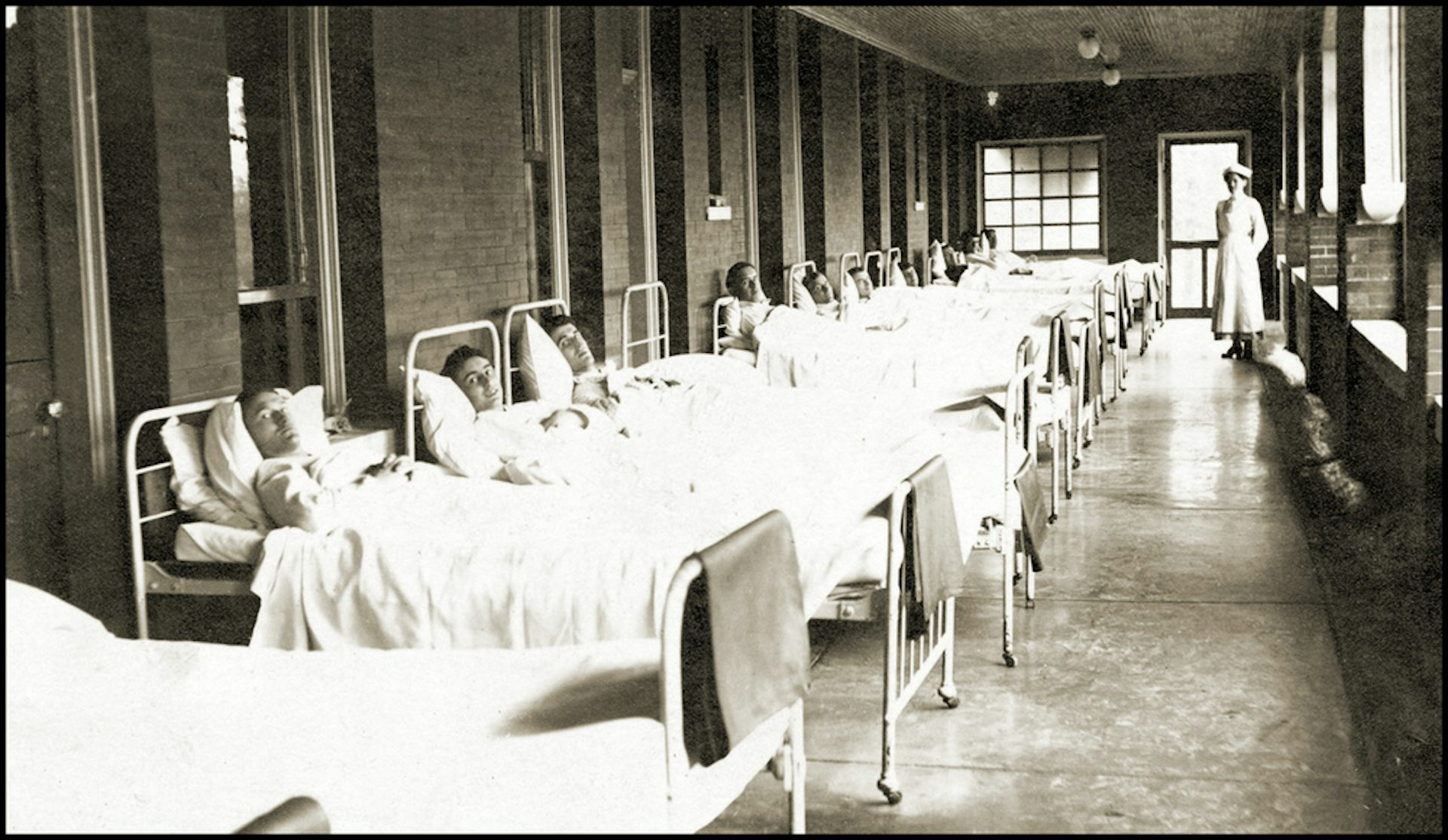
The list is endless of what we didn't have in 1918, from computers to do DNA sequencing to even testing the way we do today.