We're going off topic now, but why do all microwaves have knobs now? I hate them. I want a number pad like the microwaves had when I was growing up. I want to close the door, press the numbers that indicate the amount of time I want and hit "start". When you turn a knob, either you have no indication of the exact time, or there's a display that moves in increments that the computer thinks are good (usually 10s). I don't want to scroll to the time I think is good, and I don't want to fight the thing trying to get smaller increments, which I need for doing more sensitive foods (microwave cake, for example). The knobs can also be difficult for people with certain disabilities.
While I'm griping already, a lot of people hate the button interfaces some (rare) microwaves have because they use capacitive touch buttons with no haptic feedback, and careful aim is required to press the correct button. I wish manufacturers would make microwaves with button blister keypads instead. For blind users, blister buttons can also have raised braile indicators, or users can buy "bump dots" to make the buttons easier to find and actuate.
What do blind users do with a microwave that has knobs? If the knobs click and they use the microwave regularly, I guess they could memorize the number of clicks to turn them. If they're ultra-smooth digital no-click knobs, then they have to memorize quarter-turns and turning speed, etc. Sounds awful! Or perhaps I am mistaken and there is actually a microwave with both knobs and voice guidance (though if I were blind I think slow voice guidance would drive me nuts).
Found the millennial? The knob design is the much older one as it's purely analog.
I don't have a microwave anymore for almost a decade now, but even before I used it occasionally only, mostly for heating up food from the day before, nothing where I'd need sub-millisecond accuracy.
Also in general food tastes different/weird if you blast it at full power, so going for lower wattage and longer cooking times would reduce the need for super accurate timing controls. Unless you grew up on microwaved food exclusively, then I guess food prepared on a stove tastes weird. :-)
> Found the millennial? The knob design is the much older one as it's purely analog.
Modern microwave knobs are not properly analog. They are so infuriating - an analog control fiddling with a discrete setting. As you turn the knob, it will occasionally (with no haptic feedback) tick over to the next discrete value.
It can be done well. I've used one (I forget the brand - possibly Electrolux) with a wheel that does have haptic feedback on every tick and is actually very nice to use. As the absolute value increases, the increment for every tick also increases in a way that feels natural to me, so you don't have to turn it as much as you would an analog wheel for the same precision .
but much better than the old analog knob. For less than a minute you couldnt even turn it (usually jumped back to the bell or was anything from 20s to 1min)
This. Since becoming a father I realised how annoying our analogue microwave knob is when you just need to blast something for 20 second while dealing with a screaming child. Either it's too short and you get 2 second, or it's too long and you get 60, now you need to do your best to cool the thing down quickly
In the time before baby, the analogue microwave was refreshing, now it's a nuisance.
It's also a fire danger because the mechanical time wheels can lose spring tension / get gunked up just enough to stick right before they reach the end, leaving the microwave on until you notice.
It wasn't a huge deal when it happened to me because I wasn't very distracted and I was making tea so it just sat there and boiled for a couple of minutes until I checked in. Under slightly different circumstances it could have been much worse.
>This. Since becoming a father I realised how annoying our analogue microwave knob is when you just need to blast something for 20 second while dealing with a screaming child. Either it's too short and you get 2 second, or it's too long and you get 60, now you need to do your best to cool the thing down quickly
Not sure about your microwave, but mine (ca. 1996 Panasonic) has an analog knob (actually, that's the only control) for time.
If I need less than a minute, I turn the knob past 1 minute, then turn it back where I want it. That pretty much always works for me.
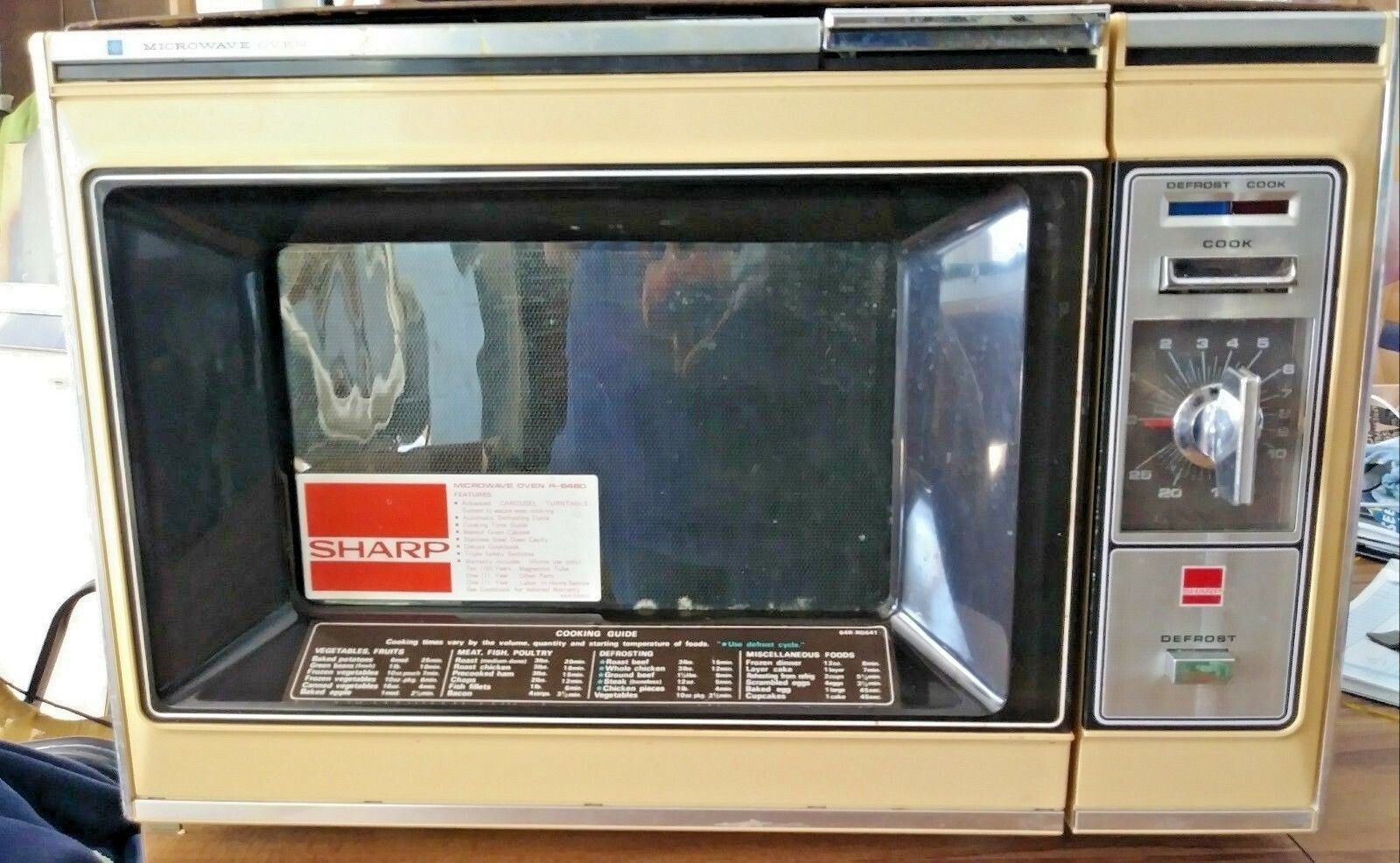
The microwave I grew up with (70s/80s) had a log-ish scale. The first quarter turn was 0-60s, the second quarter turn got you to 5 mins, etc. I don't remember the exact gradations but I remember it was very easy to get almost any time you wanted.
The log-factor wasn't as severe as I had remembered, but the 0-1m angle is about the same as the 20-25m angle. It was still pretty easy to get 15s, 30s, etc. I'm sure you could do a lot better with modern digital electronics.
Sorry this is a bit nitpicky but since this is HN ... is it strictly correct to call this knob “analogue”? The old fashioned ones were clockwork and the newer ones are some kind of digital rotary controller ... I guess if we’re describing the experience rather than the mechanism maybe just good old “knob” suffice!
Oh, they use encoders with detents, they just can't be bothered to make their software "fast" enough to reliably count every detent even though each detent tick lasts for millions of clock cycles.
I believe you're both talking about two separate designs - I'm sure one might have influenced the other but they're certainly not the same.
The analog knob you're referring to, I think, is the _very_ old design that functioned more like an egg timer. It was spring loaded and simply turned on the microwave circuit and broke it when the timer mechanically reached resting position.
The new knob is digital, and you use it to navigate a digial menu and to increase/decrease the timer prior to pressing it inward to start the process. Completely novel input mechanism.
I'm 52 and have used microwave ovens since my parents bought one in 1981. It had a touchpad and every microwave I have ever used since then has had a touchpad. My experience is that except for the extremely low end of the countertop microwave market it was rare to see a microwave with knob controls until the last 10 years.
I grew up with touchpad microwaves and I assumed that most models still used that interface. I live in Germany now, and when I search through the models on Amazon US, UK and DE I was only able to find one touchpad microwave that I could get here, and unfortunately it was capacitive :( I was pretty surprised at this change. I wonder what drives microwave UI patterns over time.
All my micro waves have been nob controlled except one but that one broke down after a few weeks so that one does't count. The rest was two analog and three digital nobs. All the digital nobs broke down after 1-2 years but the analog nobs still work after 20+ years. And you can still buy new ananlog nob microwave ovens in the store but they aren't as good any more.
Given that millennial seems to refer to anyone born between mid 70's and late 90's, that could basically be any type of microwave design that ever existed.
I think you’re right ... he’s thinking of the one that comes after. I think we’re settling on your definition but there’s still sufficient confusion. It’s only in the last 5 years I think we’ve become settled with gen x.
If you cut at mid 70's you'd basically be erasing Gen X, but just because it's popular to talk about "boomer" vs. "millennial" doesn't mean they're adjacent!
Same here. I want my button-blister microwaves back.
Knobs are low-accuracy, low-precision. Which may be fine for some cooking, but not all. On my current knob-equipped microwave, my precision is limited to +/- 30 seconds simply due to the mechanical design, which means a) it's hard to heat anything up "just a little", as sub-minute heating is hit-and-miss, and b) it's hard to do food sensitive to cooking time.
Button blisters with a digital clock telling time to the second. That's an interface I can trust because I can see the time counting down in the correct pace (I have trust issues with all kinds of analog knob timers, including Pomodoro timers). That's an interface I've learned to use without looking, one hand keying in the correct time and power setting, the other hand operating food, <Start> getting pressed as soon as the tray door close.
I still remember my most common sequence from childhood. <Cook Time> <Power Level> <Power Level> <1> <4> <0> <Start>. Could do that blind even today.
Knobs are good for things that you need to scroll around a lot (and knobs in professional devices excel at jumping precision levels to allow an excellent experience here). Setting time and power on a microwave is not like that. You have exact values in mind, and need a way to input them precisely.
Having an input level precise to 1 second is useful if you're using it day-in, day out. As a kid, I was mostly doing the same few meals in the microwave, so I had perfect timing nailed with experience. For instance, a DIY zapiekanka[0] made of bread, cheese and some flavoring, would come out perfect at Full power, 1:40 time. Add 20 seconds, and you'd burn the cheese. The cheese was the factor that determined microwave settings. If, for some reason, my mom bought a different type than usual, I'd have to correct the time (usually adjust up), but then with experience I quickly developed "cheese tables" in my head. I'd look at a slice, and think, "ok, this is the smelly one, needs +40 seconds to come out well". Etc. Then I'd key in the correct settings, and come back in 2 minutes to the perfectly made zapiekanka.
(I suppose this was my attempt at treating cooking as an industrial process and not black magic :).)
My microwave has a knob and a digital display - so turning the knob updates the display. The knob also has "clicks", rather than turning smoothly. I like this interface - it's tactile and usable.
I had a microwave like that as well, and it was absolutely fantastic! One big wheel to set the time, and it was 100% deterministic, so you developed muscle memory for setting it at different times. Loved it, never been able to find one like it since.
Easier to clean than a number pad. I think knobs are great, you can rotate fast with very little effort. I think it should be a standard feature of computer keyboards.
I love the volume roller on my Logitech G710+. Having a few programable knobs would be interesting to play around with, though I'm not sure what exactly I'd use them for.
I would be happy with a big red rocker switch. It should have labels "ON" and "OFF".
A more daring design uses the door as a switch. Close the door, and the microwave runs. Open the door, and it stops. This is about as simple as it could be. User efficiency is maximized.
I have seen and used a close-door-to-start microwave. It was a regular microwave where the timer knob was broken. Every couple of weeks you would use pliers to turn the remaining spindle of the knob all the way to the right to reset the timer. :)
Our digital knob micro was like that. This gets a problem when the digital knob suddenly malfunctions and starts the microwave in the night, set on 5 minutes and nothing inside it. Could start a nice fire if unlucky. It only happened during daytime when we noticed it luckily.
Now that you mention it, I guess what I really am is a grumbling ex-pat.
I often find things I want on amazon.com and then change the URL to .de or .co.uk, or I find items that are available for shipping to Germany (for a decent price), I assume because they actually ship from China or are already distributed in Amazon warehouses. I guess in the case of microwaves the power input is different, so the models are different by area, and this part of Europe seems to prefer knobs.
I will say, though, I don't see any there with blister buttons; they all appear to be capactive.


While I'm griping already, a lot of people hate the button interfaces some (rare) microwaves have because they use capacitive touch buttons with no haptic feedback, and careful aim is required to press the correct button. I wish manufacturers would make microwaves with button blister keypads instead. For blind users, blister buttons can also have raised braile indicators, or users can buy "bump dots" to make the buttons easier to find and actuate.
What do blind users do with a microwave that has knobs? If the knobs click and they use the microwave regularly, I guess they could memorize the number of clicks to turn them. If they're ultra-smooth digital no-click knobs, then they have to memorize quarter-turns and turning speed, etc. Sounds awful! Or perhaps I am mistaken and there is actually a microwave with both knobs and voice guidance (though if I were blind I think slow voice guidance would drive me nuts).
[Edit]: formatting