I really _really_ hope that HP continues making Itanium based servers available for 30 more years, even if they are not selling a single unit, just to spite Oracle, for the comedic value only.
In all seriousness, HP can do that to get some out of court settlement money from Oracle, as Oracle clearly does not want to continue supporting the platform.
Can't HPE stock a bunch of Itanium systems in some warehouse, just to be able to claim they are still selling them? Doesn't matter that Intel isn't producing chips anymore?
You can check my comment to cement this. The pay is excellent but the organization fits people’s general ideas of oracle. I saw contracts signed where we’d purposely lose money for years in order to box out competitors in the short term and then jack up prices for the client in the long term.
What people don’t typically think about though is how massively successful oracle is because of these strategies. They work really well.
Isn’t that a pretty widely used strategy? Eg. Uber pretty much lost on initial rides (maybe even now), so it’s hardly big evil Oracle, but big evil capitalism.
Except that Uber's product is a commodity. It's far, far easier to switch to using a different ride sharing app than it is to switch to using a different database. Especially for a large organization.
Like who? I imagine anyone who goes to work at Oracle doesn't really posses the disdain for them that allows for the derivation of pleasure from hearing they lost a court case.
Great. I worked for a governmental agency and they started migrating away from oracle. It was a gargantuan task but it was supposed to save them a whole lot of money. Oracle is a greedy company whose innovation pace has dropped significantly. Their success lies in locked in clients who have to overpay for their services.
Many of Oracle's locked in customers come from startups that Oracle purchased.
Oracle goes around looking at the lock-in potential and acquires based on that, then they ride that startup product's reputation for as long as possible until they just leave it to rot. They also try to bundle in existing Oracle products (e.g. Oracle DB) almost giving it away to get your foot in the door then dumping on you.
Unfortunately a lot of companies find themselves in a business relationship with Oracle, even after never having purchase an Oracle branded product.
This right here is what happened to my dad. By accident he started working in the wine industry as a IT project manager and developer. They used a product from JD Edwards for large scale wine production. Oracle bought them. The Oracle product they had was way more expensive. For awhile they let them use the JD Edwards product that worked well. They wine and dined him we got to go to Oracle park luxury box for game etc.. but eventually they told him you got to use the Oracle one now for like 10x the cost... Software was junk anyways so he just ended up building stuff in house. Saved the company millions in licensing fees.
I have a question about that. Big companies like these have (I believe) pretty hefty legal departments, and would be constantly involved in legal negotiations and court proceedings (though not always at such a scale).
So why do court cases cost them so much in legal fees? Do they outsource representation for these big cases, or do they just extrapolate a lot of the costs from payroll, or what?
Litigation (court stuff) is almost always outsourced to law firms. The reason is that it's a different kind of practice than day-to-day corporate stuff (contracts, acquisitions, regulatory compliance) which is primarily done in house. Another major reason is the economics - generally, court cases are not always expected, and "lumpy" in timing (for example, you can have a few hearings back to back, and then spend months without court cases). So it's not usually efficient for companies to have in-house litigators. In addition, once litigation starts, you need a very big team to handle the work (pretty commonly, 10+ lawyers working full time on a tech case during pre-trial and trial). Companies don't like big payrolls.
Don't forget that if any company were to do litigation completely in-house, the second they were involved in one major litigation would be the perfect time for anyone else to take the company to court -- their lawyers are already all busy!
It would be interesting to know how big and litigious a technology company would have to get before it made sense to develop their own litigation capability. Or would that run afoul of some legal profession expectation that "prestigious firms" are required, no matter the size of the tech company?
There isn't really a professional expectation about prestigious firms. However, there is some reputational effect of having external counsel represent you in court. Some courts (judges, juries) might view a lawyer who represents a variety of clients more credibly than a lawyer who is directly employed by one corporate party (admittedly I think this is a very small effect and can work both ways).
Most companies also want to maintain a healthy separation between internal and external counsel so that they can keep certain kinds of communications privileged and avoid awkward situations where an attorney who is both an employee and legal advisor to a company might be subpoenaed for a deposition (basically any time a lawsuit happens, any corporate employee with knowledge can potentially become subject to deposition as a fact witness). You basically never want your in-court lawyer to be deposed for any reason.
That said, there are some companies who look into this kind of stuff for smaller matters - small corporate disputes, collections of accounts receivables, and whatnot - oftentimes are now being done in-house even if they involve some in-court matters. It still doesn't seem to make sense for big files though.
I struggle to think of a firm better matching that description than Oracle. But slightly more seriously, this kind of litigation work is both very specialised and high risk, so it makes sense to rely on the best advisors in the field, who will almost certainly be external counsel.
I doubt that legal departments are good at big court cases. They tend to be more concerned with mundane busywork like drafting contracts and reviewing public statements for potential issues. So it makes sense to outsource lawsuits, especially bigger ones, to experts with experience at court.
This is true in my experience at various large corps I've worked for. The legal department has a rather small headcount but a massive consulting budget. They hire other lawyers with local jurisdiction experience, subject matter expertise, courtroom experience, etc. Their day-to-day hands on work is 1) managing all of the outsourcing 2) mundane corporate contract stuff which is more frequent/consistent in volume.
To add to this like - having internal legal counsel take on a litigation cases would be like hiring SAP developers full time to do an SAP ERP implementation. Consultants/contractors are great for episodic projects (even if they span multiple years).
> So why do court cases cost them so much in legal fees?
im not involved in legal stuff, but i think part of the reason is the system of common law. this makes past related cases as important, if not more important, than the letter of the law. so in order to mount an effective legal case, you have to research your case and every other case like it in history (!)
more simply, its a high demand, low supply, high stakes job. drives up the price.
also, the job is just complex. you need to have good PR, a network of expert witnesses, an understanding of psychology to both select and then convince the jury, technical understanding of everything related to your case (computers, firearms, recording devices, medical devices, police procedures, jurisdictional boundaries, etc etc), on top of the normal business stuff like brand recognition to maintain business relationships, etc.
Dealing with Discovery in corporate lawsuits can be extremely labor intensive. Defendants especially like to dump huge amounts of evidence in discovery that the law firms have to sift through. A recent example was Remington submitting tens of thousands of pages of cartoons in discovery for the suit against them by Sandy Hook victims' parents [11]
I’m not sure if a “normal” legal dept does cases like this but besides that, they have other things to do. That means that the day-to-day business would be postponed or the legal team expanded.
Mind most of the lawyers in any corporation are responsible for "daily business" like contract negotiations with customers or routine operations in HR or deal with acquisitions or whatever the company does.
Only few deal with actual court cases. Now many of those court cases are very specialized and you don't keep all those experts on payroll, thus you go out contracting specialists. To some degree you also want to have a firewall by using external people who can dig up dirt without you doing it directly. However also the lawyers on your paywall don't work for free but produce cost ...
And the employees, management, and shareholders at HP won’t even get compensated for the lost time, opportunity costs, stress, hassle, etc., incurred during those 5 years.
No wonder big companies settle out of court so often.
Oracle has made substantial push into the hyperscale cloud space in the last 2 years. Even though they lag quite a bit behind AWS/Azure/GCP, they are far from irrelevant. (Revenue grew approximately 26% year over year in 2019) While Oracle DB is still dominant (At the end of 2019, Oracle was the leader in DBMS revenue ($15.15 billion) and market share (27.5%)) in large enterprises, Oracle will retain a place in the industry. (430,000 customers in 175 countries and revenue of $39 billion for fiscal year 2020)
Not contesting the facts, but important to read them in context.
Market share by revenue is likely biased towards Oracle vs market share by usage/installs. I’m under the impression that those migrating towards other DBMS’s are partly doing so to get away from the high pricing of Oracle. So even if usage of eg RDS Aurora and Oracle are the same, it would show Oracle as doing really well. If I’m correct, and the underlying user base for Oracle is declining, then their numbers can only go down in the long term.
But, they have a great money printing machine today, loads of enterprise sales expertise, and the buffers (read: time) to deal with this change. So, although I don’t think they’ll become irrelevant, I wouldn’t say they’re doing particularly well either (from a trends and market direction perspective)
Larry Ellison started the Oracle ball rolling by selling an up-and-coming database technology, based on relationships, which was an R&D study at Stanford? (IIRC) to the FBI. I presume that Oracle powers all the "signals" gathering at the NSA/CIA/FBI. That alone would be enough to keep Oracle in business forever.
Sure, but the division between Oracle Database and MySQL Database is pretty large; that being said I wouldnt be surprised if they had somehow gotten some money out of it.
Don't forget that Java is an Oracle product too and it's still in the top 3 seat for languages used whether HN likes it or not. Oracle isn't going anywhere anytime soon.
You would think, but the stock price is still going up and they have a lot of cash on hand. I don't really understand why anyone does business with them, but they are likely to be around for a long time.
>>why anyone does business with them, but they are likely to be around for a long time
The answer is partially in the question.
For large enterprises where large part of IT is a strict cost centre - the "boring" areas of HR/Pay, Financials, CRM, ERM, SCM, etc - predictability, support, longevity, reliability are far more important than sexiness, new technologies, or even immediate cost of license compared to cost of change and uncertainty.
And most Oracle "customers" probably arent interacting with Oracle directly. They are buying a financial system or erp from a vendor who is Oracle under the hood. They might get to the product selection stage and be looking at 3 industry specific products built on Oracle vs NetSuite. Either way Oracle wins.
I mean, yes and no. "No", for the purposes of many traditional non-IT large enterprises.
CIO of large company sees value in having "one neck to choke" for their HR Application, Proxy Server, Web Server, App Server, Database Server, Enterprise Service Bus, Search Engine, Monitoring Software, etc. A simple licensing and support model with streamlined contract model as opposed to 27 bespoke contracts with "never heard of them" consulting/support companies for each level of the open-source stack which "nobody owns" (https://www.postgresql.org/support/professional_support/nort...).
At ground level, we may not see value in the same way; we may complain and moan about it; about vendor lock-in, license cost, slow pace, etc etc etc. I certainly did, for decades :).
They are probably going to last really long considering the impact they made before FAANG took off. Many of their customers are governments and quasi-government companies (think bank and telecom) so I actually think they are going to last a lot longer than we want.
I wonder at what point anyone will be willing to work for them and at what salary, though.
Surely there comes a point where even paying triple the standard rate, you can't get more engineers working on dusty old code while remaining profitable and their customers' best offer.
My guess is they will hang on for a long time as the reigning king of on-prem. They aren't hurting yet, because the companies that are losing ground in on-prem are losing it both to AWS/Azure, but also losing the on-prem ground to Oracle. Eventually, the continued downward spiral of on-prem will hit them. But on-prem really never goes away. Oracle will just become the king of a much smaller hill.
but they are already kind of there, they own NetSuite which is the number 1 cloud ERP
they also own Oracle ERP which is another top 5 cloud ERP
they own peoplesoft/jd edwards and all their clients
they next to SAP, own the enterprise apps market
and unlike SAP, they seem to be serious about competing with AWS ans Azure, Oracle OCI, see to get niece reviews
So how long will it take for Oracle to be irrelevant, if OCI and NetSuite continue to move in the right directions, for as long as people have money
They are a strong name in Enterprise Resource Planning software, both internally developed and acquired. Besides licenses, they do a lot of ERP hosting, likely recognized as "Cloud" revenue.
(Disclaimer/Source - I've been a PeopleSoft admin/architect/ops working for IBM for 20 years; PeopleSoft was bought by Oracle in 2005; all opinions my own etc:)
They made other plays - there is Oracle Linux as rebrand of RHEL; a few rebranded/purchased virtualization as well as hardware products; etc etc
They are pivoting their enterprise db and server (sun) business into a cloud services business. Oracle solutions require a ton of infrastructure to run properly at scale and they are using that to pitch their own cloud. I wonder how long it'll be before they start building moats to defend against "bare metal" solutions from other providers.
Wild speculation: i feel like the $3b from this lawsuit is far more than any revenue they may have lost due too the lack or Oracle products on their Itanium machines.
The suit seems to have been filed in 2011, and HP said:
"The Itanium product line was highly profitable for HP, generating over $2 billion in annual profits in 2010"
And, also "84 percent of Itanium servers ran
Oracle’s database software."
So, even though Itanium was pretty well dead for new sales to new customers 2010, they were still selling enough of them to make $2B in profit (not revenue) the year prior. That is, sales to customers that were sort of stuck on Itanium/HP-UX, and not yet ready to switch to something else.
Certainly, an EOL announcement for Oracle on Itanium would have kicked some Itanium-Locked-In customers into action faster than they would have otherwise.
I'm not sure how to translate $2B/year profit on Itanium hardware into lost sales due to the Oracle announcement. But, $3B doesn't sound outrageous in relative terms. Sounds like 1.5 years of H/W sales ending earlier than projected due to the stark message in Oracle's EOL announcement.
On the flip side, $3B is a lot more than it would have cost Oracle to keep supporting the platform. Having worked on a product that at one time or another supported Windows (including IA64), VMS (including IA64), and thirty-one flavors of Unix (including HP-UX and Linux on IA64), the marginal cost of continuing to support a platform is not that high. Sure, if the demand isn't there, we drop it, and we have dropped a lot of platforms over the years, including VMS and everything IA64. If HP claimed the demand was there, and furthermore claimed a contract required us to keep going, it would be a no-brainer. I don't get it. I mean, it's Oracle, so I get it, but I don't get it.
I never programmed it but there were legitimate things that people didn't like about it, instruction density, extremely large architected register set (which has downsides beyond density), register windows, from memory. Which have their reasons but also have very real problems.
It did have some "interesting" things like advance loads and associated speculation support, programmable branch predictors, rich prefetching and cache hinting, highly predicated execution. Which were intended to all combine and make out of order execution unnecessary.
In practice they were very difficult to use well, didn't solve all deficiencies of in-order execution, and were often inefficient and difficult to implement. Itanium remained stuck at low frequencies and performance was tied to things like heroically fast (and therefore unfortunately tiny) L1 caches.
And if you do have an out of order design, then many of those interesting aspects of it were much less useful.
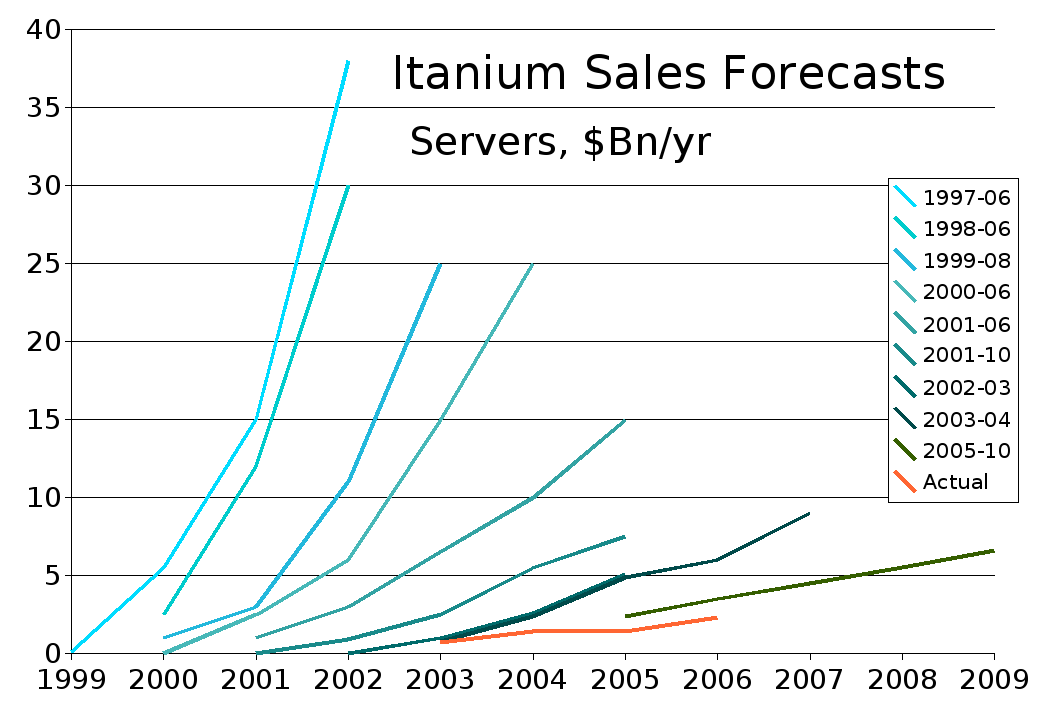
Ha. Intel pushed Itanium very hard. AMD released AMD64 and that was the end of Itanium. No one wanted it. Intel killed it because it was a failure in the market place.
I think those projections weren't really all that crazy. AMD surprised everyone with AMD64, and they were the only ones that could have done 64-bit x86 other than Intel. Intel should have had better spies at AMD :)
Also related to the 3.06GHz P4 launch were rumors that Intel has secretly included x86-64 support in the new P4 in the form of disabled circuitry on the chip’s die. Such circuitry is allegedly the product of Intel’s skunkworks Yamhill project, which is intended to give Intel some flexibility in responding to the potential threat posed by AMD’s upcoming x86-64 “Hammer” line of processors.
Intel has repeatedly denied the existence of Yamhill, insisting that the only 64-bit instruction set they plan to support is IA-64. So will we see Yamhill publicly unveiled in 2003? It’s possible, but not likely.
I wonder how many Itanium CPUs they’ve sold in the last five years. Also do they just do a single waffer or two every now and then, or do they have a production line?
Given the slow sales relative to projections, I wouldn't be surprised if they just did one run and it took that long to sell through. What was the last Itanium launched?
The ARM revolution has been a long time coming, but it was given a big boost by the use of the chip in phones, a market that Intel failed to break into (I have one of the rare x86-Android phones, a Zenfone 2). I can't imagine Itanium would have been any better at scaling down to fit into that market.
Intel had no choice but to kill it; it was outclassed by ARM64 and had a slowly shrinking customer base.
I love how ARM's killer feature of low power consumption came completely by accident. [1] ACORN designed ARM as a desktop processor with good memory bandwidth, and only discovered its energy efficiency when a prototype continued running without a power supply from signal input voltages.
> I'm still puzzled why Itanium didn't go any further.
It turned out nobody knew how to build effective compilers for them, so nobody bought them.
> And Intel just wrongly killed the project.
What's the point of a processor you can't program efficiently? What do you think Intel should have done? Just kept making them regardless of the fact nobody bought them?
> It turned out nobody knew how to build effective compilers for them, so nobody bought them.
It's a funny sign of those times. People really thought at one time that we were leaving a huge amount of potential instruction-level parallelism on the table. There was a DEC-WRL paper in the early 90s that said in the future (i.e., now) we'd be disappointed with 15 instructions retired per clock. But in the future we presently occupy we're all glad to have IPC of 0.8.
I worked on a project mid-aughts to port a scientific package to Itanium. The issue that we observed was that Itanium really pushed the hard work out to the compiler and by association the devs to make everything work with their compilers in order to get the full benefits. And since very few people had Itaniums and the compilers weren't quite there yet, the overall dev effort was not worth it. Somewhat of a chicken and egg problem.
ARM managed to be worth the trouble since it solved a real problem of power useage which got it the installed base, at which point it was worth the trouble of supporting.
It depended on compilers smart enough to make not-parallel-friendly code run well in parallel. In a way that would outpace the price/performance growth curve of the (somewhat new at the time) x86-64 CPUs.
The compilers never fully delivered on that. X86-64 just beat them with process size and clock speed on a less elegant architecture.