I see this take a lot, and it’s kind of misinformed. The primary drawbacks of nuclear are:
1) incredible slow to build. A typical plant takes ~20 years from decision to productionized
2) extremely expensive, with a massively frontloaded cost. By contrast, solar and wind are fast to install and now cheaper.
> wind power can be zero at some parts of the day
There are a few solutions to this actually. First, having a more nationalized grid can amortize variant weather conditions (very unlikely it’s not windy everywhere, for example). Second, there actually are long-duration battery solutions coming out. Look up “energy tower” for a very weird one, and “form energy” for a more traditional model.
Nuclear power can be fast to build. It would need to be constructed in volume, with immutable designs. Right now, America builds so few nuclear plants that they are essentially all one-off designs. Mass production is key here.
Vis-à-vis costs, the government can poof into existence trillions of dollars with no ill effects. Cost is an easily overcome obstacle.
If a mandate came down to produce 1000 new nuclear reactors by 2030, I think it could be achieved. The country just needs the political will to make it happen.
> Nuclear power can be fast to build. It would need to be constructed in volume, with immutable designs.
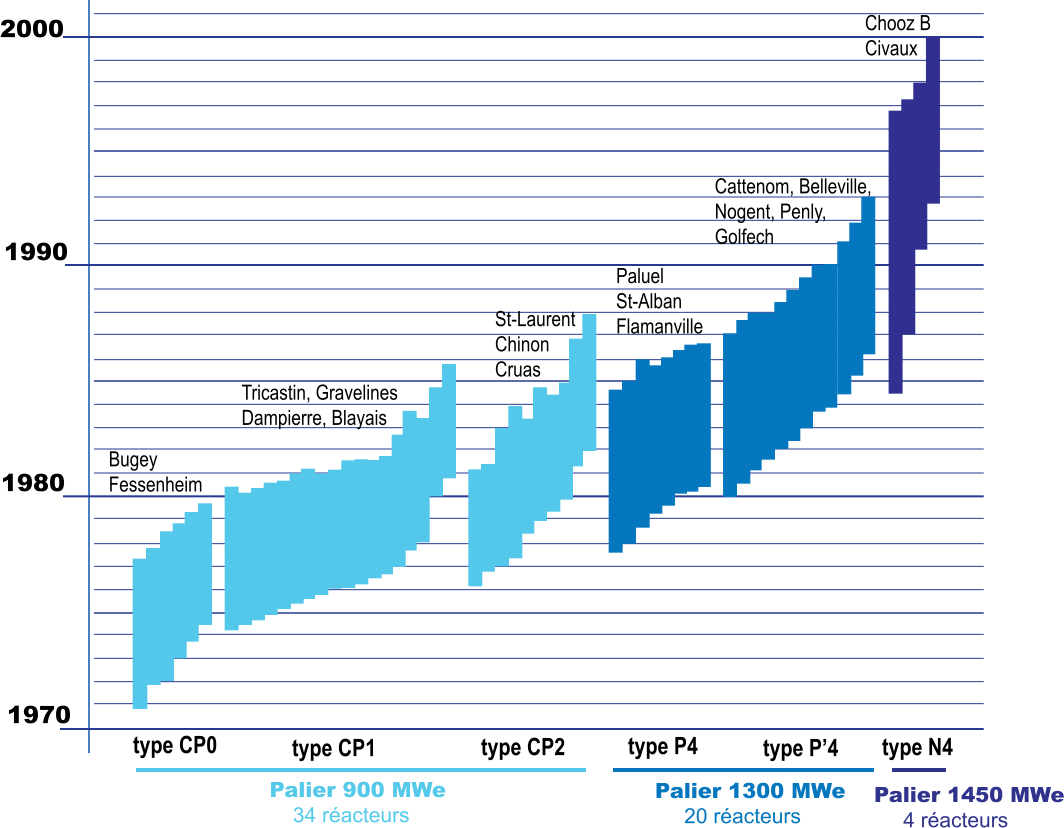
Exactly. You need look nowhere further than the french nuclear timeline for that to be clear: the country grew from 4.5GWe capacity to 49.5GWe between 1977 and 1987. 900MWe class reactors took 5~6 years to build, and the 1300MWe 7 to 8. And when you've worked out the kink, this can be parallelised massively (as long as you have sites to put them on), for about 20 years the country had a dozen reactors being built concurrently, the slowdown in construction times really started as the number of plants being built decreased: https://upload.wikimedia.org/wikipedia/commons/2/24/Chrono-p....
The design got more complex and there were teething issues with the N4, but Chooz took 16 years to enter service where the P3s took 8 years at most.
In 2020, nuclear energy accounted for 70.6 percent of France's total energy production what is stunning, if you take into account its one of the G7 countries:
It gets 70% of its electricity from nuclear, but electricity is only a minority of the energy we use, so France still gets most of its energy from fossil fuels:
I had the privilege of watching a bunch of (6 or 7) French engineers make an impromptu visit to the ticket desk (of the airline I worked for) at Charles de Gaulle airport and work their magic, running comms and power with no fuss, just teamwork and that brilliant "why not now?" European attitude.
Meanwhile back at Heathrow that would have taken months of permits and planning and dealing with useless subcontractors.
Were, things have gotten way less great since the 80s, it’s mostly coasted.
Too bad really: nuclear power was a way to gain independence (from the US and the oil) but then it kinda fell by the wayside as the country largely went with oil anyway (though the grid is both powerful and rather clean owing to the high ratio of nukes).
Would have been interesting for the country to ride the contrarian gallic spirit and decide to go all in on electricity and renewable way back then.
Nuclear power could have been fast to build if we had kept building it. We did not, and most of the people who knew how to do it are now retired or dead. Because nuclear power had no future for decades, few young people chose to make a career in it. The workforce needed for designing, building, and operating nuclear power at scale no longer exists and cannot be trained quickly enough. That alone would take 10+ years, which we do not have.
And thus, we will spend the next 10 years playing around with building piddling amounts of renewable power generation and storage instead of actually having a solution in 20 years.
The best time to plant a tree was 20 years ago. The second best time is now.
> the government can poof into existence trillions of dollars with no ill effects
This is because the federal reserve's printed money goes basically into treasuries and stocks.
The rich save basically all of their money. If they decided to spend it on real-world goods, there would be huge inflation.
But it's probably all nil. The cost of building enough nuclear power plants with economy of scale is probably near the same as building enough solar and wind farms.
Balancing systems do exist - I used to swim in Smith Mountain Lake[1] as a kid and that entire lake is a gigantic battery. During low demand periods they pump water into a reservoir to then run the turbines during peak demand hours. None of these systems are perfectly efficient - but we've got a lot of options in our tool belts for ways to balance peak demand that don't require more continuous production capacity.
Yes, pumped storage does exist, but to provide a nation sized battery using pumped storage, you would need to use two of the Great Lakes and pump one of them up by 200 feet.
The power needs of the occasional cold wind still winter week are fairly large.
Beyond the fact that electricity-generation is once again only part of our emissions issue, there's about ~450 reactors worldwide and the uranium ore reserves give us around ~120 years of operation on current 3rd (/3+) gen reactors (short of having fast neutron reactors basically). Having 1000 in the US (or rather 900 more or 3 times as many globally) would have brought that deadline closer by the inverse ratio, and we'd likely already have tensions on nuclear fuel sourcing.
Agree with you on the role of government spending though, but there also needs to be a radical paradigm shift in how we view the economy and what needs to happen in each sector (not just within energy in fact).
Yes, sure, we can go mine the bottom of the oceans and extract it by centrifuging ocean waters, that probably would give us marginally more than a doubling of margin.
Point remains: reserves are exhaustible, an exponential consumption may not be desirable.
https://en.wikipedia.org/wiki/Peak_uranium#:~:text=As%20of%2....
Recent studies found that re-using a design made nukes cost more & take longer to build. Reason being each site is different, and so the design always needs to be tweaked, and at this scale changes are more expensive than from-scratch.
SMR's made in a factory seem like the only way to address that, but I have no idea if we can ramp SMR's to national viability in the next ten years.
"Why Nuclear Power Has Been a Flop" [0] apparently does a good job of explaining exactly how our civilization has regressed in this sense over the past 50ish years. In short, it's the principle of "As Low (risk) As Reasonably Achievable". Well, they minimized nuclear risk, but sure as hell didn't minimize global warming risk in the process.
Roots of Progress has an interesting review here [0], which is what I base that on. (It's on my list to read, just haven't gotten to it yet)
This isn't practical everywhere, but on the island of El Hierro (Canary Islands) there is a wind-and-battery solution in the form of a wind-pumped hydro-electric station. In effect there is a big pool of water acting as a battery and the wind turbine "charges" it.
When I ran across it on a trip to the island I was really impressed. Very original solution!
If it would be actually climate emergency then we would be building in mountains all where reasonable. No matter the damage to some rare species, panorama and tourism.
Don't forget the substantial costs to clean up. Just think about growing up in a world full of EOL nuclear plants left by generations before you that need to be cleaned up... In a political unstable world due to an ongoing climate crisis.
Even today we as a whole struggle with decommissioning nuclear plants, and the costs are astronomical this is already a huge problem now, let alone in a post climate change world
Just think about a world full of EOL toxic waste ash ponds left by coal power plants, each of them vastly more toxic and teratogenic than any nuclear plant, let alone a decommissioned one.
In fact, you don’t need to imagine it, you are living the dream.
The report talks about hypothetical setup with smart girds and customers reacting on price change. This configuration was never tried at 80% scale. It might or might not work.
People did try decarbonise industrial economy to 70% - it worked with technology existing not now but in the eighties. And it did not put any limitations on consumers, while taking just 10 years to implement.
Surely at code red we should be looking at things that were shown to work?
That I would guess is exactly the strategy China is adopting.
And the west IMO will reel in horror at even a single meltdown there and back off any plans to adopt nuclear the day that happens, wasting precious time we really don't have.
>A typical plant takes ~20 years from decision to productionized
If this were truly "code red" and people really believed that, we would find a way to push the bureaucrats out of the way and build nuclear capacity way sooner than 20 yrs. Humans can do amazing things under dire stress.
This is not happening, so I will assume "code red" is hyperbole, something that the IPCC is not entirely known to shun.
> This is not happening, so I will assume "code red" is hyperbole
If you take the current pandemic as an example of what we do when under dire stress, I don't think we should be that confident. Yes, some people can perform astonishing feats, and yet other people can deny there's even a problem even when it's obvious.
Humans don't always react rationally in code red situations though. Right now the irrational fear of nuclear power is stronger than the fear the average person or politician has of climate change. Doesn't mean that the climate change situation isn't dire.
> I will assume "code red" is hyperbole, something that the IPCC is not entirely known to shun.
I'm not sure that’s the case and I would encourage you to dig into what the worst or medium range scenario would mean. As I understand it, the _middle_ scenario predicts that a billion people would either die in a climate-related catastrophe or be displaced before 2050. That means that several ethnic or cultural groups would go through essentially genocide.
There are details like loss of water reserves in California and the impact on food access in the US, fish population collapse, climate-related migration from the densest populated areas in the world that are very concerning.
I’ve seen scientist give very clear alarms on several global issues (usually my father was making the point); I’ve personally made several myself, and every single time, the reaction was… dumbfounding: trying to minimise, negotiate, taking the most optimistic scenario as a worst case, delaying…
I have, unironically, witnessed several conversations that literally went:
“If you do that, you, your family and your way of life will die forever.
— You are exaggerating, that’s too scary.”
They did nothing, and soon later: exactly what the prediction said.
This is not only the most common scenario, it is the only scenario I’ve seen, with one exception: CFC and the Ozone layer. And that was because there’s a handful of industrials, who had clear alternatives that proved cheaper.
“Other people do nothing; I’d rather believe the reassuring story than evidence” is exactly how we end up with the bystander effect.
Yeah I hear this every time, but very few small modular reactors (SMRs) have actually been built on account of economic and safety barriers to building them [1].
Now, I'm sure these are soluble problems. I'm by no means anti-SMR. But most of the actual serious proposals I've heard discussed for decarbonization lean much more heavily on already-existing technologies such as solar panels, which are getting cheaper and more efficient every year and which we are putting in the grid right now.
Most of the time, when I hear people talking about SMRs, it's as an excuse to do nothing. "This research tech will solve the climate problem, so all we need to do now is wait for it to pay off." Like the original poster in this thread, who claimed that a lack of investment in nuclear somehow proves that things aren't really that bad.
Apparently, the IPCC does expect and hope for substantial increases in nuclear power as a portion of our energy supply [2][3], but "[a]chieving a rapid decarbonization of the electricity sector will require, at first, deploying proven technology," presumably because nuclear on its own is not enough, and because SMRs are too experimental to lean on in any substantial way.
If it was actually code red, we would waive literally all safety regulations and environmental policy reviews, and break ground on new plants tomorrow. And cost would be no object.
Yes. I do actually think it is critical, but it's clear that most people are using "code red" as a semantic device, not out of belief that we should act with _true_ urgency.
I think we're also forgetting that adoption of nuclear power is also dependent on a stable government. Geopolitical risks probably outweigh all the drawbacks mentioned.
Yes it's slow to build today, though it hasn't always been the case: France once built 56 reactors over 15 years [0].
Yes it's expensive, but once again, this isn't a feature of Nuclear power, but one of the capitalist (or at the very least neoliberal) system it is built into: 60% of the Hinkley point C costs are due to the mode of financing (not 100% public) [1].
The real question is not whether this or that type of electricity generation is better (although it's also an important question), but rather how we can completely redesign our socio-economic system to quickly wean ourselves off of fossil fuels (hint: global logistics are far from electrified), reduce emissions from the agricultural sector (we do need to eat), etc.




> wind power can be zero at some parts of the day
There are a few solutions to this actually. First, having a more nationalized grid can amortize variant weather conditions (very unlikely it’s not windy everywhere, for example). Second, there actually are long-duration battery solutions coming out. Look up “energy tower” for a very weird one, and “form energy” for a more traditional model.
Finally — I will agree that nuclear is probably some piece of the pie in the future. But analysts think we can get to 80% renewables with currently existing tech: https://www.google.com/amp/s/www.technologyreview.com/2012/0...