Grid solar is statistically significantly safer than Nuclear. Climbing on rooftops can be dangerous, but solar is much better in a dessert than on top of a roof.
Nuclear takes longer, is more expensive, has lower ROI, and higher risks. Solar has a lower capacity factor, but having 1/3 the availability at 1/15th the cost is a net win. Especially as we need vastly more power in the daytime and idling Nuclear is really expensive.
Currently 3% of global electricity comes from Solar and 16% from hydro with Nuclear only proving 10%. Scaling Nuclear to a significantly on a global scale take not just massive construction and new regulations, but also training etc, we simply don’t have the time.
Nuclear is over 4x safer than solar [1]. As far as "not having the time", we'd still be using natural gas to accommodate wind and solar's intermittency unless some breakthrough in storage technology happens. Batteries are mostly going to go to vehicles, not grid scale plants. Other storage solutions like thermal batteries, compressed air, or giant flywheels remain in the prototyping phase and aren't even proven to be viable at scale.
Not for the people who would have liked to drink the water used to clean the panels (cf the projects in deserts). Everything has some drawbacks and it s useful to diversify.
Your off by orders of magnitude. Nuclear uses vastly more water than solar power per kWh.
“Nuclear Energy consuming roughly 400 gallons of water per megawatt-hour, 320 billion gallons of water were consumed by United States nuclear power plant electricity generation in 2015.” And that’s direct consumption in cooling towers, nuclear indirectly uses power in other ways.
By comparison the 550-megawatt Desert Sunlight project in Riverside County estimated 2/3 cup of water per megawatt hour.
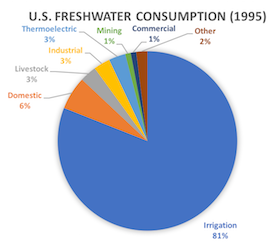
Most of the water used by nuclear is used to run the heat exchangers, and gets dumped straight back into the river it's drawn from. This looks like it's the source you're quoting [1]. It's pretty clear that nuclear power is a tiny fraction of water usage [2]. Furthermore, in water-constrained areas nuclear plants can be cooled with wastewater [3]. And lastly, plenty of nuclear plants are cooled with ocean water, which obviously has zero shortage.
The notion that nuclear power is going to significant affect water supplies is without merit.
I agree it’s a trivial amount of water and both can go without using water, the point was solar is on average vastly less.
However, wastewater is just water. Look at a long river and towns upstream dump their wastewater into rivers that towns and cities downstream collect as municipal water.


Nuclear takes longer, is more expensive, has lower ROI, and higher risks. Solar has a lower capacity factor, but having 1/3 the availability at 1/15th the cost is a net win. Especially as we need vastly more power in the daytime and idling Nuclear is really expensive.
Currently 3% of global electricity comes from Solar and 16% from hydro with Nuclear only proving 10%. Scaling Nuclear to a significantly on a global scale take not just massive construction and new regulations, but also training etc, we simply don’t have the time.