These are theorized to be produced by relativistic jets from a black hole in the galactic nucleus. Astronomical entities eject streams of matter along their axis or rotation. The energy comes from infalling matter (accretion disks). In the case of our sun, the accretion disk turned into planets and no longer powers strong polar jets.
In the case of active galactic nuclei, an incredible amount of energy is released as matter falls into the black hole. Particles are ejected at a significant fraction of the speed of light, transferring energy to the interstellar medium.
Galaxies moving quickly relative to an intergalactic medium can have helical trails, rather than bubbles. The jets precess (wobble) like the Earth or a top, which produces two helical paths. Tracing these paths is used as a tool to study cluster mergers.
I'm not sure you are talking about the same thing. These bubbles are thought to come from a black hole "eating" a star, and are a relatively recent result. You are talking about a long-known polar jet from an accretion disk.
But you're right- the bubbles are not the jets themselves. The bubbles would be interstellar gas energized by the relativistic particles. As the gas diffuses, it spreads from the jet's cone into a large bubble.


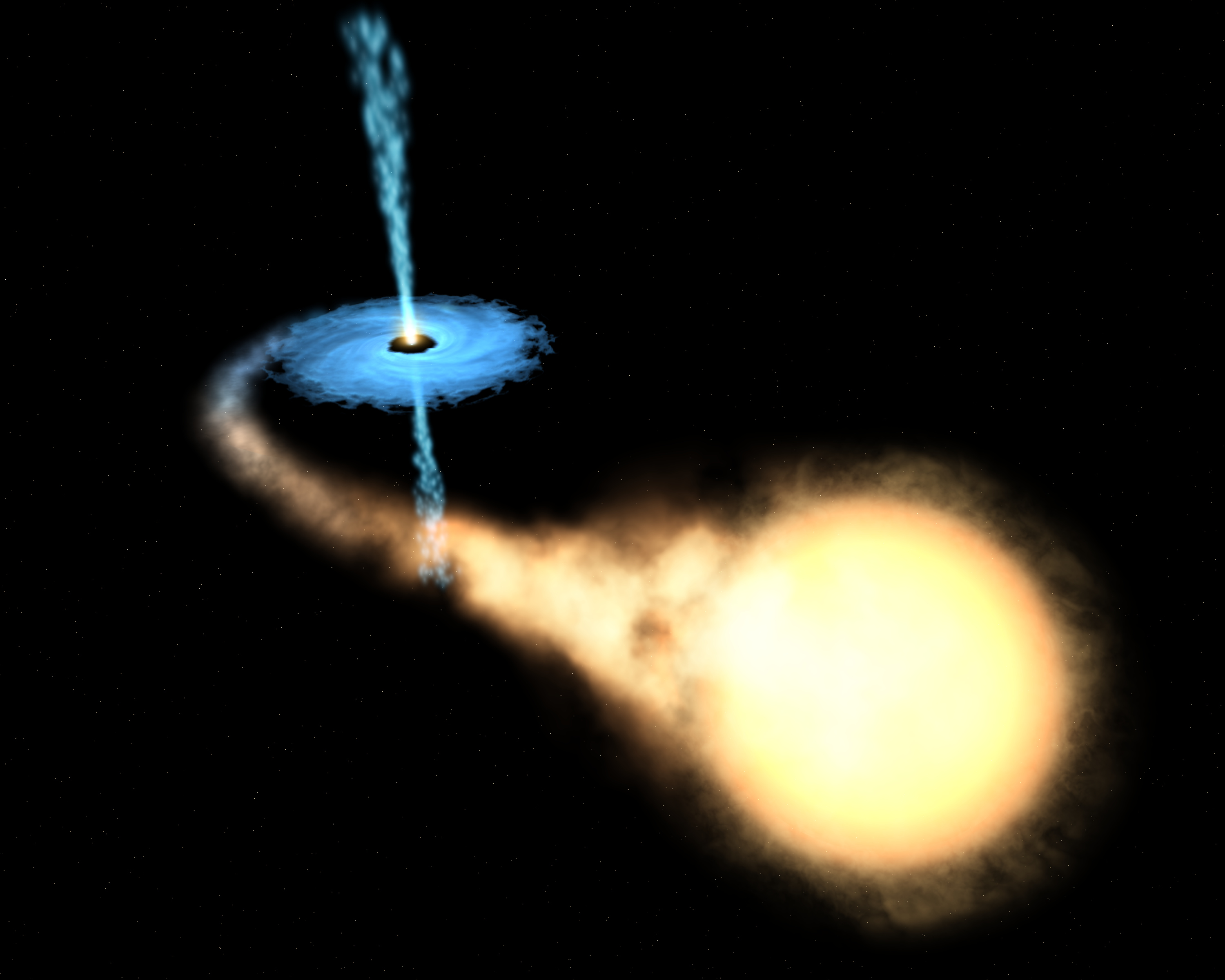
In the case of active galactic nuclei, an incredible amount of energy is released as matter falls into the black hole. Particles are ejected at a significant fraction of the speed of light, transferring energy to the interstellar medium.
Galaxies moving quickly relative to an intergalactic medium can have helical trails, rather than bubbles. The jets precess (wobble) like the Earth or a top, which produces two helical paths. Tracing these paths is used as a tool to study cluster mergers.
http://en.wikipedia.org/wiki/Relativistic_jet http://en.wikipedia.org/wiki/Polar_jet