Chicago resident here. The city making more from parking tickets is not exactly a selling point if you're the one paying them.
Before the deal we had 20-year-old meters which were generally 25 cents or 50 cents per hour (quarters only). Lakefront parking was generally free outside downtown.
After the deal, rates quadrupled or more and many more meters went up, including at the lakefront. Now there is always a worry about whether you're paid up enough to finish a picnic. At least we can pay with credit/debit cards through an app (progress!).
The deal was a con from the beginning to help fill a budget shortfall and every resident who drives felt the effects, and will for the rest of their lives.
What seems to be an economic innovation is also often a political innovation. If Chicago was losing money on parking, they have the obvious remedy of raising the price. But they would face significant political blowback.
So instead they "sell" the parking revenue to a "private" operator who then raises the price. The service provided by the metering company is not just operating the meters but also taking the blame for the cost of parking. This way the city government — i.e. the people in the city government — get to throw up their hands and point at their predecessors.
I don't even think this would be a bad thing if negotiated properly without corruption. Honestly seems like a good solution to the political parking problem
Higher parking rates means fewer people driving, which is a long-term win. I highly doubt this was the top priority for the people who set the Chicago parking rates, but it's actually a good thing for the city.
Yes, you can argue "it just means parking is for rich people" -- to which I'd respond "keep increasing the parking rates, along with some other tactics, and even rich people will turn to other means of transportation."
Here in Amsterdam, the city government is deliberately doing things like raising parking rates, closing streets to car traffic and removing street parking -- all in an effort to reduce car usage.
Two issue -
US is incapable of building transit infra. We should be able, but the last 50 years have shown otherwise. Making driving harder and praying that somehow makes transit good is not a solution, though many cities are now trying that.
I think a lot of Euros misunderestimate (to quote Dubya) how much more extreme North American city climates are. Using wikipedia data, Amsterdam's lowest mean temperature month is January at 3.8C, and highest mean temperature month is July at 18.1C.
Chicago has 3 months below 3.8C per year, in fact it's below 0C for 3 months. Plus 4 months above 18.1C. Some of our climates just aren't terribly comfortable for biking here. NYC is not much better either.
The US has built lots of transportation infrastructure over the last 50 years, including astounding amounts of highways.
I think the bigger issues here are (1) a regulatory environment that heavily disfavors mass transit, and (2) a suburban (and, increasingly, urban) culture that prefers isolation to the risk of "undesirables" brought into their neighborhoods by mass transit.
As a small example of this: DC's metro was conceived a little over 50 years ago, and opened its first line about 47 years ago[1]. It's still expanding, and yet many of its stations are inconveniently placed because the communities it served didn't want DC's plurality black population entering their segregated suburbs[2].
DC metro was falling apart with massive service cuts as recently as like.. last year wasn't it? As I recall they had some massive deferred maintenance on the rolling stock causing derailments.
The DC metro's funding scheme can be most succinctly and politely described as "bonkers"[1]. I brought it up as an example of the US successfully constructing mass transit in the last 50 years, not a shining example of municipal management.
We're talking about Chicago. It already has transit infrastructure.
Would more be better? Sure. But this is a city where many trips can already be as fast or faster via transit than driving, depending on how difficult parking is and how far your "last mile" is.
The big thing that sucks for Chicago is that this shit deal makes it expensive to remove existing street parking and use the space for other things.
Naive question here: Taking out a block of parking would have decreased the City's bottom line already, right? They wouldn't get to collect from those meters. That would have affected the city's budget. The only difference here is that the City will now have to cut a check, but the effect on the City's budget seems similar. The piece I don't know is whether the amount is different, like if the vendor is allowed to raise rates as much as they want and ask the City to reimburse at that rate instead at the rate the City "would have" chargee to park if they'd retained the ownership.
It's an interesting question. I'm just assuming the cost-per-space-removed under this regime is far greater than the lost-revenue-per-space-removed that they would have otherwise suffered, but that's just based on the fact that the deal is known to be especially bad for the city. It stands to reason that they would have gotten screwed on this point as well, but that's just a guess on my part.
I would argue that in general that's probably true but not always. Reducing car trips can also relieve stress on the communities living in these urban communities or improve the quality in specific locations. Here outright banning or discouraging driving is done to improve walkability, reduce noise and quality of stay.
Communities living in cities also need traffic calmed, quieter places nearby. Banning cars here is often a good first step and reuse the street with cafes, restaurants and transportation by bike, public transport and cars only if parked somewhere else.
The U.S. is capable of building transit infra. We are incapable of overcoming multiple nesting, competing, and ensnared layers of local, regional, state, and federal bureaucracies to actually get them built, even when there is a taxpayer desire/mandate for such projects.
That's somewhat true. Government does have the power of eminent domain to ram projects through if they want to (e.g. much interstate highway development). However, the willpower to accomplish may rightfully be tempered (e.g. fatal opposition to interstate spurs in many major cities). A state government, using eminent domain, reserves the right to seize land for "public use", which especially includes interstate highways. A "public use" project providing real, tangible benefit for a region without unsustainable cost burdens for the governed should go through, full send.
That's not to dismiss the value of local advocacy but merely to highlight the careful balancing act performed by government to maintain favor in eyes of its constituents. The fundamental tension between the People and the Government should err toward the People, as long as you place stock in a government "of the people, by the people, for the people."
Transit is a false choice if your trip takes 30 min by car and 2 hours by bus.
This is why I am not a fan of congestion pricing even though I want a more transit oriented US. The US across the board gets less transit for its money than the rest of the world. Until we get costs under control it’s hard to imagine our cities building enough of the right kind of transit.
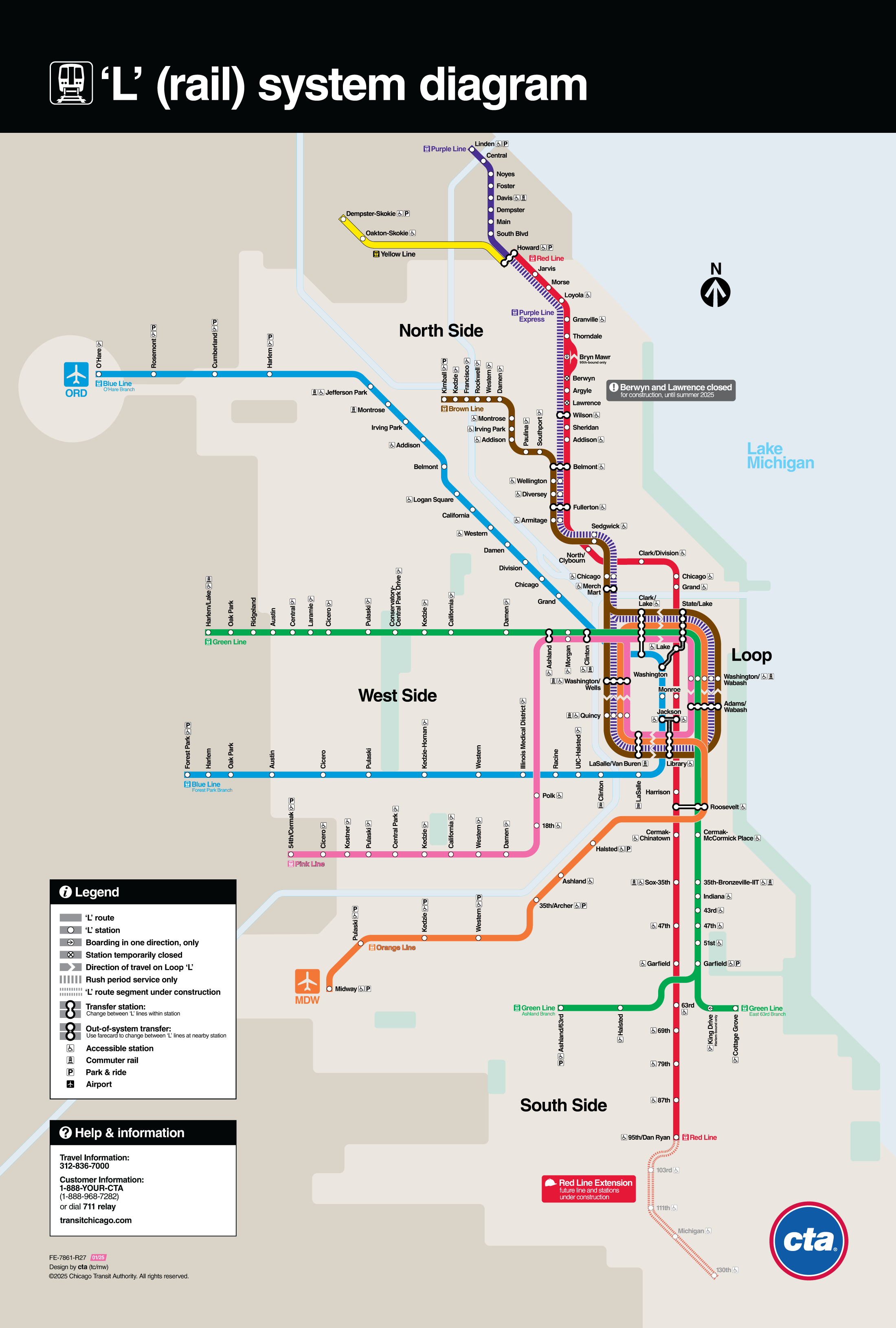
Chicago in particular was frustrating as a tourist as I found pretty much any trip not involving the loop to be tedious and lengthy.
It's not incapable. We used to have massive passenger rail networks 100 years ago. Lobbied interests destroyed them. They can only come back with a fight.
I mean sure, yes.
But the loudest voices right now are the "ban cars" crowd.
Which seems like all that will do is make life even more miserable in hopes of.. then forcing transit to be built?
Congestion pricing in NYC is a convoluted mess with perverse incentives because even the anti-car lobbyists are not actually our friends.
The plan as it stands will actually penalize private car drivers while allowing ubers/lyfts/taxis to enter/exit the congestion zone unlimited times per day for 1 toll fee. Given that Manhattan 9-5 weekday traffic is largely for hire vehicles, this is completely screwed up.
Transportation Alternatives for example, lists 2 of its biggest donors being Lyft & an automated toll/ticketing tech company, lol.
Yes, the car culture of Amsterdam, in one of the most densely populated counties on the planet, surely should be the car culture of a country with endless tracts of land.
Voters (the important part of a democracy, you see) want to drive in the US. Therefore, there should be no attempts to thwart people in that goal.
And to speak to that, Amsterdam has ample places to bike, a strong bike culture, paths, public transportation. It makes sense to remove unused parking spaces, and Amsterdam already has loads of places you cannot drive.
This is not Chicago. Suggesting people remove parking spaces before providing strong, complete, full alternatives, such as extensive piblic transport, and alternatives to cars, should be criminal.
it's not the wrong way because it's not always about the needs of the suburban/commuting community. Reducing car traffic can be a goal itself because it calms the neighbourhood for the community living in the urban areas or enables car-free, walkable zones reused for cafes etc. Those places can often fundamentally not coexist with cars. Parking can also be removed just because it's needed for other infrastructure, e.g. bike lanes. There are many reasons to remove parking spaces.
So I would say that usually it's about providing incentives to use public transit and reduce the incentives to drive, but sometimes it's purely about reducing traffic.
The poster also said that he's a former chicago resident (in his bio it says he's actually from chicago), so he exactly knows what he's talking about.
The poster also said that he's a former chicago resident (in his bio it says he's actually from chicago), so he exactly knows what he's talking about.
That's a logical fallacy.
So I would say that usually it's about providing incentives to use public transit and reduce the incentives to drive, but sometimes it's purely about reducing traffic
It should never be about either of these. Instead, provide public transportation people want to use. Carrot, never stick.
No it's not? It gives him credibility. You can not lecture someone about the car culture in an area they've lived in. He has literally lived there and in his case, as I understood it, even grown up there. It seems like you are suggesting he only knows amsterdam and does not get that chicago is different.
> It should never be about either of these. Instead, provide public transportation people want to use. Carrot, never stick.
This really ignores the effects of car traffic on the communities. Reducing traffic is a valid goal and sometimes the really only goal. It might be because of and unacceptable level of noise, or pollution or something else like an increase in safety for people on foot. Then the current amount of traffic is just not acceptable, you might not care that much if they end up not taking the trip, switching to public transit or driving somewhere else because your only goal was the reduction of car traffic in a specific area. A good example is barcelonas superblock concept, where you minimise through-traffic through specific blocks to enable more walkable, bikeable and livable neighbourhoods for the inhabitants of these urban neighbourhoods. Within reasonable bounds, neighbourhoods should have the ability to limit excessive car traffic in the area they are living in.
The metered street parking right now in LA is usually $0.50-$2.00/hour depending on the area so that seems quite normal to me. Our meters are pretty good too and you can pay in coins or card: https://ladotparking.org/parking-meters/single-multi-space-m...
In much of Europe, rather than cheap 50¢/hr or whatever parking, it's more common to have no fee but still a time limit. (Or, in city centres, a high fee and a time limit.)
Free/cheap parking is a driving subsidy. In fact the old prices were even worse than that; the prices were not high enough to actually keep spaces available, so it ended up being more like a lottery system. The correct solution would have been to just raise prices and fix enforcement, but the city dug themselves into such a financial and political hole that it wasn't feasible to do without the sale.


Before the deal we had 20-year-old meters which were generally 25 cents or 50 cents per hour (quarters only). Lakefront parking was generally free outside downtown.
After the deal, rates quadrupled or more and many more meters went up, including at the lakefront. Now there is always a worry about whether you're paid up enough to finish a picnic. At least we can pay with credit/debit cards through an app (progress!).
The deal was a con from the beginning to help fill a budget shortfall and every resident who drives felt the effects, and will for the rest of their lives.