Can someone help me understand why when there’s a record cold month, there’s a convo like this
> non-believer: “see global warming doesn’t exist”
> believer: “you can’t measure this on a monthly scale, it’s too slow of a process”
But often when the case is reversed, it’s used as evidence of global warming? I know global warming is real and I am a firm believer in it but this duality seems to cause a lot of issues when discussing global warming.
It's not, taken in complete isolation, evidence for global warming. It's an example of it. When people call something evidence in this sense, they mean it colloquially - that it is an exemplar of an overall body of evidence that points in a particular direction. The record cold month is part of the same body of evidence that, overall, points to the existence of global warming, but it isn't an exemplar of that evidence, so it doesn't get called "evidence" colloquially.
Similarly, an individual fossil might be called evidence of evolution, but nobody thinks you should take this one fossil as a knockdown argument that evolution is real. On the other hand, when a strange fossil that's anomalous with the rest of the record is uncovered, a creationist might call this "evidence that evolution is false", but just as in the record cold month case, it's correct to point out that you shouldn't be looking at individual fossils.
So what's happening here is that people are using the word "evidence" in a rather casual manner. Properly, what we're talking about here is an example, and in this case it's a very pertinent example because people have been given a concrete picture of what the world might look like on a regular basis in the near future.
(Obviously there are some members of the public who really do think a single month is proof of global warming, or vice versa, but I'm trying not to strawman anyone here.)
> you can’t measure this on a monthly scale, it’s too slow of a process
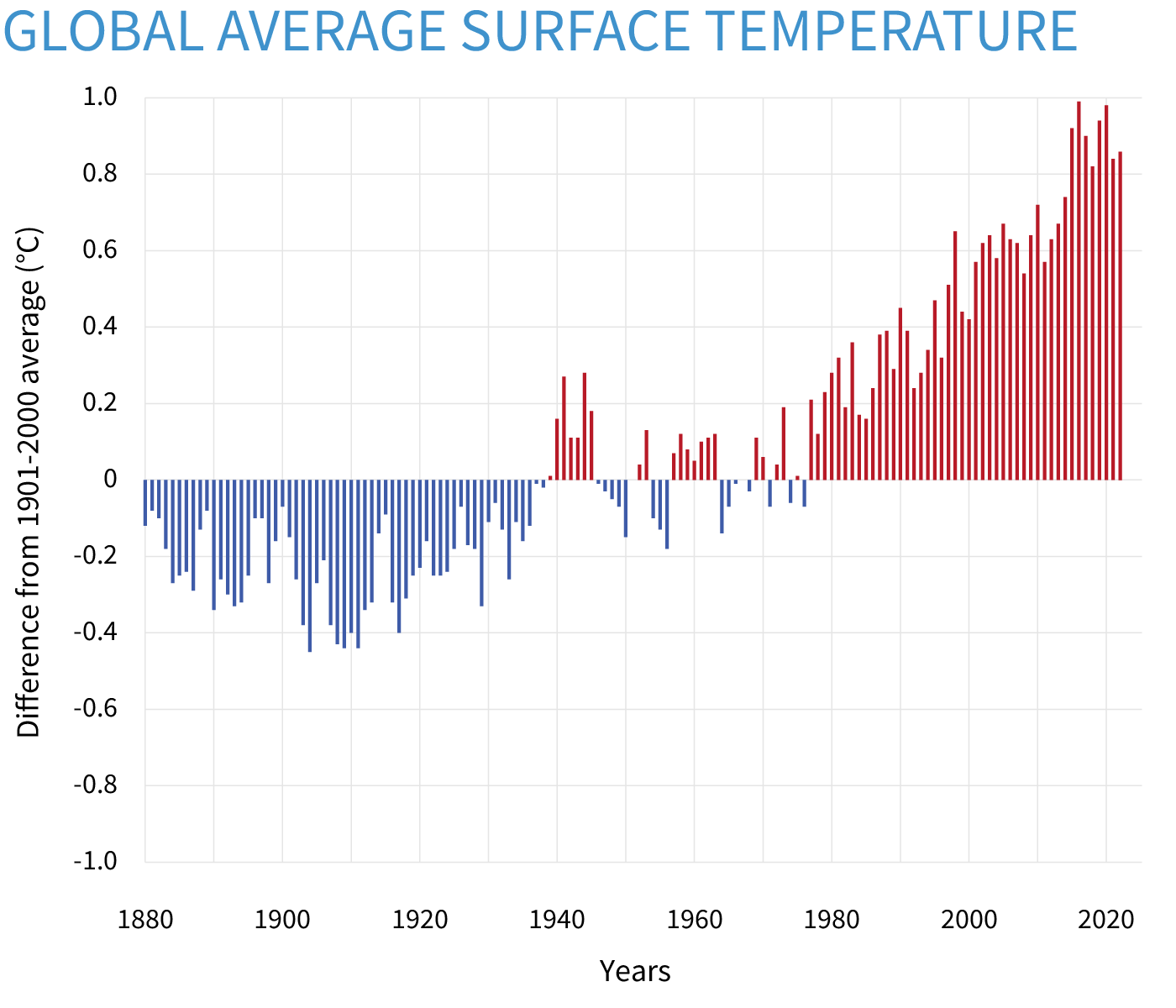
You can somewhat measure global warming on a monthly scale. Just graph the last 100 years in average monthly temperatures and you will see a graph going steadily up. So it will be with a longer scale. In that sense, global warming is a longer process, yes. The problem with that is not that "you can't measure it". It's that explaining it to a non-believer does not fit on a tweet, and it counterdicts everything that they have been told from the media they consume.
A metaphor that can help is talking about overwheight.
If you have been gaining weight for years and then you do one of those "detox diets" and lose 2 kilograms in one month, but then you gain them back the next week, and another one the week after, you are not "losing weight". The curve went slightly downwards and then continued going up.
Similarly, if you have been steadily losing weight for years and then have some friends visit and you eat out a lot during that week and you gain some weight but you lose it again in the following weeks, you are still "losing weight". The curve went up a little bit but then it went down.
So the thing you are missing is the context we can talk about individual ups and downs, but they are meaningless without being put in the bigger context.
Has that kind of metaphor ever helped in a real case/conversation you know of?
The metaphor illustrates how what you're saying might be true and helps understand what you mean. Somebody who disagrees usually understands what you mean by "it's getting warmer". They just don't believe it. At least that's my experience.
Convincing someone in such matters is completely impossible unless there is a prior personal relationship of trust and respect. Even then it's very hard.
The reason this sometimes work is not because it objectively should. It's because it helps the other person relate.
It's way more difficult to convince someone of something if they already see you as "their ideological opposite". It's a chasm too wide to cross for most of us humans.
The "gaining weight" conversation is something that they understand, probably have experienced themselves, or have seen their spouse try. It's not something that can be perceived as coming from the "scientist caste" (this is a real term I have heard used). You are less of an opponent and more of a next-door-guy trying to explain something.
It's a bridge that you lay over the chasm. They still need to walk over it, though.
I'm sure there's some sports argument that can be laid out in a similar fashion.
Trying to convince someone opposite of something they really really believe in has a very low probability of success, you will just ground them more into their belief. There are different pathways, but they take empathy and patience, some traits a lot of people lack when communicating with counter parties.
You can convince people, but you can’t do it with a simple online post. Proselytism covers a wide range of tactics that convince people to change deeply held beliefs independent of how accurate what you’re trying to convince them is. Science has a major advantage here because you can provide actual evidence, but you don’t need to limit yourself to using evidence alone.
At the extreme end deprogramming the is often referred to in terms of ‘cult deprogramming’ but it’s more widely applicable and more effective than it has any right to be. Clearly unacceptable in this context, but worth understanding from a psychological perspective.
You can get centrists over to your side, or people with loosely held beliefs. You aren't getting 99% of the extremists.
Proselytization likely works most effectively on the above groups, and while it might be a big win to convert 1 X believer to a Y believer, you could probably just convert 10 non-believers into Y much more effectively.
Deprogramming sounds exactly the opposite of 'empathy and patience'.
I bring this stuff up to promote empathy and patience.
Yelling at the uneducated may be enjoyable but it’s not effective. On the other hand understanding why people come to these conclusions can help you minimize the number of people coming to wildly incorrect conclusions. Because the issue isn’t just climate change alone, we also need to deal with antibiotic resistance, corruption, infectious diseases, and all the other complex problems faced by modern societies.
Agreed! Depending on your definition of 'modern society', I would say that pretty much all of those complex problems have been around for as long as humans have found a way to organize.
Because almost everyone who remembers a global record cold month is dead. Compare to record global hot months where the only living people who don't remember several are young children.
Take a look at this NOAA report for August 2023 [1], and scroll down to the chart showing August temperature anomalies going back to 1850.
The last record low August was in 1911. We've had 45 consecutive Augusts that were above the 20th century average.
That's how it is for all months. E.g. for January the last record low was around 1895, and we've had 47 consecutive Januaries above the 20th century average.
We are currently up to 534 consecutive months above 20th century average.
The pattern is similar for years. The last global record cold year was 1904.
Do we ever record record cold months on a global scale?
My understanding is that globally, we keep seeing record warm months. Perhaps locally there are some record cold months but that's much less _news_ than the entre global average.
Thanks for the sourced data. It is amazing and saddening to see so much “I assume record colds happen all the time too, but we never hear about them, so that’s proof of some kind of bias, which makes me question global warming” in this thread.
Have there actually be any global record cold months in the 21st century? Sure, we have months that are cooler than our (elevated) average, but I don't think we're breaking any records.
On the other hand, "hottest month ever" is not uncommon to hear. That plus the fact that we are trending in the wrong direction might be cause for alarm.
Things were slightly cooler 1920s &30s as soot increased in the air, true warming began in the 1980s and has really taken off over the last 25 years. For reference we haven't béen above 380 ppm of CO2 in 100s of thousands of years. Last time the Earth was above 420 ppm (we are now over 425 ppm), global average temperature was 20 degrees hotter. Things are going to get crazy next few years. It won't be a slight warming, it will be devastating to our food supplies.
1. please a reference to these record cold months and related discussions? curious, iirc see them starting more go the other way round, always. (what I remember, actually when was the last one really? Cause I only remember local record cold ones).
2. it is a trend and usually never one example put up as evidence, but the trend/frequency is unfortunateley clear?
It's generally local events. I remember some time ago when the north pole got so warm that the polar vortex collapsed and ice cold polar weather spread south across the central US, leading to blizzards in Texas.
That may have been record cold in Texas, but it was caused by record heat on the north pole. But people experience local extremes much more than global extremes, which are generally just statistics. And more people live in Texas than on the North Pole.
The increase in global climate energy initially called 'warming' means putting more energy into a titanic chaotic system.
When you do that, BOTH extremes become more extreme, not just 'warm' ones. Though hot temperatures are dangerous, it's not just about heat spikes, it's about the consequences of the increased energy available to the chaotic system.
This energy can just as easily be expressed in a brutal, dangerous cold snap, or an unreasonably huge storm. The 'non-believer' is so fundamentally wrong that it's impossible to discuss with them, and the global climate is not subject to their primitive understanding of what 'warm' is.
If it makes you feel any better, this September may have been the hottest of the past 100 years, but it will probably be the coldest of the next 100 years.
It is not an one-off or local event. It is part of a trend and not an isolated event. All the previous months were pretty hot or directly record breaking, and the trend seem to be going to even higher extremes, specially at global scale.
Because the correct answer from the believer is "it's called climate change not global warming and it's expected to cause new extremes in both directions"
Well, sort of. It's still global warming, it just makes things weird enough that you'll see local extrema in either direction. Globally though, we're only seeing extremes in one direction.
One data point doesn't contradict a trend. It doesn't confirm the trend either, but does provide support for it.
Just look at the chart at the top of the article. The world isn't cooling down, and one slightly cooler month isn't any evidence that the trend will reverse itself, it just demonstrates that the trend isn't monotonic.
In June 2023, none of the Earth’s surface had record cold, year-to-date.
Tangent:
I have a very good source for this fact, however searching will not reveal it. The current state of search is horrible. I'm interested if anyone can find it. I'll link to it later this evening.
1. "In June" or "As of June" really makes a difference. I wouldn't expect record breaking lows northern hemisphere summer, where 2/3rds of the land is.
2. Is it typical to have a record-breaking cold every year? Why is this even notable?
I didn't find your source, but NOAA's June '23 climate report says "No state experienced a top-10 coldest June on record for this six-month period," so that's something, but it's just for the US. But it also says it was a pretty mixed bag: "Above-average temperatures were observed across much of the eastern contiguous U.S. and in parts of the Northwest. Near- to below-average temperatures were observed from the northern Plains to the West Coast."
While the refutations of this guy seem scientifically sound, they are tone deaf. He’s speaking to perceptions. There is a problem with how the issue is communicated in common parlance.
It’s hard to keep up with the climate change denial propaganda noise machine without stooping to their level. In the end motivated reasoning means people will value cheap hydrocarbon energy over global benefits of less climate change. Just look at the French gilet jaunes protests.
a. X claims he didn't have enough money to live well.
and
b. The only way for X to reach his workplace is to consume a more and more expensive resource.
"Change job", " work more", "live somewhere else" are not good advices because X is often unqualified, works already a lot and cannot afford a place inside the town where he works.
What should X do ?
The necessity of consumption is a bigger problem than "we consume to much hydrocarbon energy".
People don't value cheap hydrocarbon energy over the future of earth, but they value their own life, and no solution exists, for a lot of regions in france, to allow you to cease using your car.
In some places solutions are implemented in a weird manner, I personally had to take the bus at 5 am to go to " Lycée", where most of my courses began around 9-10am (if there were courses the morning) and then at 8pm to go back home (I was home at 9h30pm approximately, depending on the traffic).
Lycée was great, now if I had to do this before and after a day of work, it would highly resemble what I call "a boring life".
But still, while 3 hours or more in my life were dedicated to " transit" and a lot of time in the morning was dedicated to "wait", other people living in the city were just sleeping in the morning and probably reading their lessons or socializing.
Bus was taking a lot more time than cars to commute is these regions because there's a lot of villages to connect to the town. (My village was the last of the line). As of today, there is still only two bus that connects the village to the town, one in the morning at 5am, and one in the night, at 8pm.
X could first of all stop voting for people who scream "This isn't real" and start voting for people who say "We can do something about this"
But they won't do that, because X doesn't think the climate is actually changing from human actions because they have picked one of the several half-assed narratives that claim to "prove" it.
Right. When the society makes driving easy and alternatives hard people rationally choose to drive. Government sponsored roads and parking tip the scales heavily in favor of cars. The solution is to add infrastructure so less driving is necessary. More centrally located housing. Walkable distances between destinations thanks to a not spread out city layout. Sidewalks, safe ways to cross the street, safe bike lanes, frequently arriving buses and trains. This is exactly what 15 minute cities are about!
Daily (or even monthly) temperature variance doesn't allow you to see the slow but steady increase in the global average. People aware of the impact of the climate crisis probably tend to notice the above-average warm days more than they notice the below-average cold days.
Humans are not thinking machines. We're feeling machines. That's why we need hard data to make good decisions.
Not really. Post-modernism is kind of silly when it tries to deny reality. Good luck deconstructing narratives or whatever when you're starving due to crop failures from climate change.
AFAICS mc42 is arguing that we need more watertight arguments for why we need climate change mitigation, so that deniers can't use the holes in our arguments to deny climate change is happening (or anthropogenic)
> The poster was asking why certain things are omitted and only things the support an argument are surfaced
That's just not a helpful comment. It's like someone barging into a murder investigation and saying "Why are aliens being omitted? The narrative is omitting them!"
It was a lot of words to say “perception is more important than reality”, and delivered in an oblique way hinting at some unstated “narrative” going on, without either explicitly making that point or providing evidence. Kind of the HN equivalent of the angsty teen who will only say “that’s what YOU think” to everyone.
The poster was asking why certain things are omitted and only things the support an argument are surfaced. The reason is it tends to undermine a given narrative. People are convinced of things via narrative. Both good and bad things.
It’s not an oblique criticism of climate change. It’s a comment on why narratives don’t tend to be objective.
For the same reason that in the winter the weather people tell you the temperature, but then are sure to include the windchill factor (which makes it sound worse). In the summer they tell you the temperature and be sure to include the "real feel", which includes the heat index and makes it sound worse. Arguably, in the winter there's still a heat index and in the summer a wind chill, but that would make the news sound good, and mess up the whole strategy.
Bad news sells. Mostly it's totally made up BS. Global warming is another made up tragedy to distract us from real issues like wars, poverty, wealth disparity, care for the elderly and mentally ill, etc.
> Global warming is another made up tragedy to distract us from real issues like wars, poverty, wealth disparity, care for the elderly and mentally ill, etc.
Here I am contemplating whether to "waste" my time trying to tell someone on the Internet they're wrong, or just shake my head at the "deluded idiot" (my point of view, it could be wrong) and go on with my day. I wonder what the dangers are of people doing the latter and people walking around confidently with "false beliefs" (again, my point of view, could be wrong)
But you mention wars, don't you notice how weather has had a big effect? For example there was a bad Russian heatwave in 2010 which destroyed grain yields. Food prices all over the world went up, and in north African countries this contributed to the Arab Spring revolutions [1]. Is it just a freak weather event? Can we attribute it to climate change? Can't we accept digging up carbon/methane and burning it creates an atmosphere/planet that slowly becomes inhospitable to humans?
Well, I also want to talk about refugees fleeing crisis countries, but I'm too lazy to look up the citations right now. I contemplated just abandoning this reply because of that. This sounds obnoxious but consider it a gift that someone is still willing to tell you that you might be mistaken, rather than shake their head at what you wrote and walking away unnoticedly.
>Is it just a freak weather event? Can we attribute it to climate change? Can't we accept digging up carbon/methane and burning it creates an atmosphere/planet that slowly becomes inhospitable to humans?
I think it's all 3. The problem is that, like anything remotely political in our current environment, one side says it's 100% one source, and the other says it's 0%.
The transition is going to be very expensive, and normal people (hardly getting by) aren't willing to get even poorer when they can't be sure it will help in the grand scheme. Our leaders are doing nothing but talk, they're the worst individual offenders. And globally, there's a "tragedy of the commons issue" at the Nation level, where those who continue to burn fossil fuels are going to get ahead.
Until these things are addressed, telling us repeatedly that it's getting warmer falls on deaf ears.
People often claim this, but I don't think it's true. I think news organisations on average underplay the threat from climate change.
What actually sells is confirming people's world view. Telling people "everything's fine, look at these silly scientists panicking over nothing" seems very popular with a large segment of the population.
I haven't watched recently but at least in the USA, local news is always a parade of crimes, accidents and fires with sports and weather to round out the 22 minute run time, but as you write, climate change was non existent since it's hard to adapt to the few minutes of video and sentences each story got. One would get the impression that there is a lot of crime and fires in the local area from the sampling bias, and my understanding is this where a large percentage of old people and less educated get their news so it sort of reinforces a lack of urgency to these people about climate change.



> non-believer: “see global warming doesn’t exist” > believer: “you can’t measure this on a monthly scale, it’s too slow of a process”
But often when the case is reversed, it’s used as evidence of global warming? I know global warming is real and I am a firm believer in it but this duality seems to cause a lot of issues when discussing global warming.