For a little bit of context for how impressive this is, here's my take on it with a consumer grade 8" Newtonian telescope from my backyard: https://www.astrobin.com/full/w4tjwt/0/
You already noticed the technical card [1], but I can describe some of the details that go into this for those unfamiliar with the items on it.
1. The scope they used is roughly equivalent to shooting with an 800mm telephoto lens. But the fact that it's 8" wide means it can let in a lot of light.
2. The camera [2] is a cooled monochrome camera. Sensor heat is a major source of noise, so the idea is to cool the sensor to -10deg (C) to reduce that noise. Shooting in mono allows you shoot each color channel separately, with filters that correspond to the precise wavelengths of light that are dominant in the object you're shooting and ideally minimize wavelengths present in light pollution or the moon. Monochrome also allows you to make use of the full sensor rather than splitting the light up between each channel. These cameras also have other favorable low-light noise properties, like large pixels and deep wells.
3. The mount is an EQ6-R pro (same mount I use!) and this is effectively a tripod that rotates counter to the Earth's spin. Without this, stars would look like curved streaks across the image. Combined with other aspects of the setup, the mount can also point the camera to a specific spot in the sky and keep the object in frame very precisely.
4. The set of filters they used are interesting! Typically, people shoot with RGB (for things like galaxies that use the full spectrum of visible light) or HSO (very narrow slices of the red, yellow, and blue parts of the visible spectrum, better for nebulas composed of gas emitting and reflecting light at specific wavelengths). The image was shot with a combination: a 3nm H-Alpha filter captures that red dusty nebulosity in the image and, for a target like the horsehead nebula, has a really high signal-to-noise ratio. The RGB filters were presumably for the star colors and to incorporate the blue from Alnitak into the image. The processing here was really tasteful in my opinion. It says this was shot from a Bortle-7 location, so that ultra narrow 3nm filter is cutting out a significant amount of light pollution. These are impressive results for such a bright location.
5. They most likely used a secondary camera whose sole purpose is to guide the mount and keep it pointed at the target object. The basic idea is try to put the center of some small star into some pixel. If during a frame that star moves a pixel to the right, it'll send an instruction to the mount to compensate and put it back to its original pixel. The guide camera isn't on the technical card, but they're using PHD2 software for guiding which basically necessitates that. The guide camera could have its own scope, or be integrated into the main scope by stealing a little bit of the light using a prism.
6. Lastly, it looks like most of the editing was done using Pixinsight. This allows each filter to be assigned to various color channels, alignment and averaging of the 93 exposures shot over 10 hours across 3 nights, subtraction of the sensor noise pattern using dark frames, removal of dust/scratches/imperfections from flat frames, and whatever other edits to reduce gradients/noise and color calibration that went into creating the final image.
Thanks! I hadn't gotten to writing this out, but you've pretty much nailed it.
> They most likely used a secondary camera whose sole purpose is to guide the mount and keep it pointed at the target object.
I did use a guide camera with an off-axis guider, I'm not sure why it wasn't in the equipment list. I've added it.
> The RGB filters were presumably for the star colors and to incorporate the blue from Alnitak into the image.
This is primarily an RGB image, so the RGB filters were used for more than the star colors. This is a proper true color image. I could get away with doing that from my location because this target is so bright. The HA filter was used as a luminance/detail layer. That gave me a bunch of detail that my local light pollution would hide, and let me pick up on that really wispy stuff in the upper right :)
> The processing here was really tasteful in my opinion.
Ah, of course it's HaRGB. Really cool. I'm curious, you de-star the color layers or leave them as is when combining channels? When I've tried HaRGB, the Ha layer has the best/smallest stars which means that the RGB color layers end up leaving rings of color on the background around each star.
I don't remember exactly what I did, but I do remember running into that kind of problem. I probably used starnet2 to remove stars before doing much processing, and recombining stars towards the end.
"Do you mind sharing more about the equipment and process"
I'm sorry, but this is making me laugh so hard. I don't know a lot about astrophotography, but one thing I've experienced so far is that astrophotographers love to talk about their equipment and process.
It's like asking a grandparent, "Oh, do you have pictures of your grandkids?" It kind of makes their day. :)
Haha, yeah. I could go on for hours. I've had to learn that most people really don't want a lecture series on the finer points of astrophotography. Seabass's comment was pretty much perfect; a bit of detail, but not so much to get lost in the detail.
I tried to write a quick comment on my process a couple of times before they posted, and each time I had way too many words on a small detail.
That’s super cool!!! Looks like quite a niche/technical hobby with amazing output. Do you mind sharing how much equipment costs to get similar results?
It's a wonderful niche/technical hobby, but it's not cheap. You could even say it's "pay to win". I didn't buy all of my stuff at once, and I had some mistakes, but I'd guess I use on the order of $10k in equipment.
Just to follow on, you can gets started with quite a bit less. My dad took a stab at some basic shots with his prosumer Nikon and a basic tracking tripod.
That's still $1000 body, $1000 glass, $500 tripod, give or take. So far from cheap if you're starting from scratch. But if you already have a body and some glass, it's not a stretch. Or, if you're ok with hunting for used gear, the body and glass can be ~half off new retail.
I'm assuming that'd be a non-moving/automated tripod?
I have a d850 full-frame DSLR and either a 200mm 2.8 or 500mm 5.6, with some decent tripods; but earth's rotation tends to get me pretty quickly with any long-exposure photos :(
I've seen some pretty impressive stuff done with a relatively cheap / simple DSLR setup.
The basics of astrophotography aren't that expensive, but it gets exponentially more expensive to meaningfully "zoom in". Because DSLRs with typical lenses are pretty zoomed out you can get away with much cheaper gear. You might look into getting a "star tracker". It's like a telescope mount for a camera; it'll keep the still relative to the stars but because they don't need to be as accurate they're far cheaper to make. They'll probably work just fine for your 200mm 2.8 lens for a fraction of the cost of a mount.
I think it's rotating, but doesn't have a secondary camera as described above. Maybe he spent more than $500, but I tend to doubt it, but I'm also not sure of the specifics beyond he's using a crop-frame Nikon DSLR with a lens he already had for birding (I think).
I mean I don't know if I'm more impressed by their level of detail from a $10 billion telescope or your level of detail from a consumer-grade telescope!
The James Webb image shows a level of detail we have never seen before. Hundreds of galaxies in the background that are invisible on the consumer grade telescope.
Oh, don't get me wrong, I am absolutely astounded by the JWST's level of detail and am in awe of the pictures it takes. And they are obviously far more detailed than the OP's. I also think it was a worthy expense. I was just noting that my awe of both is comparable when you normalize for cost!
Once in a while, I have the impulse to buy the equipment to make these kinds of photos, then I check the price (at least 4k USD), realize I am not from US and cool down tell next time.


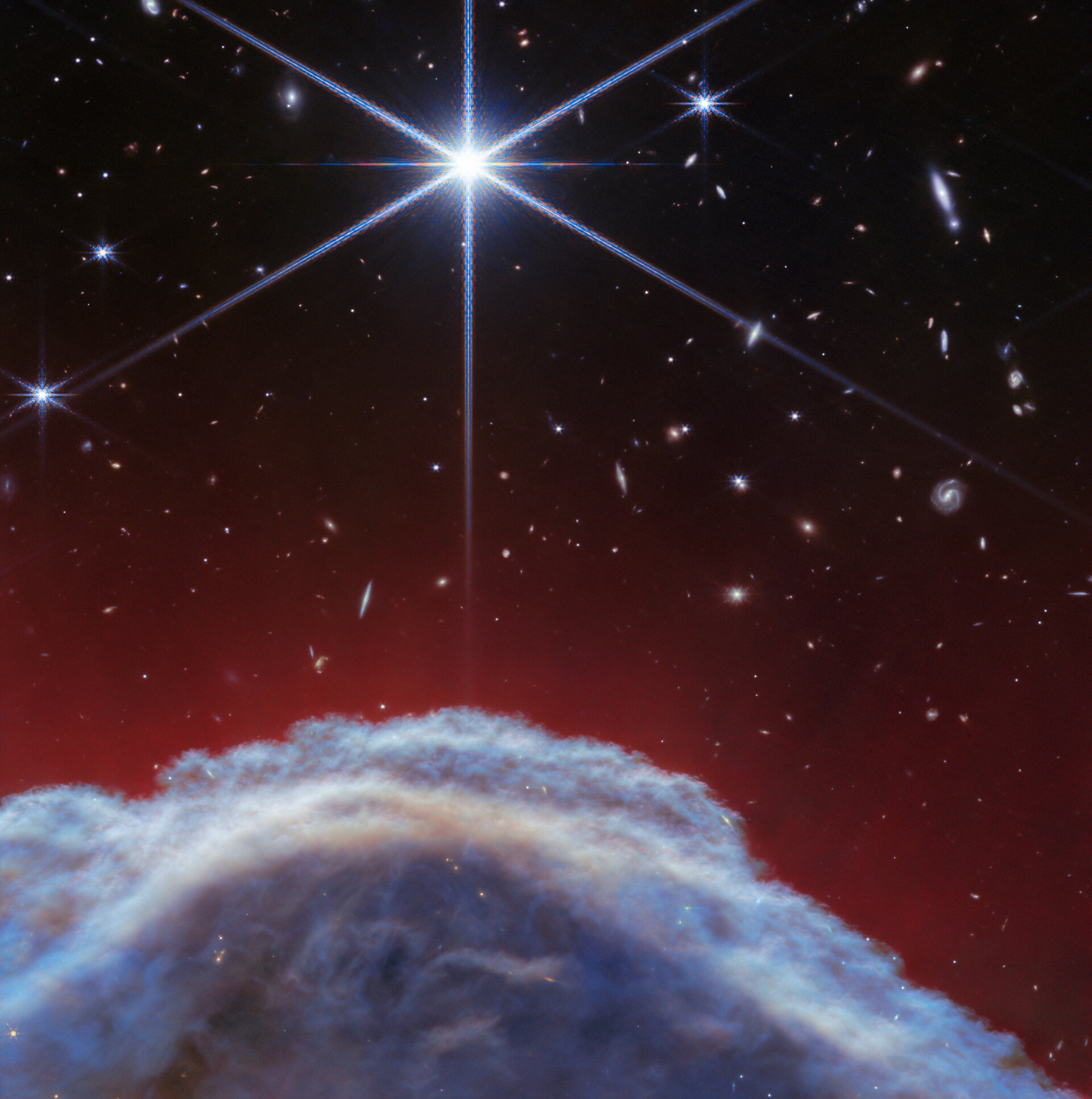
For a little bit of context for how impressive this is, here's my take on it with a consumer grade 8" Newtonian telescope from my backyard: https://www.astrobin.com/full/w4tjwt/0/