Well, it's a panorama. If the light source (sun) is located in the 'missing' portion of the panorama, then you would expect the different shadows on either side of the missing bit. This is consistent with the apparent shadow under the buggy.
Here's a terrestrial example of the madness that happens to shadows (and geometry in general)with panoramas. It's partly less obvious on the moon since it lacks familiar references.
Many features in moon photographs are bizarre, I don't blame the nuts too much...
In this crop from a panorama, for example, the rover seems completely out of proportion, like a miniature: http://cl.ly/3M0v0S3R2M2N3h180Q1W
Compare the size of the footprint and the stones in the left side, to the stones near the rover. Either the moon has some weird rock distributions, the image is highly deformed, or this is a fake :) The fact that for multiple generations we haven't been up there again just contributes to the idea.
That photo is obviously a composite of multiple shots. You see strange deformations like that all the time in composite shots.
If we apply Occam's razor, the simplest explanation is that they went to the moon. Over 350,000 people were involved at a total cost of $140 billion of todays dollars. I've never heard anyone deny that we had the capability to land on the moon. The rockets, vehicles and astronauts were all real. The evidence is too monumental. For the moon landings to be a hoax, it would require everything that it takes to complete the mission and an extra group of people to do all the work of faking it.
Agreed. People seem to overestimate the power of the government to fake things. If it was that easy to pull off a hoax of that magnitude, it is quite likely that WMDs would have been "found" in Iraq after the invasion.
A few factors contribute to that photo's impression. Aside from being a composite:
- There's no atmosphere on the moon. Which means there's no distance haze. Far objects are just as sharp as near ones.
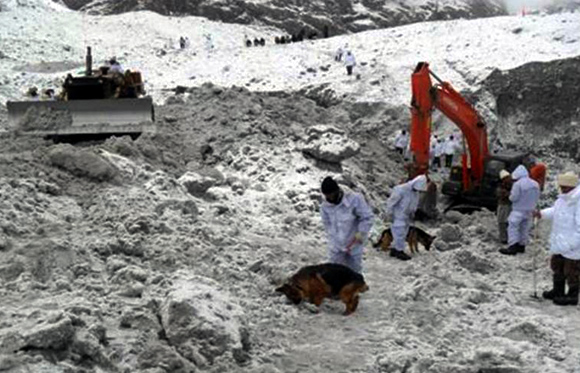
- There are no reference points to indicate scale. This is fairly common in terrestrial photos of barren landscapes, especially Alpine, Arctic, or glacial photos. In this image of a Pakistani landslide, note the apparently diminuitive size of the earth moving equipment and background figures: http://blogs.agu.org/landslideblog/files/2012/04/12_04-Siach...
Agreed, but the rocks should serve as a good enough reference. The effect on that moon shot would require rock sizes to increase almost linearly with distance - rocks are a foot wide near the camera but half-meter wide afar - which is extremely odd.
(of course I believe that to be an artifact of image stitching and perspective corrections, what I meant is that it's easy to misinterpret these oddities)
Rock sizes follow a regular distribution of some sort, most likely a power function / Poisson distribution. So, nearby, you'll have a lot of smaller rocks, further away you'll have a reasonable number of larger ones. For moderate-field views (such as the image shown) this may not show much difference.
Other factors of the moon: there's no weathering action, absent meteor impacts and very slow microparticle weathering, but this is taking place over hundreds of millions to billions of years. Where rocks of different sizes on earth will weather quickly (tens to millions of years depending on rain, freeze/thaw, wind, organic (lichen, bacteria) actions, etc.), this doesn't happen on the moon.
Upshot: near small rocks look very much like far large rocks.
And again, in alpine or desert landscapes without notable organic features (plants, animals) or human structures (roads, buildings), it can be very, very difficult to estimate range.