> So the struts (plus supporting structure) are lighter than the legs? Why is that?
Besides the other answers you've received, the lugs hold the booster from (near) the top. This means that the body of the booster is in tension during and after landing. Legs, on the other hand, support the landing load and weight after loading in compression. The booster is basically a thin-shelled tube, which is limited in compression strength (for a given wall thickness) by buckling; in tension, the strength approaches the strength of the material, so less additional reinforcement is needed in the structure to support landing loads.
Ok, so I was right: Does this end up being more efficient because more of the loading is in tension instead of compression?
This bugged me because everyone was saying the deletion of legs was key, but to me the struts are basically legs mounted up high. It's taking advantage of tensile loading that promotes the weight reduction.
the other big difference is that legs need to extend below the engine which means they need up move, which makes them much bigger and more complicated than the catch pins
The booster is already strong enough to support itself in compression, because that's what it does during ascent and the landing burn. The entire bottom structure of a rocket (the "octaweb" for F9) is basically made to transfer the thrust compression loads of the engines into the tanks.
Pressurized with what? They've already used their fuel for the landing. They can't put anything else in the tanks without worrying about contamination for the next flight.
Pressurization gases? The fuel goes from tanks to engines (engine pumps) because tanks are under pressure, right? Even if the liquids are spent - they are rarely spent in full - the gases remain.
They autogenously pressurize the tanks - they heat up the cryogenic propellants with the engines and use some of the gas to pressurize the tanks. In Starship’s case it’s methane and oxygen.
Which doesn't show the design constraints but who wants those - edit and it's not an image of the booster? Elon mentions a design feature missing from the diagram: https://x.com/elonmusk/status/1093643894917492736
I would personally guess you'd need to be very careful with your implied load bearing connections between the tanks at x Kelvin and the skin at redhot reentry temperatures...
Good luck on buying spaceY.com and competing against those engineering fools at SpaceX ;)
I am mocking unreasonably, and I know I would find similar comments in my own internet history. I am hoping you will learn to be a little less thoughtless in your armchair. We all assume other rocket-science engineers must not know what they are doing but usually that just shows our own ignorance.
Let me explain once more :) . The original post which I was replying to was
-----
> So the struts (plus supporting structure) are lighter than the legs? Why is that?
Besides the other answers you've received, the lugs hold the booster from (near) the top. This means that the body of the booster is in tension during and after landing. Legs, on the other hand, support the landing load and weight after loading in compression. The booster is basically a thin-shelled tube, which is limited in compression strength (for a given wall thickness) by buckling; in tension, the strength approaches the strength of the material, so less additional reinforcement is needed in the structure to support landing loads.
-----
Note how the author says that a thin-shelled tube is limited in compression strength by buckling. Technically it's correct, but practically if you put some extra pressure in that tube - which, after all, has also airtight caps on both ends - then the tube becomes much stronger, and is able to withstand reasonable forces during landing.
That's what I noted, and I can repeat that. I am quite sure SpaceX engineers considered that possibility, and I think they rejected that because they felt they see an even better result. I'm trying to see that here.
I also suspect that you don't know my qualifications in the area, and referring to armchair ones just so. It's interesting how many different and widely qualified people participate in HN discussions.
You know, that's completely unimportant. The important parts are that 1) Starship stage is under pressure when landing and 2) pressurization makes a thin-walled metal cylinder much stronger resisting buckling. Details of how Starship works and how pressurization is historically used to increase strength are just to support these two points. But if you already have these two points, you should admit that the argument "Starship can't land on legs because there's too big of a risk of buckling" has some counterarguments. And the overall decision isn't as clear as we'd like to have it.
Actually, it is very important. Autogenous pressurization has a much higher risk of pressurization loss than a system which uses inert gases, due to the potential for the ullage gases to mix with the liquid fuel and condense.
This is relevant when designing the landing system.
The same, its just a much higher proportion of gas rather then liquid. Basically on the pad its mostly full with liquid, as it launches, it pumps back part of the gas created in the engine back into the tank. That called 'Autogenous pressurization'. So they don't need an extra gas like helium, as for example Falcon 9 needs.
The big issue during landing is that you need to make sure that the engine doesn't suck in gas. That causes bubbles and can destroy the engine. This was actually the failure that caused some of the earlier SN flights to explode or not produce enough power from the engine.
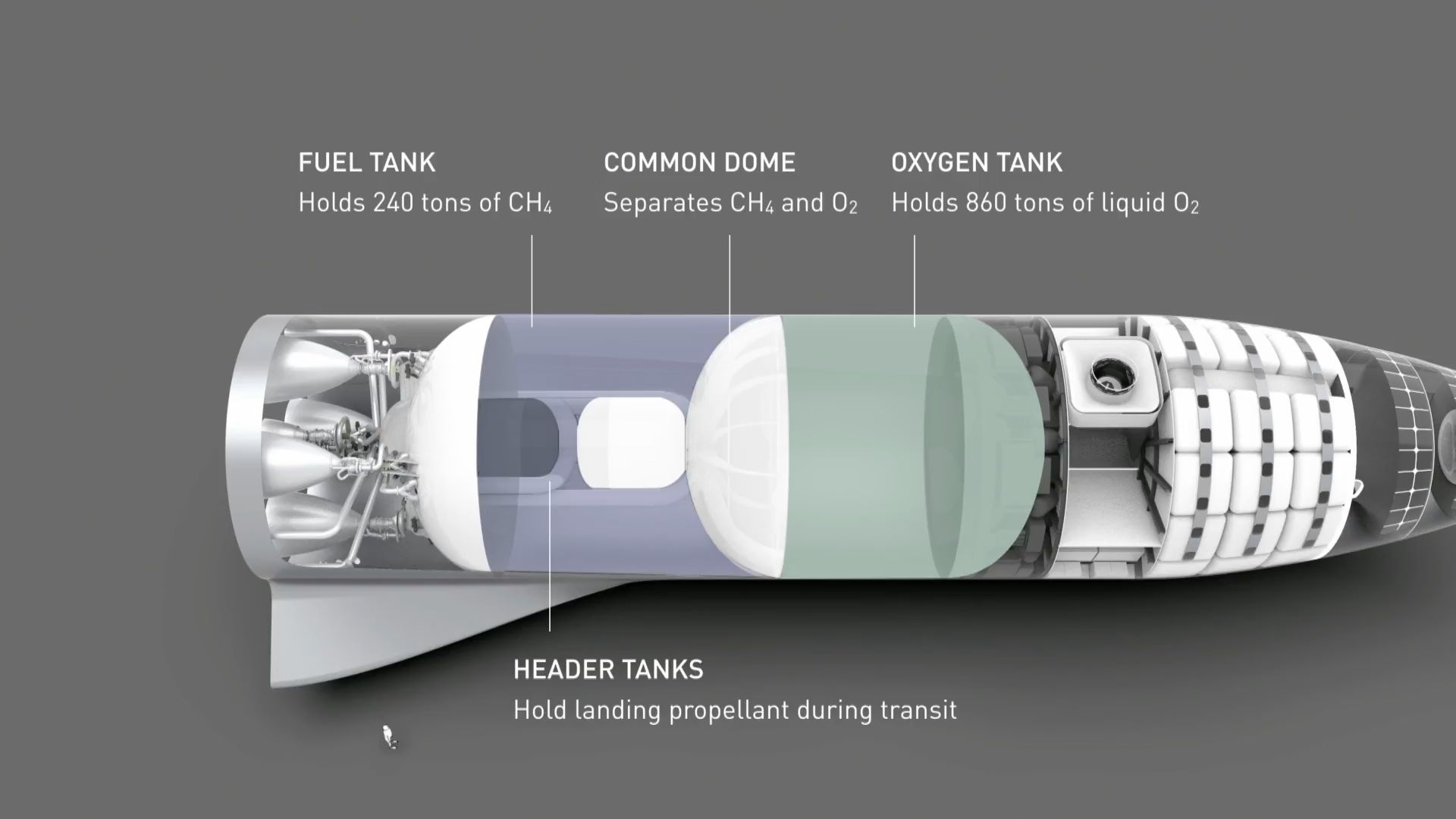
You need to either have header tanks, like the booster. Or some kind of method to push the liquids into the right place.
If you want to deep dive into the whole problem, 'CSI Starbase' on youtube has a brilliant series on all the engineering problems with all of this. Its a very complex problem.


Besides the other answers you've received, the lugs hold the booster from (near) the top. This means that the body of the booster is in tension during and after landing. Legs, on the other hand, support the landing load and weight after loading in compression. The booster is basically a thin-shelled tube, which is limited in compression strength (for a given wall thickness) by buckling; in tension, the strength approaches the strength of the material, so less additional reinforcement is needed in the structure to support landing loads.