That’s the most frustrating part. What America calls leftists is considered pretty centrist everywhere else. They’re so afraid of empathic policies it’s no wonder the country is falling apart.
> decades, possibly a generational timescale to repair.
It will easily take a generation just for people to find solidarity and courage again.
Progress takes real sacrifice. People died fighting for basic dignity and rights. The anti-slavery movement in the US fought monied interests for centuries.
It took real sacrifice for the labour movement to gain rights such as voting, education, housing, health care in the face of deadly opposition from the rich and their legislative puppets.
It just takes a moment of complaceny on the part of progressive-minded people for the rich and their legislative puppets to undo the foundations of democracy.
The risk of undoing progress so quickly is only possible after nearly a century spent centralizing the very authority that makes a quick undo possible.
The executive branch shouldn't have nearly as much authority as it does and anything we want to be difficult to be undone should be protected by law, with a legislative body needing something akin to a 2/3s vote to change it.
Instead we have a massive, powerful executive branch and legislators that can wield way too much power with a simple majority.
Under the constitution, the US federal government has far less power than, say the UK government does in comparison. Yet, if the other branches of government show no interest in constraining it, then it’ll expand rapidly.
I actually wonder if the problem the USA has is that its system has no override function like the UK does under the Parliament Act 1918. I see a lot of frustration that Congress has been deadlocked for nearly 2 decades (mostly by Republicans) so it’s no surprise the average voter demands change and wants the executive branch to take all the power.
A weaker federal government was always our design though. Really until the last century, our federal government was extremely weak and limited in authority. It wasn't until around FDR that we started seeing a shift if power to the federal government, often specifically to the executive branch.
The large executive branch has been growing since steadily since FDR though, that isn't a recent reaction to gridlock. There's a good argument that gridlock is a feature of our system meant to slow it down intentionally. We're seeing now how jarring it can be to have the government completely change source every 4 years, gridlock and bureaucracy help smooth that out.
We could be making it worse by demanding gridlock be avoided through executive actions and similar.
Sure, the system was designed to have gridlock, yet they're supposed to at least be able to operate the government. Currently, like pretty much every year lately, we're heading into March, And We Still Don't Have A Budget.
Now they're talking about keeping the government running on auto-pilot budgets all the way to September. [1] Doesn't even help that it's Rep. Exec. branch, Rep. Senate, Rep. House, Rep. Supreme Court, and Rep. Governor majority. Still a stopgap CR land where nothing gets advanced.
Agreed the budget should be a non-starter. Meaning, they shouldn't be allowed to punt on agreeing to a budget deadline.
The budget is a weird topic when we consistently spend trillions in debt. I've found it hard for me to take budget debates too seriously when the idea of running such a deficit seems completely against any fundamental financial plan.
I'd care more about budget deadlines and temporary agreements if they were required to agree to a balanced budget.
Compared to historic USA, perhaps, but compared to OTHER COUNTRIES, the US system has insane gridlock and, right now, a very unhappy public. What I’m pointing to is not that more power should shift to the executive but that it should be given to the legislature, and could happen in a way that reduces this gridlock.
Compare to the UK’s Parliament Act, which allows the Commons to override the Lords if it passes the same legislation in two sessions. It means that overriding isn’t free (it takes 1-2 years of focused effort) but critical legislation can’t be blocked. Combined with strict timetables that force rejection of legislation that isn’t passed in its allotted time, you bypass the pocket veto, too. Compromise is preferred but, if the upper house refuses to play ball, the threat of ramming it through anyway always exists to keep it in check.
Honest question (including that since its sometimes hard to tell when written) -
What additional authority doss the US legislative branch need? They have pretty wide authority to create any laws that don't violate our constitutional rights, I don't know how we could really expand that further (but my view is definitely biased since I grew up here).
I think congress would be well within its rights to change their own rules to add time limits on legislation or required expiration on proposed bills, for example.
You’re thinking too high level and not looking at the mechanics. Congress has no power to, say, give the House of Representatives override the Senate and President. In the UK, this is not only possible but happened in 1918. The USA would require a constitutional amendment which falls into the same deadlock problem.
Some things do sit within Congress such as the Senate adopting the insane role allowing filibuster. However, this is also encouraged by the fact the Senate can kill legislation like this. Filibusters rarely happen in the UK Parliament because the majority party can force through legislation they feel is important enough.
You say that deadlock is built in as though this is desirable. However the public just became so frustrated by the system that they just elected a madman to smash it to pieces.
Encouraging compromise and working across the aisle is an excellent property in the US system. But that has broken down and I think part of the reason is there’s no mechanism to break the deadlock that can force parties back to the table.
We definitely agree on needing to better encourage compromise and collaboration. I'd much prefer that to be done by changing incentives rather than expanding powers though.
The US political system is completely broken with regards to lobbying and campaign finance. All the money floating around makes it nearly impossible for representatives to work across the aisle, or to ignore the aisle and vote for what their own state wants regardless of party.
I’m not talking about “expanding” power, merely proposing that the USA learn from other systems that have deadlock breaking systems, with limitations to mitigate abuse. I’m not sure taking money out the system will have the same effect, as we’ve seen Republicans gain a lot of political capital by just being obstructive since 2008.
Here is a example of an alternative system, that I would prefer: the legislative branch is the one that people vote for, (with proportional representation), and the legislative branch then elects the executive branch.
If there is ever a conflict between legislative and executive, then the legislative branch can remove the executive branch.
In other words: the president shouldn't be head of government (only head of state, sort of a figurehead).
Which other major countries have happier publics? The UK public seems at least as unhappy as the USA. UK citizens certainly aren't happy with low economic growth (everywhere outside London), high immigration, tiny houses, and decaying healthcare. Similar issues in Germany, etc.
I would argue that the much higher incidence rate of suicide and mass murder in the US compared to the UK or Germany suggests otherwise. Citizens in other developed countries seem much less prone to irrational, life changing outbreaks, that to me seems consistent with the idea that there is a deep current of unhappiness running through the American population that is causing people to “break”
Suicide rates are more a cultural artifact than a sign of national happiness level. The rates in an number of Arab countries are particularly low, even though people there seem to be deeply unhappy to the extent of trying to escape to Europe.
There is a compelling argument that the US is culturally much more like a highly developed version of a Latin American country than a European country. Over time I find myself coming around to this idea.
To the extent it's similar to any other culture I agree, the closest feels like brazil (to me) - but it's also very distinct, it's very much it's own thing in a way that few other cultures are (I would probably count the UK as one of those few by the way).
Latin America is all quite similar.
Mainland Europe is quite similar, bar the obvious exception.
I’d argue a lot of the unhappiness in the UK is a consequence of 5 years of a Tory government choosing not to govern. The public still have a hard time believing this fact because it sounds too insane to be true, no matter how much evidence we have for it!
Also, it doesn’t help that Labour are shit at comms. They’re actually doing what they were elected to do but don’t want to tell the public about it, much like the Biden administration!
But in the UK this effectively gives power to the executive. Our exec are drawn from the legislature, and most ruling party MPs will
Have a government position - especially if the majority is slight.
It’s not a minority of Parliament though. It requires a majority vote, in two separate sessions, to be forced through (in essence, it takes up to 2 years). It’s not an easy system to abuse at all.
The UK's Constitution is the result of a literal war between the legislative and executive branches. The legislative branch won, and cut the King's head off.
The legislative and judicial branches are both expected to hold the executive accountable if it breaks the law. If that doesn't happen our system is fundamentally broken, we might as well throw it out and start over.
Is there any democratic system that is safe from democratically voting to dissolve the democracy and replace it with whatever autocracy/kakistocracy/oligarchy we've got now?
No, every country is one election away from this shit-show.
Which is why under no circumstances you should ever elect anyone who will send yours in that direction. Canadians, take note, the CPC only detached its lips from Trump's backside because they needed to come up for air.
At minimum, don't elect people who staged failed coups. They and their supporters will not ever act like they are bound by law.
The executive branch has blatantly violated numerous laws but so far they have still obeyed court orders which explicitly required them to follow those laws. The real Constitutional crisis will come if they decide to openly defy a federal court order.
I would also note that while the current Trump administration has broken federal laws at an accelerated rate, the previous Biden administration did much the same thing on a smaller scale. People here on HN frequently make excuses for Biden's illegal student loan forgiveness program because they liked the results but if we want to preserve the rule of law then it needs to apply to every program. In the long run allowing unchecked growth of executive branch power and the administrative state will be bad for everyone.
Right, continuing a tradition of executive overreach to help indebted students get the dick out of their ass is the exact same thing as dismantling the federal government, installing loyalists, betraying allies, allying with dictators, and promising lots of money to billionaires. I intend for it to be telling that I don't see them as the same. We don't even live on the same fucking planet.
I expect "illegal" action in the sense that it will sometimes turn out the executive doesn't have the authority to do it when tested by courts. I expect that to happen when the executive tries to push its agenda past an obstructionist Congress (for better or worse). It's not something I would consider "illegal" in the sense you could go to jail for doing it. But the reasons for acting a certain way absolutely matter here as they always do, and I am much more concerned about sanewashing with both-sideisms. Not just the reasons, but the extent to which he is willing to circumvent established systems of how basically everything works is much more concerning than attempting to pass EOs that are eventually struck down in the courts.
> Not just the reasons, but the extent to which he is willing to circumvent established systems of how basically everything works is much more concerning than attempting to pass EOs that are eventually struck down in the courts.
Hope you don't mind me continuing to pull on this thread, I'm genuinely interested to better understand where you have drawn the line here.
Biden was circumventing established systems when he tried to cancel student debts. He even tried again when the first attempt was blocked. Our higher education system, legal framework around student debt, and the debt industry as a whole was very well established and legally defined.
What is so different with Trump's executive orders? I get that you disagree with them, I disagree with many of them too, but legally I just don't see much light between the two. They both abuse executive orders in an attempt to Dodge existing legislation on the books and make change that the office has no authority to make.
One intended to help relieve people's debts and the other attempts to dismantle the government and remove those who oppose him. I don't understand how you don't understand how they are categorically different actions, even if both are illegal. I feel like I'm taking crazy pills. To reiterate
> dismantling the federal government, installing loyalists, betraying allies, allying with dictators, and promising lots of money to billionaires
>People here on HN frequently make excuses for Biden's illegal student loan forgiveness program because
Biden didn't do anything you suggest. You're consuming the propaganda. George Bush made it so that Federal workers with student loans could get them discharged at X years of service. X just happened to fall into Trump's first term.
Trump broke the promise made to people doing their civic duty, Biden repaired it.
Biden never took on more authority than what was established almost two decades ago.
Biden was absolutely trying to cancel, or partially pay for, any federally backed loans and pell grants [1]. It wasn't limited only to federal employees with student debt.
Lawyers are paid very well to present the best case possible for their client, you can't honestly believe that every detail of the events are going to be submitted as evidence, right?
How do you distinguish between propaganda and a lawyer arguing a political policy on behalf of the president of the united states, with the understanding that a lawyer should make the most compelling case they possibly can? Its political, its a one-sided view, its cherry picked, and its meant to persuade the target audience to believe a certain point - that sounds pretty propagandistic to me.
That's a total non sequitur. Did you even read it? I linked to the final Supreme Court opinion, not the arguments made by lawyers on opposing sides or exhibits entered into evidence by the trial court.
Its not a non sequitur. The court can only rule based on what was admitted into the record, and that's controlled by the lawyers who as I said earlier are there to make the best case for their client, not the most complete and accurate case.
Again a total non sequitur. Both sides had ample opportunity to present evidence and make their arguments. If you think something was missed or wrongly decided then be specific and provide citations.
In theory, that isn't too far from the system we have. The President was never meant to have so much authority, and Congress already requires a 2/3 majority in order to make certain kinds of decisions, including overruling a presidential veto.
There was some debate whether or not to remove the rule requiring a 60% vote to end filibusters in the Senate. Because this rule still stands, most laws cannot pass without 60 Senators' votes. Budget reconciliation bills, however, can be advanced with only a simple majority of the Senate. Though this is not a recent rules change, much recent legislation has gone through the reconciliation process to avoid the supermajority requirement.
That's fair, Lincoln did kick it off. I've always considered it more that Lincoln crested the precedent that was only really used layer by FDR, but maybe that's ignoring nuance of how powers were expanded between the two.
Before Lincoln states had much more power. Both Lincoln and Wilson curtailed civil liberties. Wilson created the income tax which gave the president a large source of income. FDR created the bureaucracy that spends the income tax money.
If the voting public of a democracy fairly elected so many people to office like that, I don't really know what we can complain about.
Democracy would have worked in that scenario, and society would just have bifurcated enough that the slight minority lost most power and very much disagrees with the direction.
Congress does have to act pike adults though and do their job of keeping the executive branch in check. If they don't the system is just fundamentally broken and the only reasonable choice is to throw it out and start fresh.
The word “fairly” is doing a lot of work there. There has been a lot of success on one side to tilt things with redistricting and voter suppression since the 80s.
Redistricting and voter suppression are definitely a problem. If they were both done in a way that was technically legal though, we can't be too angry about it before we change the laws that allowed it in the first place.
Fairness in the context of an election only means that it was done in accordance to the existing laws. Maybe equal access to voting needs to be on that list too, but I'd expect that to be covered by voting laws.
The purpose of the laws should be to ensure fairness. Fairness is not defined by the law. Unless you consider it was fair for women not to be able to vote, when that was the law.
There have been many attempts to fix districting laws, but of course those changes have to be approved by representatives elected under the previous laws.
It has been difficult to challenge these in court because it’s hard to argue whether a districting is “fair”. There has been a little progress on challenging some districting based on a statistical argument that shows the one-party advantage resulting from the particular districting is extremely unlikely to be the result of chance.
Nah, it's a by-product of giving people what they want to make money. This sort of issue has been building for a long time. It's based on abundance of resources and availability of choices. As we have more time and money to spend on things, we can make more independent choices and take positions on issues that we didnt even think about before. Essentially, the semi-homogeneous population slowly fragments into smaller and smaller factions that are not geographically constrained (thanks to tech).
If you have engineering or product skills, now is the time to take a hard look in the mirror, inventory your interests and concerns, and figure out how to fight fire with fire.
We need to be proliferating alternative, humanistic, empathetic software in the world and putting it into people's hands. It's easier than ever for us to independently build a wealth of defensive infrastructure for the common people.
We already have the tools. The problem is marketing, FOMO, etc. We can use stuff like Cloudflare restrictive DNS, a Pihole with additonal lists (like social media), a VPN, screen time or app usage timers, etc. Will and self-control are what's lacking.
The problem isn't marketing or FOMO. The problem is the average person barely understands what you just said, and we can't expect them all to become domain experts, especially when many people lack the fundamental research skills and experience needed to intuitively grok these technologies.
We have to use our intelligence and expertise to make applications which take care of users and their privacy, without them needing to suddenly become overnight computer experts. Most of the tooling I see today has (understandably) massive UX issues and is largely relegated to at least the mildly technical.
We need new and open Facebooks, TikToks, calendars, operating systems, etc. which protect and empower people but don't complicate their lives and stress them out, which leads to security and privacy fatigue. Even my current operating system, macOS, is so intensely user-hostile and obfuscated off the happy path, despite being heralded as a champion of human-oriented design.
We need a modern GNU-like organization but focused on building the social/web tooling that most people today are using.
Almost anyone who cares about their privacy should be able to Google how to improve it, find an article about VPNs, and sign up for Nord VPN (pretty user friendly and commercials everywhere). Dive just slightly deeper and you can find information on DNS and set the VPN to use the DNS you were recommended.
Most people don't care enough to even ask the questions. Creating competing services were the value differentiation is privacy (likely at the trade off of cost or quality) is bound to fail for that same reason.
You're proving my point, that users have to be protected by software engineers in the same way that pedestrians know nothing of civil engineering but trust that bridges are safe to walk on, and aren't to blame when they fail. It's not a marketing or FOMO issue, it's a matter of culture within our profession and way of life as engineers.
No, that would be a matter of law. Bridges aren't safe because some group of engineers wants safe bridges. They have to meet safety standards set by the government, the engineers need license issued by the government, etc. If you want privacy, you need to change the law to grant it. Trying to make some end-run around market forces is futile. People en masse aren't going to pay for a service with privacy when they can get a free version that does the same stuff but blasts them with ad trackers.
Okay, you can work on changing the law, and the rest of us can work on just building infrastructure now and not waiting for the law to catch up. I don't know about you, but in my current country I have absolutely zero representation with the current oligarchy.
> Trying to make some end-run around market forces is futile
Market forces and the law are two different things, which one are you arguing?
> People en masse aren't going to pay for a service with privacy when they can get a free version that does the same stuff but blasts them with ad trackers
I never suggested anyone pay for anything, this is a straw man argument.
I don't understand your aggressive stance against engineers building better, open alternatives to current offerings. The market is getting hungrier for it, and if a product is genuinely better, "market forces" will do their thing, no run-around needed.
The workflow goes like this -> R&D -> rl testing -> if broken with deaths -> law to prevent it from happening again
But.. it's a chicken-egg problem. Has there been a law for prevention before an incident happened or is the law formulated after something happens?
.. it's naive to think and say
> Okay, you can work on changing the law, and the rest of us can work on just building infrastructure now and not waiting for the law to catch up.
If it were like this, then no house would be destroyed by earth quake like in Turkey somewhen 2-3 years ago - and Turkey did pass a law some 10 years ago to prevent cheap buildings in earth quake areas.
No bridge would've collapse in Germany - the laws in Germany are one of the toughest making construction very expensive.
And there are much more examples in real world that opposes your "Okay, you can work on changing the law, and the rest of us can work on just building infrastructure now and not waiting for the law to catch up."
The problem is no one wants to pay much money for the better quality, if a little less in quality will do similar job. Compare housing and housw building costs in US and western Europe/Germany.
So, your engineers can do the best things and the market decides. .. yes, ma‘am!
All of those examples are irrelevant because we are talking about software, which is much, much different than your physical examples. Get back to me when we can have open source, community-maintained roads and bridges which can be copied, forked and modified to suit anyone's needs.
The problem right now isn’t the rich. The problem is that half of the electorate is on board with this stuff. You can’t rally the people against this when half the population is in favor of it.
I’m sure there’s a good argument that wealthy people and a broadening wealth divide are responsible for this, but it’s too late to attack that now. We need a huge shift in public sentiment if this is going to change now.
Even if the outcome had been different in November. We’d still be in deep trouble. A lot less, but still a lot. The fundamental problem we have right now isn’t that Trump is President, it’s that about 50% of those who bother to vote think he’s worthy of it.
I think you need the populace on your side first, though. Otherwise how can you change anything if you have neither government nor a majority?
Unfortunately, I don’t see any way to change the minds of the American populace. They’ll have to learn the hard lesson of where this stuff goes. The problem is that we all have to learn that lesson alongside them whether we need it or not.
It doesn't help that the tech sector is falling in line. Spearheaded by Musk who is still glorified my many in the industry, other tech giants are following suit. Meta, Google, Amazon, nobody dares challenging the new US order and is playing along. This is really where the HN crowd should realize how much they are involved in this. Tech was one of the bullwarks against right wing fascist takeover. Not anymore, they are playing along. It's going to be dark.
I never thought that. They have always just played along with society. When LGBT rights were fashionable, they were more than happy to jump on that bandwagon and rainbow wash everything for money. Which, is great, don’t get me wrong, but I never thought for one second it was because the leadership truly thought that was important deep down in their hearts (Tim Cook perhaps excepted, but even then not fully, as he still cares about business more than principals, though he has more to lose personally.)
Excellent point. Why would a move a certain crowd likes be out of principle and when the tide turned and a move in the opposite direction happens suddenly be just opportunism? The more realistic/neutral interpretation is that it's all just opportunism in either direction.
Most authors that look at the subject have usually proposed 3+ groups post-balkanization. Tends to depend on whether it's simply an "After America" balkanization or a complete apocalypse scenario. Table top roleplaying games are full of speculative fiction on those kinds of concepts. Nukes, or zombies, and sometimes black swan "magic" tend to be rather popular.
After America would be like the Fall of the Roman Empire, or the collapse of the Chinese Jin (romance of the three kingdoms) and Tang (five dynasties, ten kingdoms) eras, usually because of human bickering over power and control. Occasionally, systems like Shadowrun have a "mild" apocalypse that mostly serves as a catalyst for balkanization. Whatever vestiges of a state remained fall apart under the stress.
Complete apocalypse tends to be something like large scale devastation from a known threat that final gets used (nuclear, biological, dangerous machine sentience) and everybody's too busy dealing with their own issues to care about larger ideas like a continental federal state of "America."
Either way, tends to result in 3+ most of the time. From looking at the Roman Empire and the multiple collapses of China though, it really does not take anything especially dramatic to result in pretty severe balkanization. Often its the old "Blue and the Grey" divide and then most of the West just does their own thing. Occasionally it's more like East Coast, Heartland, and often the West still is not really included.
The result for the West has actually been one of the weirder parts of reading a lot of those settings. Often this undercurrent that the West has never really been a part of "America." The heavily populated East is still mostly fighting over the same issues with each other, the lightly populated West is just some far away land they occasionally pay attention to (mostly California and Texas).
For this to happen, the US population is probably too old on average, and too overweight.
Civil wars and the like are usually based on youth bulges, as they need a lot of breathing bodies to fight it out. Preferrably slightly hungry bodies, as hungry people are easier to provoke into fighting.
What is more likely is that significant portions of rural America break off and the part that's left doesn't feel it's worth it to take it back by force.
A lot of rural area across the country have movements to break states into pieces, or join other states. I don’t think most are very serious but at least two of them are serious enough.
One, there are a few counties on Oregon that want to redraw the boundary so that they become part of Idaho. This, I think, is only mildly serious.
The second is the border of Indiana and Illinois, which is serious enough that the Indiana state legislature has voted to create a commission to work on it. It was a bipartisan vote, too. Because there are a number of rural counties in Illinois that would like to join Indiana, and two urban counties in Indiana that say if the option is on the table they’d rather be part of Illinois. Such a thing would need both states to agree and then send it on to Congress, but ultimately I don’t think anything will come of it.
When you look at state funding, these urban counties are sending more tax dollars to their respective state capitols than the states are spending in their counties. In the case of these rural Illinois counties, the state is spending between $5 and $6 per tax dollar collected. Does Indiana really want to take on such welfare queens? And give up some of their few donor counties in exchange? It seems hardly likely!
That’s the rub all across the US. The urbanized areas are subsidizing the rural areas. Are the rural areas prepared to do without such subsidies? They can say “the cities can’t live without the food we grow”, but the entirety of human history shows that the cities always come out ahead in these transactions.
The Jefferson area of CA seems about as serious as Oregon.
With out current structure of governments, as we get around/over 80% urbanization, the rural areas will just get steamrolled and want to break away due to a lack of agency. If you study people in the "western Idaho" area and on the Oregon coast, it would be easy to see that they are two different nations.
Also,do you have e a source for the 5x tax collected number? The 5x seems really high. I couldn't find one for Indiana, but Illinois shows it's <2x.
Right. So anyway, if various states (or the whole country) breaks apart based on urban/rural divides, the urban areas have very little incentive to try to reunite. It’s a losing proposition for the rural areas.
My personal opinion is that our state and nation legislatures have way too few members given our current populations. For example, the US House should have some sort of dynamic membership count: the smallest odd number such that when you run the apportionment algorithm the smallest state has 3 members. That’s probably somewhere around 1100 members (just spitballing).
Economics aren't the only factor, so the rural areas may not care so long as they are free. That also assumes the rural areas keep the same service levels and regulations. It's possible they could create conditions to lure some industries to them. They would also have to raise food prices to deal without subsidies. It's likely many services would see reductions, such as road maintenance, anything heavily relying on grants, and possibly schools. Certainly the colleges in the article would be closed.
Decreasing the ratio of constituents to representatives won't really work. It may work at the margins, but you will still have the mismatch in proportions between urban/rural.
California has multiple times brought up splitting out into multiple states, its made it as a prop a few times too. I think most people want it to happen, its just tough to figure out what the best split would be
Despite all the 2nd Amendement talk, it mainly comes down to the military.
The military have the tanks, the air support, the logistics, the surveilence net, the miscelaneous support equipment, and all the training to use everything.
A split within the military, that gets real ugly real fast.
I think any civil war would have a split within the military, because in your premise that they're using tanks and aircraft, some people are not going to want to bomb the place where their mother or child lives, not to mention the supply chain of all that fancy stuff relies on a somewhat functioning domestic society to make and deliver much of the underlying goodies and support.
Yes, almost certainly. But I meant more of a split between those on opposing sides; not between those who refuse to fight at all because they had just been asked to fight the very people they signed up to defend, vs. those who will follow any order.
And then, because there were demonstrably some absolute sadists demonstrably present in the armed forces during my lifetime (e.g. https://en.wikipedia.org/wiki/The_Hooded_Man), perhaps the conscientious objectors will be convinced to fight anyway, to stop the sadists.
It also matters what such a civil war be about — Is it between those who would seize power and those who would prevent it? Is it the same borders as the old Civil War? Is it city-vs-rural?
If there is one (still an if), and if it is Trump vs. the constitution… it's still not impossible for such a conflict to be without a single shot fired. Conversely, if it's between two groups of cities neither of which will consent to the other's choices for president, it could have every major city in the US reduced to radioactive debris.
The youth are also of poor quality these days. It was one thing in 1860 when a given 18 year old was built like an ox from hauling bales of hay or whatever else. Today most 18 year olds are sedentary. We don’t even do the mile run in gym class anymore.
Well, looking into really old draft records, you will find a lot of disqualified recruits with bad health - tuberculosis, parasites, or general bodily problems caused by malnutrition.
But yeah, there also was a lot of physically strong young people to choose from.
Yes, exactly. Some of the federal farm subsidy and low-income nutrition programs we have today came out of findings in WWII that many potential recruits who had grown up during the Great Depression were literally malnourished: too weak and underweight to be combat effective. While the new HHS secretary Robert F. Kennedy Jr. is kind of wacky and has terrible policies in many areas, he at least recognizes the serious state of youth obesity and poor nutrition.
Has there been a single HHS secretary that did not acknowledge the youth obesity problem?
Our expectations are so low that we ignore the real things that qualified people have done, to pretend that an anti-science wacko has some semblance of sanity.
Don't forget school lunch programs were pushed by the military in the 1946 National School Lunch Act (America's Great Age to MAGA) to improve the fitness of potential recruits. Programs the Republicans now attack as 'woke' nonsense.
Gen Z are a lot fitter and drink and smoke less than my Gen x peers afaict. What’s more, the 90th centile Gen zer is a -lot- fitter. Not everyone needs to join up…
>What America calls leftists is considered pretty centrist everywhere else. They’re so afraid of empathic policies it’s no wonder the country is falling apart.
Maybe on economic issues. On certain social issues it's definitely not "centrist" and arguably further left than other developed countries.
I agree, but would add that many issues (left and right) here are more extreme. I think two things are a self-reinforcing cycle driving both ends of the political spectrum to extremes. First, hyper-partisanship has emerged where it was formerly held in check by social norms within our political institutions. Second, US politics has become a national pastime, replacing sports and other things in our attention. Everyone is able to be part of the commentator class by virtue of social media (I cite this thread, including my comment, as an example of this).
Normie centrist views tend not to garner much attention either in traditional media or in online forums. Instead, we tend to focus much more on the issues that clearly and quickly establish our membership and bonafides in a particular group.
The same extreme-voices-get-heard feature gets recapitulated through our political system. Especially the rise of getting primaried from the left or right. Break ranks with your side? Get primaried. The result is that, to get heard over the fray, political candidates need to articulate more extreme views and stick to them.
Lots of words have been spilled about how various electoral reforms could get us out of this mess. For me, I believe ranked choice voting and open primaries represent an optimal trade-off between "legal, and plausibly implementable" and "yield biggest improvements to electoral system." A major complaint against ranked choice voting is that it tends to bias for more moderate centrists, which I think would be a not-bad problem to have.
For economics (both sides) healthcare, labour, "defense", energy, firearms, speech, religion and basic human rights, both main parties in the US are far right by Western standards (and true outliers for most).
It's really only identity politics where the left is actually on the global left, and then it's far-left.
>For economics (both sides) healthcare, labour, "defense", energy
Those are arguably closer to "economic" than "social". Energy is plainly economic. Even healthcare and labor at the end of the day, boil down to dollars and cents (ie. how much people are paying for healthcare and how much they earn).
>speech
Having the strongest free speech protections in the world is "far right" now?
>religion
The Republicans might be "far right" on religion, but I don't see how the Democrats are. They can certainly be more secular (think the CCP), but at least they're not obviously religious. Compare this to the UK and Denmark which have state regions, and the christian democratic union in Germany.
>basic human rights
Clarify. "basic human rights" has been muddled by the left to include mean stuff like "healthcare", as well as the right to mean "right of babies not not get aborted" and "kids not being groomed".
If you think the UK state religion is in any way relevant to this then you are sorely mistaken. The Church of England has little to no influence on daily politics and is a historical oddity. All political parties, left and right, are essentially secular. Religious politicians basically have to keep their faith quiet while gaining and maintaining office. Blair is a good example of this.
> It's really only identity politics where the left is actually on the global left, and then it's far-left.
That rings true, but how did the US get here? How did identity politics suddenly come to be the most important thing, bringing the world order to its knees?
I don’t actually think it’s far left though. And they are certainly much less effective than other socially liberal parties in Europe.
In the UK it was our right wing party that legalised gay marriage, for example.
Europe is a lot more woke than the US (and a good thing too)
The American left seems to be very focused on making sure nobody will ever need to feel even the slightest bit offended or pressured. Best intentions, I'm sure, but I don't think that's an achievable or even a desirable goal. A healthy society requires a certain amount of peaceful friction.
Europe seems to be following America's lead (as we always do/did), but it hasn't reached the same extremes and probably won't, imho.
US is still pretty far-right on social policy by the standards of most of Europe. This is an average, there’s lot of outliers such as even the proper left in France being weird about Muslim dress.
Identity politics is on the right in Israel. In a general sense I think it might not belong on the same spectrum as redistributive policies or militarism.
That's true to an extent, but President Biden also maintained a de facto open borders policy which undercut wages and drove up housing prices for US union members. This was deeply unpopular with the union members that I know. I'm not trying to start a debate on the merits of various immigration policy options, just pointing out that union members perceived this as a lack of support.
The biggest win the Republicans and billionaire class ever had was convincing the American public that left == liberal. It's not. Blue hair, trans flag, black lives matter, pro-palestine, etcetera; these are socially liberal stances. "Left" doesn't mean any of these things for the rest of the world in a conventional sense. Left means unions, workers rights, socialism or sydicalism; generally, power to the workers/99%/people rather than the capatilists/monarchists/regime.
Americans should continue to conflate socially liberal and economically left-wing at their own peril.
It's worth noting that labor unions have mobilized all over the globe in solidarity with Palestine. Given that the main bone of contention in this country is continued material and financial support to a military campaign it feels odd to lump in with "social liberalism".
>Left means unions, workers rights, socialism or sydicalism; generally, power to the workers/99%/people rather than the capatilists/monarchists/regime.
Everyone claims they're the true voice of the 99%. Trump, despite being a billionaire, claims he's defending Americans workers by imposing tariffs and deporting undocumented immigrants. More broadly the right claims that they're fighting against the "elites" in the media/academia/corporations/"deep state".
It was surreal watching Trump, the man who has made his very name into a corporate product, campaign against Hillary Clinton with claims that she's too influenced by corporations. And, somehow, our politics managed to get even stupider since then.
Well yeah, plenty of developed countries are xenophobic and bigoted in terms of same sex marriage still. I’m curious what “social issue” you are imagining that is represented by the american left but not the european left otherwise.
The US left wing is far more supportive of trans rights, particularly youth gender affirming care, than its counterparts in Europe. For example, I do not think you'd see a Democrat outside of a swing district publicly say, "It's very important that we protect female-only spaces," as Keir Starmer has. Also, while on the campaign trail he said he wouldn't scrap the proposed ban on teaching young people in England about transgender identity in school, saying, "I'm not in favour of ideology being taught in our schools on gender," language not too dissimilar from the Trump administration's.
> For example, I do not think you'd see a Democrat outside of a swing district publicly say, "It's very important that we protect female-only spaces," as Keir Starmer has.
Maybe a year or two ago…the political landscape has shifted drastically in recent years and months.
California governor Gavin Newsom has a new podcast, and recently told Charlie Kirk (yes, he invited Kirk to pander to the young white male voters) something along the lines of “trans people shouldn’t play sports”.
That's not what Gavin Newsom said. What he actually told Charlie Kirk is that it isn't fair for women to have to compete against biological males. You can disagree with him but don't misrepresent his position.
Yes, that's my point. And there are many Labor MPs that are to the right of Starmer on this issue. The party that's closest to the Democrats (and arguably slightly more left on the issue though not by much) are the Lib Dems, and they got, what, 12% of the vote?
Also, do you not think American right wing media is not capable of whipping up panics? This feels like special pleading.
Outside of trans rights though, it’s hard to see what issues the us left is to the left of Europe on.
What’s more, we actually have left wing parties in power and using govt machinery to advance what would now be called ‘woke’ in the us.
Which? Be clear, because the only ones I hear you dogwhistling here are Trans folks rights or Black folks rights if you are vaguely referencing "social issues" and generally America's historical context there is Pretty Dang Bad.
There is nothing dogwhistleable here, US leftist race policy is a huge outlier in the Western world and I would hesitate to call it "liberal". Once someone groups people into racial groups and treats them like interchangeable Lego bricks by color, they have left any pretense of liberalism, which by necessity considers an individual to be the smallest and most vulnerable minority of them all.
That’s been shared a lot on social media but those posts tend to leave out the context that this was only in technical language around IVF, not a broad change, and that it was intended to resolve confusion around what “mother” means in the context of what goes on a birth certificate in the case where a same-sex couple means the child has two mothers.
Thanks for clearing that up, it really changes the story for me. This actually came up as only 4% reported by the left in Ground News' weekly Blindspot Report [1][2]. It only lists one left-leaning source, also from USA Today [3], but not the one you linked, one critical of the measure. I guess Ground News really didn't help here in guarding against bias. That's pretty disappointing.
I get being against this sort of thing, but it’s wild to me how people are SO against something so inconsequential (official language on government forms or whatever) that they’re willing to instead support a party that’s actively pushing us into authoritarianism.
Like sure some inclusive language is silly, but it’s a lot better than losing our national parks, destroying our social safety nets, celebrating cruelty to immigrants, and ripping the constitution to shreds in the process.
My feeling is that people aren't much against something inconsequential per se, instead they are against something that's out of their status quo and that question some underlying values they haven't ever questioned themselves (for example: genders).
Instead of being curious why exactly some people are proposing something that challenges their worldview they instead immediately allow their fear to take over, and reject the change.
It's the same pattern that non-accepting parents of gay children tend to go through when their kid comes out of the closet; in that case a lot of them have a change of heart into acceptance because they love the person, over time they are able to overcome the fear and understand a new worldview.
Not so much for the masses with flames being fanned by politicians wanting to capitalise on that fear, they are kept in fear, they are told to reject any attempt to educate them, the messaging calls it "evil" or "not from God" or "only for betas", adapted to the audience's most chauvinistic identity (religion, machoism, etc.).
Since it's easy to manipulate those into hating whatever is the bad-word-du-jour then those same politicians can attach any policy with "combating bad-word-du-jour" and a lot of the believers won't question it much.
It's disheartening because even though I'm quite progressive and leftist (in the European sense), I still believe that conservatism is necessary to balance out the discussion, unfortunately it's also an ideology intrinsically bound to the fear of change, a feeling very easy to be co-opted by power-hungry people.
It's an ideology that rejects rationality and almost completely embraces emotion (fear), which is rather ironic since its most fervent followers want to believe they are the most reasonable and logical ones.
Whether a birth certificate for a same-sex couple in the IVF case mentions "mother" or the less ambiguous "inseminated person" is indeed fully inconsequential for the vast majority of the American public.
Changes in official government paperwork to be more inclusive are very much not "control of language and attempts to assert control over its use and definitions".
I mean, you could describe the Trump administration's executive order requiring government agencies to stop using Gulf of Mexico and instead use Gulf of America as simply "changes in government paperwork." But I think it's obviously also an attempt to change the language.
I wouldn't classify it as "changes in government paperwork" since the EO defined the official name for a geographical feature, very different from some law changing the usage of a term in a government's form. Quite a different level and degree, if that's out of consideration everything can be reduced to some more general form to be played as equivalent.
I also DGAF about the renaming of the gulf of mexico relative to essentially any of the other, much more consequential actions the administration is taking.
> the recent proposal to change the word "mother" to "inseminated person" in Wisconsin state law
Life gets easier once one realizes that talking points like this are at best missing all important context, if not outright deceptive. Other examples would be the "They spent $X studying OUTRAGEOUS_THING"
The exhausting thing is doing to required research to point out to people that the outrage pornography sound bite they're screaming about is, of course, completely fake and designed to enrage them.
Then they thank you for the information and go on to completely believe the next one with no pattern recognition whatsoever.
Indeed. Social democracy is a requisite for stability. It’s surprising it lasted this long. I guess the New Deal might have been instrumental in postponing collapse.
People forget, how oligarchies are actually not desirable for the oligarchs. Because there is no law and no stability. The zhar/king has a bad day and the whole crowd around you shifts in some economic landslide. Oligarchs in Russia came and went, and they took their money to europe/swiss/uk/us - because you can not thrust a oligarchy, when you are today in favor of the golden god king.
Such moves towards such systems, are usually desperate jumps of those whose empires are under threat of being broken up anyway.
The countries that have had the most successful but empathetic policies have reversed course on the key issue of immigration: https://www.nytimes.com/2025/02/24/magazine/denmark-immigrat.... MAGA would be thrilled to achieve the reversal of immigration that's happening in Denmark, for example.
Immigrants to the US are mostly from the Americas, so Mexico, Guatemala, Honduras, Venezuela, etc. The US also has people fleeing war, such as Ukrainians.
The main difference is that they are easier to integrate. For instance, immigrants from the Americas speak a romance language, and if they speak Spanish, that's like a second language for the US. Most are also Christians, and yes, it matters because they don't uphold Sharia over local laws. Yes, the US is also getting drug dealers and such, but I bet that a vast majority are there to work and pay their taxes.
Europe has the problem that it took in many people from Africa and Asia, that are harder to integrate, and with many of them fleeing war. And the difficulty here is that people fleeing war have no intention to integrate or even to work for a living if they can get away with subsidies, many intending to return home as soon as possible. Europe also has the issue that it has never been a melting pot, smaller countries in Europe don't have a tradition of cultural diversity, they are unprepared to integrate that many people over a short period of time.
There was also a story recently about Russia apparently fuelling immigration from war zones into Europe, to destabilize the EU and its governments. They also funded “green” NGOs and politicians who succeeded in shutting down shale gas extraction and nuclear power plants, increasing the energy dependence on Russia. I'm guessing their hybrid war is a wild success.
Not to be misunderstood here, I am pro immigration. For example, Germany has been a powerhouse of Europe due in no small part to their generous immigration policies. The population is growing old, and we need people to support society. The “low skilled” classification is a canard. Countries require “low skilled” work as well, and note that unemployment is at an all-time low, US and EU included.
I'll also note that the UK ran xenophobic ads ranting against Poles, Romanians and Bulgarians, as a justification for Brexit. After Brexit, they wanted them back, especially during the pandemic, since “low skilled” Eastern Europeans started going to Germany and other EU countries instead. And immigration actually got worse for them after Brexit, which was ironic, but not unpredictable.
Trump is the result of anti-system vote by people who were ignored for decades by both parties.
Trump obviously won't solve their problems. Inequality won't decrease. Healthcare won't become more accessible. Workers' rights won't be fixed. Homes won't get more affordable. Inflation won't drop.
So - even when Trump disgraces himself completely - these disappointed voters will just vote for another anti-system con-man.
Trump's core voters desperately need Sanders to win. But they will vote Trumps and get fucked over time and time again.
This is how democracy dies. People distrusting the system so hard they destroy it.
> This is how democracy dies. People distrusting the system so hard they destroy it.
Funny. Reminds me of the last time I visited Brazil. In the last day I heard someone justifying voting for Bolsonaro by saying "things are so bad that I just want someone who will destroy everything".
It's weird, they think things can't get any worse. In my country, union got us 7% raise in 3 years, thats 4% if you discount union membership cost and people talk about leaving union "because it's not worth it".
Without union we get nothing and people before us had to fight to get us these rights and now some people want to throw it away because they didn't get big enough raise.
Bolsonaro is a symptom of the same disease as Trump. At least he's ineligible until 2030. Who would have thought that Brazil would have stronger democratic institutions?
That really caught me by surprise. On the other hand, this is mostly to the credit of their Supreme Court, and one can argue it's one judge doing the most work... so it's all probably quite fragile :/
There are safety features built-in in more recent democracies. USA is just a very early implementation and hasn't been keeping up with the patches.
2-party system is bad. Regional representation instead of population representation is bad. Allowing gerrymandering is bad. Letting companies/oligarchs to contribute to election campaigns is VERY bad.
All of this ends with a system that cannot reform itself. It's a common failure mode in early democracies. There are known workarounds.
First-past-the-post voting systems are extra dangerous. I.e. where all the votes of a district go to the winner of the district.
If instead all votes go proportionally according to what people voted, you get less extreme policies and encourage parties to build coalitions. Nobody is happy, but fewer people are extremely unhappy.
I realize this is just my own idea, but I think the Constitution forbids gerrymandering, by demanding a "republican form of government" in the states. The question is how this opinion would stand up to being tested by the current Supreme Court.
You can find plenty of "workarounds" in any Wal-Mart or pawn shop in the US. You can even buy a "workaround" from someone directly and avoid a background check.
Bernie Sanders would not fix the American Problem, because he too would be unable to do anything. It's a mistake to think that there was one recent event decided on the margins that somehow led to collapse.
The American Problem is not one of systems or policies. The American Problem is about people, what they do to each other, and that you allow that to happen. The constitutional arguments they have are Red Herrings. What matters is what people do, and what they want to be allowed to do by their arguments.
It's not like in authoritarian countries where their votes just go down to trash. It's not like they cannot voice their opinion or organize demonstrations. I agree there is a sentiment of "I'm ignored", but at any point in time it's up to them to not being ignored in democratic society.
This is just a baffling attitude. Sanders is the only name that regularly gets respect from every corner of the political spectrum. His most vociferous critics by a long shot are centrist democratic loyalists.
Sanders means well in the things he does, but he's unfortunately very very .. how do I put this, stupid in his ideas.
Even his own party never votes for his stuff because his ideas are always terrible. They are always emotional, but he never thinks them through. I don't think he's able to think them through.
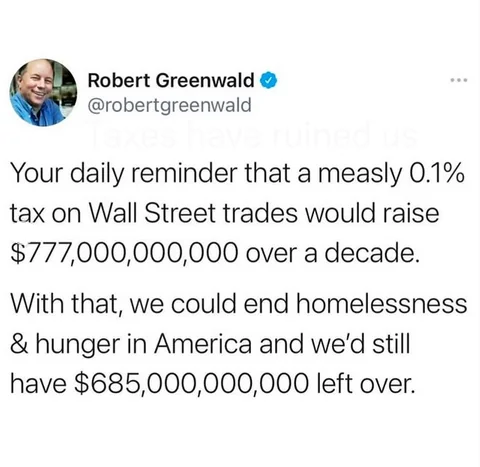
I'll give you an example from a different person: There's someone on Twitter who wants a 0.1% tax on stock transactions, and then he calculates that this little change will fund everything we could possibly want. He utterly ignores that if you put this tax people will change their behavior! There will be fewer transactions, and this tax will fund nothing at all.
Sanders is the same way: He makes an idea, and completely ignores how people will respond to it.
This is a misrepresentation of the position. It’s possible that to sell a policy like a transaction tax you might overstate the potential revenue. But nobody serious actually thinks you could simply multiply the tax rate by transactions to predict revenue.
But that doesn’t matter. The revenue would be non zero. And there are plenty of other reasons to tax transactions anyway (stability, realign market and societal priorities)
I can't find his original post on X (although that's probably for the better because his feed is filled antisemitic garbage, and he's pretty clearly at utter idiot).
But yes, some people really do think that way: They never think about the results of their proposals, and getting back to the topic at hand Bernie is the same way (although unlike that other guy Bernie really does seem to care about people), but he never thinks about the effects of his proposals, how people would react and change behavior.
This would make him a terrible President.
And I would remind you that despite being in congress for 34 years Bernie has never manged to get even a single idea of his passed.
Bernie’s Sanders is very easy to attack because of how fast he folded to the DNC in the past decade.
Even for the Trump "bull in the china shop" voter, Sanders has become less relevant in 2020 and 2024 because he offers so little and for someone so called principled, he doesn’t hold the same ideas on immigration that he has before.
Look, all I have is polling data from multiple national presidential elections to back me up.
I know many Trump supporters but not a single one of them respects or like Sanders, and all the polling data I can find points out that this is the general trend.
Any Sanders path to victory involved massive amounts of youth turnout that would have otherwise stayed home, and there's basically zero Republican leaning voters that would switch to Bernie. And the swing vote swings massively to Trump when Sanders goes against Trump.
I wonder what those swing votes would be today, now that people start to realize how quickly and efficiently the USA is being destroyed from the inside, right now.
Could you please implement Sander's socialist paradise in Vermont first? I'd really like to see how it works out before you try and subject the rest of us to your ideas. thanks!
If there was some way to isolate VT from the rest of the country then there are many strategies to make it work. This is a major cause of the homeless problem in CA> Progressive policies designated for the citizens of CA get abused by all the red states dumping the results of their bad policies into California (by way of one way bus tickets). The same would happen to VT. Its much easier to just look at the EU and see the positive results.
The idea that anyone can know without a doubt what someone else needs is part of the problem.
People need to be treated as adults before they can be expected to act like adults. There's always the risk that goes wrong, it has in the past, but we're doomed if we believe the only way forward is a small group of elites forcing change on us because they "know best".
Political science has decades of research that consistently shows that it’s entirely correct to think that most voters have no clue about anything, including what would be best for them.
Reasoned, informed votes aren’t a major factor in elections.
[edit] see if your library has a copy of Democracy for Realists and also dig into older major works they cite, if you’re interested in more on this. For a quick gut-check, look up the proportion of US voters that understand how marginal income tax rates work, then reflect on the fact that this is something very simple that directly affects them in ways they must confront at least once per year, and despair at how bad similar measures must look for practically everything else and that if they don’t understand the basics of how things work, they can’t even begin to figure out “what’s best” for them or for anyone else.
I will see if I can find that book, thanks for the recommendation.
I'm not sure how we could untangle the issue of today's uneducated populace with our education system itself. If people don't understand marginal tac rates, for example, and most people go to public school because the government makes it pretty difficult to choose anything else, is it not the fault of public education for either not teaching it or teaching it poorly?
More importantly in my opinion, if people don't care to understand it that's fine - they can make that choice. If the system still works and no one complains, great. If it becomes a problem we can either better educate people on how it works or move to a more simply form of taxation that is easier for people to understand.
I’m not sure how much understanding the issues is a factor in democracy functioning well. I think it has more to do with widespread belief in democratic and rule-of-law identity, such that voters will reliably punish those who violate those tenets, and structures set up to resist the kind of rot that targets inherent weaknesses in democracy, especially to prevent capture of media and lobbying by rich minority interests. These reduce the effects of directed exploitation of voter ignorance, and block democratic attacks on democracy itself.
Both of those factors are, to use the scientific term, completely fucked in the US, which is why we’re where we are now. We’re not here because people think that we spend 20% of our budget on foreign aid, but rather, people think that because of concentration and capture of media ownership, and intense lobbying. The ignorance would be there either way, but the direction and form of it is carefully cultivated, and allowing that cultivation is the problem.
The generation of hard data demonstrating that voters (more or less) don’t know jack-shit about anything goes back to IIRC the 1950s, and the best answer Poli Sci has for why this results in a functioning system at all is that voter behavior is fairly erratic (much of it amounts to “do I perceive that things are bad, even that have nothing to do with the government or with me? Then throw the bums out!”) and (this was once accepted but is now controversial) that voter ignorance kinda balances out by virtue of being chaotic. If that ignorance becomes directed, however, both of these things are weaponizable or breakable.
Many of the founders of the US wrote about the importance of an educated populace and feared that an uneducated voting public would ruin the system.
What you describe are both results of an uneducated voting public in my opinion. At least as I see it, those are two important effects with the root cause being a lack of education and critical thinking.
If people were better educated on how our systems work and issues that impact them directly, and willing to think critically and listen to, or engage in, reasoned debates we wouldn't have to worry about what shit they may hear or see in the media, or from politicians, lobbyists, etc.
The solution at the time largely involved not letting groups unlikely to be educated… vote at all.
I’d definitely be interested in evidence that there are democracies with voters who are significantly better at understanding the function of their government, the breakdown of the budget, how basic functions of it work, et c, than in the US before, say, 1975.
I'm not totally sure whether you meant the 1975 point as a comparison of democracies today versus 1975 US, or democracies from 1975 compared to the US.
This is anecdotal since I don't have evidence handy, but I've been impressed with Swiss voters that I've met and they have all spoken highly of both their Democratic model and their voters. I don't know all the intricacies of it, but my understanding is that their system pushes any meaningful change to a vote. Its slower and requires more voter engagement, but at least from my experience that has succeeded in building a better informed public.
We should never expect people treated as children to act as anything more.
Acting like an adult requires practice and learning lessons when you mess up. Treating those you may disagree with, or don't trust, as children is a self fulfilling prophecy and strips them of the dignity of having the chance to make their own decisions and deal with the consequences.
Is there much overlap in Trump and Sanders policy views?
I wouldn't expect voters for either candidate to agree with much from the other candidate, but maybe I don't know their platforms well enough to see the similarities.
People are definitely voting for policies. There was a study that found trump spent a higher percent of time talking about policies than Hillary. The PBS documentary on 2016 had an anecdote than in 2016 the trump rally crowd would chant things that became trump policies.
Trump surely has policy views. Maybe they aren't consistent, and he often speaks contradictory to whatever his views are, but you're underestimating him if you believe his has no views. If you consider him a threat, underestimating him sounds dangerous
> Trump _is_ the policy and the view.
That may be true for voters, I know quite a few Trump voters that only care to vote for him and couldn't explain any coherent policy reason for preferring him. That has no bearing on Trump's own policies or views though.
I assume you mean they're racist. Yes I do know one openly racist person who happened to vite for Trump. I don't think he voted for Trump for that reason though, he's just been a republican voter for decades if I'm not mistaken.
No, I mean they'd rather not verbalize why they want Trump in office. Like one of his voters mentioned during his first term when she felt he wasn't "hurting who he's supposed to". A surprising number of Trump voters see him as a tool for retribution against various groups the voters' feel animosity towards. Saying this outright is probably something most are not comfortable to say to you, so they stay vague and non-specific.
I would assume the same goes for some Democratic voters as well. There's a lot of hate thrown across the aisle in both directions these days. Maybe it comes more frequently from Trump's supporters, I don't know, but I've been surprised by how much blatant disregard, disrespect, and animosity I've heard from those on the left. The idea of voting for Trump was so foreign to many in the Biden/Harris bubble that anyone willing to vote for Trump must have been crazy or less than.
I didn't vote for Trump (or Harris), but working in the tech industry and mostly around people who would consider themselves progressive or liberal has been pretty eye opening the last few elections. Everyone wants to be inclusive unless its political and they strongly disagree with the other side.
I distinctly remember the lead up to the 2016 election. I remember having one conversation with a friend who is relatively affluent. Not independently wealthy but a top 1% earner. I had been watching Bernie gain steam and I brought this up in the context of how unhappy with the status quo people seemed to be.
This immediately got dismissed. "Everything is fine". It is a mistake to paint all Trump voters as just being proto-fascists (which the majority are). Many ended up there because they desperately wanted change and establishment candidates were just offering more of the same. Hilary absolutely was a "more of the same" candidate. And the entire GOP primary field (21 at one point) were "more of the same". That's why Trump won the primary. That, combined with Hilary's massive negatives and her generally being a terrible candidate, were why Trump won in the first place.
2020 was an anomaly in many ways. We had Covid lockdowns and were coming off 4 years of Trump chaos. Because of the lockdown, voting was made substantially easier with early voting and mail-in ballots. The more people vote, the more Democrats win. It's why voter suppression is a key part of the Republican platform (make no mistake, "voter ID" is simply voter suppression). Were it not for the pandemic, I very much suspect Trump would've won re-election. Biden was a terrible candidate and never should've been the nominee. Clyburn basically handed him the nomination (in South Carolina) and Warren stayed in long enough to split Bernie's vote, the second time the DNC had actively sabotaged Bernie's campaign.
Remember in 2020, Bernie had Joe Rogan's endorsement.
The Democrats are really just Republican Lite now. Kamala's immigration plan was Trump's 2020 immigration plan. Kamala abandoned opposition to the death penalty from the party platform and called for the most "lethal" military. She courted never Trumpers like Liz Cheney. Like seriously, who was that for? She refused to separate herself from Biden on any issue despite his historic unpopularity. And of course, she refused to deviate from the deeply unpopular position on Israel-Gaza. In short, she offered the voters absolutely nothing.
In this election, progressive voter initiatives outperformed the Democratic party by a massive margin. For example, minimum wage increases passed in Missouri, a state Trump won by 22. Trump won Florida by 14 yet recreational cannabis and abortion protection got 55-59% of the vote (unfortunately, you need 60% to pass in Florida).
The Democratic Party exists to actively sabotage any progressive momentum. We didn't get a convention primary after Biden withdrew because the DNC was scared a progressive candidate would win. They stuck us with Kamala to avoid that.
My point here is that Trump doesn't have and has never had a majority. He only won each time because there was effectively zero opposition. A chunk of Trump's base are simply people desperate for change. At least Trump lied to them and gave them something to vote for. Democrats wouldn't even lie to them and tell them they were going to fix housing and egg prices and give them healthcare.
This is an excellent summary. The core problem that has led us to this point. I wish there was an easier way to explain the entire context to my European and Non-American friends but I try my best.
I have often felt that the only way to break this cycle is to get more non-voters to join the fray. There are enough people totally checked out but get a bunch of them and you can make up for the centrist dems. Its gotta be a celebrity that has any chance of ramming through the Democratic primary just like Trump did. AOC isn't going to cut it. If we make it to 2028, We need a superstar.
This is the real bisector. If one party gets to use magic and capture the stupid vote, what's the other party supposed to do? Lie more? Lie less? As long as magic appeals to stupid people, we're screwed.
The real underlying problem is the collapse of the consensus of the elites, projected through corporate media. Murdoch saw a financial opportunity to break from this model, and social media companies followed with this as their only business model. Murdoch and Zuckerberg make money spreading magic which appeals to stupid people who vote in deranged morons. There is no effective feedback mechanism because not enough voters have the mental skills to evaluate the consequences of their actions. Or perhaps they just like seeing chaos and destruction. Rinse repeat.
Thats more than enough of a margin for a definite loss. Image if Trump lost in 2016. His supporters and the whole world wide right wing ecosphere would never had gotten emboldened.\
The article doesn't touch upon it but there was a contagion of two time Obama voters that voted Trump. This group was touched upon in Michael Moores documentary Farenheit 11/9. People like those in Flint, MI who felt abandoned by Obama switched their allegiance to Trump.
> That’s the most frustrating part. What America calls leftists is considered pretty centrist everywhere else.
The most frustrating part is that Trump is sabotaging the US by enacting the pseudo-anti war policies that the republican party has been vilifying for decades.