Limitations demand and produce extraordinary creativity. That's the secret behind pico8 and Animal Well and so many amazing games.
I wish I didn't think of a significantly better architecture for my 2d-pixel-art-game-maker-maker this weekend. Now it'll be another month before I can release it :(
Were those imposed as artistic choices rather than due to hardware limitations etc? I just asked because it shipped on PC and the major consoles, so any limitations seem like they were by choice.
Cheap? In its generation the Nintendo 64 was the expensive choice. Maybe not because of the console itself (price varied across its lifetime relative to the competition) but because of the cost of the games (and nearly complete lack of piracy).
As for Pokémon, the Nintendo 64 launched in June 1996 and the first Pokémon game was Pokémon Snap released nearly three years after the console in March 1999.
Around the end of the PS2’s lifetime, some engine dev friends of mine figure out to do palletized spherical harmonic lighting on the PS2. That was pretty straightforward.
What was tricky was a separate technique to get real cubemaps working on the PS2.
Unfortunately, these came too late to actually ship in any PS2 games. The SH trick might have been used in the GameCube game “The Conduit”. Same team.
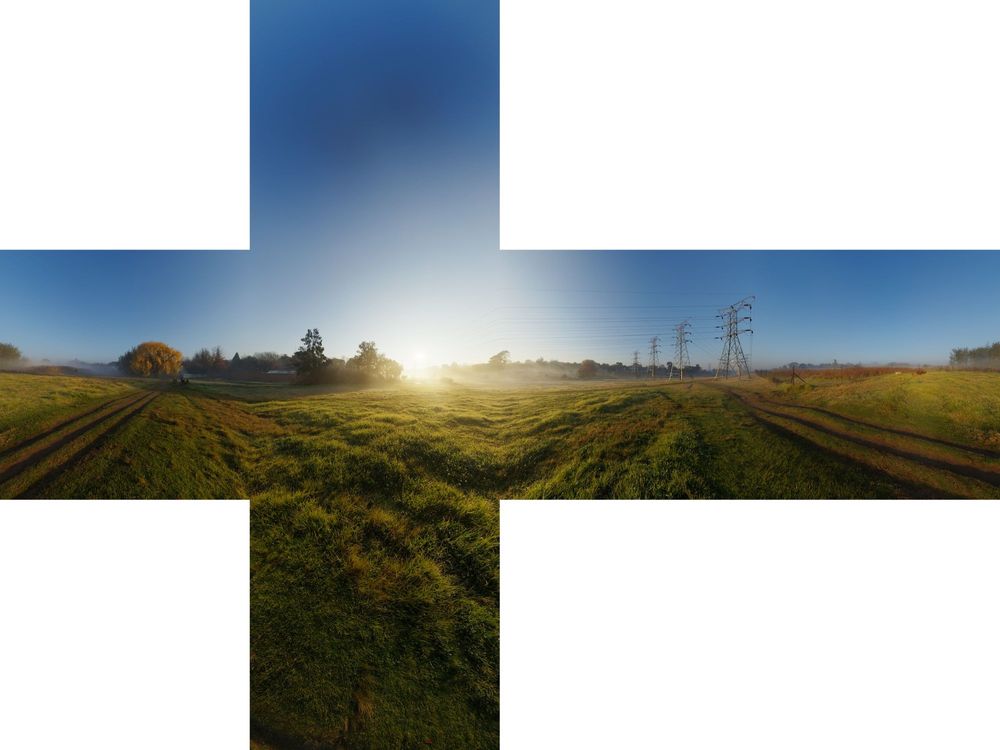
If you lay out a cubemap as a 2d texture that looks literally like https://www.turais.de/content/images/size/w1000/2021/05/Stan... it's not hard, given the VU1-based triangle processing (like proto-mesh-shaders 25 years ago), to set the UVs of triangles independently to use the correct square even in the case of dynamic reflections. This doesn't do per-pixel spherical UV normalization. But, with a dense enough mesh, a linear approximation looks good enough.
Except... The triangle UVs will often cross over between multiple squares. With the above texture, it will cross over into the white area and make the white visible on the mesh. So, you fill the white area with a duplicate of the texels from the square that is adjacent on the cube. That won't work for huge triangles that span more than 1.5 squares. But, it's good enough given an appropriate mesh.