Hacker Newsnew | past | comments | ask | show | jobs | submitlogin
I'm Peter Roberts, immigration attorney who does work for YC and startups. AMA
196 points by proberts 17 hours ago | hide | past | favorite | 241 comments
As usual, there are countless immigration topics and I'll be guided by whatever you're concerned with. Please remember that I can't provide legal advice on specific cases for obvious liability reasons because I won't have access to all the facts. Please stick to a factual discussion in your questions and comments and I'll do the same in my answers!

Previous threads we've done: https://news.ycombinator.com/submitted?id=proberts.


Thank you again for all the interesting questions and comments. I will be logging off now but checking in again tomorrow for any unanswered questions. Have a great weekend.

I have worked in the US on an L1B converted to H1B visa for about 5 years, left for Europe in 2021. Including the time I was absent from US soil while employed on an H1B and the time I had remaining on it before I left, I would be able to recapture about 18 months for an extension. Can I now return to work for a US company again if they hired me and would they be subjected to the $100k fee?

I am a native citizen currently watching my first child grow up without me while my wife waits in line for her nearly 2-year-long immigration process. Every attempt to expedite her processing has been denied, even during Typhoons where she loses power and access to hospitals. I feel forgotten, and cast aside by the system - like my family situation is inconsequential and undeserving.

Is there really nothing native citizens like me can do to get our family here outside waiting in a generic line with everyone else in the world?


That doesn't make any sense. I'd need to know all the facts to advise. Please send me an email to schedule a call (proberts@robertsimmigration.com). Which Consulate is she applying through?

Isn't 1-2 year wait time standard for spousal immigration?

Shocked and curious to know why anyone would downvote a story like this.

Because people’s lives have become collateral damage for performative cruelty by the current administration and its supporters.

Hi Peter, thanks for the AMA!

I work for an American company and I am based in Europe. I visit the US for work every now and then. I heard a lot of horror stories regarding border entries. If I am ever in a situation where the border police asks for access to my personal phone and pin code, what are my options? Can I refuse and what happens then?


Border Patrol can wait longer than you want to wait at the airport, you should not bring your personal phone if you don't want them going through all the contents, they can hold your device for an inconvenient amount of time if you are an American citizen. If you say no and are not an American citizen you can be denied entry at the airport and sent home.

>you should not bring your personal phone if you don't want them going through all the contents

isn't the right move here: wipe your phone, travel to destination, then restore from cloud backup? in the middle, you can let them inspect your wiped phone.


Being quickly denied and sent home is the best possibility in that scenario.

If you're on American soil they can just detain you. Or worse.

If you ever want nightmares, read the story of Maher Arar.


You are within your rights to say no but if you say no, almost certainly CBP will assume that you are hiding something and deny you admission.

Can they deny you admission when you are a US citizen?


A country can not deny entry to its own citizens.

They can immediately arrest you, however.


But not for not giving them access to your phone.

What the will arrest you for vs can arrest you for are very different things. Really. This isn’t cynicism, is empirical knowledge. If they want to arrest you, you’re getting arrested. They can arrest you because they can arrest you. This is the strict literal sense of can.

In America, Europe, etc.

They are not legally entitled to deny you entry.

That doesn't mean they can't deny you entry. It means you might win a court case some day.

ICE cannot legally arrest people who are citizens for no reason, and yet they have done exactly that 30% of the time by their own admission.

"Knowing your rights" is meaningless if the public chooses to vote for people who don't care about those rights, and celebrate when you do not get your rights.

It doesn't matter what the paper says, it matters what CBP feels like doing, and what their management lets them get away with. The constitution is just a magic circle we all agree to play in, and isn't real if enough people disregard it.

If the border agent doesn't want you to come into the country, you are fucked. Nobody's job is to get between that agent and you and ensure the border agent follows the law on the paper, and the border agent will not go to jail or even lose their job for completely ignoring the law.


> If the border agent doesn't want you to come into the country, you are fucked.

You are seriously inconvenienced, but assuming your paperwork is in order, you will be allowed into the US. This isn't just against US law, it's a violation of international law to render a person stateless.

This ignores the real point, which is that while you cannot be refused entry to the United States, you can be arrested at the border. ICE these days has mastered the art of making people's detainment so uncomfortable that even those with a right to be in this country end up deciding to leave.


yes sure you can come into america, straight into a holding cell until you hand over your pins/passwords or go back home.

> ICE cannot legally arrest people who are citizens for no reason, and yet they have done exactly that 30% of the time by their own admission.

Where are you getting that statistic (honest question)?


I overstated, but it's murky.

https://www.dhs.gov/news/2025/12/05/despite-medias-claims-ic...

Why would ICE leave the number as low as "70%" if they could be higher? Every illegal alien is a criminal as far as the law is concerned. Every illegal alien arrested is "charged with a crime". Otherwise ICE is openly stating to its supporters that they arrest illegal aliens and then release them, something their supporters are vocally against, and the administration believes and claims to be a serious problem.

Meanwhile, the Cato Institute a libertarian think tank, claims they have been leaked far worse data https://www.cato.org/blog/5-ice-detainees-have-violent-convi...

A direct reading of ICE's claims (that seem to be contrary to information obtained through FOIA?) is that 70% of the people they arrest are criminals, which by their own definitions, would imply 30% of the people they arrest are not illegally here, but that's reading between the lines and it's hard to lend any credence to anything said by an administration that treats public statements as a fun gaslighting game.

But essentially, if ICE COULD claim everyone they arrest is an illegal alien (and literally a criminal they are legally allowed to arrest and deport), why wouldn't they?

Flag my claim if appropriate.


I think this is a misinterpretation of the document. The claim is:

> 70% of ICE arrests are of criminal illegal aliens charged with or convicted of crimes in the U.S.

I believe the claim here is that 70% of the people ICE arrests have been charged with or convicted of crimes other than being present in the USA illegally. I don't think this is at all meant to imply that 30% of arrests are of people who are present in the USA legally. I think it's just sloppy writing.


I mean, you didn't just overstate, you flat out just made it up. The opposite of "illegal alien" is not "citizen".

So basically bring a burner phone.

[flagged]


Foreign countries have no obligation to admit you within their borders.

There’s many points you could make about the United States and immigration, but I don’t think this is one of them.


[flagged]


He's not talking about other nations, he's talking about the US and saying if you are not a citizen of a nation, its a foreign nation to you and they have no obligation to let you in.

> Foreign countries have no obligation to admit you within their borders.

That doesn't sound relevant.

Nobody said that they were obliged to admit you, they complained that the reasons for declining admittance were unfair. Unless you think "no obligation to admit" means carte blanche to decline for any reason, and to treat you however they like?

If so, then that is unreasonable. It is a much stronger condition than "I don't have to let you in".


Yes, "no obligation to admit" means they don't have any obligation whatsoever, and that includes doing so for any reason they see fit and not having to disclose those reasons (if any) to you.

It is exactly the same as "I don't have to let you in".


No, it isn't.

For example, I do not have an obligation to let people into my house. I can choose to let them in or decline them entry. But there are certain preconditions I cannot apply. I cannot, for example, say "you may come into my house only if you murder my neighbour". That's because I'm legally bound not to induce people to commit murder. It would obviously be disingenuous to say this means I have an "obligation to admit" them.

It's the same with immigration. They actually are legally bound in certain ways - an immigration official can't assault you for instance. It's not hard to imagine them being legally bound not to search people's phones. That doesn't mean "they have to admit people".


You're confusing yourself with irrelevant analogies. You can say, "you may come into my house only if you give me your unlocked phone," and an immigration official can't assault you because there are certain protections granted to foreigners against being randomly assaulted. It's also not hard to imagine them NOT being legally bound not to search people's phones, and if you're trying to say someone's breaking the law here then it's your burden of proof.

> But there are certain preconditions I cannot apply. I cannot, for example, say "you may come into my house only if you murder my neighbour".

How is that a relevant argument?


This is not some debate competition where you try and come up with useless analogies to try and win the contest.

There are many contexts where this comment would apply, but border crossing is not one of them. If you're a foreigner trying to enter another country, then by definition you have less rights than natives.

There is a solution to this. You can become a US citizen.

* terms and conditions may apply

And then wonder if they'll try to take your citizenship away anyway - the exact boat I'm in. Naturalized after almost 20 years of holding a GC, because I expected trouble with this administration - and now wondering they'll try to take away my citizenship because I did it recently.

I actually expected to leave and have my right to come back not dependent on GC status (which expires after 6 months), but due to family have stayed so far. by the by - I'm a citizen of that dangerous country bordering the US - Canada.


Didn't realise it was that easy. Why don't all the illegal immigrants just do that?

It doesn't have to be easy to be factual. You simply are not owed entry into any country if you are not a citizen of that country, that is a fundamental part of what things like "citizenship" and "sovereign state" mean in the modern world.

Very hard process though.

Another option is that we can treat our guests better.


[flagged]


Who said anything about a “right to enter”? This is just about not massively invading visitors’ privacy for no good reason.

Of course, if you just don’t want anyone with intelligence or dignity to visit the country, this is great policy.


As explained upthread,

> You are within your rights to say no

Given that you don't have a right to enter, if you say no (which you are within your rights to do), and you are denied entry, then nothing wrong has happened.

If you believe that they shouldn't make entry conditional on something, then you are asserting a right to enter. That's what "right" means.


This argument is absurd.

If someone comes up to me and asks for food, I am not obliged to give it to them.

If I say to them, "I will give you food, on the condition that I can punch you in the face", and they decline to be punched in the face, do you really believe "nothing wrong has happened"? That I, applying an unethical condition, did nothing wrong?

If someone else says "You must not make punching someone in the face a precondition of giving them food", does that create a "right to food"? Of course not.


I'm not who you're arguing with, but I'd also take the opposite side of that argument.

Your analogy does seem workable, though - let's examine:

> If someone comes up to me and asks for food, I am not obliged to give it to them.

Yes! 100% agree. They probably have a right to ask for food in countries that protect free speech, but they have no right to have requests fulfilled.

> If I say to them, "I will give you food, on the condition that I can punch you in the face", and they decline to be punched in the face,

Sounds great. You have the right to say no. You did say no basically, but you did make a counteroffer. (This is arguably also especially true due to free speech, though that's unrelated to our points.) Your exact counteroffer doesn't seem relevant to me, it could also just be that you'll give it for $50, or $1,000,000 and nothing changes.

He thinks it's a bad offer and gets none of your food.

> "nothing wrong has happened"?

I do think nothing wrong has happened! Is it only because you used food, which a necessity, that you think it's wrong? What if it's a PS5? Would this be ok if the asker is seeking a free PS5? Visiting a foreign country is much more like a PS5 than it is a potato.

> If someone else says "You must not make punching someone in the face a precondition of giving them food", does that create a "right to food"? Of course not.

That is the worst policy I could imagine since it's vague and undefined. Can one ask for a kick to the groin? An elbow to the funny bone? If you did the policymaker's job correctly you'd need to make the policy like "No one may deny a request for food/PS5s" -- that exactly creates a right to food/PS5s. Or you could make the policy "No one may deny a request for food/PS5s but one may require compensation, which may only be less than $50 in US Currency. Compensation in the form of a service or a trade may not be required."

That creates a right to pay $50 or less for food/PS5s.


> That is the worst policy I could imagine since it's vague and undefined.

Every ethical problem is vague and undefined. If you can't find an infinitely precise specification of the ethical problem, that doesn't make it invalid.

However, even at the level of policy, your analysis does not go through. It is routine and unproblematic for laws to exist that prohibit "you can't enter this bar if you're black" or "I won't hire you because you're a woman". It simply does not follow that employers are "forced to hire people". They are forced to apply consistent, legitimate rules when hiring people. Whether a rule is consistent and legitimate is usually decided by a judge. This is not an unusual thing.

P.S. are you writing this with an LLM? If you aren't, I'm sorry. But it really sounds like you are. If you are, please stop.


Sorry, I don't know any LLMs that would argue politics without using their own heavy bias and getting caught up in trying to not harm people, I'm afraid you just hate my writing style. Maybe you don't like the inline quotes? idk. Also I can't imagine wasting the effort to have a bot debate people online if I don't care enough to do it myself.

The whole reason we have those types of employment and public accommodation laws is a special case though. In terms of employment, we prefer this to a world where black people or women can't get jobs, because jobs are necessary, or can't enter half the establishments because people witnessed that Jim Crow was a shitty and shameful situation. And I do stipulate that that doesn't mean the same as "all women have the right to a job at my company upon demand."

But why don't we also have laws criminalizing things like refusing to be friends with $SKIN_COLOR people? I think it's because it's only in those specific realms like employment and public accommodation where we have created rights. The right to shop in a place that is open to the general public is a right Black people got from a law. And the right of people to be considered for a job without regard to their membership in certain protected classes is something the Equal Employment Opportunity Act of 1972 created. There is no right of foreigners without a green card to enter in the first place - CBP can completely legally say no to anyone, so no 'counteroffer' of conditional admittance could be inappropriate. The only exception I can think of is misconduct of the officer, e.g. 'I'll admit you if you give me $10,000' or a more unsavory favor. But with that already being illegal, I don't think it is too relevant here.


> But why don't we also have laws criminalizing things like refusing to be friends with $SKIN_COLOR people? I think it's because it's only in those specific realms like employment and public accommodation where we have created rights.

Not just that, at least in my understanding of American political theory. It's because of the existing right to freedom of association. If it is criminal to refuse association, that association becomes compulsory, and thus not free.


> If I say to them, "I will give you food, on the condition that I can punch you in the face", and they decline to be punched in the face, do you really believe "nothing wrong has happened"? That I, applying an unethical condition, did nothing wrong?

Yes, of course nothing wrong has happened. The other party decided that the food was not worth a punch in the face. The other party is no worse off than if you had made no offer. The other party is no worse off than if you had responded to "may I have some food please" with "no".

Downthread:

> It is routine and unproblematic for laws to exist that prohibit "you can't enter this bar if you're black" or "I won't hire you because you're a woman".

This is completely irrelevant. "I will give you food, on the condition that you change your immutable characteristics" is incoherent. "You can't enter the country because you didn't submit to this violation of your privacy" is a) targeted at someone who definitionally doesn't have those constitutional protections in the US and b) not an expression of any kind of identity-group prejudice.


Well, by offering food for punch in the face you changed it from charity to free market transaction. Basically you gave them a chance to earn their food instead of just giving it to them. If they deem the price too high and refuse your offer then again, nothing bad happened.

Not all free market transactions are reasonable. Selling yourself into slavery is a "free market transaction" I hope you would not consider legitimate.

Being offered something unreasonable, given free reign to decline that offer, does not cause harm.

Not op and may not agree with them but the original comment was how I read it "...we ostensibly have rights but the exercising of rights is ...".

We're talking about a non-citizen on a visitor visa and there is just simply no legal right to enter if the port of entry official don't like their answers or behavior. They can't say "you have to let me in, it's my right".


I think this EFF document probably provides a more comprehensive answer than what can be provided in a HN comment https://www.eff.org/files/2017/03/10/digital-privacy-border-...

Peter might have good insights on whether the relevant case law has changed since 2017 though.


The only relevant part from that document is this line from page 33: "Foreign visitors have the fewest rights... if a foreign visitor refuses a border agent’s demand to unlock their digital device, provide the device password, or provide social media information, and the agent responds by denying entry, the foreign visitor may have little legal recourse."

Why not just carry a burner phone or buy a blank one and restore it after customs from backup?

One of the latest tricks is that if you have social media accounts yet no social media apps or accounts are loaded on your phone, or your phone appears to be a burner phone, they'll ask you why you didn't bring your main, primary phone.

So your "burner phone" needs to be your primary phone, which is something that is hard to go back in time to fix.


This sounds like a rumor to me. Plenty of people (including me) have no social media presence (unless you count HN as social media). How do you know that the person on whatevergram with the same name is me?

It's in general possible to only access social media via browser, not apps.

I have a few social accounts, but no apps installed on my primary, 2.5+ year old S21. I prefer to visit via browser (firefox, mostly).

I always traveled with a feature phone and a travel laptop with just work stuff on it when going to the us. Nothing personal like email or other stuff on me.

Hi and thanks for doing this.

I went through CBP twice in the span of 20 hours. I was granted entry once and denied the second time. The second time, I had to sign some electronic pad and later a form (I-275) was given to me. Did I have the option not to sign? And is this contradictory decision in span of 20 hours legally OK?

Below are some more details:

At Toronto Pearson (Terminal 3) on December 1-2, 2025, I went through CBP twice and the first time I was granted entry and second time denied. I am a dual Canadian-Iranian citizen. On day one I was given a detailed biographical form, questioned repeatedly about my purpose of travel (Conference), employment, etc and especially about any Iranian military service. I provided old passports and a university transcript showing that I have not been in Iran since 2019 and prior to that I was studying in the university. They also explicitly questioned me about a prior incident in which Canadian police claimed an explosive trace ("Tetryl") on me, which I disputed as an error. CBP took my belongings (backpack, watch, wallet, phone), conducted a body inspection in another room (through search, hands inside my pants followed by groin search) took my fingerprints multiple times and took my phone after requiring the pass code and it was out of my possession for about an hour. After several hours they told me I was "negative" but by then my flight had departed. I was given only a piece of paper with CBP stamp. Since there was no flight for my airline for the rest of the day, I was brought back to the Canadian side. The day after, I went through CBP again and when I showed them their paper with stamp I was told "we are not going to take your word for it" and the full process happened again (although no body check or phone check this time). A different officer then stated that my documents were not sufficient to prove I had not done military service in Iran and that I now needed an official exemption letter or something similar from Iranian authorities. He added that I should have been "advised differently" the night before. Finally, my picture was taken and I was asked to sign on a pad twice. Only afterward did they print and hand me a form (I-275) showing a withdrawal of my application. I was escorted back to the Canadian side. Did I have the option not to sign? If in future I decide to visit US is this going to be held against me? I can provide more details or the form if necessary.


Could you please help with any insights about the social media vetting rules? This has been a blackbox to the visa applications - started with student visas, now being forced on work visas too from Dec 15th.

That's right, both before US Consulates when applying for visas, before CBP when applying for admission, and before USCIS when applying for a benefit (H-1B, O-1, green card, etc.), social media is being reviewed, not across-the-board but more and more. And there's really no option to keep social media as private if asked to turn to public by a Consular Officer or CBP Officer. The review is broad and not limited to social media that is critical of US policy but extends to a review of an individual's entire background to make sure there were no violations of US immigration law, including unauthorized employment.

CBP actually made me give them my facebook password when entering on a J1 visa in 2017, so I'm surprised to hear so much talk about this. Is it more that the practice of checking social media is more widespread now?

If one didn’t have an account with meta they just wouldn’t get the visa then or how does it work?

Does the government have any direct link to meta re what accounts people actually have. I’m surprised people aren’t up in arms about this, I guess it affects mostly visitors and immigrants but the fact that the government needs to see your activity on a private company’s web app is wild to me.


"I don't use social media" is probably a good answer, it just has to be true.

If they ask you "well, do you use any social media?" You'd presumably have to answer with HN, which maybe doesn't sound all that great :)


You could say you use Y Combinator's news comment board.

HN isn't social media, any more than a bus is a car.

I don't think you want to try that argument with immigration officials, although it might just keep your incorrect answer from being straight up fraud or willful misrepresentation.

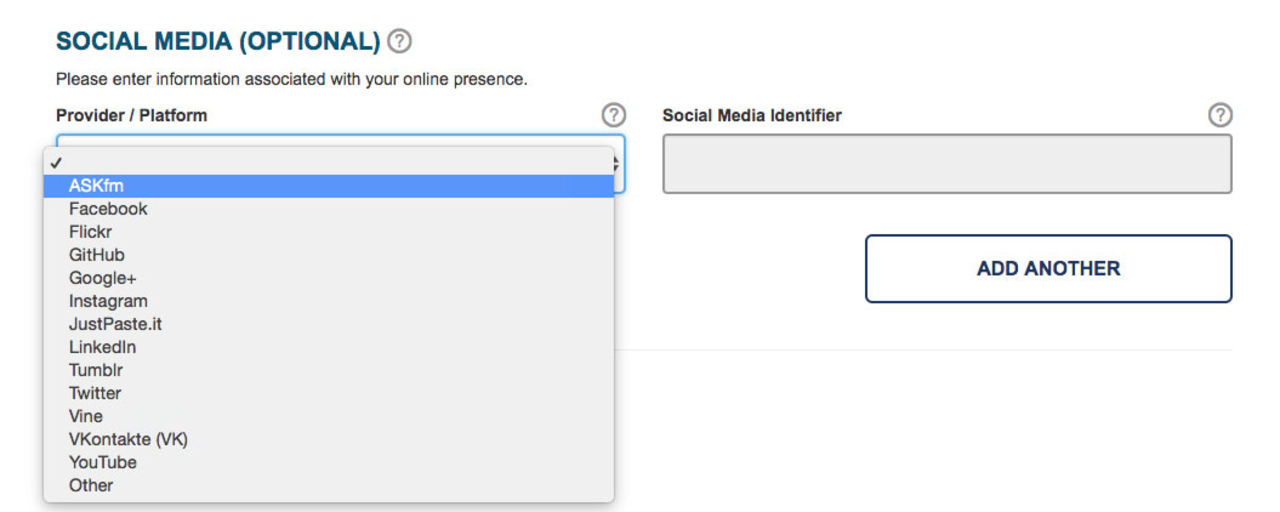
I mean, some US govt immigration forms asking for your social media usernames include pastebin sites like "justpaste.it". See for example: https://static.feber.se/article_images/42/10/92/421092_1280....

Knowing that, it's crystal clear HN falls strictly within that definition of "social media", although it might not be as clear if you don't know what that particular site is.


I love how bad that list is.

For what it's worth, the somewhat hilarious reason justpaste.it is on the list is likely that it used to be a favourite of Islamic State terrorists a decade ago. https://www.politico.com/magazine/story/2014/08/islamic-stat...

Googling 'site:gov "justpaste.it"' also brings endless results of government documents mentioning the site in the context of terrorism.

I somewhat doubt US immigration authorities thwarted any would-be terrorists by asking for their justpaste.it username, but what do I know, perhaps this was an important breakthrough in the global war on terror.


You'd be surprised at the number of people who willingly give up their social media accounts, only for immigration officials to find comments in support of terror attacks in the Middle East.

It's pretty easy to think it's harmless if you live in a country where that viewpoint is not uncommon.


It can be an easy charge of “lying to the government on an official form” when they discover you have a user account somewhere that you didn’t disclose, even if they can’t get anything else to stick.

Yes, it did occur to me that there would be no way to verify it. But it felt like it was in my best interest to at least provide something.

You would have to make sure your search footprint supported that. IE - fully private, non-publicly-visible profiles everywhere.

I think the only bit that surprises me is they don't have a back door into Facebook.

I would consider it extremely likely they have some kind of visibility into your data at Meta via Palantir.

Why waste the backdoor on routine screening?

Who says they don't?

And who says that asking for your password is to gain entry?


What are the most common reasons for failing the social media check?

Based on news, it seems like if you like Donald Trump you may get in. If you don't like him you don't. You may also be jailed for two months for not liking Trump - that's happened a few times and that's why tourism fell off a cliff.

> You may also be jailed for two months for not liking Trump - that's happened a few times

Do you have a concrete example story that illustrates this?


Rumeysa Ozturk

A question about TN status for a Canadian living in the US. There are some income-generating things I'd like to do outside of my work visa (play a music gig, upload music to Spotify, act in a movie). My understanding is that I can't do these things in the US. Am I able to do these things if I do them outside of the country, or is there any way to make them work? For example, if I went to Canada, recorded an album, uploaded it, then came back to the US.

Yes, if the activity occurs while you are outside U.S., then you can get paid for it without having to have U.S. work authorization to do it. So, yes, recording an album while outside is fine but it becomes a little more complicated if you are now getting paid for downloads while you are in the U.S.

While I'm inside the US, can I perform work for non-US entities? For example, remotely teaching a music lesson do someone in a different country or writing a book and publishing it abroad but not in the US.

The short answer is no.

I think a related but separate question would be "Can I do these things if the proceeds are going directly to charity instead of to me?"

I suspect it would be important that any funds never reached you, so you couldn't simply receive money then donate that amount. Playing a charity gig where the receipts go directly to the charity would likely be fine, streaming/Spotify revenue I don't know, acting in a movie might be out of the question if it's being professionally shot because the producer might have insurance or other requirements that only paid performers and crew can be on set, etc.


IIRC from the time I was waiting for employment authorization, I wasn't allowed to do any charity work that could otherwise be a paid position, so be very careful with this charity idea.

I got no answer but it sounds really fun what you’re planning to do :)

It's no fun if you legally can't do it...

Just remember, if you want to put your content on youtube be sure you're demonetized by cursing up a storm.

(not real advice. I think.)


I moved to the USA in 2016 thanks to Peters help and every successful interaction I have had with USCIS since then has been because of his sage advice. You will not find a more knowledgeable or kind adviser than Peter.

That's good to hear. Thanks!

How has the Section 174 elimination of 5-year amortization for domestic SWE salaries impacted decisionmaking on whether to hire overseas?

Since overseas workers are still subject to 15-year amortizations I'm wondering if people are getting pulled in from Canada.


Those are excellent questions but really more directed to those hiring at tech companies. From my limited perspective, I haven't an impact on hiring.

Hey Peter, I’m an F1 visa student and I’m trying to found a company with two Americans while being an Indian citizen. I plan on taking significant equity and will be part of the cofounders. Are there any significant hurdles that I should be on the lookout for here? I’d like to sign the founders agreement and found the company while I’m still pursuing my education but I’m not sure whether my visa status would throw any wrenches here.

Hi Peter, founder of a YC startup here. My startup got acquired and I now have a new O1 visa but in my indian passport I still have the old O1 visa stamped. I’ve now traveled internationally. Can I enter the US with my old visa? Asking because the waiting times to get the new visa stamped are ridiculously long. Thank you for your time!

What should i keep in mind if i move to sf from India?

Hi Peter, thanks for the AMA!

I'm currently living in the US on TN status and am married to an American. Have you heard of anyone on TN status having difficulty applying for a green card? And do you have any sense of what the wait times currently are, particularly how long until you can get a travel authorization?


There was just an article in the NYT where ICE is arresting people at the end of their green card interviews for essentially no reason.

https://www.nytimes.com/2025/11/26/us/trump-green-card-inter...


Those targeted in this article are spouses of US citizens that had entered the US on ESTA and allowed that status to lapse whilst awaiting their AOS.

That was tolerated previously.

It does appear that these arrests have stopped since the NYT article was written.


That’s misinformation. They’re being arrested because they were in the country illegally, usually overstaying a visa: https://www.newsnationnow.com/us-news/immigration/green-card...

They have a green card interview because they married an American. But you can’t get an adjustment of status if you are in violation of your current visa terms.


I havent been through the US process in a while, but usually that is allowed if your application is processing. You just can’t leave the country.

No, if your visa expires you need to maintain your legal status while a PERM application is pending: https://www.alllaw.com/articles/nolo/us-immigration/maintain... (“This is especially important if and when you are waiting to apply for lawful permanent residence, commonly called a ‘green card.’ If you are in the United States without any immigration status, you are considered to be here illegally, and U.S. Citizenship and Immigration Services (USCIS) may deny your green card application for that reason alone.”).

What’s happening here is that these people were here on tourist visas or completely illegally. Then at some point they married a U.S. citizen and filed a PERM application. But that filing doesn’t protect them from deportation for their original illegal status.


> What’s happening here is that these people were here on tourist visas or completely illegally. Then at some point they married a U.S. citizen and filed a PERM application.

There's no PERM process in family based adjustment of status. You're confusing FB AOS with EB AOS.


>But you can’t get an adjustment of status if you are in violation of your current visa terms.

This is both right and wrong. Congress passed a law ages ago that grants forgiveness to overstaying spouses once the greencard is issued. The AOS process is allowed.

The hole however is the AOS does not extend your authorized stay if you were out of status when it was filed. So this leaves one vulnerable to the ICE arrests.

However, your AOS can still be processed even when arrested because of the forgiveness granted by law, so it just becomes an issue of having a good lawyer to get a judge to intervene.


The relevant provisions are subsections (a), (c), and (e) of 8 USC 1255: https://uscode.house.gov/view.xhtml?req=granuleid:USC-prelim...

Subsection (a) allows the “Attorney General, in his discretion” to grant an adjustment of status.

Subsection (c) categorically denies adjustment of status under certain conditions, including where someone has violated the terms of their visa. This takes away the Attorney General’s discretion to grant an adjustment. The adjustment must be denied.

Subsection (e) then makes subsection (c) inapplicable where the immigrant enters into a bona fide marriage during a legal proceeding regarding their immigrant status. It’s not correct to call this a “forgiveness,” because it doesn’t guarantee you any sort of legal status. Instead, it takes away what would otherwise be a categorical bar against an adjustment of status. That puts you back under subsection (a), where the decision is made by the “Attorney General, in his discretion.” The law says the Attorney can grant you the adjustment of status, not that he must. Under the law, the Attorney General can still categorically deny any adjustments under those circumstances.


Exactly. Unauthorized work is also forgiven.

We've obtained lots of marriage-based green cards for those in TN status. The issue is intent at the time of the most recent entry prior to filing a green card application since the intent at that time cannot be to apply for a green card. Generally speaking, if there's a gap of at least 90 days between entry and filing, USCIS's concern about intent goes away or is at least greatly lessened.

Is there a way for someone on h1B to start a company in a roundabout way by doing something like placing company shares into a trust and having a unpaid board seat? Is that pushing luck? Not for me but a friend who I had plans to go into business with but we're facing a chicken or egg problem until she gets a green card or changes her visa status.

There are ways for someone in H-1B status to start a company and not in a roundabout way. The approach will depend in part on whether she will leave her current employer and get an H-1B through her startup, stay with her current employment and get a concurrent part-time H-1B through her startup, or just stay with her current employer and somehow work on her startup.

If she is issued equity (reverse vesting restricted stock) and not paid a salary, does she still need work authorization for the startup?

> or just stay with her current employer and somehow work on her startup.

The first two options make sense but this latter option sounds like a risk. As I understand it, she can't earn any active income from this startup unless see has an I-129 for it. A share grant counts as income.

I mean, yeah you can work on a side project in your spare time that could become a business, but the moment employment and active income enters the picture that becomes something else.


Why don't they just start a company in the country where they are from or why don't you start a company with someone who is a citizen or has a green card?

The entire premise of your question is misaligned with the intention of the H1-B visa. Yes, everyone abuses its intent, but that isn't justification for more people to find more ways to abuse it. The abuse of that visa (and other visas) is why folks just want it abolished outright. I guess the purpose of a system is what it does, but it was sold to the American electorate as a way for companies to get access to talent that they simply cannot find domestically.

Trying to use the H1-B to hire a very specific person instead of any person with the skillset needed for the role would be in contradiction with the labor market test (LMT) needed for PERM status.

An H1-B can only work for the employer on the I-129 petition. There are some forms of passive income allowed but to placing shares in a trust and having an unpaid board seat just seems like an attempt to cheat the process because ultimately the goal is for her to work for this startup. Doing what your proposing puts a target on her head where anyone that is anti-H-1B can report her to USCIS and get her deported.

Moving home, working remotely and then applying for an L-1 seems like the correct approach here for what you're trying to do.


I've got friends who tell me they'd never consider applying for YC because they are on a classic H1B with a tech company. What typically happens with folks on a H1B who make it into YC?

That's hard to respond to other than to say that there are multiple visas that allow participation in accelerators and training programs.

That makes sense ... is there a typical path? Basically - are they right in thinking it's a high risk thing for them or should I encourage them to take a shot?

My understanding is that their time spent on the company before YC accepts them is the biggest risk factor?


No I don't think it's high risk at all because even if the path were something other than H-1B, they always could go back to H-1B.

As a non-lawyer, it seems that you'd have to leave your company to join YC, meaning you'd forfeit your H1B visa.

What if you have deleted social media accounts? It's possible to state that you had them with whatever identifiers, but do you have to prove their existence in some way so they can check an archive (assuming it was Twitter)?

If I understand you correctly, there's no obligation to maintain access to deleted social media accounts or to archive them.

Hi Peter, have you been seeing either a slowdown or increased denial rates to N-400 applications (5 year rule)? Just curious if it's more or less business as usual or if there is any impact on N-400 applications (we've heard of the neighborhood checks etc.) Thank you!

It's not business as usual anymore. Clients have shared that interviewing officers have shared that flexibility and leniency in adjudicating N-400 (and green card) applications is over. So officers are taking a much tougher stance on criminal records and extended absences from the US. That being said, applications without any issues are being approved although the approvals are taking longer.

I have recently taken a job with an American based company and will need to complete a few weeks training in Miami. Based on the information they have given me I need a B1 visa and maybe an ESTA since I'm in the UK, and a C-1/D for moving through the US.

However they keep flip flopping between me needing a B1 and me just using my ESTA for the training, and their communication hasn't been the most straight forward. Which visa do I need to get to enter the US for the training?


Whether you present a B-1 visa or ESTA for admission, you will be seeking admission as a business visitor. Under these circumstances, my advice is almost always not to risk a denial of a B-1 visa application (which happens all the time) and to travel on ESTA. The only relative downside is that ESTA limits admission to 90 days. But of course run this all by the company's immigration counsel.

Thanks for having another round?

In your view, who are the winners and losers of the recent H1B changes? And any changes on your perspective for YC harboring international talent in SF Bay Area?


In the end, the new requirements - really, just the $100K payment for now - are manageable/avoidable and absent this requirement, the rules and their application haven't really changed. The bigger change, which hasn't happened yet, is the across-the-board increase in prevailing wages. And this will have a profound effect on H-1B employment since the increases will be significant.

In October, the state department introduced a new policy:

> Applicants for U.S. nonimmigrant visas (NIV) should schedule their visa interview appointments at the U.S. Embassy or Consulate in their country of nationality or residence

> Applicants must be able to demonstrate residence in the country where they are applying, if the place of application is based on their residency.

What sort of proof is required to demonstrate residence? What about cases where an applicant legally has residency in a particular country (e.g. PR card or work visa) but in practice lives in the US as an H-1B/TN/L-1/O-1/etc. worker or H-4/TD/L-2/O-3/etc. dependant? Especially for the dual intent visas?


There's a lot of uncertainty here and the outcome will depend in part on the interpretation by the particular Consulate but my general understanding is that applying in a country where you hold permanent status but where you are not currently living would be risky.

Hi Peter, thanks as always. It seems that i-131 Reentry Permit processing times are greater than 12 months these days.

If an i-131 is pending, would you advise that person to return briefly to USA before their 1 year date of exit (ensuring that they are never out of USA for greater than 1 year prior to approved i-131)?

Or does a reentry permit allow them to remain out of country for longer than that even if pending (presuming it gets approved)?


If the RP application ultimately gets approved, then it would "protect" that absence of one year that occurred before the issuance of the RP (although the RP validity period will start when it's approved not when it was filed). The reason to still reenter before you are outside for one year has to do with qualifying for naturalization rather than maintaining green card status.

How does the Supreme Court’s elimination of Chevron deference affect USCIS’s ability to narrowly interpret the EB-1A regulatory framework, particularly at Step 1 of the Kazarian analysis? I am specifically interested in two areas: (1) whether, under a strict textual reading of the judging the work of others criterion in 8 C.F.R. § 204.5(h)(3), participation in code review where the beneficiary evaluates and approves the technical work of others in the same field should qualify without USCIS applying extra regulatory limitations, and (2) whether USCIS can continue using its historically restrictive approach to comparable evidence under 8 C.F.R. § 204.5(h)(4) now that courts are no longer required to defer to agency interpretations. I understand that even if these issues favor the petitioner at Step 1 they may not change the outcome of the final merits determination under Step 2, and I am trying to determine how a post Chevron, strictly textual approach might influence Step 1 outcomes for petitioners whose achievements do not align neatly with the ten listed criteria.

Thanks for the AMA Peter!

What impacts are you seeing as a result of the $100K H-1B fee which took effect on 9/21/25?


In the end, it's largely put a stop to H-1B sponsorship of workers outside the U.S. That doesn't mean that all these workers can't get visas to work in the U.S. but other - tougher visas - have to be explored.

Suppose you could wave a magic wand and change US immigration law in any way you like. What changes would you make?

Good question. There's so much I would change. I'll give this some thought and respond later today.

Looking forward to this answer!

Many of the absurdities of the US immigration system exist for good reasons and it would be great to understand the nuances.


Thanks for offering to answer this question. Immigration law is so often an inflammatory topic, but I think your perspective as someone who has to work with the law, the US agencies that enforce it, and the people trying to navigate it could be really valuable.

Not Peter but would like to spur discussion on positive changes that could be made.

- Paper-free overhaul of the entire immigration system.

- Green Card recapture [0].

- Country of Birth caps abolished for Green Cards. Impossible to justify this as it doesn't serve the intended purpose since AC21 was passed.

- EAD/AP premium processing - so many livelihoods ruined and immigration journeys derailed because people can't get work authorization or cannot travel.

- TD holders granted working rights incident of status same as L2S.

Now for the not-so-popular suggestions...

- Diversity Lottery - there's bipartisan support to cancel the program and it's really hard to justify bringing almost 55k with a min of high school education into the country.

- Removal of F2B, F3, F4 family based categories to move inline with other developed nations immigration systems such as Canada [1].

[0] - https://www.fwd.us/news/green-card-recapture

[1] - https://www.canada.ca/en/immigration-refugees-citizenship/se...


> - Country of Birth caps abolished for Green Cards. Impossible to justify this as it doesn't serve the intended purpose since AC21 was passed.

You are saying that since, for example, Indians can remain indeterminately as long as they are employed, they are de facto kind of like in a green card situation already, therefore country caps don't make sense?

That would mean then that every other country wait will go up for over a decade, with all the backlog that India has (1.2M vs 140k EB green cards per year).


It should be done in tandem with GC recapture or possibly a single one off Bill to clear backlogged applicants.

Hello Mr. Peter,

A few I registered a company in Delaware as a foreign company for SaaS business.

I have been unable to complete an organization certificate for my website.

Unfortunately I could not get one since my legal phone is not the way to reach me and they tell me that they cannot change that phone to reach me according to my legal representatives in Delaware.

I need some kind of certificate of good standing or being able to have a verifiable phone and/or email to reach me in a "reliable" way from a third party source.

How could I proceed for this, since I am not knowledgeable of the law in Delaware. Probably I need an attorney and I would be happy if I can be recommended one that could emit such verification.


This question arises from the current regime's efforts to reverse naturalization.

For anyone who has one US citizen parent and one non-citizen parent, where the citizen parent has passed before the child applicant for naturalization reaches 18 years of age, resulting in the applicant applying for and receiving naturalization as an adult, can that same currently naturalized citizen also obtain natural born citizenship status through the deceased citizen parent and would it be advisable?


If I understand you correctly, you are asking whether the naturalized citizen was a citizen at birth based on his or her father's citizenship. To answer that question, we would need to know when the naturalized citizen was born and the countries where the naturalized citizen's U.S. citizen parent lived from birth until the birth of the naturalized citizen.

Thanks, you got it right. 1970 is the birth year and father lived in the United States for decades prior but had a child while out of the country, the naturalized citizen. The question is really about whether natural born citizenship is available to children of an American citizen when the child is born abroad, but the parent was deceased before majority age. Naturalization would probably be sufficient, but given that even naturalization is theoretically at risk, maybe obtaining outright natural born status is better insurance. There is an N-form for this sort of thing.

I know this is a general question, but:

Assuming a US startup is considering engineering hires outside the United States, how does one currently assess the likelihood of getting them a visa to work in the USA? And what timeline and cost would be involved?


Unfortunately, a case by case analysis would be required. However, if they are from a country with its own visa (that is, Australia, Canada, Chile, Mexico, and Chile), it's relatively easy to get engineers visas.

My H-1B with my current employer expires on Jan 10, 2026 and can’t be extended because I don’t have an I-140. Another startup plans to file my O-1A at the end of December. Can I remain in the U.S. while the O-1A petition is pending?

The regulations and long-standing USCIS policy and practice support remaining in valid status in the U.S. after January 10th as long as the O-1 petition is filed before January 10th. But we are hearing stories of USCIS starting to take a different view and treating someone in that situation as out of status even though the O-1 change of status petition is pending and was timely filed.

I've asked this question in a few places but never gotten an answer.

A TN visa/status holder that applies for a EB Green Card by filing form I-485 is considered to have shown immigrant intent and will no longer be granted TN status in the future.

Is this bar permanent or would an applicant who failed to obtain a Green Card or surrendered it in the future be able to seek TN visa/status provided they could prove strong links to Mexico/Canada?


There's no permanent bar but the standard would be high to show with a subsequent TN application that the applicant possessed good faith intent to return to Canada/Mexico. We've argued that successfully.

Thank you.

Hi Peter, thanks for doing the AMA! I have a Delaware registered LLC (10 years old), I managed to get even an EIN remotely. However, I can't open a bank account remotely and so I have just been paying the registered agent fees and Delaware gov taxes for the LLC all these years. I however, genuinely want to come to the states to open the bank account and actually expand my business into the US. The LLC hasn't really had any annual meetings/etc. but taxes are always paid on time. How do I use my LLC to apply for a B1/B2 to visit the US?

OR should I just close it and try the normal route? Thanks in advance!


But you _can_ open a bank account remotely for a DE LLC. Both Wise and Mercury supported this for years.

It's going to be difficult to answer this in this forum because really what you are asking is how can you get a B-1/B-2 visa because the existence of a non-operating LLC really has no bearing on that question.

My understanding of the B-1 visa is all you really need is a letter of employment. Might get tricky with you providing the letter of employment to yourself however.

How easily can one get E1 treaty trader visa and what volume and quantity of trade are recommended? If I have a company registered in my home country (eligible country) and have payouts from a US provider like an advertising network, affiliate provider or some marketplace etc. and my clients are all US companies, can I apply for that visa? Would a low six figure yearly revenue with monthly payout be sufficient for that?

There's no minimum amount of trade specified in the regulations and the answer depends in part on other factors (such as how active the foreign and U.S. companies are and whether they employees and funding) but the minimum annual trade is generally understood to be at least $100K/$150K.

Can you have just one US client like a marketplace or network that gives you monthly payouts totalling $150k a year? The client is a famous US based company.

Hi Peter, thanks for your time :)

I am planning to move to San Francisco to join the startup ecosystem. Regarding the H-1B visa, what does the current process and timeline look like for a new applicant? Given the lottery constraints, are there specific 'red flags' or common mistakes I should avoid when looking for a sponsor?


The issue right now is that if you are sponsored for an H-1B while outside the U.S., the sponsoring employer will be subject to the additional $100K payment and this of course will dissuade most potential employers.

How serious is/was this whole $100k for H1-B applications? How has this impacted the hiring process?

The subsequent clarifications has significantly lessened the impact since it only applies to those who are the beneficiary of H-1B petitions filed with a request for consular notification rather than with a request to change or extend status. So it has impacted the ability to get H-1Bs for those outside the U.S. but that was always a small number.

Someone studied in the US under a F1 visa and a scholarship. No other substantial income other than that. This person while in the U.S. had to file tax forms, although there was no tax to be paid because this person had no income outside the scholarships. The student finished the studies in, say, October last year and then left the country for his home country. The student graduated and does not intend to return to the U.S.

The educational institution sent the student's home address some tax form that he had to file by April 15, but the former student forgot to do that.

The question is: would the student have problems getting a U.S. visa as a tourist and entering the U.S. several years after that? If yes, how could that be fixed? Thanks in advance.


Pretty sure the best time to file tax-related stuff is before it's due and the second-best time is immediately after you become aware of it. Filing late is almost guaranteed to be better than not filing at all, and if there was no tax due then I suspect there also won't be late filing penalties.

Yes, unresolved tax issues can cause U.S. immigration problems.

hey peter, Im on an h1b visa (year 10, have approved i140 and pending gc application). Ive never done an h1b stamping as I was paranoid about being denied. Will doing the stamping now trigger the 100k h1b fee?

No since the underlying H-1B petition was filed and approved before this $100K payment provision went into effect.

thank you!

Is there clarity right now around foreign students attempting to obtain h1bs in the future?

Yes. F-1 students can get H-1B visas. The issue is the $100K payment which applies if the H-1B petition is filed not with a request to change status but with a request to notify a consulate. But if it's filed with and approved as a change of status, then a subsequent H-1B visa application will not trigger the $100K payment.

Can a US citizen with a foreign spouse bring the spouse to the US on a tourist VISA and adjust status? What if they already filed the i-130 with consular processing?

That could be viewed as fraud at the time of entry under both scenarios. I recommend that you speak with an immigration to come up with a workable plan. Note that if your spouse applies for his or her green card visa (known as an immigrant visa) at a U.S. Consulate, he or she can visit you on a tourist visa for extended periods of time while waiting for the interview at the U.S. Consulate.

Thanks for the info. Tricky situation because we have a kid who has dual citizenship, and we are not in the US, but want to move back.

Your best bet is to plan a year or so ahead and get sponsorship in the queue so the spouse can enter with a green card. Timelines are about 8-14 months.

But as PRoberts said, a non-citizen spouse can't enter on a tourist visa with the intention to change status. A spouse can visit, but then change their mind while in the US.

But CBP is well aware of people trying to shortcut the process this way, so it can be very challenging convincing CBP your non-citizen spouse intends to leave. But it can be done showing a job, property or other elements that would require someone to go back.


Hi Peter, I have a valid h1b visa stamp till 2027 but when my new employer filed for my H1B from outside the US I got an RFE for the 100k. The company lawyers are arguing against fee payment since I has a valid H1B visa stamp. What are my chances of denial?

The subsequent guidance on this question was in conflict and unclear. On the one hand, the guidance indicated that if the beneficiary had a valid visa stamp, then the petitioner wouldn't be subject to the payment but on the other hand, it indicated that if the petitioner selected consular notification, then the petitioner would be subject to the payment. So I think it could go either way.

Have you handled cases/seen outcomes of self employed founders' H1B applications under the new rule?

Yes. The forms only require disclosure of ownership if it is above 50% so this has made it much easier for international founders (with cofounders) to obtain H-1B status. The challenge comes when ownership exceeds 50%.

If the company has 3 founders with equal ownership, it would not have to be disclosed? Is there a requirement that one founder be in the USA and be either a citizen or green card holder?

Yes im referring to cases when the founder has >50% or in fact 100%.

Curious how the statistics/success rates are looking?


What about exactly 50%?

I'm living in the US on TN status and I'm interested in starting a startup, a subscription-based mobile app. But I have a pending PERM application and leaving my company would mean abandoning the whole thing, which I'm not eager to do. Is there any legal way I could start a startup without having to do that?

Concurrent employment is an option, meaning you could keep your primary full-time TN while getting a concurrent part-time TN. The problem is more that self-employment isn't allowed on the TN.

Thank you for all your questions and comments. I'll be taking take a short break.

Thanks for the AMA Peter!

Do you think there are risks involved with leaving (and hence returning to) the country on a Green Card?


I don't but a quick discussion with an immigration attorney to make sure that there are no hidden issues probably isn't a bad idea.

Thanks for the response, greatly appreciated!

Can I get an H1b for just 10hr/week like a part time job and be valid status in the US?

How has AI impacted your profession?

In a limited way. Where it has impacted our clients is it has made it much easier for them to get reference letters when reference letters are required. But our basic every day work is largely unaffected by AI. So far.

I have green card and last time I left is 2 years ago, How can I return back to the US?

If you have been outside the U.S. for 2 years without having obtained a reentry permit, then you could be considered to have abandoned your green card. But all isn't necessarily lost. The ability to keep your green card will depend largely on the reason that you were outside the U.S. for 2 years and likely will require you to apply for a returning resident visa.

Hello sir, my question is: What do you think of the trump admin?

Is it normal for incubators to ask founding engineers to come over on tourist visas?

I'm not sure about that being a requirement but participation in an accelerator/incubator while in the U.S. as a business visitor is fine and common.

dear Peter Roberts, your responses have been super helpful. I'm a unlucky position of losing esta for smoking weed once in New York. looking into waiver of inadmissible as you recommended should I get I writing from a therapist before or after o1 application?

should it be d3 or i601?


Has the current administration made it harder to qualify for an o1 visa?

A bit but not significantly so.

Thanks for answering questions!

Do you think H1B visa holders looking to move to a Green Card (in coordination with their employer) should be concerned about rejected applications or other issues?


There is no issue specific to those in H-1B status impacting the ability to get a green card but I would say that it's getting tougher to get green cards in general, particularly through the National Interest Waiver and Extraordinary Ability routes.

We are in the Nordics. Do we stand a chance at PR or citizenship in the US?

I'm not sure I understand what you are asking.

[flagged]


I would expect someone who apparently feels so strongly about this to be able to do the bare minimum of looking up the publicly available statistics (https://ohss.dhs.gov/topics/immigration/yearbook) on visa and green card allocations.

I do understand that performative victimhood is much easier as it does not require much intellectual honesty.


Hi Peter, let's play hypotheticals. USMCA (CUSMA) is dead, Trump actually acted on his threat and the US left the treaty.

I assume it means TN visas are dead in six months if the written notice clause is respected.

Is the zombie CUSFTA now out of dormancy? Can we now use the TC visa? If CUSFTA dies as well, what are the other options and how long does it take to process?


I don't CUSFTA would immediately go into effect again. I believe Congress and the President would need to act to revive it.

Just my opinion, but I think USMCA dying is massively unlikely. Already there is some resentment in the Republican base for souring ties with Canada (e.g. bourbon producers, tourism) and I do see Canada-US ties moving in an upward trajectory in the recent months. The USMCA is also used by US citizens to work in Canada. And considering how watered down the H1B changes have been, I don’t think this administration has an appetite for materially pissing off coastal hi-tech. At most we’ll see tightened category adjudications.

If this happened would existing TNs still be valid till their end date?

Typically, a benefit once granted (unless improperly granted) can't be taken away.

What if I am selected in YC but i don't have us visa?

That's a question for YC because if I understand you correctly, you are asking if you can participate in YC without being in the U.S.

Are you noticing any contraction (or increase) of immigration?

Early on in this administration, yes, but now, it seems as busy as ever although this latest suspension of immigration processes for those from 19 countries has definitely sent a chill.

Were those 19 countries a significant source of work in the system?

Can a person on a nonimmigrant visa file for patent unrelated to the employer?

You've stated in a previous comment that non-US citizens can be denied entry to the United States if border officers request access to your phone and you decline to do so.

... but what about when non-US citizens leave the US?

For example, as a Canadian, if I'm down in the US and, on my way back up to Canada, a US border officer requests access to my phone and I decline... what happens then?


Hi Peter, thank you for doing this AMA.

How can an European Senior SWE land a job, let’s say, SF and have some kind of guarantee regarding the visa before flying into the US.

The 100K cost for the H-1B is so absurd that it crushes any hope of me ever participating in Silicon Valley or any other tech hub in the US. Is the tech alive or are companies just relocating to EU/others?


What's the best way for a lawyer more familiar with other parts of the law to break into immigration?

Join AILA, attend AILA local chapter meetings, and attend the annual AILA conference. And get a mentor if possible.

Should individuals on a green card be concerned about anything, such as criticizing this administration?

Definitely moreso than before but it's not so much about being concerned as being aware. For example, travel to certain countries could trigger aggressive/tough questioning on reentry and certain public comments about the government also could trigger aggressive/tough questioning.

Anything notable about Ukrainians? Especially since Trump's inauguration?

[flagged]


At $22/h you are actually competing with offshore workers in remote low COL locations.

How would you justify it's you should get the work/money, not imigrant worker? The fact your parents immigrated earlier than they should justify it in your opinion?


22/hr for offshore work? Where, India?

The fact that I'm American justifies it. If Americans flooded into say, Somalia, bought up all the houses, took up all the jobs etc, you'd be horrifically offended.

Americans have no where else to go. This is my home and I will not abandon it. You can't just drop 50 million extra workers into a country and expect people to just take it.


You say people born in other countries do not deserve american pay in America?

It's like saying you are white male and it justifies higher salary.

Also if you struggle to compete with immigrants who usually have no network, English is not their native language, have many other disadvantages - you are doing something wrong or are not competitive in the first place.

The fact is you should not fight against imigration, you should fight for decent payment for it and same rights


Do I as an American deserve a job in India or Somolia just because I ask?

We are incredibly atomized in the west, foreigners always have more closely knit networks. They always help each other out. People who make the arguments you're making are almost always foreigners. You have no say in the affairs of my nation. You should leave.


That’s a very valid question. However, I’m not sure why an immigration attorney would be able to answer it.

[flagged]


I don't really get your point, there's high unemployment outside the US too in many places?

[flagged]


> Why is the US an open economic zone

Do you know of the fable of a goose that laid a golden egg once a day?

You are proposing to kill the goose to see if you can get multiple golden eggs at once.

> country with an identity

Like it or not, the identity is 'land of opportunities' and not 'land of anglo-saxons who emigrated before ~1850'


[flagged]


> America put men on the moon without millions of foreign immigrants

Did you drop out of middle school?

America saw the highest rate of immigration in history between ~1910-1960. A majority of the scientists and engineers in the Apollo program were immigrants or children of immigrants.

> Why is it only ever white nations that are expected to let everyone else in?

They are not, have you considered moving to Russia?


Ah okay. I'm not american, but I do hope that the situation for you and other Americans improves soon.

What do you consider the probability that there will ever be free elections in the US again? Please answer with a value between 0 and 1.

I'll get back to you after the midterms.

Just a high level question. My youngest son was adopted. He isn't white. He is naturalized. Should we go ahead and renew his passport so he can carry around a passport card at this point(we never got one in the past because they seemed like a waste). It seems crazy but with people being grabbed off the street for being brown, it seems prudent have a quick way to prove citizenship.

It's awful to have to consider these things. But since you ask, he also could carry his naturalization certificate. The other option is to get a Certificate of Naturalization but that's akin to getting a passport.

I’m not white (and never have been). Haven’t yet been “grabbed off the street for being brown.”

I've never been murdered either. Good to know that doesn't happen at all.


Guidelines | FAQ | Lists | API | Security | Legal | Apply to YC | Contact

Search: