I was hoping that an article about careful use of measurement units wouldn't contain a blatant mathematical error.
The article calculates, presumably correctly, that driving 70mph costs $3.66/hr more than driving 55mph in some reference car. It concludes that driving 70mph is worthwhile if getting to your destination an hour early is worth more than $3.66.
This is completely wrong. Driving 70mph for an hour gets you 15 miles farther than driving 55mph for an hour. Doing that costs you less than $3.66, since you're driving for less time. It also doesn't save you anywhere near an hour.
I think that's as good of an example as any provided by the author as why the US should do away with the mpg measurement. If even the careful author can make a mistake like that, then think about the average person.
I don't know how a/b is somehow magically easier than b/a. They're both involving division.
Most cars outside of the US report L/100km.
For example, if you have to go 250km and you're running at 8L/100km then you need 2.5x8 = 20L. If your tank holds 50L, then you'll need nearly a half tank.
If you want to know how far you can get on a half tank, say 25L, then divide that by 8 to get roughly 6, or 600km.
AFAIK, MPG is not used anywhere in the world but in one country where people don't even grasp the beginning of it.
MPG is actually quite useless to do range estimates. If you got n gallons you could possibly maybe travel more or less m miles depending on a variety of factors unrelated to the vehicle fuel efficiency such as speed, terrain, open or closed windows, driving with A/C on, and much more.
There are a few mythbusters episodes dedicated to the myths of fuel efficiency/consumption.
GPM doesn't seem that useful for budget estimates either as this depends on the fuel price, well maybe it is in the US where oil price is maintained artificially low but in other parts of the world you have a hard time guessing the price of oil 6 months from now or at the next gas station.
I've seen price fluctuation of 0.8$ per gallon from a week to the next and 1.5$ per gallon from a gas station to the next in the same city.
GPM is only useful to compare vehicles between them, which is something people in position of power in the USA do not want.
If you got n gallons you could possibly maybe travel more or less m miles
I track my mileage in a hardcopy log: miles driven, fuel consumed, and mileage.
While I see some variation (about 35% difference between worst urban and best highway driving), I've got a very solid idea of how much range I can get on a tank under various driving conditions. Sufficient to make "stop or continue" decisions when passing fuel stops on long road trips (though sometimes cutting that closer than I'd prefer).
And range estimates are usually only needed when you're sitting in your car driving ("do I need to stop at this gas station or can I go on to the next one"), and every car I've ridden in made in the past decade has a remaining range display.
Budget estimates and car fuel consumption comparisons OTOH are needed when you're either buying a car, or at home planning a trip ("is it cheaper to drive or fly?")
I've seen range estimates in vehicles, but generally more high-end models. I've got experience with mid-market Japanese models which quite decidely don't offer a range estimate, though as I (manually) track my mileage per tank, I've got a really good idea of what my probable range is based on driving conditions. And city vs. highway really makes a difference. I've seen lows of about 10.6 l/100km to 7 l/100km for urban vs. rural/highway driving.
Could even use gallons per 250 miles as a fair approximation in US-style units, and I think it's a more practical measure than gallons per mile since it indicates perhaps a week of moderately heavy driving.
Canada pretty much uses X litres/100km nowadays recently replacing mpg. The lower the litres, the more efficient the vehicle. It actually was fairly easy to become accustomed to these new metrics.
L/100km is roughly equivalent to L/h at highway speeds, and you can figure Litres to destination when you see a road sign by multiplying L/100km by the hundreds place.
With gas stations being upwards of a hundred kilometres apart in the prairies and northern ontario, especially at night, it's nice that this is so easy.
> Fuel consumption is a better measure of a vehicles performance because it is a linear relationship with the fuel used, as opposed to fuel economy which has an inherent reciprocal distortion.
Fuel economy is a better measure of travel potential because it is a linear relationship with the distance you can go, as opposed to fuel consumption, which has an inherent reciprocal distortion.
Realistically, knowing that you have 200 miles of fuel is often useful when driving in that part of the country. There's even one part of I-70 with 100+ miles between gas stations, IIRC.
I recently drove from Raton, New Mexico eastbound along US 87. There were a lot of abandoned gas stations along that stretch. The first operational one was 40 miles away in Des Moines; the next one was another 40 miles away in Clayton.
Sometimes that sort of spacing makes the difference between one stop and two, or two stops and three, on a longish drive. Or, put another way, another 20 miles of range makes the difference between filling up in this town or filling up 40 miles down the road.
Does that difference really matter though? A gas stop is what, 5 minutes? And I quite often stop when I don't even need gas, just to get up and walk around a little and/or use the bathroom.
An useless but fun observation: you can do the litres/100km division and arrive at units of area. A family car might have a fuel consumption of 0.05 mm^2.
This is the cross-section of the imaginary pipe of fuel along the highway that a car with no fuel tank would have to pick up as it travels.
Actually, what you're arriving at is energy use per unit distance. The unit of area result you're getting (correcting from original content) is a misuse of units: "liters/100km" is more properly "liters of fuel/100km", where liters-of-fuel is a shorthand for quantity (that is, mass) of fuel used per 100km -- it's more convenient to measure fluid volume than mass (though you'll find that aircraft will measure fuel by weight). And that is still a shorthand for "energy contained per unit of fuel over distance travelled". That reduces to energy/distance, or: ( kg × m ) / s^2. That doesn't have a unit applied to it, though it works out to mass times acceleration.
So, as noted, "Liters of petrol" (or diesel) are actually a shorthand for "energy contained in a liter of fuel". There's an imperial unit for this, the barrel of oil equivalent, "barreloil" in GNU Units. This is equivalent to:
• 6.12 billion Joules
• 1.70 MWh
• 5.8 million BTU
• 0.000107 Hiroshima bombs
• 0.21 tons of coal
• 3.82e+28 electron volts
• 1.46 million kilocalories (food calories)
So, a 30 MPG car (7.8 liters/100km) is burning 0.049 barrels of oil per 100km, or roughly 83.4 kWh/100km.
I happened to catch a recent video Robert Llewellyn posted to G+ on the VW e-Golf, an all-electric version of the Golf (previously the Rabbit in the US)[1]. He mentioned getting approximately 15 kWh/100km driving performance, with the manufacturer claiming efficiency as high as 12 kWh/100km. This means that, overall, the electric vehicle is a lot more efficient than a typical internal-combustion vehicle. Checking on Edmunds.com[2], the 2014 Golf Diesel 2.0L 6 speed manual is rated for 30/42 mpg -- the eGolf uses nearly 7x less energy (6.95x) on the road. Mind that generating and transmission losses run around 30%, so the net efficiency gain is only 4.87x, but that's still a lot more efficient than an oil-powered vehicle.
The eGolf does offer far less range than the oil-powered version, however, as a result of the much lower energy storage density offered by batteries over liquid fuels.
This topic came up on HN a couple of years ago [0], and I posted a comment that was well received. So here it is again, edited for the present context and updated with my recent thoughts:
People do seem to misinterpret MPG ratings. A study published in Science in 2008 [1] found that participants consistently overvalued vehicles with high MPG ratings. They assigned values linear in MPG rather than linear in its inverse.
The study's authors told participants to "assume you drive 10,000 miles per year for work, and this total amount cannot be changed." The participants were then asked to come up with values for vehicles of varying fuel-efficiencies. That is just the sort of optimization problem people face when choosing which car to buy, and apparently a fuel-efficiency metric that puts the amount of fuel in the numerator makes the problem easier to solve because expenditure is proportional to the amount of fuel burned, at least when distance driven is taken as given.
But in reading many of the words expended on this topic over the last couple of years, my lasting impression is that this a lot of hullabaloo about the wrong problem. It's the lack of attention paid to the "miles" part of the equation that most needs fixing. If the goal is to reduce carbon emissions (or any of the other negative externalities of driving), then taking distance driven as fixed frames the problem in a way that obscures the real solution: we should be encouraging people to drive less.
Yes, reordering your daily life to drive fewer miles is more disruptive than simply buying a car that goes farther on a gallon of gas. And, granted, once you've chosen your style of life, minimizing the amount of gas you burn as you go about your daily routine is the thing to do (even if your optimization problem is a purely financial one). All the same, it's ludicrous to ignore the basic inefficiency of the suburban lifestyle that predominates in America while we wait for automotive engineers to come up with clever solutions to pricey gas and to carbon emissions that are twice as high per capita as in similarly wealthy countries.
Elon Musk isn't going to save us all by himself. Surely living closer to where you work, using mass transit, cycling, and walking more must be part of the solution as well. ... So maybe houses and apartments should come with a "miles per day" rating suggesting how far you'd travel getting to and from shops, restaurants, entertainment venues, and your place of work every day you live there. ...
we should be encouraging people to drive fewer miles
To do this we basically need denser neighborhoods, as Edward Glaeser points out in The Triumph of the City (http://www.amazon.com/Triumph-City-Greatest-Invention-Health... he points out, as does Matt Yglesias in The Rent is Too Damn High, that the big problems are with local zoning requirements, which by and large forbid density increases.
There are lots of local battles going on regarding density, and I agree that these are good things: "living closer to where you work, using mass transit, biking, and walking more," but they can all be encourage or discouraged by zoning. In most of America they're discouraged.
In the meantime better mileage is at least an improvement.
A lot of people simply don't want to live in a crowded city in an apartment crowded on every side with other apartments. I'd prefer a location in a low-density suburban area (with a lot of forest around me) where I could get to the city in a few minutes.
That's a false dichotomy. There are ways to create suburban areas with forests and local gardens that are much higher density than our current suburban outlay while still being enjoyable to live in. However, it requires giving up the McMansion style of building. The only way for this to happen though, in my opinion, is to incentivize developers into planning these types of neighborhoods vs. McMansion lands (and I say this from an experienced standpoint with a family of real-estate developers).
You misunderstood. I meant literally around me. House surrounded by at least a mile or a few miles of woods. If the houses were lined up in front of the forest you could increase the density, though. But the way I posed it originally, not so much.
What's your threshold for where a house becomes a "McMansion?" What would you think of ~1200sqft, two stories with a basement, with a good yard?
The lower the neighborhood density the less incentive there is for local retail. Without local retail everyone is forced to drive and in some cases drive fairly long distances when the area is full of low density houses.
Still, the internet can significantly reduce peoples need to drive because package delivery can be much more efficient than driving to a shopping mall.
> A lot of people simply don't want to live in a crowded city in an apartment crowded on every side with other apartments. I'd prefer a location in a low-density suburban area (with a lot of forest around me) where I could get to the city in a few minutes.
This is always an interesting aspect of the zoning debate to me. People who prefer to live in suburbs often seem to oppose zoning that allows densification. But if more development were allowed in cities, there would be less pressure to densify the suburbs. Seems like it would be a win-win for both lifestyle preferences.
Which is fine. But I'd prefer not to subsidize your lifestyle choice I do now through my taxes that subsidize your fuel, roads, and emergency services.
And I don't want to subsidize your police force, welfare programs, or subway with my taxes, but I'm not out there complaining about urban hipsters. More power to them. If you don't like suburbs, don;t live there, and leave them alone.
>The net subsidy is usually from city to suburbs and countryside.
Because of progressive taxation and the fact you have to pay people a lot more to live in dense cities. Any time you want to propose a flat tax you'll have my support.
But you miss the point: a large fraction of those suburban dwellers work and get paid in the city. Cities like London have literally millions of daily commuters.
Money flows out of cities because they contain a lot of taxpayers that consume resources efficiently. Collecting the garbage from a 200-unit condo building is way cheaper than visiting 200 houses in a suburban subdivision. Yet the dollar value of the house and condo are similar and they pay similar taxes. If the city condo dweller works at the next desk to commuting suburbanite, they get paid the same and pay the same taxes. The suburbanite costs more to service and consumes more energy, etc.
Also, cities have a higher ratio of taxpayers to non-taxpayers. There are fewer kids and retirees living there, for example.
I'm not against suburbs at all. Often a great place to live, particularly with kids. But it's helpful to understand their costs.
>But you miss the point: a large fraction of those suburban dwellers work and get paid in the city. Cities like London have literally millions of daily commuters.
Yes, and they use fewer services than locals. They also pay transportation-related fees (commuters are a gold mine for San Francisco), and sometimes even income taxes (as in NYC). Hell, New York forces you to pay city income taxes if you telecommute to a company there even if you never set foot in the city.
In my local big city the two biggest budget items are "protection" (police and fire, mostly) and "health and welfare". Commuters don't require police or fire protection in the evenings, and they don't use the local methadone clinic. They don't use residential services either, which tend to be subsidized by businesses.
>Money flows out of cities because they contain a lot of taxpayers that consume resources efficiently. Collecting the garbage from a 200-unit condo building is way cheaper than visiting 200 houses in a suburban subdivision. Yet the dollar value of the house and condo are similar and they pay similar taxes. If the city condo dweller works at the next desk to commuting suburbanite, they get paid the same and pay the same taxes. The suburbanite costs more to service and consumes more energy, etc.
Suburban people pay the cost of their own trash pickup, as well as other utilities. At least where I live these kinds of services are done on a city-by-city contract basis, so nobody is subsidizing the water, trash, communications, or sewer for my suburban city. And yet, I pay less than the local urban people do, which implies it's not as efficient to provide services to built-up areas as proponents claim.
I work at a mobile provider, and for us urban customers cost many times what the suburban customers do. Everything in cities is crazy expensive, the permitting process always takes longer, and you can never put things where you want to put them. When I want to do a drive test it takes forever because of traffic, and people who work in the city have to be paid more. If I want to open a storefront for customer service the rent is many times what I pay in the suburbs.
Everyone who's providing services has to be running into the same sorts of costs.
>Also, cities have a higher ratio of taxpayers to non-taxpayers. There are fewer kids and retirees living there, for example.
That's because high density cities are too expensive to raise children or take care of grandpa. This is a counter-argument to the one you're trying to make, as it implies cities are forcing suburbs to take people who aren't a net tax benefit.
>I'm not against suburbs at all. Often a great place to live, particularly with kids. But it's helpful to understand their costs.
Yes, well, my argument is the costs you've enumerated are being paid by the people who incur them. Usually people who try to claim cities are subsidizing suburbs lean on highways, which are normally paid on a regional or national basis. But that argument rests on the fanciful notion that when California builds a highway between Los Angeles and San Francisco it's primarily a benefit to the people in the Central Valley.
Unfortunately, if you follow that train of thought to it's logical conclusion, such a place is a contradiction. If everyone wanted to live in a low-density suburban area, these low-density suburban areas have to be built farther and farther away from the city, well more than "a few minutes" drive. To see the fallacy of this you only have to look at places like Toronto, or Atlanta.
Your suggestion to rate houses with a "Miles per day" rating is brilliant. With some moderately rigourous standardization, I could see the concept becoming more commonplace in urban centres where private vehicle travel is simply unfeasible.
Just as we have mile-per-gallon ratings for city driving, highway, etc, we could have mile-per-day ratings for different lifestyles, based on how much you eat out, whether you have children, whether you cycle, etc.
Commuting distance might be tricky to incorporate, as there are a wide range of places you might work. If you live in Guildford, then if you work in Guildford, your commuting distance could be 3 miles, but if you work in central London, it could be 30 miles. Perhaps that falls into the classification of lifestyles as well. Perhaps we just exclude commuting as too variable.
If we knew how long it took to get to places, we could make this measure in the time domain rather than the distance domain - minutes per day. Say you work for Google in London. If you live opposite East Croydon station, your commute is 11.3 miles by road, and takes 16 minutes on the train. If you live opposite Wallington station, your commute is 11.1 miles by road, but takes 38 minutes on the train.
The thing is we have a lot a lot of leverage on the technological side. Choosing a behavioral and societal change vs. technological is always a trade off - but for this case some things make improving the technology much easier. The median age of a car in the US is about 11 years vs. 36 years for homes. Cars are individually replaced whereas reconfiguring homes that are on fixed land is a much more difficult task. If you're asking about an individual level I agree it's a choice, and you've covered those pain points say within a metro area. However if your family is in many South/West cities - say the Houston metro area or Las Vegas, distances are going to be pretty far. Amazingly, Los Angeles actually has pretty low average miles per year - one of the lowest for metro areas.
While the technological advancement is pretty much a universal win, the behavioral change isn't, or is at least debatable/not everyone's cup of tea - a lot of Americans prefer to live in large houses with lower density neighborhoods (of course others prefer large dense cities). Many also live in rural or semi-rural areas, and the US has a lot of cheap land compared to say Western Europe. Zoning in a city is dictated by those residents. However with better technology and cheaper energy, the expense of this lifestyle will be lowered and allow more choices (similar to how remote work allows people to remove geographical limitations). If we think about developing countries, any efficiency gains will also reduce their energy impact as consumption increases
From a European point of view it seem obvious that the gallons per mile trick is a small but effective cog in the larger US automobile conspiracy going on for decades. From the destruction of public transportation[1] to the many billions of dollars bailouts and current tesla battle this conspiracy is quite an obvious and documented one.
I think there are other examples of this, such as price-to-earnings ratio, and focal length of lenses. In those cases, since a denominator can go through zero, the ratio goes through a big discontinuity. And I've seen p/e ratios reported as "n/a" when they should really be represented by a big negative number.
Either I did not understand the post or it is totally uncompelling. MPG makes much more sense to me. Gallons per 100 miles (or whatever) sounds very clumsy.
A typical person drives a fixed number of miles per month, rather than using a fixed number of gallons of gas. So one advantage of "Gallons / 100 miles" is that it requires one fewer steps of arithmetic to figure out how much gas you need every month.
On the other hand, a typical person driving between Denver and New Orleans knows they just put 14 gallons in the tank and would probably like to figure out how far until their next required fuel stop.
Different use cases mean different natural measurements.
Yeah, the exact same usecase in Europe is different - I calculate how much fuel it will take until the next city (distance * my litres/100km fuel rating), and check if I'll need a fuel stop on the way; the described USA usecase seems to be to check how far until the required fuel stop.
Density probably changes that situation. If I were driving a 2000 mile distance, I could simply make a fuel stop every time the car flashes that red light, so the 'range' knowledge isn't important (as usually everything is in range anyway); but a small difference in fuel consumption would mean significant amounts of money as fuel is about twice more expensive than in USA, so knowing the total fuel amount/cost of that trip becomes important.
right, I'm not saying one measurement is "bad" and the other is "good". Just that one is more natural for specific conditions.
Something I learned in grad school (applied mathematics): a lot of people care about metric because the conversions are easy. But a lot of systems are better measured in units that come from the system itself. Traffic flow may be best measured, not in feet or meters, but in multiples of the average car length. If you get too caught up in trying to force everything into metric just because it's usually better, you can end up creating extra work for yourself in circumstances where the system is better measured using itself. Likewise, if you insist on gpm because it's "better" than mpg, you make some calculations a little easier and others a little harder.
> Traffic flow may be best measured, not in feet or meters, but in multiples of the average car length.
And you've just thrown out the other advantage of metric: universality. The average car length is different in USA than in Europe. If you use "the USA average" to count flow in there, and "the EU average" to count flow in Europe, then you cannot compare those measurements afterwards. If you force EU to use "the USA average car length", then the measure is extra counter-intuitive for EU people. If you just use the "world average car length" then the figure is subtly counter-intuitive for most people.
That's why it is better to stick with a universal measure, and let that measure be easy to operate with. The metric system provides both features. Then just let people do what they're good at: figuring out what the "normal" ranges of values are and work from there.
> "you've just thrown out the other advantage of metric: universality"
Nope. I've done the opposite.
Let me explain: when you set up a traffic flow equation (or many other complex equations), you don't write it in terms of meters or feet or any other supposedly universal unit. You write it in terms of whatever the natural scale is -- whatever makes the math simplest. (You might define the average car length as "1", for example.) Then once you've finished solving your equations, you can rescale everything in whatever units are most familiar to the audience you're presenting to.
A typical person knows how many gallons their gas tank can hold, and thus how far they can go without needing to refuel. For day to day driving, it doesn't really matter. For long road trips, it can be essential if you're on an extended barren interstate highway.
How many times do you need to make that calculation?
I know how far I can go on one tank and how much it costs to fill - everything that follows is trivial arithmetic.
Frames per seconds is better in almost every way. When you use it to watch movies it is better since a normal human understands seconds but not what a frame is. In gaming, frame times usually vary quite a lot, and the average, which is fps, is the important part.
When doing real-time graphics and looking at a profiler, it does help to know that you want to have less than 16 ms of calculations per frame. But agreed, in most other respects fps is nicer.
I disagree.
First, the human mind is not that good at dealing with decimal and numbers between 0 and 1. My car is rated 4.5l / 100 km, which is easier to deal with than 0.045l / km.
For a simple calculation, say 5km, what the easiest 0.045 * 5 or (4.5/10)/2 ?
Secondly, a car is designed to be driven over distance, so making measurement on only one kilometer wouldn't be representative of real world usage.
Actually in Italy I've always seen km per liter for years and years, let's say all the 80s and 90s ("my car runs 14 km per liter, and yours?" "mine is crap, I can't do more than 10km with a liter of gasoline" and same for auto magazines). I think only recently (new century?) they started using more the "liters per 100km" approach
Citations, or you are just promoting your opinion.
I'm also curious about the numbers showing that 55mph is the most efficient. I do not particularly dispute that this is the case for the majority of vehicles. I am curious as to whether or not this is as it has to be, or because that is the way vehicles are built in the US. That is, could you do better with different high speed gearing?
> Citations, or you are just promoting your opinion.
This is an inherently flawed statement. If you follow the citations in a scientific paper at some point, the citations are going to end. A scientific article that consist only of citated information doesn't bring anything new to the table, it only summarises.
I think most people, when requesting a citation in this context, would also be fine with a description of an experiment (preferably a repeatable one) and a record of the empirical result of that experiment. That's the "base case" you're talking about in the otherwise infinite regression of citations.
But this offered nothing other than some slight preference with a compelling argument that the differences in spending are more obvious. Yet, even in stating this, the conceit is held that "higher mpg is always better."
So, my citations desire would best be settled by any sort of empirical study showing that they actually affected buyers in the desired way.
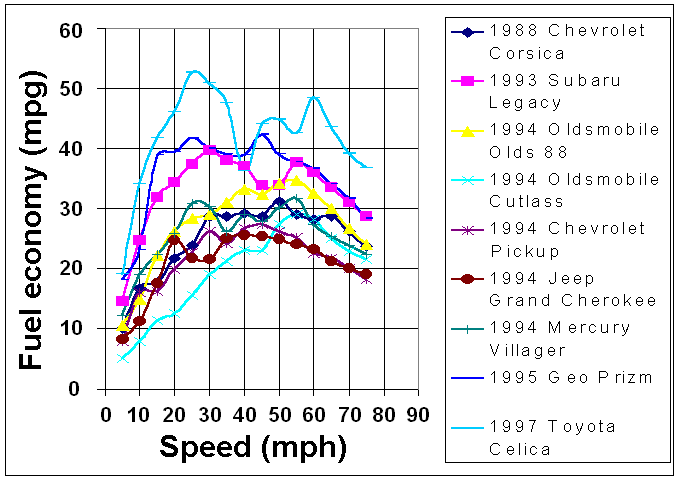
It's not always the most efficient for every car, but there are lots of charts showing this tradeoff. Some cars are more efficient at 65 or 70 than 55 (97 Celica), but in modern gas cars, 40-50mph is where you hit a peak, and you start getting worse from there. 40mph on the highway is painfully slow though, so people generally pick an optimal point higher than that.
(One inconsistency I've found is how the Motor Trend test below sees a very high peak at about 40MPH and a decline after, while other sources show a flatter peak). And 55MPH seems more like a magic number the author picked, but not a bad one if we don't know the model.
Generally cars are geared so the engine begins entering its optimal / most efficient RPM range where it can produce more torque in top gear around 40-50mph, and rolling resistance and wind drag (which is a cube function of speed) contribute to make mileage worse after that. Usually the speed at which you first shift into top gear and cruise comfortably is close to optimal. Efficiency doesn't start dropping for a while because of the cubic nature of drag, and the engine sometimes is more efficient at higher RPMs for a bit (see nols' post on manufacturer optimization).
Fun fact: At top speed (254mph), a Bugatti Veyron will use its 26 gallon tank in 12 minutes.
As I stated in a sibling, this still boils down to "this is how current cars are built." I would imagine if you looked at the average vehicle built in, say, the 1940s, you would see a vastly different "optimal" number.
Which is all to say, do we expect this to stagnate forever at 55? Is this a hard physical limit? I understand drag gets higher there. Are there no tricks left to us?
And again, I fully concede that this is likely not the most pressing fact around. Just one I am curious on.
OK, now I understand where you're coming from. The physical limit is that at higher speed, we must expend more energy per unit of distance, to overcome drag (relatively little is lost in braking or rolling resistance of tires.) [1] So on any planet with an atmosphere you will have to contend with this.
The 'ideal' speed isn't really even 55MPH, but lower if you had all variables at play to get the maximum MPG at any speed (probably 30-40MPH), but manufacturers expect people to cruise on the highway faster so they adjust the gearing. If you're asking how to push out the curve so that going faster than 75MPH doesn't offer a huge loss of speed, lower drag coefficients are the trick. Or switching out of the 4-wheels-on-ground automobile.
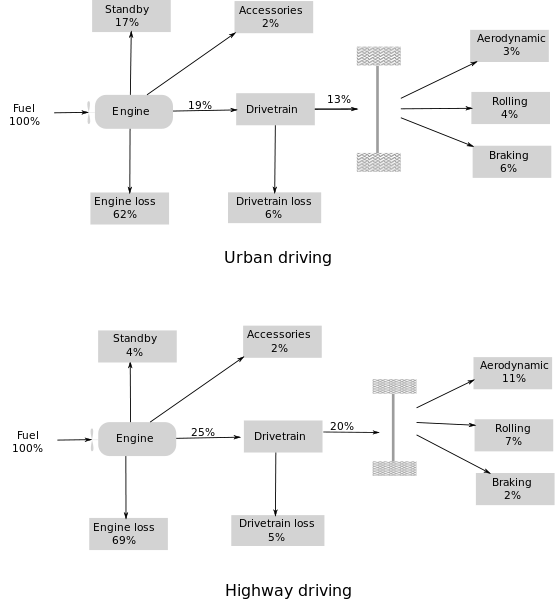
In this generic diagram, the ratio of drag (air)/rolling (ground) resistance is 11-to-7. As you get to higher speeds, the ratio tips even more in favor of drag.
Fun fact: The Bugatti Veyron gets 2.15MPG at its top speed of 250MPH.
This was exactly the angle I was looking for. I am still not entirely satisfied with this, as it does not flat out state why better gearing couldn't achieve some increase.
That is, my naive understanding is aligned with what a sibling post said. That there is an "ideal" torque rating of my engine. Seems that if my cruising speed isn't stuck at that number, than some gearing changes could be made to put me there. Why does that not work? (Adding a 7th gear, for example, seems to be a natural idea.)
I'm curious to hear that the ideal speed would actually be below 55. Do you have good references on that?
Also, I'd assume the "switching out of the 4-wheels-on-ground" refers to such as trains and friends?
For an automobile, at cruising speed, the force of the drivetrain pushing the car forward, and the forces of drag and friction are balanced (If the net force is zero, the acceleration is zero).
In the engine and drivetrain, force per unit of fuel is dependent on velocity (this is probably a pretty complex dependency), but you can probably tune the system to have peak efficiency at whatever speed you want.
For aerodynamic drag, it's a function of the square of velocity. You can certainly work to lower the drag coefficients, but whatever the force is at 39 mph, at 55 mph it will be about double, and about 78 mph will be double that.
Realistically, it makes sense to put the peak of engine and drivetrain efficiency in the range people are going to be driving the most; so this is why many vehicles will be most efficient around the 55-70 range.
If you're willing to radically change behavior, you would likely have a much more efficient vehicle if you tuned for 40 mph, and people drove it at 40 mph. At lower speeds, other frictional forces become more significant as well, so maybe tuning for 5 mph isn't a great idea.
> That is, my naive understanding is aligned with what a sibling post said. That there is an "ideal" torque rating of my engine. Seems that if my cruising speed isn't stuck at that number, than some gearing changes could be made to put me there. Why does that not work? (Adding a 7th gear, for example, seems to be a natural idea.)
You could add more gears -- or you could just use a CVT.
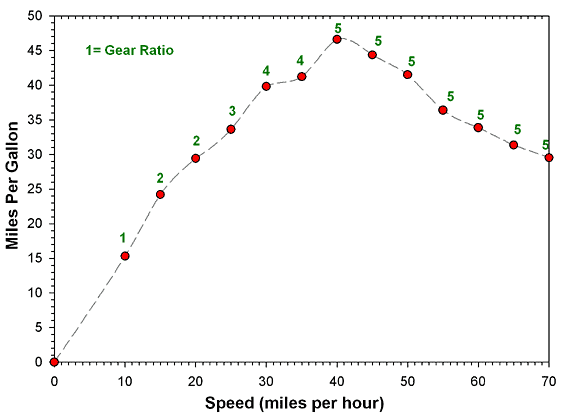
Longer gearing will improve the high-end efficiency where it wasn't yet optimal - to help 90MPH you could target that with your super 7th gear at "ideal" torque/RPM. However the overwhelming aerodynamic drag means the peak efficiency won't shift to the right much, and it'll probably stay around 40-45mph (the power required is proportional to the cube of speed and 11x stronger at 90MPH than 40MPH) [4]. In many cases that super 7th gear wouldn't help 40mph (peak) at all if 5th/6th had already optimized 40mph.
I think the 55-70 range is pretty optimized on production cars today, including those with 5 or 6 speed transmissions - but you may be able to make more gains with longer gears/a CVT at speeds above that. In an earlier age of 3-4 speed autos (and sometimes a national 55mph limit), manufacturers had fewer gears to work with so a super long gear for 80MPH efficiency would trade off midrange efficiency and acceleration, and the EPA didn't test that anyway until 2006 w/ higher highway speeds
[4] My reference on the ~40MPH ideal speed (which I'm now more convinced about is the ideal for cars today) is the Motor Trend [1] test (all economy sedans peaked 35-40ish), several Hypermiler/car specific forums [2] and some personal cruise control tests with some rental/Zipcars with a digital gauge. Other ways to test include Scangauge/the Torque Android app. (The reason the ~40mph peak isn't even lower, is due to gas engines especially larger ones, being less efficient if they produce too little power - there is a minimum RPM at idle and always friction). So my earlier statement of "optimal peak would have been 30-40" - it's already around 40, and it doesn't have to achieved in top gear.
I put "ideal" in quotes earlier since the torque peak is one of many factors for the engine - the ideal cruise RPM is almost always lower due to less engine friction and lower pumping losses when you aren't asking for full power. If you ask for more power, your optimal RPM goes up closer to the torque peak. A generic motor from a friend's auto engineering class [3] (If you say had a Honda S2000 with a torque peak at 7500rpm, cruising there would kill your mileage)
Yeah, though by 4-wheels-on-ground I was mostly referring to flying/maglev type vehicles, or perhaps a vastly different design that had very little aerodynamic drag
Thanks for the comments and further reading. I see I should have also made clear I was never expecting anything in the upwards of 90mph range. The article was quite leveled at 55, though. Seems upping that to 60/65 should at least be possible.
I'm not sure I understand what you mean on "if 5th/6th had already optimized 40mph." Again, it may be my naive view, but I had thought each gear would have its own optimum. Or, were you just saying "top, be it 5th or 6th"?
I can definitely understand the wind resistance point. It really just comes down to my being somewhat incredulous that it is pinned at a mph point. Surely with better gearing, we have pulled the number up from where it was back when I had a 3 speed automatic? You seem to be implying otherwise.
Got it - I think you're asking why the peak is still so low at 40mph, and why we haven't shifted it toward 55, or 65. The reason there is a peak at all and we aren't most efficient at 5mph is due to (1) for gasoline cars, low efficiency at low loads - a motor may have a maximum of 200hp but only asking 10hp to power you means you'll pay a lot of frictional/throttling losses (at 10hp you'll be in the far bottom left in diagram [4]) (2) "fixed costs" per unit time - power steering, power brakes, alternator for electronics. Those two factors push us out to the right, whereas wind and rolling resistance push us to the left.
I'm not an automotive engineer so I don't understand the overall system equations, but I suspect for a given vehicle weight of ~3000lb, drag coefficient ~0.30, and 4-cylinder gasoline motor characteristic that provided sufficient passing acceleration, the "solved equation" for economy cars happens to end up in in the 35-45 optimal range. Gearing can't move the peak so much as make the decline less severe. (In my experience 4 speed autos generally had similar top gear ratios to 5 speed manuals of the time, but had other losses/at in-between speeds)
If you wanted to just shift the peak to the right, you could (1) equip an engine that is very large/extremely inefficient at low power outputs, and had higher parasitic losses and (2) reduce drag. Thus, it would make sense to drive faster, to move your motor out of the extreme bottom right in [4], and "spread out" those parasitic losses over a larger distance.
Adding more gears makes the slope go down less steeply after 40mph (but it's always going down consistently - see the Motor Trend article). The reason I used a 90mph example is I believe most 6 speed transmissions today already have 6th gear optimized for ~70mph cruising due to their motivation in post-2006 EPA testing. By optimized, that doesn't mean the optimal MPG in that gear occurs at 70mph, just that we've eliminated the gearing mismatches/inefficiencies compared to a CVT, which always has "perfect gear ratio". You could still add a 7th and find improvements at 80/90 probably.
So if 5th gear (in a 6-speed) had optimized 40mph, and 40mph is inherently more efficient, we would be driving there instead for overall peak MPG. I was trying to say that with enough gears, you don't need to be in top gear for optimal MPG due to drag. Hope that makes sense
I was actually asking why don't we keep the peak at 55 from dropping till later. I fully grant this is because I was ignorant of the lower peak at 40.
I should probably have added that most of my understanding in gearing comes from bicycles. I fully expect that my limited understanding there will not necessarily transfer. However, it has built up an intuition that gearing makes a huge difference. It is easy to get a sense that the other components of the equation have the final say, but it is impressive the difference going from a mountain to a road bike.
And again, thank you for the responses. I don't know as that I learned anything I can use in making decisions, but I do feel I have at least learned something.
Got it, hope that helped! I'd be very interested to see what the analysis is for a bike and what the optimal human efficiency is like.
In my experience riding road/hybrid bikes vs. mountain bikes, the lower resistance tires reduce the effort even if the gearing is similar. I'm also guessing the human leg has a narrower efficiency range in terms of RPM and power produced, so bikes usually have 15+ gears.
Now that I think about it, the 'simplest' way to explain the curve is - the vehicle/powertrain variables determine the efficiency curve with ideal gearing e.g. a CVT. If you have a 4 speed transmission, you choose 4 optimal points and imagine a steeper efficiency fall off in between each point (4 flattened parabolas with vertices at the optimal points).
The wikipedia article covers it decently.[1] And, the tires definitely have the most obvious effect at getting up to speed. However, I know that my top speed is higher on my road bike than it is on my mountain bike of similar tire size. I have mostly attributed that to the gearing. (Simply put, I am peddling as fast as I can on the mountain bike and going slower than a modest peddle on the road bike.)
Nit: aerodynamic drag force is modeled as quadratic (squared) with speed. The power required is force times velocity, which means the power is cubic with speed, but the force is only quadratic.
When taking into account wind resistance, the optimal speed for efficiency varies greatly with the current weather conditions too: with a tailwind, the optimal speed goes up, while the opposite is true with a headwind.
Usually the speed at which you first shift into top gear and cruise comfortably is close to optimal
Although automatic transmissions and lack of tachometers are probably responsible for this, I've noticed that a lot of drivers remaining at the upper RPM range for a certain gear while cruising, when they could've sped up 2-3MPH and upshifted. I don't know if there's a term for this, but it's certainly recognisable as a passenger: the engine is much louder than it should be, often with accompanied higher levels of vibration and discomfort.
Over the long term you expect the weather to average out and cancel itself out of the calculation. The question is does the headwind lower your efficiency more than the equivalent tailwind raise your efficiency?
Yes, in general getting 50/50 up+down hills, as tail+head winds decrease your total efficiency, as if you drive both directions (getting both the advantage and disadvantage), then you tend to drive the disadvantaged half slower (but not using less power, so no efficiency benefits from that) = it affects you longer = it has more effect on efficiency.
Generally the most efficient is highest gear-lowest RPM, and with car makers that's usually around 55-60. You could change the fuel efficiency to different speeds(I'm sure they're adapted to local markets with metric vs Imperial), but it would be worse off for most people to do that. It's not simply a gearing issue to change fuel efficiency, it's also the ECU controlling the fuel/air going into the engine. They aim for optimal fuel efficiency for normal driving, and that seems to be the sweet spot.
Contrary to what I've heard before, changing fuel efficiency to higher speeds wouldn't make things better. It's also not that simple because drag increases exponentially with speed.
This is still not any more satisfying than "because this is the way they are built."
Also, I should say that I realize this is a side show. One that I think should get less attention. No matter how much more efficient you make a car, I doubt I would ever be able to do better than local transit. (I, of course, welcome evidence otherwise.)
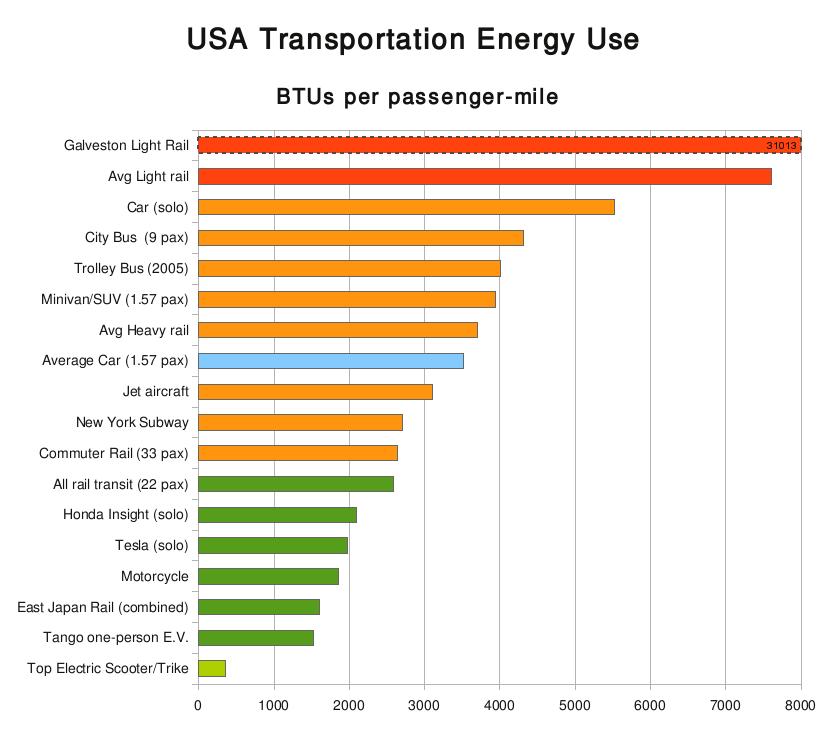
Right now local transit in the US is often less energy efficient per passenger-mile than a solo-driven Prius or Insight, or even the average-loaded (gasoline) passenger car. The numbers vary of course based on passenger load and route efficiency of course.
They are only rough estimates using existing vehicles, but engine losses are pretty constant, and if you take the 'power to wheels' group, wind resistance is always the largest factor (especially in the 'highway' cycle, which is sort the best one for your concern).
Choosing gears to make the engine most efficient at a higher speed will increase that contribution (without really changing any of the others much; I guess there are a bunch of critical points where the different fuel losses cross each other, and they aren't necessarily straight lines).
Cars are built for their purpose, designing cars to be super efficient at speeds they're never driven doesn't make any sense. The higher speed efficiency is a trade-off between all the varying speeds the cars are driven and the limitations of physics.
They could also produce extremely fuel efficient cars by ignoring the safety laws (even get around them by building trikes that don't have to abide by the laws) but they'd either not be allowed or never bought because they're impractical.
55mph is a sweet spot where the engine is operating close to peak efficiency and air resistance hasn't yet exploded. There very much are cars that are most efficient at 65, but that is because they sacrifice efficiency elsewhere.
Peak efficiency is the intersection of many curves- gearing, rpm, aerodynamics, speed... Aerodynamics is possibly the biggest factor though, hence the common point of 55






The article calculates, presumably correctly, that driving 70mph costs $3.66/hr more than driving 55mph in some reference car. It concludes that driving 70mph is worthwhile if getting to your destination an hour early is worth more than $3.66.
This is completely wrong. Driving 70mph for an hour gets you 15 miles farther than driving 55mph for an hour. Doing that costs you less than $3.66, since you're driving for less time. It also doesn't save you anywhere near an hour.