Could you please help with any insights about the social media vetting rules? This has been a blackbox to the visa applications - started with student visas, now being forced on work visas too from Dec 15th.
That's right, both before US Consulates when applying for visas, before CBP when applying for admission, and before USCIS when applying for a benefit (H-1B, O-1, green card, etc.), social media is being reviewed, not across-the-board but more and more. And there's really no option to keep social media as private if asked to turn to public by a Consular Officer or CBP Officer. The review is broad and not limited to social media that is critical of US policy but extends to a review of an individual's entire background to make sure there were no violations of US immigration law, including unauthorized employment.
CBP actually made me give them my facebook password when entering on a J1 visa in 2017, so I'm surprised to hear so much talk about this. Is it more that the practice of checking social media is more widespread now?
If one didn’t have an account with meta they just wouldn’t get the visa then or how does it work?
Does the government have any direct link to meta re what accounts people actually have. I’m surprised people aren’t up in arms about this, I guess it affects mostly visitors and immigrants but the fact that the government needs to see your activity on a private company’s web app is wild to me.
I don't think you want to try that argument with immigration officials, although it might just keep your incorrect answer from being straight up fraud or willful misrepresentation.
Knowing that, it's crystal clear HN falls strictly within that definition of "social media", although it might not be as clear if you don't know what that particular site is.
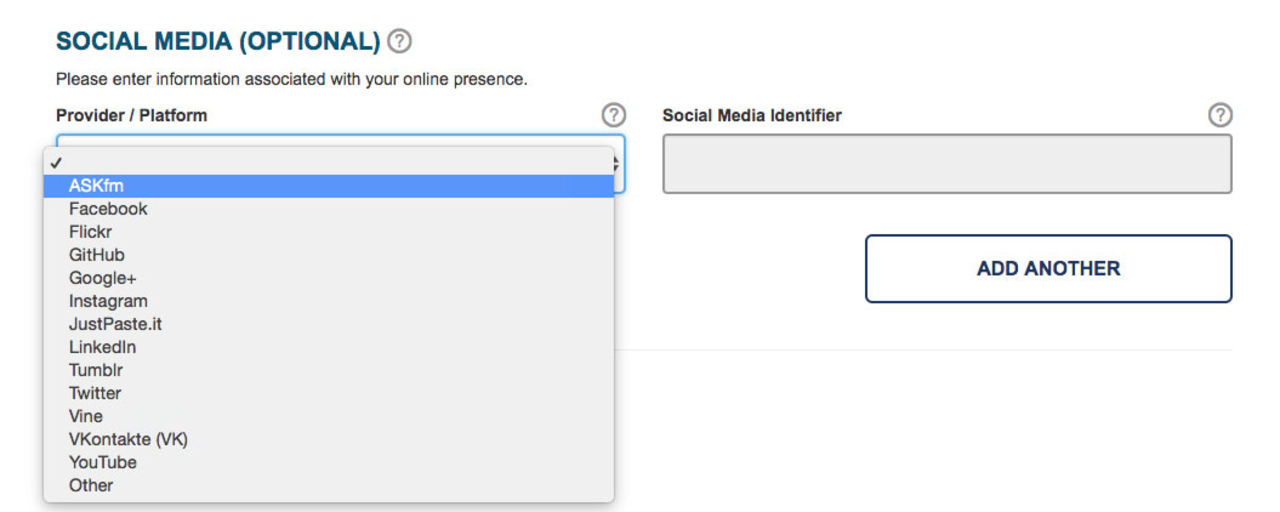
Googling 'site:gov "justpaste.it"' also brings endless results of government documents mentioning the site in the context of terrorism.
I somewhat doubt US immigration authorities thwarted any would-be terrorists by asking for their justpaste.it username, but what do I know, perhaps this was an important breakthrough in the global war on terror.
You'd be surprised at the number of people who willingly give up their social media accounts, only for immigration officials to find comments in support of terror attacks in the Middle East.
It's pretty easy to think it's harmless if you live in a country where that viewpoint is not uncommon.
That's not surprising at all, but I think the people who could get caught by the justpaste.it thing are not the same people casually praising Hamas on Instagram.
If you're putting terrorism related content on justpaste.it, you're probably pretty deep into the whole thing.
It can be an easy charge of “lying to the government on an official form” when they discover you have a user account somewhere that you didn’t disclose, even if they can’t get anything else to stick.
Based on news, it seems like if you like Donald Trump you may get in. If you don't like him you don't. You may also be jailed for two months for not liking Trump - that's happened a few times and that's why tourism fell off a cliff.
You have to enforce a copyright, or any other license, contract, or TOS.
It's up to you (and a lawyer) to decide if & how to attempt to enforce it. Either way, it's going to cost you money, though going to court may enable you to recover these funds. DMCA may be another approach you can consider. Many times a letter from a lawyer is enough, although if they are not having any success, why bother?
Thanks you all for comments. I have made a decision to subscribed to dedicated IPs (credits: @slau).
The differentiating factor between our current AWS SES plan and the competitors (mentioned in the comments) is having a dedicated IP. With our current volume, none of the competitors are anyway near AWS SES costs. So, moving to a dedicated IPs thats cost 25$ extra not only solves our issue, but also no change in code/infrastructure.
Just make sure you have sufficient traffic to warrant a dedicated IP. An unknown IP suddenly sending a burst of emails is going to get soft-blocked very quickly. You need to build up your reputation, and you need to slowly increase how much you send.
The managed IP is an option, although I’ve never used it.
When I was the VPoE at Dixa, we switched over to SES, and we had 3 dedicated IPs, and for our volume back then (a few thousand emails a day), this worked very well. I don’t know if they ever hit scaling issues after I left.