For reasons I won't go into the farming lobby is really strong in Iceland.
Sheep run free-range around the entire island, if you'd like to grow something that sheep like to eat you need to fence it in. It's not like pretty much anywhere else in the western world where people who own grazing animals need to fence them in.
Thus the sheep range far and wide and destroy Iceland's native low-lying forests. Iceland's native crooked birch hasn't developed resistance to grazing animals as mainland trees had to do, the sheep love to nibble at them and eat the seedlings.
The native trees and other native vegetation are generally much hardier than the foreign plants. But since the forestry service has lost the battle with the farming lobby they're desperately trying to introduce some trees that the sheep won't eat.
Reforesting the country is largely being done through subsidies to farmers, who aren't concerned with topsoil preservation beyond maintaining the desolate landscape they inherited, but they are interested in the eventual promise of a commercial forest on their land.
Which is something to keep in mind when reading articles like these and wondering "why don't they...", usually the answer is that they're planting in a field that's going to be full of grazing animals, and there's no way the forestry service is going to win that battle anytime soon, or that they're not really aiming to restore the topsoil per-se, but to do that as a side-effect of commercial logging.
I was in Iceland a few weeks ago and the people, museums, info plaques, etc. talked about deforestation and how the early settlers chopped down all the forests. Also mentioned was forestation and how they were slowly replanting. The grazing by horses and sheep were never mentioned as a problem. I did hear about how flocks of sheep are just let loose in the highlands in the summer to graze and the sheep herders separate out the flocks in big festivals in the fall. Similar to the old time Spanish rodeos in California.
This article obliquely mentions the sheep problem but only by saying:
Mr. Jonsson and his volunteers then plant the appropriate species for the plot — birch, Sitka spruce, lodgepole pine, Russian larch or other species. “We’d love to plant aspen,” he said. “But sheep really love aspen.”
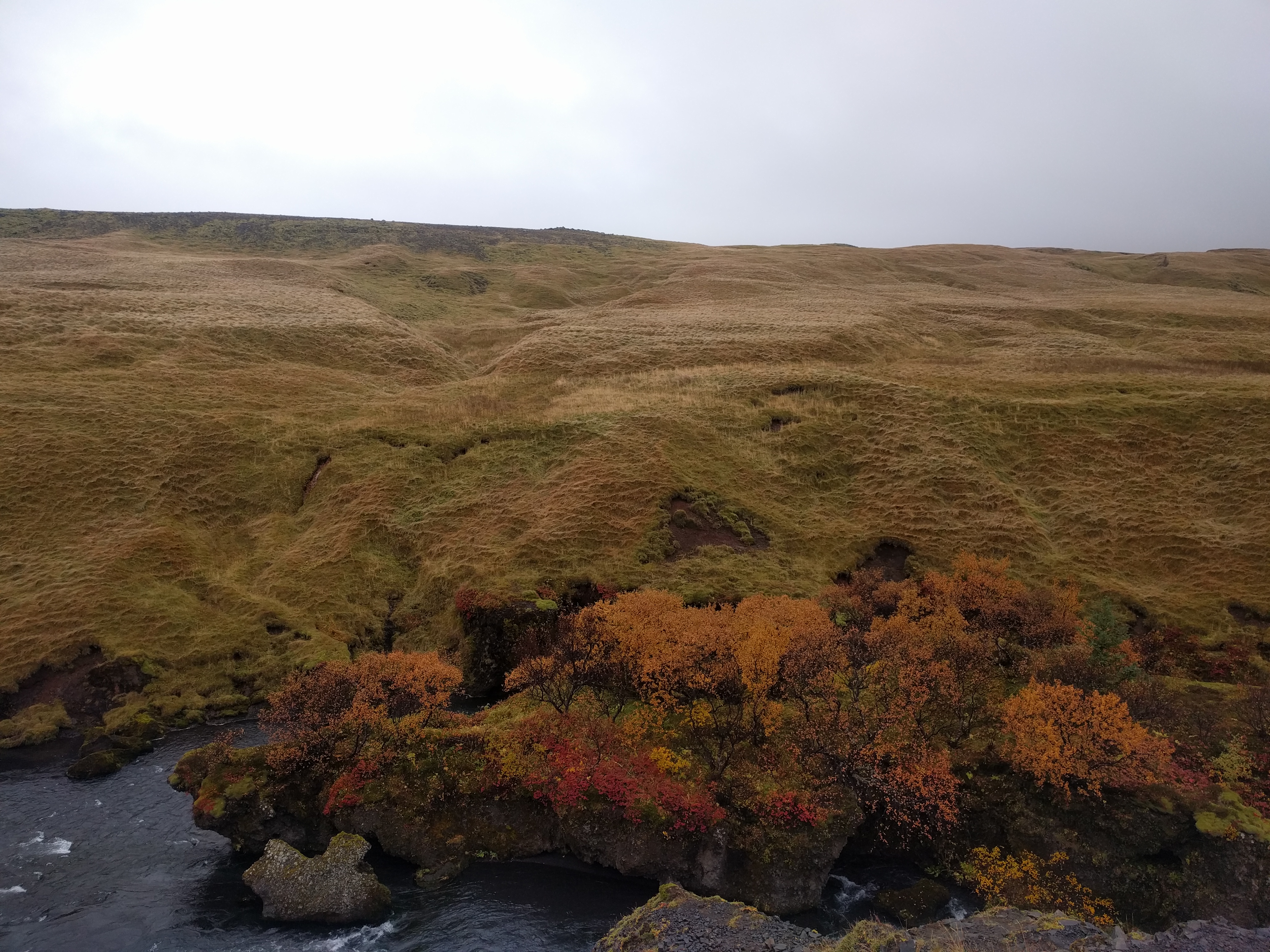
Sheep may love aspen but they will eat all the other trees also. I did not realize this was the main reason there was only grass everywhere until, when up on top of the Skógafoss waterfall, there was this[1] little island in the river covered in a little mini-forest. This rocky island would not be a very good place for trees to grow compared to the nice soil under the grassy fields around it, but since nothing could graze on the island, the trees could grow up.
The tl;dr of Iceland's colonization is: Norse settlers arrive, placement in society is based on how big of a farmer you are. Thus they overgraze and unlike their native Scandinavia they're doing this on a volcanic island with really thin topsoil, so the overgrazing leads to runaway topsoil erosion and dustbowlification. This leads to desperate logging of the last of the trees around for firewood and housing.
It's never remotely recovered, but that process is slowly starting just now. I was trying to find a photo like the one you just posted but couldn't. There's lots of examples like that where the plant biodiversity in an area where the sheep can't get to is night & day compared to the area right next to it where they can.
Which is not to say that those specific trees are old growth forest or anything like that. Icelanders pretty much lived in mud huts until after WWII in large parts of the country. If the sheep didn't get to a place like that some guy would have certainly swam over there to gather firewood. But it'll have been left alone by sheep and man in the last several decades, which as you can see makes a huge difference.
The accompanying article (in Icelandic, but it translates ok-ish) says that compared to the land around it it has a lot more biodiversity and a better topsoil, similar to other areas in the country protected from grazers that they've studied: http://www.skogur.is/um-skograekt-rikisins/vidburdir/2014/04...
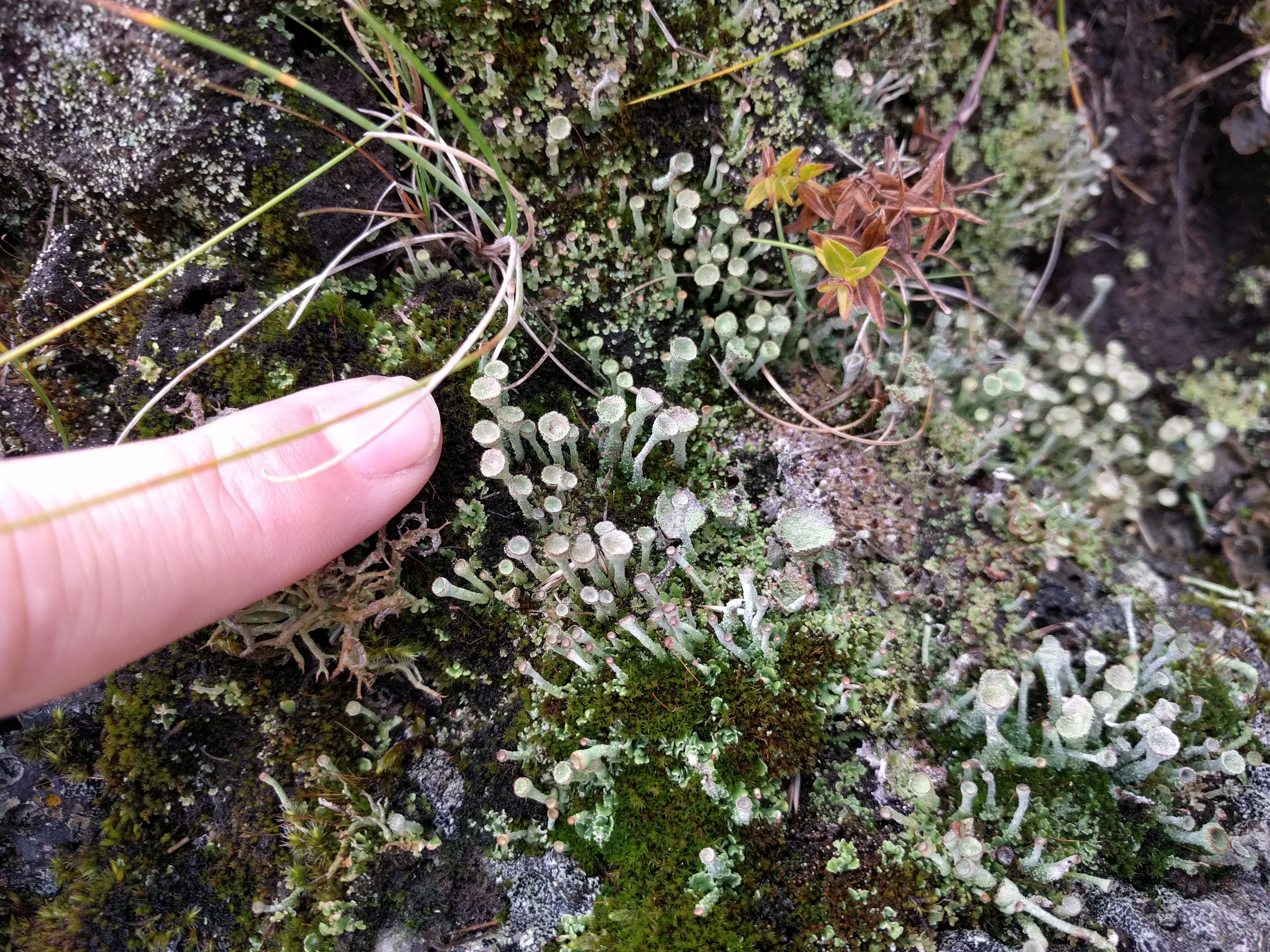
Another part about Iceland vegetation is that developing soil on top of fresh lava takes a long time. Tens of thousands of years in some cases. Large sections of Iceland gets covered up with lava flows pretty often. But you can get some great biodiversity on the lava pretty quickly in a wet place like Iceland with lots of moss and lichen growing. On an 8,000 year old lava flow in the middle of Iceland near Leirubakki, the moss is half a foot thick[1] in places. You find a few old gnarled birch growing here and there in the hollows where wind blow dirt accumulates, but mostly just huge mats of moss and lichen with a bit of grass.
Grazing by sheep and goats in California devastated native flora in California's Central Valley and foothills, and also introduced the Mediterranean grasses that put the Golden in California's current landscape.
Src:Allan A. Schoenherr's A Natural History of California
It’s theorized that CA’s golden hills used to be entirely covered with wildflowers. I find it sad that no photosynthesis can occur all summer due to the dead grasses. Such lost potential. But we get some amount of beef and dairy in exchange for the dramatic loss of efficiency and biodiversity.
That photo is a sharp (and fascinating) reinforcement of the grazing sheep point. Is there any other reason those trees would grow clustered right there and nowhere else? Was that area not accessible by sheep?
As you can see somewhat in the photo, this island is isolated from grazing by the river and the steep rocky sides of the island. You could probably get a mountain goat to climb up there with some prodding, but sheep and horses that range on the slopes behind wouldn't.
Yes, I was aware of it, thanks though. That is why I mentioned the novel in the first place. Was going to mention the jökulls too, as sibling comment does. One of them was Vatna or some such, need to check - it was long back that I read it :)
There is actually a similar problem in the Northeastern United States. Deer are overpopulated (in my area 6x traditional level) because they have no predators and hunting is restricted. The deer eat all of the hardwood saplings. In many mid-Atlantic forests there are very few 10-20 year old hard wood trees, they don't survive the deer.
Reminds me the story of reintroducing wolves to Yellowstone [1]. Imapact was relatively large to the whole ecosystem with many unexpected surprises, mostly positive.
"Perfectly good" is an overstatement. Efficacy wasn't that great (80% or so) and there was some evidence of side effects. Overall, the vaccine should almost certainly have not been taken off the market but it's not a near-perfect vaccine vs. FUD story either.
oh_sigh is correct, humans are a dead end host for lyme. It's primarily maintained in a mouse reservoir - the larval and nymph ticks feed on infected mice, and then the nymph and adult ticks can expose humans and deer. Deer are not really a big reservoir either, since mostly adult ticks feed on them, but they do move ticks around.
As I understand it the vector is mice, not deer. There's a correlation between mouse populations where the juveniles feed and Lyme disease outbreaks 2 years later when the adults latch onto humans.
Read "should not" as it's unfortunate that potential legal issues around Lymerix were such that a vaccine was a losing business proposition. In general, human vaccines aren't a great opportunity for pharma companies--to the point where they're protected against liability for common vaccines.
it was recalled because it was causing damages. the article is wrong. they found that body tissues has similar protein structures as the target for the vaccine, and left some people in wheel chairs. there are some developments for an improved vaccine but not out yet.
There's a really interesting article about how Yellowstone (a national park in the US) reintroduced wolves into the ecosystem, reducing the dear population, altering the ecosystem for the better:
And as is often the case with science, here's another more recent study (2015, vs 2010 cited in the NY Times piece) which largely confirms the prior results noting Aspen regrowth.
Went into that article ready to argue, but I had to quote this line from it:
"But by insisting that wolves fixed a broken Yellowstone, we distract attention from the area’s many other important conservation challenges. The warmest temperatures in 6,000 years are changing forests and grasslands. Fungus and beetle infestations are causing the decline of whitebark pine. Natural gas drilling is affecting the winter ranges of migratory wildlife. To protect cattle from disease, our government agencies still kill many bison that migrate out of the park in search of food. And invasive lake trout may be wreaking more havoc on the ecosystem than was ever caused by the loss of wolves."
The NE also went from 30% forest to 70% open/farming land to 70% forest 30% open in about 100 years as agriculturalism gave way to industrialization. So that could also contribute to giving deer more cover/habitat. Also we killed all the wolves east of the Mississippi 50 years, and coyotes have yet to fill their niche.
> The NE also went from 30% forest to 70% open/farming land to 70% forest 30% open in about 100 years as agriculturalism gave way to industrialization.
Source? It would surprise me to see that many people voluntarily give up their farmland rather than, say, selling it to industrial farmers or real estate developers.
If you are driving thru New England and pull over to any forest you can start walking and eventually you will find a short stone wall. These stone walls used to mark the borders of farm land but now they are in the middle of the forest. They are everywhere! Really gives you an idea of how much farming used to go on there.
In my area, once you get passed a point south of me, those walls are fewer and fewer. There are areas where it was never farmed and old growth trees still exist.
What is great is you can walk out to places and stand there and be reasonably certain that you're the first human to have ever stood in that spot.
I'm way up outside Rangeley, Maine. I even have true old growth and there weren't many natives in the area. So, there are some places where it's a good guess. They aren't easy to get to, of course.
It's because it was never really good farm land to begin with. With the advent of the Erie canal, railroads, and industrial farming techniques the competition from the really excellent farm lands of the Midwest made farming NE rocky terrain impractical.
I grew up in Vermont and the woods are full of old stone walls put up by farmers and cellar holes where their buildings used to be. Not just on the edge of the woods, but deep within them too. I'm not a student of farming but I don't think that New England is a particularly good place to do it. Lots of hills and mountains and rocky soil. As for real estate developers, there's a lot more money to be made in heavily populated areas of the country. Taking VT as an example, the state contains fewer residents than the Boise, ID metropolitan area does, and the largest city has fewer than 45K people.
edit: removed link to an article that has been posted several times.
Real estate developers pale in comparison to the sheer amount of land in the US. Hell, even just on the "wrong side of the tracks" in many very expensive cities there's often completely abandoned/disused land that's worth a tiny fraction of the land a half mile a way.
Once you get somewhere more rural/remote, the land is going to have even less value.
The landscape was largely unsuitable for large scale farming (tiny fields with thin soils among rough terrain), and most farming areas aren't near cities.
Lot's of people gave up on farming hardscrabble New England in the early part of the 20th century which resulted in reforestation. Farming is making a comeback in niche products, but nothing at the previous scales. This article (sorry for the paywall) gives a good summary: http://www.bostonglobe.com/ideas/2014/11/21/how-new-england-....
Just find some photos of places in the countryside of Maine, New Hampshire, Vermont, or Massachusetts from 1900 and compare to the same places today.
Or go walking through the forest, and count how many stone walls you have to clamber over. Every one used to mark the edges of a field or a pasture that was hacked out of the forest, and then was allowed to grow back up when farming the cold, rocky soil of New England was no longer cost-effective.
You're right - farmers generally didn't just let the fields lie fallow and become forested. Piece by piece, farmers sold their most marginal lands to housing developers, commercial ventures, etc.
Do areas of the NE not allow seasonal suburban hunts?
In VA, many local parks are opened to bow hunting through winter [1] in an effort to control the deer population. Signs posted all over parks to warn users [2].
We have very similar signs in the Blue Hills Reservation just outside Boston, but the hours are rather more restricted (I think it's just Tuesdays). So it's not completely unheard of even in the relatively urban Northeast, probably because the deer situation really is getting that dire.
I don't know what the case is in NE US, but in my town in British Columbia, the deer population is out of control in the metropolitan area, and every time a cull is mentioned, animal rights activists put a stop to it through loud and effective lobbying. It's quite irritating.
The grizzly, as a top predator, was not really very afraid of humans and many people were killed by them in California before they were hunted to extinction. I would definitely not want them around as a farmer in the 1800's. With antibiotics, helicopter transport, and ER rooms today, I might support a reintroduction of grizzlies to the state. There is one on the state flag, after all, and are amazing creatures. On the other hand, I like how relaxed I can be hiking in the California Sierra without them. Hiking and camping in the Canadian Rockies feels a lot different.
Mountain lions (at least the ones evolved when we hunted them for the last 12,000 years) are much less hazardous to humans than grizzlies or wolf packs.
We have an urban coyote population in Vancouver. It's very strange seeing a coyote in the city. I was 20 feet away, once. They are amazingly beautiful creatures.
Even if they were allowed to hunt deer, it probably wouldn't help. So much of the land deer graze over in the Midwest is suburban and have laws in place regarding setting off a firearm.
This limits hunting to public lands, of which, there might be 2-3 within an hour drive of the city. So no matter how much the hunters kill, they aren't likely to effect the populations in the surrounding suburbs.
There are more hunting spots in the rural areas, but those areas are also populated by natural hunters, like wild dogs and large cats.
You can still bowhunt, or at least you ought to be able to...
It makes me very sad to go south and see the huge numbers of roadkills on the side of the highway. Where I'm from, we try real hard to inflate the deer population, since the winters and the coydogs keep the population down so much that the hunting isn't real easy.
This problem is widespread in the urban areas of my rural, pro-firearms home state. They solved it by hiring sharpshooters to kill the deer with rifles at night within city limits. It worked really well and they gave a ton of meat to the food bank.
Which state is this? I'm surprised anyone would authorize hunting in an urban environment at all, given the risk of collateral damage. Just because you've shot the deer precisely doesn't guarantee the bullet isn't going to fully penetrate and keep on going.
Where are these animal rights activists? I'm from PA, the state with more deer than any other, where the white-tailed deer is the official state animal, and I've never seen anyone shed a single tear over a deer hunt.
It's not a simple solution, because it's not very effective. In areas with limited open space, hunting is very much an exclusionary activity. In Staten Island, the NYC Parks Department is performing an experiment in deer sterilization: https://www.nytimes.com/2017/09/22/nyregion/deer-vasectomies...
In NJ there's a restriction from hunting within 450 feet of a building. In Idaho that's probably laughable, but here it leaves a lot of space where you can't discharge any weapons.
There's a parallel with the charge that the "Drug Free School Zone" laws discriminate against minority communities because everywhere you go in cities, you're within 1000 feet of a school.
The hunting restrictions are basically why the deer population recovered to the absurd levels they have. They need some tuning the other way, maybe extend the season (eg, shorten the exclusive bow-hunting season and lengthen the regular hunting season).
If you're not allowing hunting on your property, it would also be good (albeit expensive) to fence it, so deer cannot easily move through, to reduce their available forage.
Wolves kept the deer population in check for eons before humans ever showed up. The real reason the deer population is out of control is because we've extirpated their natural predator. Unfortunately for the forest's sake, it will never be politically tenable to have wild wolves roaming the exurbs of New England.
Mentioned it above but I live in the northern Idaho region. We've grown our wolf population for awhile. Now we are at the point of having too many wolves that we are opening hunting to them.
Deer can be quite the issue. There are a handful of cities in Utah (and I'm sure other places) who have opened up hunting to archers - within the city limits because the deer population is out of control.
Back to the tree side of the story - I'm in NW Montana where trees are like weeds. In the spring I could find 1-2 fir tree seedlings per square inch and sometimes 4-5 in an inch! Despite having quite a few deer, forests are thick. I should rent some sheep to keep down the "weeds" we call trees.
I always felt it was kinda unreal that a tiny plant barely larger then the surrounding grass can become a huge tree given enough time of poor lawn maintenance. It doesn't even seem to take very long until tree saplings gain the ability to do some damage to your lawn mower.
I saw the same thing on the island of Achill, Ireland. All sheep are allowed to roam the island freely, so if you want anything protected, you have to fence it in.
And there are no trees to speak of. That could either be because of the harsh winds on this almost-westernmost point of Ireland, or (never thought of this until now) it could be the sheep.
The government pays people 50 pounds per sheep per annum, so people just let their sheep roam forever, unshorn, spray-painted with each owner's distinct colors.
(Disclaimer: probably ignorant observations from an outsider, taking a couple of our girls to the world-class Irish music camp they hold each year.)
Pounds in Ireland? I was curious if that was a typo or an old fact from pre-Euro days so I dug around a little about this subsidy/stipend, but couldn't find anything. Any ideas what it could be?
There's a gorgeous tiny forest on the Beara peninsula that I visit whenever I can. I think it's my favourite place on the whole island (Beara as a whole is happily underrated and relatively lightly touristed).
However, it's fenced in by old stone walls, and I was dismayed to see someone had driven a tractor through said wall the last time I visited and there were at least a couple sheep munching away in there.
I'm confused, there's no private property laws to prevent farm animals from grazing on non-farm property? Nor is there crown land to build national parks with giant forests? An effective farm lobby wouldn't be able to affect either of those things in almost any other western countries...
The problem doesn't seem to be the lobbyist but some strange lack of fundamental laws, if the government can be coerced into allowing this to happen by industry.
Unless you're saying the farm industrying (with grazing animals) controls a massive amount of land? They say only 1% is tree covered, I can't imagine they own such a large amount that they can't find any significant amounts of land to plant trees...
First of all you have to understand that private property in Scandinavia and Iceland works differently than it does in say the US. It's more appropriately phrased as a "limited land-use right", and the land use is always for a particular narrow purpose.
So for example, if you buy a farm and put a fence around it I'm still free to walk across your property to get to where I'm going, because farms are intended for farming, and as long as I'm not unduly interrupting that you have no standing to stop me. I can also set up a tent overnight on your farm as long as I don't unduly bother you, i.e. set it up too close to your house, I need to pick up all my trash etc.
Now, back to your question. During the summer the sheep wander around and graze on any grass they can find, and due to precedence going back to colonization (where everyone who mattered was sheep farmer anyway) if you'd like them not to do that it's your responsibility to set up a fence around your property, and of course the sheep are likely to start eating there first since sheep are lazy and go for the easy pickings first.
But this only applies to sheep, not e.g. cows, and that's entirely to do with ongoing lobbying not just by the farming industry, but people in rural areas that hold disproportionate sway in parliament.
There are successful reforestation efforts going on in Iceland, but most of these are in park-like areas near municipalities. There's not enough money being spent on this to fence wast swaths of land.
But yes, you could of course buy land, fence it off, and start planting trees on it. But that's expensive and not very lucrative, so very few farmers are doing that to make money.
There are big national parks, but they're almost all in areas that would be the last to regain any topsoil, i.e. in the highlands around glaciers.
There are a bunch of reasons from tradition in terms of letting sheep roam free to farming always having been a source of power. Further you have other weird facets like the votes of people in the countryside being worth twice those in Reykjavik. But basically for a long time farming and fishing controlled a lot of voting power. Although the traditional party of the farmers is on the wane now. The whole country has the population of a medium sized town so it’s on the whole very similar but also very different to larger countries.
The US also has lots of federally owned land which is "public" but used primarily by ranchers for grazing their cattle. It's not that unusual of an arrangement, and the ranchers have way more political pull than environmentalists.
They probably have to let the sheep roam because there isn't enough food if they fence them in. Here is a nice video on farming practices that might reverse desertificaiton:
Except that the land they tried his ideas on really did start growing stuff again. Nobody refuted the results he shows in the presentation. What may have been "debunked" is the notion that it's somehow good in terms of CO2 production, but even that isn't clear to me - plants take CO2 out of the atmosphere, and animals put it back.
I was recently in Orkney, which has the same issue regarding sheep and trees, and happened to catch the crime in progress: https://i.imgur.com/fEXWccm.gifv
> Sheep run free-range around the entire island, if you'd like to grow something that sheep like to eat you need to fence it in. It's not like pretty much anywhere else in the western world where people who own grazing animals need to fence them in.
This is the case in at least Norway as well - it's certainly not unique to Iceland. Though I assume environmental effect of it in Iceland is compounded by the climate.
I just finished listening to 'Collapse' by Jared Diamond and it goes over Iceland a bit. They've got serious ecological problems because of soil. Most of their soil comes from light volcanic ash, which replenishes at a much lower rate than other places with tons of vegetation and rivers and other things contributing.
Soil, generally, is surprisingly delicate stuff. It accumulates at the rate of about an inch per century under natural conditions on such abundant landscapes as the US plains. That's slow, but over the 10,000 year span since the last ice age, it's enough for 100 inches or so to accumulate (about 250 cm).
Much of that isn't deposited but fixed from the air by plants which then decay in place, though the freshly-arrived material often provides vital micronutrients -- itself a problem in Australia where the lack of geological activity means that there is very little of these materials, limiting ag productivity.
In regions with harsh climates and short growing seasons (e.g., Iceland), there's little time for soil-forming processes to set hold, and the slight progress made can be undone quickly. Even in places that appear full of life, conditions may remove soil or nutrients, e.g., tropical rainforest.
If I think of things that may bring doom to humans, I tend to think a lot about dirt and bugs and plankton and algae.
>> It's not like pretty much anywhere else in the western world where people who own grazing animals need to fence them in.
It's an exception and not the rule, as you're saying, but I know of at least a few spots in the Rocky Mountains in the US where farmed cattle graze openly and property owners have to let them. The ones I'm thinking of I think became that way because it was a permanent condition of the sale of the property in smaller parcels (i.e. the original owner parceled it up for cabins but retained grazing rights in perpetuity). But it's in areas where they actually want to keep vegetation in check to mitigate forest fires.
Also I think throughout Montana there are free grazing areas for sheep. I think that's what you're seeing in the fantastic documentary called Sweetgrass: https://www.youtube.com/watch?v=AV9iah71iPQ
Came to post exactly this. Once upon a time there were vast western lands open for grazing. There were even "wars" fought between cattle and sheep ranchers over grazing rights. Today the feds have closed off many areas -- for example, if I understand correctly, in the Hells Canyon area there were once 300,000+ sheep left to graze, where today there are effectively none. Certainly there were areas that were significantly damaged by overgrazing and a better balance for the public good was needed. That stated, one of the counter arguments is that it started with the ranchers, then the feds come along and close the roads, soon the public forests become inaccessible and unused altogether. There are a lot more public lands in the west apart from the major national parks. Certainly the Bundy's approach missed the mark in terms of articulating their arguments on this issue.
My understanding was that Bundy was grazing his cattle on federal land and was refusing to pay grazing fees. He argued in United States v Bundy (1998) that he didn't have to pay grazing fees. https://www.scribd.com/document/218116757/1998-U-S-Dist-LEXI...
Which is an effing joke, as the federal government charges pennies on the dollar for grazing rights compared to what a private landowner would charge. And yet, the Bundys want the taxpayers to take it in the shorts even more for their privilege and profit.
While there are many that share your view, the legal situation is far more complex. While disputed, there is in fact legal precedent for considering "grazing rights" to be private property, with the annual fees being paid for the administration of the program rather than being a rent designed to be equal to the free market value of the grass.
Did you know, for example, that grazing rights aren't something that is available on the "open market", are specifically attached to piece of private property, and are generally transferred (and inherited) along with it? That the IRS considers grazing rights such an integral part of the valuation of a ranch that they are subject to estate taxes?
And a recent update in central case that's been ongoing for decades, alternating between many (mostly Nevada district court) decisions favoring the ranchers, and many (mostly California circuit court) reversals:
https://www.fseee.org/2017/03/08/nevada-rancher-hage-loses-i...
This is unsettled law, and calling it "an effing joke" doesn't do it justice. You are welcome to disagree with the ranchers' arguments, but if you care about truth, fairness, accuracy, and respect, I don't think you should call it a joke, at least until you've looked at the situation more closely.
Let's go into the Bundy case here. His family has had grazing rights over this land in Nevada for generations. Then in 1993 the federal government restricted access to much of that land to protect an endangered species. They seized the land but he refused to sell, continued grazing, and stopped paying his grazing fees. He could have challenged the seizure in court, but he did not. He could have kept paying his grazing fees, but instead he went to court and tried to argue he should be allowed to graze for free. When he lost, he continued grazing his cattle there and refused to pay for it, at which point the government took his grazing rights for lack of payment.
Whether or not grazing fees count as private property is actually irrelevant. He lost his grazing rights by refusing to pay for them. If he had kept paying, and actually challenged the seizure and sued, that would be an interesting case, but he did not.
There are interesting argument here, but Bundy is not the one making them. He doesn't even acknowledge the authority of the federal government, and instead fell into the crazy Sovereign citizen crowd.
He lost his grazing rights by refusing to pay for them.
I've read the filings for Hage, but I'm not as familiar with the details of of the Bundy case. So I presume you are right, that their behavior seems indefensible, but I also presume that "the choice of starting point" has a large effect on the narrative. I'd wager that the Bundy's feel the story starts somewhere earlier, in a way that makes their response seem more reasonable. Here's an update from a couple months ago on the upcoming 3rd retrial of the defendants there: http://www.azcentral.com/story/news/local/arizona-investigat...
I think the tendency so far for juries to repeatedly fail to return guilty verdicts is a pretty good defense of the "unsettled law" theory. Or worse, as the mother/wife in the first video linked suggests, maybe it's a sign that the government treats the legal system itself as part of the punishment rather than a dispassionate means of adjudication.
The narrative that actually interests me is most is the extreme conflict between the district and circuit courts. Nominally, they are both "federal" courts, but at least in the Western US, the local district courts are all about states rights and the San Francisco based circuit courts tend to lean heavily in the opposite direction.
Those people are being tried for taking up arms against the government, who were trying to seize Bundy's cattle to pay for his $1M fines for illegally grazing. That trial has exactly nothing to do with whether grazing rights are private property. What exactly is the "unsettled law" part? Are you implying an armed standoff with federal officials carrying out a court order is "unsettled law"?
I'm strongly in favor of arresting people for violent crimes. One would think it would be an easy "guilty" verdict if the situation was as you (and most of the media) describe it. Oddly, though, there have been multiple trials of the participants where multiple defendants have been declared "not guilty" on all charges[1]. Either the jury trial system in America is extremely unreliable (certainly possible) or there is more to the case than the summary you offer.
I wasn't there, and haven't read the court records, so I don't know what happened in the courtroom, much less what happened in the real world. My guess would be that unsettled law was not a reason for the (lack of) verdict, but that it goes a long way to explain how the situation came about. I'd also guess that they story being reported in the media misses a lot of important details.
The video interview with Carol Bundy in the earlier link I gave you describes a different view of the situation. I don't have specific reason to trust her, but I think she comes across as fairly trustworthy. In her view, they were terrorized by corrupt government officials who brazenly lied about what happened. This clearly isn't the whole story, but might explain why they get the popular support the do.
It also might be relevant that there are several ongoing parallel cases that involve the BLM and FBI agents. The BLM agent in charge of the Bundy ranch raid was found guilty of "ethical misconduct" with regard to Burning Man[3], then later sacked after another OIG investigation cited him for "official misconduct"[4].
The FBI agent who fired two of the first shots in the killing of Lavoy Finicum was indicted for obstruction of justice by claiming he had not fired his gun.[5] The camera video filmed by a passenger in Finicum's car tell at different story than most of the media coverage[6]. I think it's worth watching, at least to see the other side of the story.
But as I said, I haven't been following the details of the Bundy case. Maybe they did things that are horribly wrong. I don't assume, though, that hearing the national news coverage gives me insight into what actually happened. So I'll ask you instead: If these are open and shut cases, why is it so hard for the federal government to get the verdicts they are seeking? Separately, thank you for participating civilly in a discussion even though we seem to disagree.
That's a blatant misrepresentation of the state of prosecution.
To date, 2 of the 19 people arrested have been found not guilty on all counts by the courts. 2 (Scott Drexler and Eric Parker) were found not guilty on most charges, but the jury was unable to reach a decision of some of the charges, and so they are being retried. Note that all of the charges carry a penalty of at least 5 years in prison, so both of them can still face decades in prison if found guilty on the remaining charges. 2 have been found guilty in court, 2 plead guilty.
Gregory Burleson sentenced to 68 years. Todd Engel was found guilty of obstruction of justice and interstate travel in aid of extortion, sentencing pending but he faces up to 30 years. Gerald "Jerry" DeLemus plead guilty, sentenced to 7 years. Peter Santilli pled guilty to conspiracy to injure or impede federal officers, sentencing coming next year.
Cliven Bundy, Ammon Bundy, Ryan Bundy, and Ryan Payne, the ringleaders of the whole standoff, start trial Oct 30th.
That's a blatant misrepresentation of the state of prosecution.
Possibly, although not intentionally. I read the links I sent you for the first time yesterday, and think I summarized them reasonably. Other articles make claims that I think are compatible: http://www.hcn.org/articles/cliven-bundy-why-the-bundy-crowd.... Clearly there are other points of view, many from more reputable sources, although I'm not sure if their reputation means they are less biased, or just differently biased. Some of those reputable sources point out that Burleson's conviction may have been an outlier, since in addition to his overt racism, as a former FBI informant the jury may have been particularly less sympathetic.
Ironically, Burleson's conviction was obtained in part through footage provided by a fake documentary team that was actually the FBI: https://theintercept.com/2017/05/16/the-bizarre-story-behind.... That article claims that as of May there have actually been 7 acquittals vs 6 convictions, but I didn't track down whether that had changed. I think we should ignore the number of those who "plead guilty", since that's often a tactical decision rather than an actual admission of guilt.
My point though is not that there have not been eventual convictions (I appreciate the details) but that the path to getting them seems to involve more hung juries and retrials than one would expect for an "open and shut" case. My larger point is that there is extreme antagonism between certain Western district court judges and the federal government, with the San Francisco 7th Circuit siding fairly consistently with the Feds and reversing local decisions. Judge Jones's Finding of Fact for the Hage trial (decision overturned by the Circuit) is long and dense, but a surprisingly fun read and a good introduction to the debate regarding Western water rights: http://www.inversecondemnation.com/files/usa-v-hage-findings....
I thought that Jones's Finding was extremely well argued, but the 9th Circuit disagreed and vacated and overturned his decision: https://cdn.ca9.uscourts.gov/datastore/opinions/2016/01/15/1.... To my reading, the Circuit willfully misinterpreted Jones's reasing, and then burnt the straw man. The Circuit also took the unusual step of declaring Jones to be too biased against the federal government to be involved in any subsequent proceedings. Locally, many think this the greater example of judicial bias: https://sparkstrib.com/2016/09/15/one-persons-bias-is-anothe....
I'll bow out now, but will happily read any further responses you have or links you think I should look it.
There's a very beautiful documentary from 2011 about open range sheep grazing in Montana, called SWEETGRASS. It's un-narrated, mostly just lets things speak for themselves.
Interesting. The main problem seems to be the short growing season, no? From my experience after a few years, sheep cannot do much to trees, in fact many leave them unattended it their orchards. Granted some eat the skin and such sheep are kept away but most do not.
I guess Iceland needs to compensate sheep farming for a few years, so the trees grow. But even then, sheep will eat any new saplings, meaning humans will have to be involved "forever."
I left about an acre without being tilled for 3 years and now they are more than 1000 saplings--wind did it's magic from trees 50+ yards away. I am going to fertilize about 100 of them and keep it as it is. In 10 years, I'll no longer need to buy firewood, which is a way better return financially for that particular plot. Not to mention the environmental side benefits.
The problem is that "carefully protect your trees" doesn't scale. And it's completely impossible for natural propagation, which is the only realistic way of meeting the goal of reforestation.
In West Virginia there's a similar thing going on with deer. There's so many deer that there's actually a browse line up to where the deer can't reach, and the forests are pretty unhealthy as a result.





Sheep run free-range around the entire island, if you'd like to grow something that sheep like to eat you need to fence it in. It's not like pretty much anywhere else in the western world where people who own grazing animals need to fence them in.
Thus the sheep range far and wide and destroy Iceland's native low-lying forests. Iceland's native crooked birch hasn't developed resistance to grazing animals as mainland trees had to do, the sheep love to nibble at them and eat the seedlings.
The native trees and other native vegetation are generally much hardier than the foreign plants. But since the forestry service has lost the battle with the farming lobby they're desperately trying to introduce some trees that the sheep won't eat.
Reforesting the country is largely being done through subsidies to farmers, who aren't concerned with topsoil preservation beyond maintaining the desolate landscape they inherited, but they are interested in the eventual promise of a commercial forest on their land.
Which is something to keep in mind when reading articles like these and wondering "why don't they...", usually the answer is that they're planting in a field that's going to be full of grazing animals, and there's no way the forestry service is going to win that battle anytime soon, or that they're not really aiming to restore the topsoil per-se, but to do that as a side-effect of commercial logging.
This page has some more details: http://www.skogur.is/english/forestry-in-a-treeless-land/