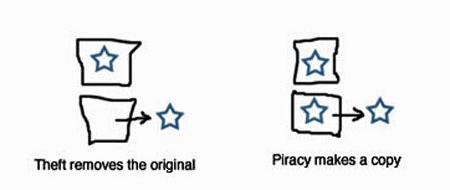
The proper economic arrangement for those who wish to make a living with creative works is patronage. Someone asks you to make something, you make it for them, then you get paid. You then don't get paid until you make another work.
Thus content creators shouldn't have an automatic entitlement to get paid each time someone reads/listens to/watches a work.
If you work once, it's only fair for you to get paid once. The idea of royalties that pay beyond the initial act of creation is unfair because you should not get paid to do nothing.
Copyright is meant to be temporary scheme to encourage creative works. It is not meant to establish ownership over non-physical goods like music, art, etc. though it is definitely currently abused to be that way.
I guess at some point in history we needed copyright to encourage more creativity, but honestly look around you - we are saturated with so much intellectual property. So many movies, software UIs, rehashes of rehashes. Does society really need/benefit from the incentive of copyright/royalty any longer? It seems only entrenched legacies are significantly benefiting currently.
Similarly, the proper economic arrangement for those who wish to consume art is patronage. If you want to view someone's creative work, you must hire them, come to an agreement about the subject to be depicted and materials to be used, and commit to paying the full amount upon delivery.
The idea of reproduction of artistic works from all over the world and from any time in the past? It makes everything too complicated to analyze in terms of what's fair!
It’s fair you get paid an amount commensurate with the quality of the work you produced. The quality is determined by the number of people who view it, so while in effect it’s payment per view, it’s not practically different than having an oracle who can perfectly assess quality of work pay the artist once up front.
> Thus content creators shouldn't have an automatic entitlement to get paid each time someone reads/listens to/watches a work.
If those are the conditions for which the work was created, then they absolutely do. Regardless, downloading a work and distributing it, that’s theft. If the creator/financer made it available, then that’s their prerogative. At some point in the chain, that content left someone’s server under a license agreement that then was broken when the downloader shared it.
The breaking of the license agreement is the issue here. People don’t have a right to break a valid contract unless a court says they do. Regardless if your feelings, it’s still theft.
And yes, we do benefit from copyright. It protects your work from thieves who played no part in the financing or creation of the work.
If a work is truly useful, it's better for more members of a society to have it at a low cost. The other way around benefits one person at the expense of society.
There are valid arguments for whether it is right nor wrong, but it is most certainly not "theft". Call it copyright infringement or piracy or whatever else.
BTW—I never thought that I would still find use of these things from early 2000s. Going into the 2010s, it looked so promising. But they couldn't have a good thing going.
Copyright infringement doesn't change whether you charge for the copies or not. No authorization === infringement. Fair use privileges never let you reproduce and distribute an entire work for casual consumption.
But torrents don't distribute the entire work, they distribute fragments of a work with instructions on how to reassemble them. ;)
That being said, the point here isn't to argue that file sharing is ok, the point is that making something harder to consume legally than illegally is a recipe for failure. Media companies try to maintain maximum control over their content and are surprised when people innovate ways to distribute it more simply?
I just want to have a file (preferably legal) on my computer that I can watch whenever I want with whatever software that I want. I would probably cancel my Netflix subscription and spend more total buying content if that purchase option was available. I would rent far more movies and TV shows if they were more reasonably priced ($1-2 per movie, $0.50 per TV episode or something), probably spending more in total if they were available DRM-free (as in, just an MP4 stream from some CDN). I don't want to steal stuff, I just want to consume media in a convenient, DRM-free way.
I don't want to steal stuff, but I absolutely don't want to be locked in to a content provider.
It's worse than theft. When you steal a car, only that car is lost. When you infringe copyright on a massive scale, it dilutes the value of the original work and reduces the value of all future copies.
This can be seen with music today. Rampant sharing made it so you can't really sell albums anymore. If you want to make a living, you almost have to go with a big label.
It's also why most software companies have now have SAAS and we now are renting software by the month instead of being able to buy a copy.
All of those people I remember a decade ago who claimed they were sharing music to help the indy artist are nowhere to be found and their actions have only hurt any chances of an Indy artist to make a living.
If I remember it increases the value of the most popular work. The content viewer creates a viral effect and shares feeling/opinions about the content.
I remember one video game ceo saying. We don't want you to pirate oir game but if you do choose to pirate we hope you choose our game over the other guy. Makes sense if everyone is playing WoW and talking about it you are more likely to buy said game.
I know Paradox Games specifically doesn't block piracy, and AFAIK they do pretty well. I bought all of the DLC for a game I enjoy because I enjoyed the game so much. Yes, I could have easily pirated the game and all of the DLC, but buying the DLC wasn't that expensive (when on sale), was super convenient (I can still play the game just fine without internet access), and I want to support the developers (especially since they maintain a Linux port of my favorite games).
Hollywood should take a page from the iTunes/Steam world. Make purchases easy and you don't need DRM. Yes, Steam games use DRM, but it's much less invasive than movie DRM and also is usually optional (I can run most games without starting Steam directly on my Linux box without internet access).
I've actually reduced how many movies I watch and increased how many games I buy because the experience is so much better.
Of course, this is so logical. Well, to everyone but the suits. With video games, there is also the risk that you might buy a game, and it's a buggy and/or unopimized mess. They used to release demos where you could try the game and see how it runs. Today, they push preorder nonsense and ship broken garbage. I would never buy a game without testing it first, which usually means I pirate first, then buy if all is well.
Yes, a viral effect. If the effect is to download it for free, people will be unwilling to pay for it in the future and the value has started creeping toward $0.
If you are going to infringe on someone's copyright, at least be honest about its effects.
Absolute rubbish - and quite sadly I note that you're just parroting industry talking points.
>This can be seen with music today. Rampant sharing made it so you can't really sell albums anymore. If you want to make a living, you almost have to go with a big label.
This didn't happen due to piracy. Music piracy is dramatically down compared to the lofty heights of the late 00's. The culprit is music streaming platforms, who used their official licenses from the music labels to dramatically dilute the perceived value of music.
Music piracy was popular, yes, but everyone knew it was illegal. That combined with the relative lack of convenience (compared to streaming) meant that it never had the effect of dilution that streaming has caused.
Now that consumers can get a near-complete music collection for $10 a month, and the entire thing is legal and endorsed by record labels, there is a general perception that music has no value.
As always, the big companies cause the damage, take the profits, and pass off the blame on the little guys. It's a story as old as time, and people keep falling for it. Compare this to 'jaywalking' or 'litterbug's.
>It's also why most software companies have now have SAAS and we now are renting software by the month instead of being able to buy a copy.
How on earth you connect SAAS to piracy, I'll never know. In reality, that's being caused by companies realising that they can make a hell of a lot more money, and more consistent money, by moving to the SAAS model.
>All of those people I remember a decade ago who claimed they were sharing music to help the indy artist are nowhere to be found and their actions have only hurt any chances of an Indy artist to make a living.
Except numerous indie artists did make their break though internet piracy. A number would even put their own music on the pirate bay as a marketing ploy.
This isn't really a thing now, because gasp music piracy is dying, and now the Spotify's and Apple Music's of the world are the sole gatekeepers to music - for most people, at least.
--
In general, when major harm is happening in the world, it is always being caused by those with major power - and that means corporations and governments. Those with power will always try to misdirect the anger of those wronged upon each other - look at the way the 'debate' over immigration in US politics has overtaken real issues like healthcare, taxing the rich/corporations, or tackling climate change.
Immigration is being pushed as a social issue by corporate media and politicians as a wedge issue which doesn't matter to the average person, but gets them really riled up so they don't get too upset about anything which actually matters.
You really and honestly believe that the 'exposure' artists get from piracy is balancing/used to balance out the lost revenue from sales?
Yes sure a few made it. But for the vast majority of small artists there's just no venue to sell their music anymore because no one buys music anymore. Streaming definitely helped accelerate this process but to believe that piracy only helps creators and did not already erode the market for anyone but those with big names and marketing budgets is really just self-delusion.
Streaming services are only popular and accepted by big companies now because piracy reduced CD/album sales so much, they had no choice.
A sliver of the Indy artists got popular and signed with a big label after getting pirated so much (which was my point about requiring a label).
The rest make nothing on streaming sales (fractions of pennies) and forget about trying to sell an album. I suppose begging for donations on patreon might work, but it's not a very good way to make a living.
The culture acceptance of music piracy pushed all music in the hands of big corporations. To not admit this is not accepting the truth about your actions. It seems you want to justify your own piracy and ignore all of the negative effects it had on companies...which most likely led to the loss of many jobs.
I connect SAAS to software piracy because I've been in countless meetings over the past 5 years with business owners of software companies saying exactly what I told you.
If software can be turned into a service, it will be..because companies don't want to deal with lost sales, people that somehow think they can get free support with a pirated copy, and the spreading of misinformation when a pirated copy filled with viruses and malware is attributed to them.
Not to mention organic google keywords that lead to the pirated copies rather than the original..causing confusion, more lost sales, and harm to the company reputation.
As for the Immigration issue, blame the Democrats. When you have politicians pushing for open borders, it's difficult not to pay attention.
I really think we need new language around digital content. I'm not a lawyer but it seems intuitive to say "the reason theft is bad is because you're taking something from somebody else that they, then, no longer have" or "you did not compensate somebody for services that, had they provided those services to somebody else, they would otherwise be compensated for."
With digital content this is just not the case. The original file still exists. You not paying for a movie you download does not deprive the license-holder of an opportunity to offer that download to somebody else. Only the opportunity to sell it to you, one they wouldn't have had in the first place because of [your stance on draconian DRM, high prices for streaming, needing multiple different services instead of a single stop, etc]. What did they lose?
It’s a big assumption that you wouldn’t have purchased the product anyway. Sure, it’s often true, but there are clearly many people who dislike DRM and subscription fees who would nonetheless accept them if the alternative was to forego copyrighted entertainment altogether. The loss of the opportunity to sell to ‘you’ is not negligible.
Not sure why you're being downvoted. It's certainly true that while there are many people who would not pay for the content at any price, there are also many people who would stop pirating and instead pay, if they got the right price, format, terms, etc.
But that's not what the parent is saying. They are saying that if piracy stopped dead cold, almost all pirates would just go and buy the content they were pirating. That's categorically not true, or at least not 100% true. People would probably buy stuff, but at a rate so low, the industry would be hard-pressed to notice the difference.
They didn’t say “almost all”, only that there were many people who would. That seems highly plausible given how many millions of people have pirated content: no, it wouldn’t be everyone buying everything they’ve downloaded but even a modest percentage would be a noticeable increase in sales.
There’s a widely accepted claim that Netflix entering a market correlated with piracy going down because many people are looking for something to watch at a reasonable price. The person who is looking for, say, the latest release or determined not to support certain large media companies is probably still going to hoist the Jolly Roger but that’s far from everyone.
Yes, there are always people on the edges of the spectrum. But most people who can afford it, will prefer to pay some price for the most amount of content. For a time, that service was Netflix, but it is no longer the case (not necessarily Netflix' fault).
If I pay for streaming service Z but don't like their streaming tech or the geofraphical restrictions they put on show Y that I was watching while traveling, I feel that there's no ethical harm happening if I obtain a copy of Y for private storage. It might not be legal or might be in violation of ToS, but personally I wouldn't call this theft. Would you agree?
As long as you delete that copy once your streaming subscription ends, it might actually be reasonable. Otherwise a month of Netflix or Spotify would entitle you to pirate their whole catalogue.
According to whom? If region enforcement is in place, it's because of legal obligations. So yes, there's ethical harm involved when you do something like this because you're intentionally circumventing a business's legal obligations to their partners.
One thing in ethics you might ask is “if everybody did it, what would happen”?
If everybody pirated their videos, maybe media companies would get a clue and make a better product. Nobody pirates music anymore—it is much easier to just pay a small amount to Spotify and the like and get access to almost any song you’d want on basically all your devices.
If anything, perhaps it is more ethical to hard pirate video than it is to let media companies shoot them selves in the foot...
People wouldn't stop producing content because regional restrictions became something that customers don't want to pay for anymore. Any entity that refuses to change those restrictions would leave the market open for another entity who's willing to do business without imposing these terms.
The demand for the fundamental content would remain and if some suppliers are unwilling to provide for the demand, other suppliers would arise.
Did people stop producing music when Spotify hit the market? No, so why would Hollywood stop producing movies?
Music piracy was a huge problem in the 90s, and from what I can tell, that's essentially disappeared with iTunes and Spotify. It should be easy to buy exactly what you want for a reasonable price.
From what I can tell, movie and TV show piracy went way down in areas where Netflix was available, so what does Hollywood do? They lock down their content even more and reduce the content available at any given service.
That's backwards. They have a winning service, they should double down on it and make more content available. Maybe distribute new releases to Netflix customers that have a premium account or something, and have a payment tier with nearly complete access to old content with a single subscription. That's essentially what Spotify does, and it works.
That's a bridge too far. If I have Netflix and I'm in the US and then I travel overseas on vacation and I can't watch the same content, I would have no problem pirating it.
Absolutely. It's illegal, but ethical, provided you remove the content when it disappears from US Netflix and you don't share it with anyone who isn't a US Netflix customer. Also, make sure it's the same quality or worse than your service agreement is.
Ethics and contract law are different things though. Is regional licensing ethical?I don't have opinion one way or the other but violation of a contract is not automatically unethical.
I do but in modern society as a party to an exchange with a faceless entity, I have very little opportunity to change terms in a way that I feel is more fair to my circumstances. If I believe in good faith that my detraction from the terms is not unfair, detrimental or damaging to the counterparties, considering the imbalance in power at play, then I feel that I'm well within the bounds of ethical behaviour.
IP infringement isn’t like theft because it doesn’t deprive owners of their property, but it is a lot like trespassing (e.g., sneaking into a concert, movie, or amusement park without paying).
Your “watching a concert through the fence” analogy doesn’t hold up because the experience of illegally copied content is identical to the paid experience.
You couldn't be more wrong. You do not have an entitlement to intellectual property, our entire society is built on top of that concept.
It's more like you're saying you get to use any logos you want because you can download the images for them on their website.
The only reason you can listen to a concert outside of the venue is because there's no way to stop you that's also in any way proportionate to the crime.
Edit: I'm rate limited so here's a clarification.
My point is that just because it's available doesn't mean you ought to have access to it. You do, no arguments there, but should you? No. You are not entitled to that media by virtue of the fact that it is available to you, much like you are not entitled to the contents of someone's home just because their door is unlocked.
You're not satan if you download a TV show, but I hate it when people try to rationalize that behavior with a moral argument.
You seem to be confusing the idea of entitlement with simply having the ability to do something. It's perfectly possible to download copyrighted content while also not feeling entitled to that content. If I look for a torrent for some movie, and I can't find a torrent, I don't throw a fit, because I don't feel entitled to that movie. If I do find the torrent and download it, cool, that still doesn't mean that I feel entitled to it. People seem to label any actions they don't like as being an indicator of "entitlement," when that word actually has a pretty clear specific meaning.
And yes, you're completely correct about the reason you can listen to a concert from outside, and that is also true of online copyright infringement. Remember the whole "suing grandmothers because their grandkids used Napster" thing? It wasn't even remotely proportionate, and it didn't go over well.
He's not saying you're acting entitled towards the content, (ie you'll throw a fit if you can't pirate it). He's saying you're acting entitled towards being morally justified in downloading the content for free from a torrent site.
It's perfectly possible to have an ability to do something and not be justified in doing it.
> The only reason you can listen to a concert outside of the venue is because there's no way to stop you that's also in any way proportionate to the crime.
As is stopping people from pirating. Where there is will, there is a way. The promise of Netflix was that virtually all content (or at least a very large percentage of it) would be there, under one subscription, at optimal quality. And convenience.
As years have gone by, that promise is nothing but a husk (not necessarily by Netflix' wrong doing).
I agree, I don't think the individual pirates are ever going to be in any real trouble. HOWEVER, while it's impossible to find every person who improperly listened to a concert without paying for a ticket, it is not impossible to find every person who improperly obtained a video file for content they haven't paid for.
Just something to keep in mind as we talk about this; you can actually find the people who did it, and there's actual (digital) evidence, if the government ever decides to change its mind on the issue.
Let me be clear; I don't give a shit if someone pirates digital media. But I do think it's a personal failing of mine that I don't care.
I do, in principle, believe in the concept of intellectual property, and I do, in principle, believe someone who owns an idea can decide to only give it to people who have paid. However, on a purely practical level, I cast no judgement towards anyone who violates that belief, even though I do understand that it does cause real, tangible harm.
It’s not just enforcement challenges. There is no law that gives you the right to prevent someone from ‘improperly’ listening to your concert, because restricting that freedom is not seen as a necessary condition for the continued existence of concerts.
Usenet is still around, and there is content, but for archival purposes, torrents are still a lot more convenient. Years back, publishers started issuing take downs to Usenet provides on specific binary posts. So, as all cat&mouse games go, there were private NZB forums/sites which posted encrypted content and provided the key to members.
I'm actually much happier with my usenet setup than I ever was with torrents. I use tools like Sonarr and Radarr to subscribe to and automatically download content from usenet. Since it's automatic, it's easier to pick up content before DMCA take down notices. Especially because usenet will allow me to use my full bandwidth instead of relying on a trickle from peers.
It depends on the torrent tracker. I've settled down on several private ones, which normally max my 200mbps connection right away. The reason I prefer torrents is the back catalog. With Usenet, it was very difficult to find older content. Also, the content that is uploaded there is scene stuff, which for 15 years now, isn't the most quality stuff (technically). With torrents, the library is always there, and plenty of versions to choose from.
Nice to hear it's still around. I suppose more folks would then use burner cards with VPS providers + torrent and just sftp down their loot. I can't imagine torrenting from home is safe.
> You do not have an entitlement to intellectual property, our entire society is built on top of that concept.
Our society is based on the idea that the public in fact does have an entitlement to all IP except trademarks. The Constitution is pretty clear that it's a limited monopoly that was originally 14 years for copyright. When that's been perverted so that "forever minus a day" is a limited copyright, then I don't feel the need to respect their property.
The constitution literally describes IP as "for limited Times to Authors and Inventors the exclusive Right to their respective Writings and Discoveries." with "for limited times" clause in many, many court cases being taken to mean that everything eventually enters the public domain. That's why the CPEA couldn't extend copyright indefinitely like originally planned as constitutionally it all must enter the public domain eventually. The "forever minus a day" thing is their dubious legal hack that's blatantly at odds with the constitution.
The key word is eventually, which makes what you're saying irrelevant to the conversation we're having here.
No one is talking about downloading media outside of copyright and you know that, but insist on derailing the conversation by continuing to talk about it anyway.
Except, as I've said multiple times already, that part has been perverted to where now "forever minus a day" somehow suffices. When they pull that crap to hold on to property that should be in the public domain, I don't feel a need to respect even the concept that they own that IP.
Right, but in so doing you're presenting an inconsistent and selectively favorable-for-you viewpoint, which in reality is nothing more than a smokescreen for your greed.
I have elsewhere. If you want to discuss this further, email me. HN isn't good for any kind of protracted conversation such as what you're trying to have now.
Eh, we're in legalese grey area here. "Entitlement" is a loaded word.
Personally, I believe that if I am walking down the street and someone is playing The Avengers on a screen, I'm very much entitled to stick around and watch the movie. The internet, to me, is the same thing as walking down that street - public space. Feel free to disagree though - the CCP does. Not to get into politics, but it's fundamentally similar.
If I torrented a movie and then went to resell it in the public market, feel free to pursue legal charges.
If I click a link and the movie downloads onto my computer, look for the person who uploaded it if you want someone to charge. Don't come at me for using the internet.
The internet is a free market, or at least ought to be, if we're discussing what ought to be.
The internet is a free space, but so is reality; there's nothing actually physically preventing you from walking into a store, grabbing whatever you want, and walking out. You're not violating the laws of physics if you do that, in other words. However, laws apply, and on top of reality we've created a set of rules that are enforced, ultimately, by big burly people with guns.
Nothing, to me, makes the Internet any different from that. There are a set of immutable properties of the Internet, akin to its "laws of physics" (ultimately they still are the laws of physics but I digress), and in that sense yes, the Internet is a truly free space, just like physical reality is. However, just like reality, we've also laid on top of those rules a second set of rules that are enforced, ultimately, by big burly people with guns.
Not to say that laws are a perfect mirror of morality, but why would a rule (moral or legal) that exists in physical reality not also exist on the internet? If you believe in intellectual property in physical space, why wouldn't that belief hold over onto the Internet?
You are using hyperbole to straw man what is being said.
If you go into a store and take a laptop, this is completely different from downloading a movie. If I could, I would download that laptop, and that, too, would be completely different from physically taking the laptop from the store, which robs the store owner from compensation. To use your argument, if I go into a store, look at a laptop but don't buy it, that's theft, because if I did buy it, the owner would have profited.
Sorry, I'm not, and there simply is no moral argument for pirating content, because no, if you believe in intellectual property, the is nothing whatsoever different about stealing a laptop and downloading a movie.
If you believe in intellectual property, piracy is amoral. It's not pure evil incarnate, but harms more than it helps.
And yeah, of course I would download that laptop. Doesn't mean I should!
There absolutely is a difference. The cost of reproducing a laptop for the owner exists and the cost of reproducing something in the digital world does not, or is negligible.
That's just an argument against intellectual property, which I've already said is a non-starter. If you don't believe in intellectual property at all, then of course it's fine to pirate, but if you believe in intellectual property, then you are violating your own beliefs when you pirate.
Its not a straw-man its a very real comparison if you think about a physical copy of content vs a digital copy. When you bought a dvd in stores you paid more than the $5 it cost to manufacture, ship and store the physical medium. You payed mostly for access to the content therein, and gave that compensation to the creators of the movie.
If the movie is showing in the park for free, you can stick around and stand to watch it, but if there was a better service at a reasonable cost, you could go home and watch it there more comfortably.
Works even better. You can stand in the dirty alley (with piss smell and dog poo) and watch it, or go home and watch it comfortable, if the price and service is right. Sure, some people will never go home (maybe they don't even have one), but most people will, given the right incentive.
That's not the same scenario. The content was taken from a private place (bootleg, studio leak, paywall/subscription, etc) and put into a public place.
Why does using the proper definition of words matter? I think that should be fairly obvious.
"Downloading copyrighted music is murder."
Ok, then downloading copyrighted music should be punished like murder.
Oh, it isn't Murder?
Well, it also isn't theft. So it shouldn't be punished like it is theft or treated like it is theft in conversation. It should be punished like and treated as copyright infringement, which it is.
Well, we have trespassing and copyright infringement. Neither of those have the emotional baggage as theft, so the movie industry uses the term for maximum effect.