saw this comment on Reddit:
>They weren't trapped for years. There was a ventilation pipe they were falling down from. That's how they got down there. New ones kept falling in all the time, keeping their numbers high. They didn't survive for years "because cannibalism" and there is no evidence that any individual ant survived for more than a short time.
Yes, it says in the study that new ants were falling down. A million ants didn't fall down all at once though, and they did sustain themselves by eating the corpses of dead ants.
Yeah, and they found evidence of cannibalism on the ant corpses examined
> Of the corpses collected from ‘cemeteries’, a vast majority (93%) bore traces of bites, and also fret holes were seen on their abdomens – typical signs left when the contents have been consumed.
This species is also known to eat their dead in other circumstances:
> It is known that wood ants consume dead bodies of their conspecifics left in masses on the ground during spectacular ‘ant wars’ early in the season.
I'm interested in knowing what the consequences were for the source nest from the sudden influx of a million escaped worker ants, positive or negative.
If there were Bats in the bunker, surely there must have been other insects (prey / predators)?
This is anecdotal, but a WW2 bomb shelter I saw was filled with beetles and other creepy crawlies in Scotland. Ok it probably wasn't as deep underground as a nuclear storage facility but life finds a way.
While searching for another source to verify this fact, I learnt from wikipedia that Formica polyctena ants are near threatened: https://en.wikipedia.org/wiki/Formica_polyctena
Good that they got out of the bunker.
Given that ants make 20% of the entire animal biomass on land (https://www.youtube.com/watch?v=7_e0CA_nhaE), it didn't cross my mind that subspecies could go to extinction ^^
That's actually surprising. I would have guessed around 0.25-0.50g or so. I'm usually pretty good at guesstimations, and yet I'm off by a factor of 100 here.
"Dude, where am I?"
"We don't know."
"How do we get back to Mother?"
"We don't know, or we would have gone home"
"You say 'we', how many of you are here?"
"Millions"
"Is there anything to eat? I'm so hungry I could eat a horsefly"
"That depends on how long we have to chase you around for"
While this is technically accurate, the OP suggests more that they survived by eating their own corpses. There was just one source of ants to the bunker; living workers ate dead ones, presumably without murdering them first.
There needs to be some clarifying questions. I'm basing these questions on the premise that the trapped ants ate the corpses of incoming worker ants without killing them first.
(1) How did the incoming worker ants come to be in the bunker? Based on the premise, they fell into the bunker already dead.
If that's the case and if the ants were not reproducing, unless they have a relatively long lifespan, (2) shouldn't they die out overtime regardless of how many corpses fell into the bunker?
(3) Why couldn't the trap ants make it across the ceiling into the ventilation pipe--are some ants unable to crawl upside down or did the texture of the ceiling impede them?
If the premise is incorrect and the ants have a short lifespan, it's reasonable to think that the "trapped" ants are just an accumulation of worker ants that kept falling into the bunker.
No, it doesn't say they were dead when they fell into the bunker. In fact, the contrary.
From the abstract:
> Here we show that the ‘colony’ in the bunker survived and grew thanks to an influx of workers from the source nest above the bunker
And the introduction:
> Ants which had dropped through the pipe to the bunker were not able to reach the outlet, located in the ceiling, to return to the mother nest.
And regarding your question about being able to crawl across the ceiling, probably not enough texture to grip. After all, the article indicates that there was question about whether they would even be able to crawl up the ventilation pipe:
> the only way to free the ants from the bunker would be to enable their spontaneous return migration to the maternal nest through the ventilation pipe – assuming that the rusty pipe interior is coarse enough for that
And to your point
> it's reasonable to think that the "trapped" ants are just an accumulation of worker ants that kept falling into the bunker.
Yes, and that is the premise of the study. However, a million ants didn't fall down all at once (or in a very short period), so however long they were down there they had to adapt to survive - which is what the study is about.
For an interesting science fiction take on ants you should read the book "Children of Time"! This story of ants adapting reminded me of the ants in that book.
From my understanding they don't know where they're going, they just walk around aimlessly hunting for food and following pheromone tails so it'd be hard to find that one hole in the entire room, especially when it's on the ceiling. There may have also been slime built up around the hole which would make it difficult to traverse even if they did find it. They'd need to survive starvation and cannibalism to find their way out too.
It's only an inconsistency from a "vegan" worldview -- it's prerequisite that you see all animals as being total equals that it's inconsistent to butcher one and save the other.
On the other hand, a non-vegan worldview likely sees some animals i.e. domestic farm animals as existing (or at least eligible) to be slaughtered and eaten. Upon seeing these ants trapped in an endless cycle of death for no reason at all, and having no clear purpose in the wider scheme of things, it makes sense to want to "correct" the problem.
Whereas, there's no problem in eating a steak, as it came from livestock which lived for the purpose of being slaughtered. If the cow were suffering "out of place", the scientists would likely want to ease its pain, while still being able to go out and get a hamburger for lunch.
This seems like the same logic that says shooting and eating a non-endangered wild deer is less ethical than eating a cow that someone else killed for you. (Which is a viewpoint I've encountered in real life. Basically anyone who is not vegetarian but thinks hunting/hunters are gross.)
I would say that many humans have a natural empathy for suffering things, but it can be short-circuited by emotional distance (you never see the cow as anything but a ready-to-cook steak) and social pressure (everyone knows it's okay to eat cows). We're really good at finding moral justifications for things we really want to do.
(I am not vegetarian, for whatever that's worth. I admit I have the same emotional/non-logical responses I described here. But I see perfectly civil attempts at debate being downvoted to hell and accused of "virtue signalling" purely for going against groupthink, and that bugs me.)
I'm not arguing for veganism here, but your reasoning seems very flawed.
If being born and raised for slaughter makes that slaughter justified, then would it be ok to kill and eat humans if they were born and raised for that purpose? This argument doesn't hold water.
Humans and animals are not equal. It's simple as that.
According to our laws humans have some rights by just being a human. Some animals have rights only because humans like them. Cockroaches have no rights because humans don't like them. Bear which killed human have no rights and will be killed to prevent more deaths, because humans don't like him. Cute kitten have a lot of rights because people like him and will be angry if they find out that someone tortures that cute kitten. Nobody will be angry if some kid tortures cockroach. It'll be disgusting, but that's about it.
> According to our laws humans have some rights by just being a human.
Being human means you can plan things out and recall the passage of time by sharing stories. Language and higher thought make us peculiar in that regard; they give us a past and a future, which is why you're destroying something if you end a human being's life early.
For a similar reason, we have rules against causing suffering that apply to animals that can suffer.
That situation could not occur, for several reasons:
- You do not want other human to do that to you, so you do not do that to them. This is the same reason why murder is frowned upon in societies
- Humans are animal, and you have a natural empathy towards other human beings. In addition, there would be sexual appetite for the captive, people falling in love etc. which would lead to very problematic situation
- Humans seem very dangerous and inefficient to raise for food, they could rebel, and it takes foverer to get from a baby to an adult (comparing to a chicken for instance).
I'm pretty sure we would not farm cows if cows were as intelligent and threatening as us and took 15 years to become adult, we would just exterminate them because they would be a threat, or make a peace treaty, just like human societies do.
It's the not the nurture of the thing but the nature of the thing. It's not that the animal was raised to be slaughtered, but that it was "made" to be slaughtered, if you choose to believe that.
If I had to try to explain it, I think it's either people have internalized hierarchies about nature "hard wired" intuitively and/or also passed down by culture, where animals like livestock are "meant" to be food. I don't know nearly enough about anything to speculate on which if either is the case.
I'm not stating that as fact, or that it's a good thing, only that's what I've observed. Humanity seems to be predisposed to this kind of "you're made to do this", and it's definitely not always good or ethical.
But I don't think that it's "inconsistent", if that's what you believe. Unethical, maybe, but not inconsistent.
Obviously it wouldn't be okay to birth and raise humans for the sole purpose of consumption. That's why you don't see humans being raised for consumption.
I think that the main question is about how animals are killed and how they live until then.
To me, slaughtering a cow quickly is not bad because the cow may have had problems in its old age and we are causing one minute of pain vs long years of potentially serious discomfort. Also the animal’s experience is considered pretty limited so robbing the cow of many more years of experiencing life as a cow is not considered very bad. On the upside you get to use the cow’s meat, hide etc.
In the animal kingdom, deaths are often far more brutal, including from bacteria etc. so humane slaughter is far better.
The problem starts when you have to breed far more cows and keep them in terrible conditions during their lives. Especially how they used to keep veal. To this day I avoid veal out of principle. But it’s also the dairy industry, the National Dairy Checkoff and how cows are forcefully inseminated, the calves taken from them and the cows milked without being able to move.
The problem is induced demand and the explosion of number of people on the planet. The farms are not your grandparents’ farms. And cows have it relatively good compared to turkeys and chickens.
What’s really immoral is the way they keep these animals confined, cut off their beaks so they don’t peck each other, and let them live in their own dung and stench. The chickens can’t spread a single wing.
The way they use antibiotics to both combat the rampant spread of disease in confined conditions (from feces, etc.) and to fatten up the animal has heavily contributed to antibiotic resistance of MRSA strains etc. So there are negative externalities for humans even if you don’t care about animal welfare.
We must do something about ending factory farms in the USA. When you are not paying you are the product. Capitalism always selects for the farm with the lowest overhead, though. So we will have to use non-market mechanisms to solve this. Does anyone here have good ideas? Here are some of mine:
Regulations (like in Europe)
Nonprofit offering farm subsidies and to build vertical space to house animals in exchange for cameras and seizing the farm / fining it (like a government) if violations occur.
Make more people lactose intolerant by encouraging interracial marriages with non-Europeans like Asians (far fetched and works only for cows, if it works at all)
Impossible burger may be the best thing to get people to switch. Just like Qbix and Matrix.org and Solid and Mastodon need to exist as alternatives for people to switch from centralized systems.
I'm an individual and I value some things above others. I will help my friends and family members before I help strangers. I would take the proverbial bullet for them, but for you? I'd probably not.
Equally if I came across a trapped cat I'd try to rescue, if I come across a trapped housefly I don't take notice.
People who aren't vegan still value animals, just with hierarchies of concern rather than one rule to fit all. That answers the good faith portion of the comment, the virtue signalling isn't something I can provide an answer for.
No, things I disagree with aren't automatically virtue signalling. Feigning ignorance to ask an obvious question (Why do people treat different animals inequally?) but just happening to bring up their own moral stance is textbook virtue signalling.
If everyone in the world becomes vegan, what exactly do you think is going to happen to all of those domesticated cows, sheep, and chickens? Are people going to continue raising them as pets in the same quantities, out of the goodness of their hearts? Of course not -- they would basically go extinct.
I think that on the whole, I think that having a reasonably comfortable and safe life and then being humanely slaughtered for food is better than not existing at all. So while I'm definitely ethically against "industrial" meat production that treats live animals like meat-generating machines, I think that raising animals in reasonable living conditions before killing them to eat is perfectly ethical.
(Whether we have the resources to raise them is a different question; I'm resigned to the fact that eventually we'll all be on plant-based diets for planet sustainability reasons.)
FYI, some land is well suited to grow food crops, other land isn't. The share varies by region, of course. There's a limit to how much meat we can eat if we are to use the land optimally. That limit isn't zero.
Well, most people on the planet don't eat meat in every single meal.
I've commented on this before, but I'm Greek and our traditional cuisine has many dishes that are naturally vegan, in the sense that no meat or animal products are used in them, but nobody actually calls them, or thinks of them as vegan, only as "normal food". There's a list here, compiled by a vegan very happy to have visited Greece:
I believe this is a common situation in many parts of the world. I thik most people eat meat only according to their needs. Especially earlier in human history, before industrial farming, meat would have been an expensive luxury for most people, who would have complemented their diet with fish, dairy and eggs, being naturally lacto- ovo- pescaterian rather than vegan, and would have eaten meat (especially beef) on special occasions like feasts and weddings and so on.
So maybe veganism is a reaction to the particular eating habbits of specific parts of the world, where meat is eaten too frequently?
Different genotypes have different levels of dependence on animal protien. They found specifically in India a pathway that made plant protiens better used. So what too much meat is varies by person. I think 1.5lbs of beef a day is probably more than enough for anyone. I did that for a year and my blood work was fantastic but it was definitely excessive to my needs.
I was rounding 1.36lbs (raw) of grassfed ground beef (85 / 15)mixed with diced hatch chilis and 2 mashed sweet potatoes. That was just lunch. I lost 30lbs that year, my tryglycerides recovered from my soylent months as well.
It depends a lot on the particular climate and soil. In a lot of places, the best you can do with the land is grazing. The soil is good enough only for raising pasture, and as we don't diggest cellulose, cattle serve as some kind of reactor to transform unedible cellulose into food.
In other places, like mountainous ranges, it would be pretty hard to get some sustenance directly from the ground, but again, goats are useful factories that turn otherwise unedible brush into food.
Most of the problem occurs because government subsidies make economical to raise cattle in places that should have no business doing so because there is plenty of better-suited environment in the third-world to free-range cattle.
Feeding grains to cattle in a high-wage first world country under confinement is way more expensive than buying meat for third-world countries in Africa or Latin American, and it only happens because of the lobbying power of farmers and agro-corporations.
I've read a serious attempt at finding out what it might be. All I can say is: Some people eat too damned much meat, but whether they eat 13× or 7× too much is a difficult question.
(EDIT: Sorry about the obscenity. I think the "bacon in milkshakes" got to me.)
I'm not vegan, but that's absurd. Right now we spend an inordinate amount of land on the relative monocultures of raising these animals, consuming vegetable matter is generally more efficient when it comes to land use.
So we'd have fewer chickens, but we'd have more land left to the wilderness. I don't really care about the interest of 100 chickens somewhere, but purely from a conservation point of view veganism is one of the worthwhile things we can be doing. Those animals are taking up land that we can replace with a more varied ecology.
But these species are never going to become extinct, we won't have 100% veganism, and some of them will still be raised even if they're not being eaten. E.g. chickens are very useful for pest control and to dispose of food waste.
Sorry, I'm having trouble figuring out from your response what it is that you disagree with. The main point of my post is to address the question of whether it's ethical to raise and eat animals at all: whether, all things being equal, a world in which nobody eats cows or sheep or chickens is better than a world in which we eat cows and sheep and chickens, but give them decent living conditions.
Obviously other things are not equal, as I alluded to in my final paragraph.
How does that make any sense? In the real world we have resource constraints, so positing something like "there won't be any chickens" as a moral loss doesn't make sense, we'll have something else instead since the resources to raise chickens were freed up.
If you're throwing resource constraints out the window the question should be why we're not raising 1 billion blue whales for food in addition to of cows.
After all they're smarter, and if you're going to follow this logic that these animals ultimately benefit from their numbers being raised as a result of food production that should go for all of them. Having 1 billion city-sized aquariums isn't an issue if we're assuming we have infinite resources.
But we don't, in fact that's the entire reason we ended up with these particular species as food animals, they're the most efficient relatively speaking, not necessarily the tastiest.
Again I'm having trouble figuring out what the "that" is that offends you. I'm guessing that you mean, "How does it make any sense to consider a chicken's life to have any value whatsoever?"
All I can say is, you may not think so, but lots of people do.
We're discussing a story in which some researchers found millions of ants that had fallen into a pit and were living only by cannibalizing their comrades who had starved to death, and responded by building them a "bridge" to allow them to escape. Why did they do that? Party to see what would happen; but partly because they felt bad for the ants and felt better when they helped them. I mean, not a huge amount. I'm sure the researchers wouldn't have intervened, or even felt that bad, if the ant nest had been destroyed to make way for a parking lot. But there's not a parking lot, and all it takes to help is standing up a wooden beam. Like, sure, why not help if it's so easy?
In response to this, someone asked how it was consistent to do this and yet continue eating meat. That person obviously cares enough about chickens to think they shouldn't be slaughtered, and to argue about it on Hacker News. In response, a bunch of other people, like myself, jumped in to explain why it's perfectly consistent to value ants enough to save them, but still eat chickens.
It was the person who cared about chickens being killed and eaten I was responding to. I was trying to show how trying to make the current system more humane would be better for chickens than eliminating chicken farms altogether.
I'm not going to cry for the grass and ants and crickets if they dig up a field to build a useful building. But I'd rather have grass and ants and crickets than an unused parking lot. And I'm not going to cry too badly if chickens go extinct; but all things being equal I'd rather have happy chickens than no chickens.
I mean yeah, if you don't give two figs about ants or chickens, then it doesn't matter one way or the other. But an awful lot of people do -- at least a little bit.
Can you cite that because my understanding is it takes less space to have live stock as you don’t need to do crop rotation. Organic is the worst as the yields are low you need to plant more to attempt to come close to the same yields as a GM crop.
Livestock always takes more land than an equivalent calorie-load of crops. It has to; you're feeding the crops to the animals instead of eating the crops yourself, so there's a lot of energy lost on building cows.
The actual farm footprint may be smaller, but the feed for those animals was still grown somewhere.
(Of course there are resources besides land. In desert environments, livestock still takes more land, but it takes several orders of magnitude less water, since ruminants can digest dry scrub while humans need well-watered grains. But in places that get plenty of rain, livestock is always less efficient.)
Sheep, goats and reindeer will spend the summer there and taste great. It's not done on that particular mountain at present due to... explanations vary, and generally contain some or all of the words "market price", "herders" and "bears".
I suppose you could say that keeping sheep there is less efficient than transporting grain from somewhere else. But that isn't the sense of "efficient" you had in mind, is it?
I don't know about Norway, but in general you might be underestimating how much that landscape looks like that because grazing animals range on it.
See e.g. this thread about Iceland & my top comment there, but perhaps the amount of ecological destruction doesn't carry over to Norway: https://news.ycombinator.com/item?id=15515292
Norway is different from Iceland, which is a key reason why Iceland suffered. Settlers brought along practices that had worked for centuries in Norway, but Iceland's soil and geology are very different from Norway, and its native flora and fauna differ too.
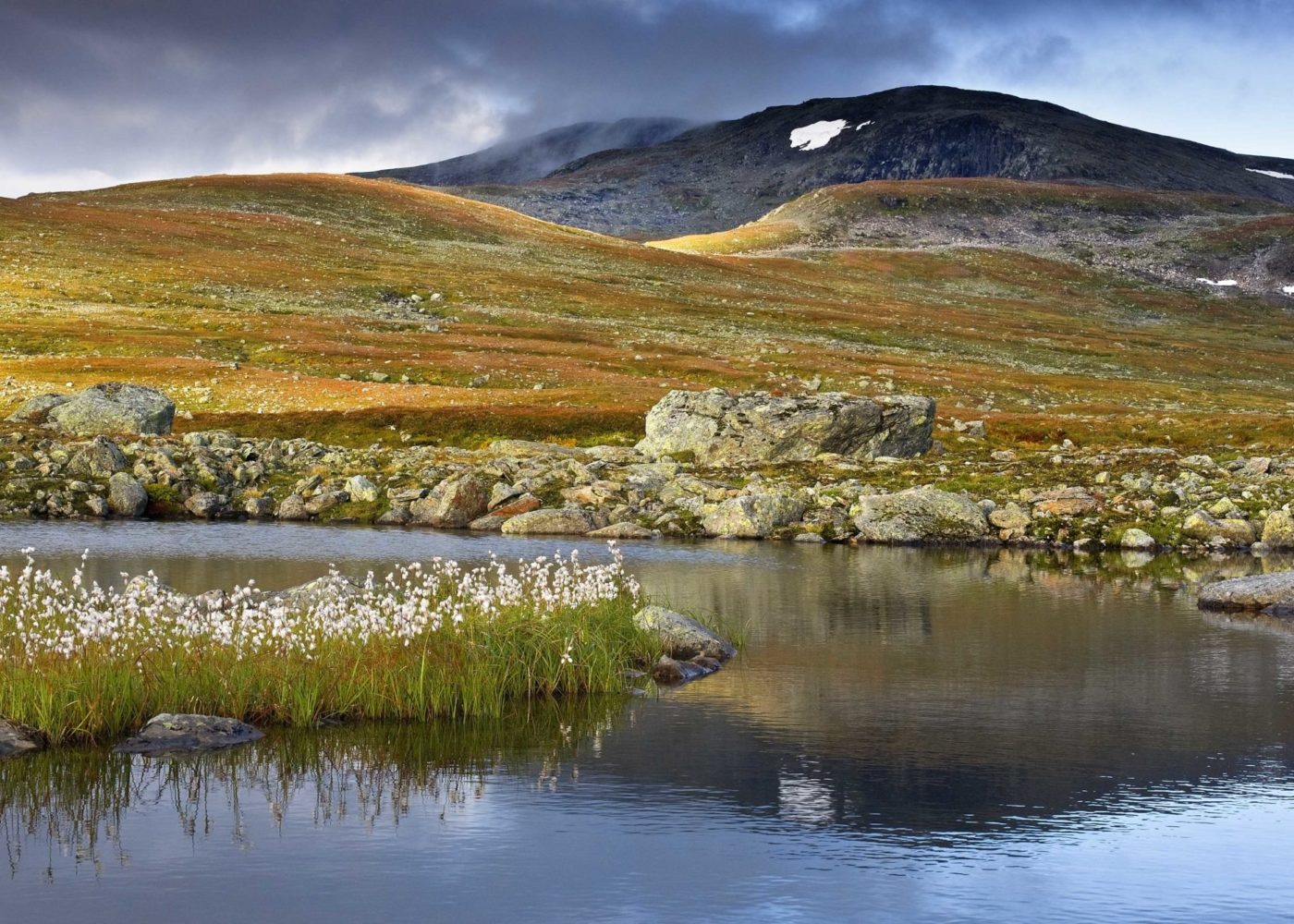
There are no trees there because that's above the timber line. The photo on https://en.wikipedia.org/wiki/Tree_line is realistic, the trees do cease suddenly, the horizontal line is clearly visible in the landscape. That photo was taken 100-200m above above the timber line, if my memory of the landscape isn't too bad.
The larger point is that no, that landscape wouldn't be usable for wheat or for hardier crops like rye or potatoes. Some of the world is usable for wheat, some is too barren. One way to get human food from barren landscape is to let animals graze.
We mostly live in cities (built on and) surrounded by flat, fertile farmland, so it's easy to forget that barren areas such as mountains and deserts even exist. But they do exist, quite a lot by area, and can provide animal food without displacing wheat etc.
(Writing this makes me wonder about a farm where I've stayed a few times. Flat, lush landscape, near a river, but the farmer told me that the soil was completely unusable for growing food crops. Only grazing suited the land. I wonder what invisible factors may make land unsuited for food crops.)
Yeah Iceland's definitely a big outlier in this regard, but searching around a bit it seems this pattern holds to some degree in the sort of landscape you referenced, see [1] and [2] (just a couple of relevant papers I found).
I.e. some Norwegian researchers fenced off areas of heaths (the sort of landscape you linked to) and within just a few years those areas were noticeably different.
That's the general effect I'm pointing out, you can't just look at a current landscape that has herbivores on it and conclude it can't be used for other purposes, even something as basic as the tree line can be regulated by those herbivores.
Fair enough, there are other considerations besides just water that make land less practical for growing food crops. It still takes more land--square kilometers--to produce X calories of livestock than X calories of plants. It's just that sometimes there are more important factors than square kilometers. Water, soil quality, markets, terrain inclination.
A lot of land can’t be used for farming crops. But you can shove animals on much wider variety of land scapes. Meaning you don’t need to deforest on the same scale. Coupled with not needing to do crop rotation. Etc etc. Results in less land required.
Expecting the entire world to turn vegetarian, seems unrealistic, unless there is some major collapse of the entire ecosystem. The ideal solution is that meat goes back to being a luxury or treat, instead of consuming it daily multiple times. With a majority of our calories coming from vegetables. There is just far too much cheap meat available.
> If everyone in the world becomes vegan, what exactly do you think is going to happen to all of those domesticated cows, sheep, and chickens? Are people going to continue raising them as pets in the same quantities, out of the goodness of their hearts? Of course not -- they would basically go extinct.
I googled "How many zoos in the world", and got an estimate of about 1500. If every single zoo had 10 chickens, that would make about 15,000 chickens in the entire world. I think going from however many millions of chickens there are worldwide down to 15k would count as "basically exctinct".
Far, far more than millions of chicken. According to this NY Times article 23 billion alive at any one time. [1] The most numerous bird species in the world.
That raising an animal for slaughter is permitted.
You can't separate those two; the choice doesn't happen between the raising and the slaughter. Farmers don't breed animals and only then consider whether to slaughter them, the choice happens earlier.
So the argument is that letting an animal see the light of day on condition that it'll be slaughtered at the right age is a valid thing to do. (Digressing: my own opinion is that it depends on how the animal gets to spend its time on earth. But that's just my opinion, not really relevant to the argument.)
To some extent, yes. I'm not saying it should put that over your own moral line, but I definitely think that sacrificing an animal you cared for is more acceptable than hunting a wild animal, for example.
Consider the relationship between ants and aphids. Ants care for aphids and they survive because of ants. But ants have also been known to physically tear wings off of aphids to prevent them from flying away!
And of course, farming is far different than hunting and fighting, which ants do as well.
Statistically, food animals are far more likely to be raised in hellish factory farms than in the traditional bucolic pasture or chicken run. I don't actually think raising animals for meat is immoral, but causing unnecessary suffering to improve the bottom line is.
Consider the anteater, or any actual creature apart from humans. Carrion eater could be another good example. Now consider where does human morality come from and what does it mean within nature?
But I suspect your question is not a sincere search for understanding rather it's a statement about your own beliefs and choices.
Let's consider the ongoing fad of meat-free pet food which is controversial to say the least. It appears that some members of the vegan community do wish to change nature to suit their world view, where carnivory is wrong in any context.
It's a huge area of interest to me, the cognitive dissonance that shields a person from guilt of causing harm when they cannot see that harm being caused, yet wouldn't hesitate for a moment to save an individual instances of the same animal they would other have destroyed in other circumstances. See the care taken to save this deer [1] - the same workers probably went home to eat a steak or pork chops, where an animal was caused suffering to provide that for them. (I'm not immune:I don't eat meat but I wear leather. It's a challenge, deciding what part of suffering one is Ok with).
I imagine in the same circumstance, I would either try to save the ants or see them relieved from their Sisyphean task through destruction of the colony.
This has nothing to do with seeing the harm being done. Sacrificing the animal has always been a part of human experience in traditional societies.
Even today, in my country, sacrificing a pig before Christmas is a cherished tradition, that friends and family gather together for, and enjoy the meat immediately after.
I believe that the justification is simple - people care for the animals and try to give them a good life (in pre-industrial agriculture, not the horrific meat factories we get most food from now). Then, there comes a day when one animal's life must end, as is the natural circle of life. The sacrifice itself is performed in a way which is perceived as decent (though by modern standards, we now realize it is often not decent).
Essentially, the humans have given the animal their care, and then the animal 'gives' the humans its meat. It's a simple quid-pro-quo, if you want to look at it purely rationally.
It's still significantly better than what would happen to the animals if they were living in the forest - unlike many other animals, we at least kill them before eating their flesh.
Unfortunately, all of this has been turned gruesome by moder industrial practices, and that IS a part that benefits from staying out of sight.
My comment wasn't about whether it's wrong or not to kill animals - I absolutely prefer than an amimal's death is witnessed by those who will profit from it. It's the case where, particularly in the sheltered west, we have people who happily eat meat and yet would not kill the animal themselves to do so, and would save a cute animal from suffering if given the opportunity when they see it, but do nothing to stop suffering from happen when they cannot see it.
As you say, it is the purpose of the industrial machine to hide these horrors from us. But it's shameful for those who ignore that it exists and still profit from it.
If it helps, no additional cows are killed for leather. There is enough skin as a by-product to go around - in fact, lots of cow skin is thrown out since the demand for leather is not nearly as high as the demand for meat.
It‘s not my intention to provide justification, but granted they accept animal murder as a ethically correct way of gathering food, then it makes perfect sense. Why should they let starve the ants WITHOUT REASON?
They didn't seem to want to help the ants. They were just completing their study (confirming that the ants weren't able to find an exit on their own instead of eg. chemical residues in the ventilation shaft), and confirming the colony they came from. I fail to see any empathy on the actions taken.
Most people who eat meat eat meat because they feel the need to eat meat, not because they like the idea of having to kill other animals to eat their meat.
Most people hate the idea of causing unnecessary suffering and also find it wrong to allow suffering to go on when they can do something about it.
And most people would do for a trapped cow or a trapped sheep the same thing those researchers did for the trapped ants.
It's better to have "inconsistencies" compared to consistent "bad". Also, there are people addicted to meat, but due to their empathy, they eat animals which are already dead and can't be saved.
It's incredibly logically consistent. People do things that they are able to do. Saving millions of ants with a stick is very easy. Dismantling the entire meat industry is a decades long effort that requires millions to cooperate and probably isn't going to succeed either way and its results won't be attributed to a lone scientist helping ants.
I'd do the same, because I like hymenopterans better than I do cows. It's not a question of logical consistency, but rather of ethical schemata. Yours changed in a particular way that mine hasn't.
You see this kind of thing all the time, I believe basically it comes down to humans being wired to protect and care for their in-group while exploiting their out-group. We're really inconsistent with defining in-group vs. out-group, though, so you get things like this. Another example is people who protest horse racing as being 'barbaric' because some horses end up being butchered, but then happily chow down on a steak.
Can anyone hep me understand what looks like a glaring moral inconsistency?
Do you model humans as perfectly rational actors following a handful of base axioms from which they derive behaviour? They simply don't work like that. If you wish to improve your understanding, you need to improve your model.
There is no moral inconsistency here. Your (vegan) moral beliefs have different axioms than (dare I say) real "gut" human morals. Put simply the vegan axiom is "A life is a life." vs the gut axiom which is "A closer life is more valuable".
This is why people, for example, would risk their life to rescue a cat stuck in a tree[0]. Because it's there. You can see it. The cow that's in my burger is not in my proximity, so my morals are intact. For this reason most people wouldn't find it easy at all to slaughter a cow, or even watch it being slaughtered. Because it's close.
One might think that this is irrational/bad but this, like any argument about axioms, is a matter of taste rather than logic. However, I'd venture off saying that most everyone holds the "gut" morals, including "vegans", which if anything makes the latter group inconsistent. For example: A vegan would probably fumigate their house if it had pests (even though their lives are equal to any other and all death could be avoided if one just moved house), or give a kidney to a dying family member before giving it to a dying stranger. Or to a dying dog (if that were possible). Or consider this moral conundrum: You must chose between (a) manually killing a single child yourself, or (b) press a button that will kill a 1000 people far away. (I used "child" as this is another "gut" moral axiom: The younger the life, the more valuable it is). Option (a) is aligned with "a life is a life" because 1000>1, but not only would most people chose (b), but I would be extremely uncomfortable with anyone that would actually be able to chose (a) as they would seem to be a sociopath.
Why are you assuming they did this purely for the ants' sake?
Maybe it was just a curiosity, or maybe they just have too much time on their hands, or maybe they wanted to prevent the bunker colony from getting any larger as it could attract other vermin being a food source. (they mention bats in TFA)
Also, how do you know someone's vegan? They tell you.
That's a really tired joke. Do you know why you hear it so much? Have you ever considered how inundated the world is with carnist culture? Everyday vegans come across media, friends and assumptions about the normalization of eating animals. How do you know that someone is a carnist? They'll tell that dumb "how do you know someone is a vegan" joke.
No, "carnist" is ideological rather than concerning diet, one who supports the ideology that it is morally acceptable to eat animals for food. One could be a vegetarian carnist (who does not like the taste) for example.
It's kind of insulting, you think you know my ideology?
Just ignore these people, don't voluntarily enable them to insult/offend you with their zealous idiocy.
I feel like we used to be better at this. There's so much stupidity from the vocal minority getting air time and unwarranted attention now with social media, it's diminished everyone's ability to differentiate the signal from the noise.