If everyone in the world becomes vegan, what exactly do you think is going to happen to all of those domesticated cows, sheep, and chickens? Are people going to continue raising them as pets in the same quantities, out of the goodness of their hearts? Of course not -- they would basically go extinct.
I think that on the whole, I think that having a reasonably comfortable and safe life and then being humanely slaughtered for food is better than not existing at all. So while I'm definitely ethically against "industrial" meat production that treats live animals like meat-generating machines, I think that raising animals in reasonable living conditions before killing them to eat is perfectly ethical.
(Whether we have the resources to raise them is a different question; I'm resigned to the fact that eventually we'll all be on plant-based diets for planet sustainability reasons.)
FYI, some land is well suited to grow food crops, other land isn't. The share varies by region, of course. There's a limit to how much meat we can eat if we are to use the land optimally. That limit isn't zero.
Well, most people on the planet don't eat meat in every single meal.
I've commented on this before, but I'm Greek and our traditional cuisine has many dishes that are naturally vegan, in the sense that no meat or animal products are used in them, but nobody actually calls them, or thinks of them as vegan, only as "normal food". There's a list here, compiled by a vegan very happy to have visited Greece:
I believe this is a common situation in many parts of the world. I thik most people eat meat only according to their needs. Especially earlier in human history, before industrial farming, meat would have been an expensive luxury for most people, who would have complemented their diet with fish, dairy and eggs, being naturally lacto- ovo- pescaterian rather than vegan, and would have eaten meat (especially beef) on special occasions like feasts and weddings and so on.
So maybe veganism is a reaction to the particular eating habbits of specific parts of the world, where meat is eaten too frequently?
Different genotypes have different levels of dependence on animal protien. They found specifically in India a pathway that made plant protiens better used. So what too much meat is varies by person. I think 1.5lbs of beef a day is probably more than enough for anyone. I did that for a year and my blood work was fantastic but it was definitely excessive to my needs.
I was rounding 1.36lbs (raw) of grassfed ground beef (85 / 15)mixed with diced hatch chilis and 2 mashed sweet potatoes. That was just lunch. I lost 30lbs that year, my tryglycerides recovered from my soylent months as well.
It depends a lot on the particular climate and soil. In a lot of places, the best you can do with the land is grazing. The soil is good enough only for raising pasture, and as we don't diggest cellulose, cattle serve as some kind of reactor to transform unedible cellulose into food.
In other places, like mountainous ranges, it would be pretty hard to get some sustenance directly from the ground, but again, goats are useful factories that turn otherwise unedible brush into food.
Most of the problem occurs because government subsidies make economical to raise cattle in places that should have no business doing so because there is plenty of better-suited environment in the third-world to free-range cattle.
Feeding grains to cattle in a high-wage first world country under confinement is way more expensive than buying meat for third-world countries in Africa or Latin American, and it only happens because of the lobbying power of farmers and agro-corporations.
I've read a serious attempt at finding out what it might be. All I can say is: Some people eat too damned much meat, but whether they eat 13× or 7× too much is a difficult question.
(EDIT: Sorry about the obscenity. I think the "bacon in milkshakes" got to me.)
I'm not vegan, but that's absurd. Right now we spend an inordinate amount of land on the relative monocultures of raising these animals, consuming vegetable matter is generally more efficient when it comes to land use.
So we'd have fewer chickens, but we'd have more land left to the wilderness. I don't really care about the interest of 100 chickens somewhere, but purely from a conservation point of view veganism is one of the worthwhile things we can be doing. Those animals are taking up land that we can replace with a more varied ecology.
But these species are never going to become extinct, we won't have 100% veganism, and some of them will still be raised even if they're not being eaten. E.g. chickens are very useful for pest control and to dispose of food waste.
Sorry, I'm having trouble figuring out from your response what it is that you disagree with. The main point of my post is to address the question of whether it's ethical to raise and eat animals at all: whether, all things being equal, a world in which nobody eats cows or sheep or chickens is better than a world in which we eat cows and sheep and chickens, but give them decent living conditions.
Obviously other things are not equal, as I alluded to in my final paragraph.
How does that make any sense? In the real world we have resource constraints, so positing something like "there won't be any chickens" as a moral loss doesn't make sense, we'll have something else instead since the resources to raise chickens were freed up.
If you're throwing resource constraints out the window the question should be why we're not raising 1 billion blue whales for food in addition to of cows.
After all they're smarter, and if you're going to follow this logic that these animals ultimately benefit from their numbers being raised as a result of food production that should go for all of them. Having 1 billion city-sized aquariums isn't an issue if we're assuming we have infinite resources.
But we don't, in fact that's the entire reason we ended up with these particular species as food animals, they're the most efficient relatively speaking, not necessarily the tastiest.
Again I'm having trouble figuring out what the "that" is that offends you. I'm guessing that you mean, "How does it make any sense to consider a chicken's life to have any value whatsoever?"
All I can say is, you may not think so, but lots of people do.
We're discussing a story in which some researchers found millions of ants that had fallen into a pit and were living only by cannibalizing their comrades who had starved to death, and responded by building them a "bridge" to allow them to escape. Why did they do that? Party to see what would happen; but partly because they felt bad for the ants and felt better when they helped them. I mean, not a huge amount. I'm sure the researchers wouldn't have intervened, or even felt that bad, if the ant nest had been destroyed to make way for a parking lot. But there's not a parking lot, and all it takes to help is standing up a wooden beam. Like, sure, why not help if it's so easy?
In response to this, someone asked how it was consistent to do this and yet continue eating meat. That person obviously cares enough about chickens to think they shouldn't be slaughtered, and to argue about it on Hacker News. In response, a bunch of other people, like myself, jumped in to explain why it's perfectly consistent to value ants enough to save them, but still eat chickens.
It was the person who cared about chickens being killed and eaten I was responding to. I was trying to show how trying to make the current system more humane would be better for chickens than eliminating chicken farms altogether.
I'm not going to cry for the grass and ants and crickets if they dig up a field to build a useful building. But I'd rather have grass and ants and crickets than an unused parking lot. And I'm not going to cry too badly if chickens go extinct; but all things being equal I'd rather have happy chickens than no chickens.
I mean yeah, if you don't give two figs about ants or chickens, then it doesn't matter one way or the other. But an awful lot of people do -- at least a little bit.
Can you cite that because my understanding is it takes less space to have live stock as you don’t need to do crop rotation. Organic is the worst as the yields are low you need to plant more to attempt to come close to the same yields as a GM crop.
Livestock always takes more land than an equivalent calorie-load of crops. It has to; you're feeding the crops to the animals instead of eating the crops yourself, so there's a lot of energy lost on building cows.
The actual farm footprint may be smaller, but the feed for those animals was still grown somewhere.
(Of course there are resources besides land. In desert environments, livestock still takes more land, but it takes several orders of magnitude less water, since ruminants can digest dry scrub while humans need well-watered grains. But in places that get plenty of rain, livestock is always less efficient.)
Sheep, goats and reindeer will spend the summer there and taste great. It's not done on that particular mountain at present due to... explanations vary, and generally contain some or all of the words "market price", "herders" and "bears".
I suppose you could say that keeping sheep there is less efficient than transporting grain from somewhere else. But that isn't the sense of "efficient" you had in mind, is it?
I don't know about Norway, but in general you might be underestimating how much that landscape looks like that because grazing animals range on it.
See e.g. this thread about Iceland & my top comment there, but perhaps the amount of ecological destruction doesn't carry over to Norway: https://news.ycombinator.com/item?id=15515292
Norway is different from Iceland, which is a key reason why Iceland suffered. Settlers brought along practices that had worked for centuries in Norway, but Iceland's soil and geology are very different from Norway, and its native flora and fauna differ too.
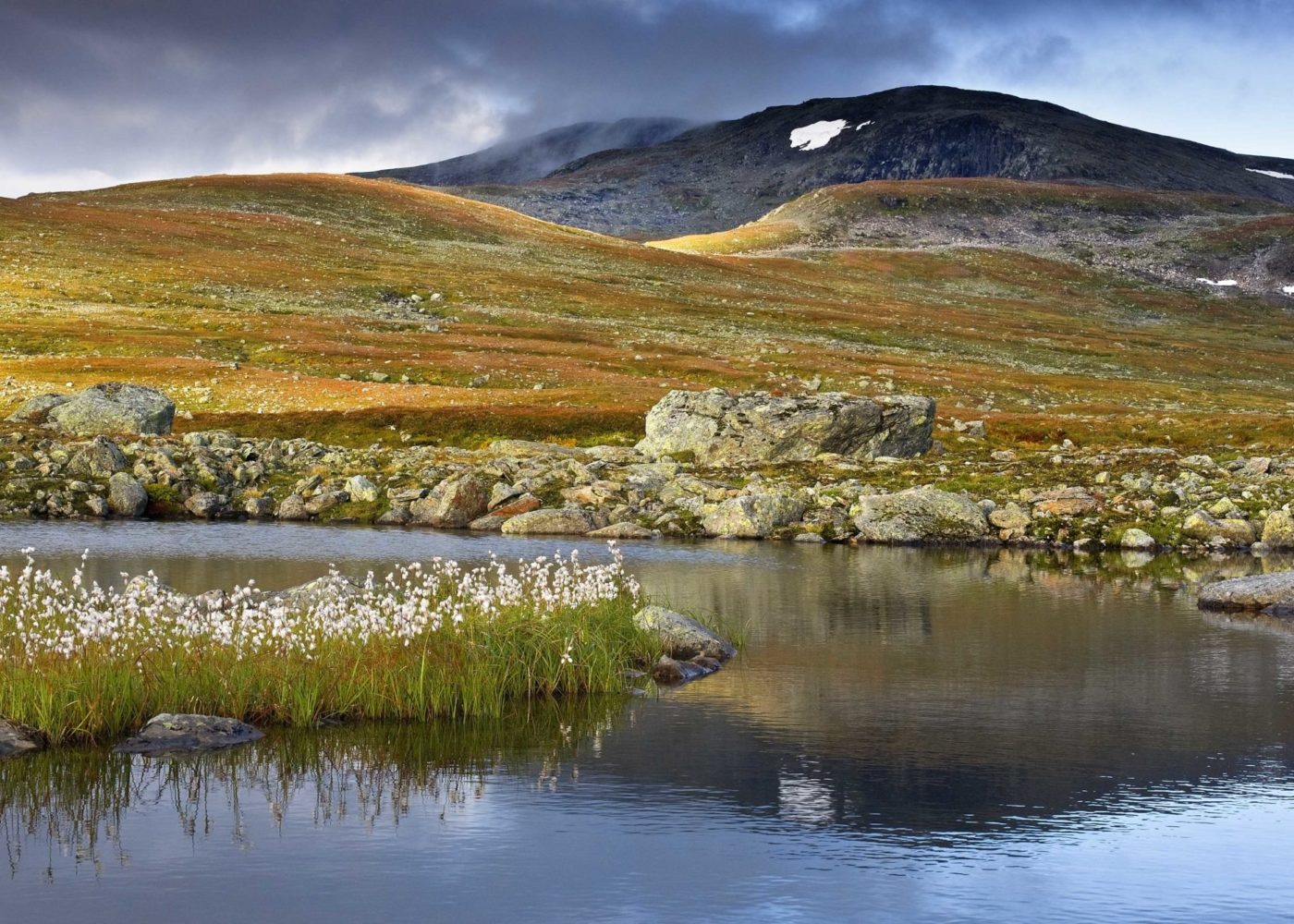
There are no trees there because that's above the timber line. The photo on https://en.wikipedia.org/wiki/Tree_line is realistic, the trees do cease suddenly, the horizontal line is clearly visible in the landscape. That photo was taken 100-200m above above the timber line, if my memory of the landscape isn't too bad.
The larger point is that no, that landscape wouldn't be usable for wheat or for hardier crops like rye or potatoes. Some of the world is usable for wheat, some is too barren. One way to get human food from barren landscape is to let animals graze.
We mostly live in cities (built on and) surrounded by flat, fertile farmland, so it's easy to forget that barren areas such as mountains and deserts even exist. But they do exist, quite a lot by area, and can provide animal food without displacing wheat etc.
(Writing this makes me wonder about a farm where I've stayed a few times. Flat, lush landscape, near a river, but the farmer told me that the soil was completely unusable for growing food crops. Only grazing suited the land. I wonder what invisible factors may make land unsuited for food crops.)
Yeah Iceland's definitely a big outlier in this regard, but searching around a bit it seems this pattern holds to some degree in the sort of landscape you referenced, see [1] and [2] (just a couple of relevant papers I found).
I.e. some Norwegian researchers fenced off areas of heaths (the sort of landscape you linked to) and within just a few years those areas were noticeably different.
That's the general effect I'm pointing out, you can't just look at a current landscape that has herbivores on it and conclude it can't be used for other purposes, even something as basic as the tree line can be regulated by those herbivores.
Fair enough, there are other considerations besides just water that make land less practical for growing food crops. It still takes more land--square kilometers--to produce X calories of livestock than X calories of plants. It's just that sometimes there are more important factors than square kilometers. Water, soil quality, markets, terrain inclination.
A lot of land can’t be used for farming crops. But you can shove animals on much wider variety of land scapes. Meaning you don’t need to deforest on the same scale. Coupled with not needing to do crop rotation. Etc etc. Results in less land required.
Expecting the entire world to turn vegetarian, seems unrealistic, unless there is some major collapse of the entire ecosystem. The ideal solution is that meat goes back to being a luxury or treat, instead of consuming it daily multiple times. With a majority of our calories coming from vegetables. There is just far too much cheap meat available.
> If everyone in the world becomes vegan, what exactly do you think is going to happen to all of those domesticated cows, sheep, and chickens? Are people going to continue raising them as pets in the same quantities, out of the goodness of their hearts? Of course not -- they would basically go extinct.
I googled "How many zoos in the world", and got an estimate of about 1500. If every single zoo had 10 chickens, that would make about 15,000 chickens in the entire world. I think going from however many millions of chickens there are worldwide down to 15k would count as "basically exctinct".
Far, far more than millions of chicken. According to this NY Times article 23 billion alive at any one time. [1] The most numerous bird species in the world.
That raising an animal for slaughter is permitted.
You can't separate those two; the choice doesn't happen between the raising and the slaughter. Farmers don't breed animals and only then consider whether to slaughter them, the choice happens earlier.
So the argument is that letting an animal see the light of day on condition that it'll be slaughtered at the right age is a valid thing to do. (Digressing: my own opinion is that it depends on how the animal gets to spend its time on earth. But that's just my opinion, not really relevant to the argument.)
To some extent, yes. I'm not saying it should put that over your own moral line, but I definitely think that sacrificing an animal you cared for is more acceptable than hunting a wild animal, for example.
Consider the relationship between ants and aphids. Ants care for aphids and they survive because of ants. But ants have also been known to physically tear wings off of aphids to prevent them from flying away!
And of course, farming is far different than hunting and fighting, which ants do as well.
Statistically, food animals are far more likely to be raised in hellish factory farms than in the traditional bucolic pasture or chicken run. I don't actually think raising animals for meat is immoral, but causing unnecessary suffering to improve the bottom line is.